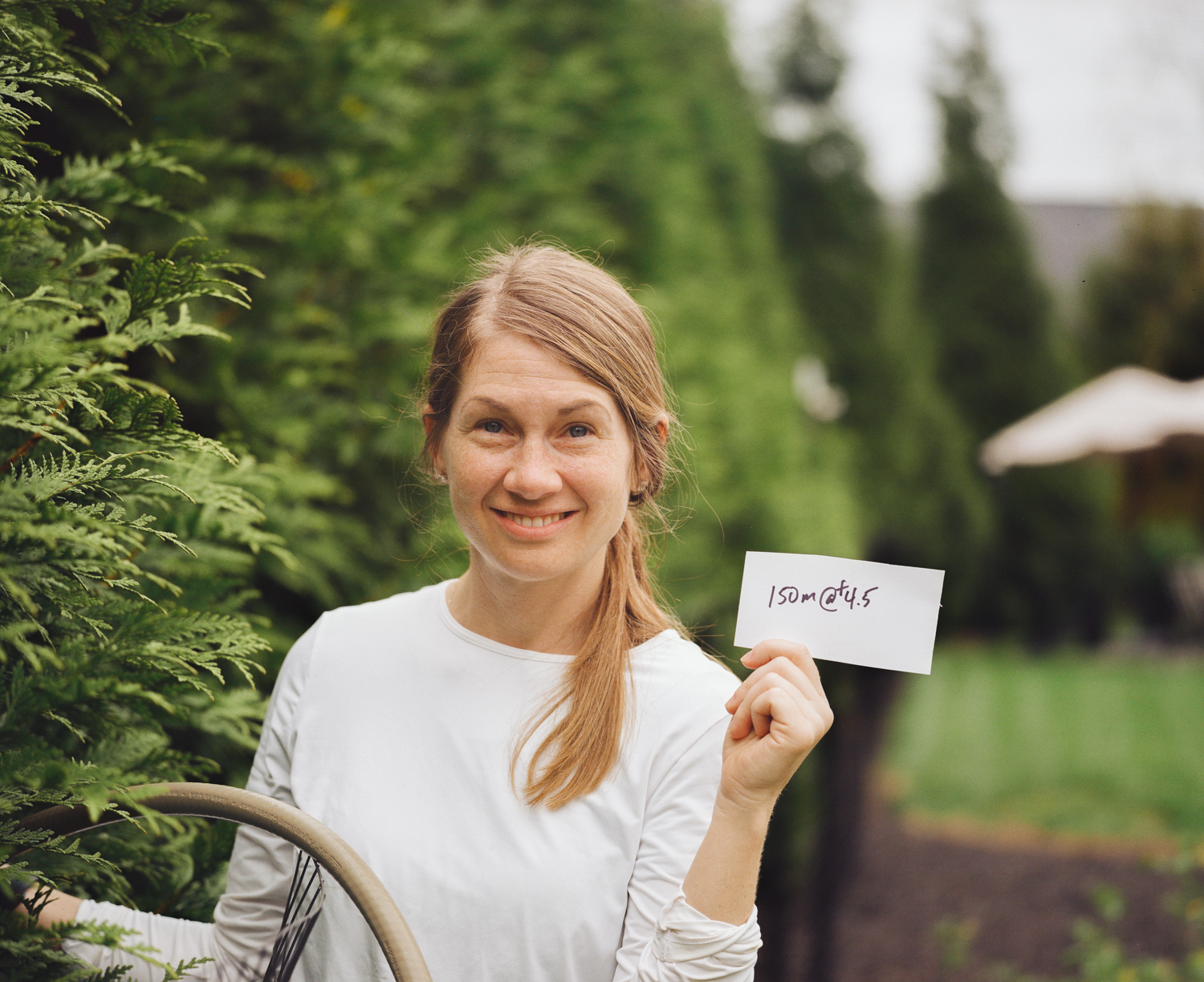
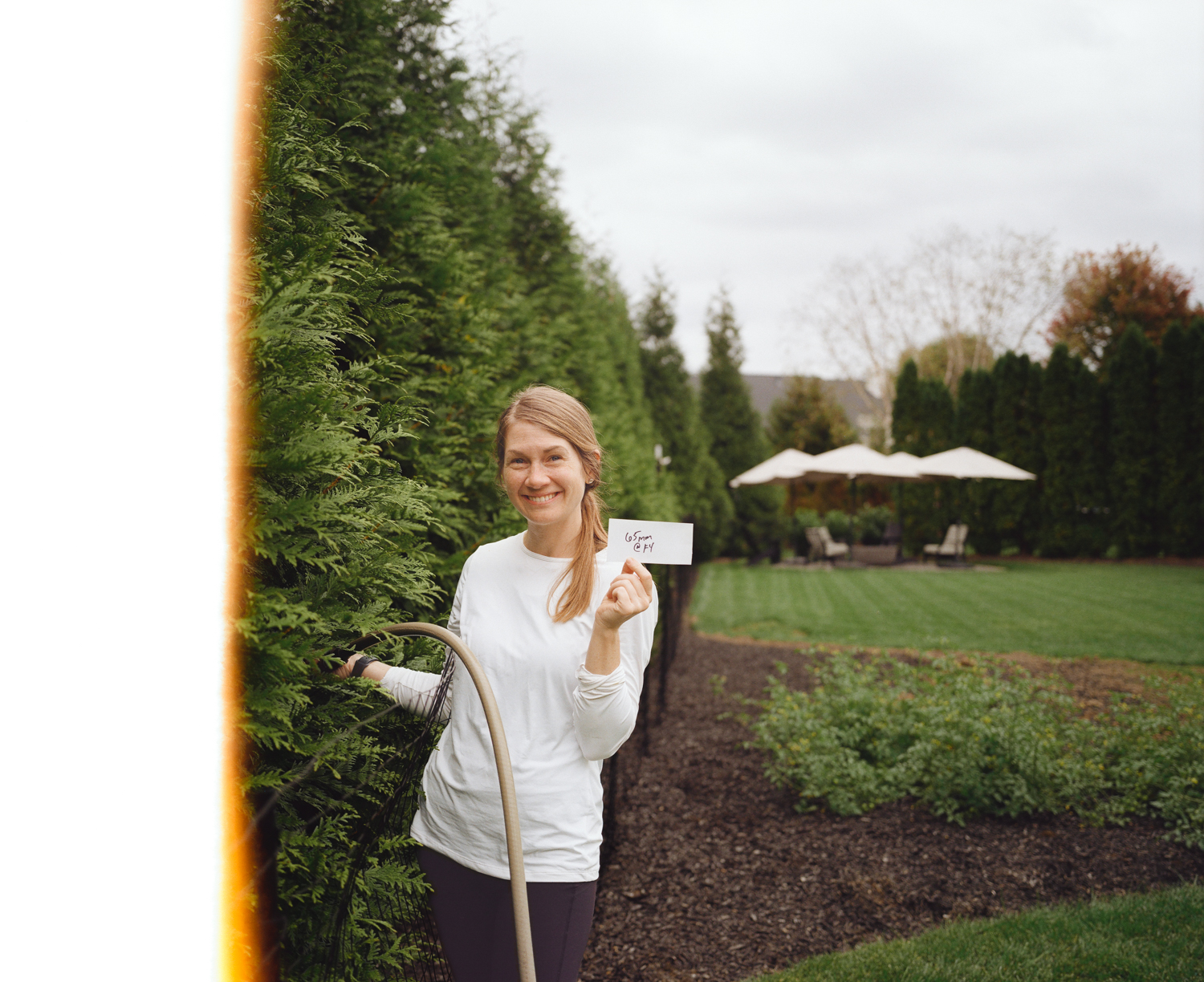
First roll through the Mamiya 7 came back. Just a test roll to make sure the camera works and lenses looked good. Read lots about the camera and the two lenses that I have 65mm and 150mm. I read about calibration issues with the 150, so wanted to check that for sure. Seems excellent. Checked MFD, mid distance and infinity. Here is a quick one I made my wife hold the card while watering the trees. If only she knew I was such a nerd when she met me.
Desmolicious wrote:
And yet I will still say, avoid Wolfen NC400. It is a hot pile of garbage and I couldn't do anything with it apart from produce grainy, unsharp, muddy washed out poop. It really does behave like 20 yr old film left on the dash of a car in the blazing sun for a few months.
Now that I've tried it (well, not NC400 but NC500), I agree. I shot a roll of it last month and got it back the other day. Thirty six frames of meh.
I like grainy film for B&W but not for color, and everything's just washed out and muddy.
This was the only shot I even came close to liking:
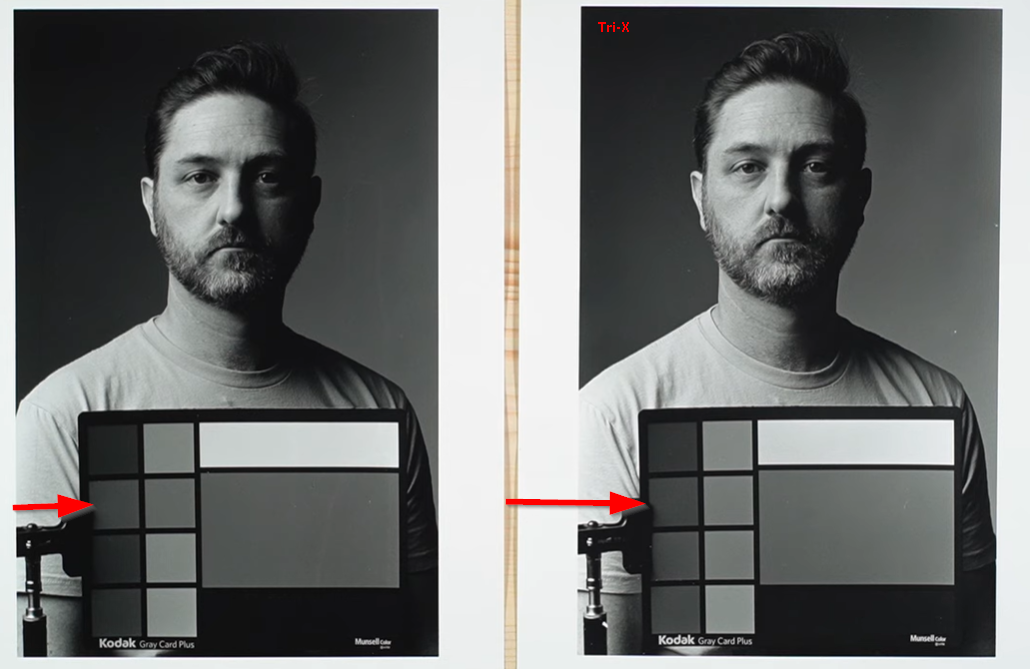
One of the eternal questions, Hp5+ or Tri-X? In the real world, there is very little difference between them but every time I think of making the switch, considering HP5+ is two thirds the cost of Tri-X, I just feel Tri-X brings something to the image that HP5 is lacking. Am I missing something? Any opinions will be appreciated.
madNbad wrote:
One of the eternal questions, Hp5+ or Tri-X? In the real world, there is very little difference between them but every time I think of making the switch, considering HP5+ is two thirds the cost of Tri-X, I just feel Tri-X brings something to the image that HP5 is lacking. Am I missing something? Any opinions will be appreciated.
I can't tell any difference after I scan them and do my thing. So I go for the cheaper one. Kentmere 400. Wait, that is the cheapest one. Still applies.
Honestly I feel the difference would be if you actually print from the neg in a darkroom.
Whatever gear you use, make sure you have a P&S camera. Not one of those hyper expensive ones that is about to grenade leaving you with an unfixable door stop (why yes, my door stop is made out of titanium!).
But a nice plastic jobbie. I favour the Fuji Work Record.
These girls were spinning heat in Little Tokyo - I barely stopped my bike and just grabbed a shot with Fuji P&S before looking for the next victim..
Desmolicious wrote:
I can't tell any difference after I scan them and do my thing. So I go for the cheaper one. Kentmere 400. Wait, that is the cheapest one. Still applies.
Honestly I feel the difference would be if you actually print from the neg in a darkroom.
Tri-X differs from nearly all BW films in one key aspect. It has reduced sensitivity to red. I don't want to overstate it but it's almost like having an 80C on your lens. With so many super-panchromatic films that have hit the market (mainly repackaged surveillance films) it stands out more.
Naked Photographer uses Tri-X as his baseline when testing film and it's a reoccurring finding. A lot of films smooth out ruddy skin tones by showing up as brighter. Tri-x can show a bit more texture and be about a 1/3 stop darker.
I think all of these subtle differences will disappear with a touch of the contrast or highlights fader in Lightroom. So yeah, shoot Kentmere or go for grain/detail advantages when going direct to digital.
madNbad wrote:
One of the eternal questions, Hp5+ or Tri-X? In the real world, there is very little difference between them but every time I think of making the switch, considering HP5+ is two thirds the cost of Tri-X, I just feel Tri-X brings something to the image that HP5 is lacking. Am I missing something? Any opinions will be appreciated.
My choice is clearly HP5+ since it is much easier to push with less grain in the final image. Tested it with Rodinal/Xtol developers. Tri-X is IMO overhyped and therefore the higher Kodak price tag (Kodak branded films have become crazy expensive, I am no longer using them). I also find that HP5+ is giving less harsh contrasty look than Tri-X - likely another reason why Tri-X is often recommended when harsh contrasty B&W images became fashionable (not my preference, but I can see why others went with it).
Personally I also prefer FP4+ or Delta 100 over ISO 400 B&W films, but this depends on photo style and need.
Desmolicious wrote:
Is this why we need a film forum?
We could also kick around that Leica seriously considered ending production of film cameras after a disappointing 2015 when they sold a grand total of 500. This year they’re on track to sell 5,000.
Back to film. I had been using TMax for ages but wanted to try something different which is how I ended up with Tri-X. It was fun with the Rodinal but I’m going to stay with either D76 or ID-11 at 1+1 once my FPP-76 is gone. It’ll give me the incentive to expose enough rolls to use a gallon in six months.
madNbad wrote:
We could also kick around that Leica seriously considered ending production of film cameras after a disappointing 2015 when they sold a grand total of 500. This year they’re on track to sell 5,000.
Back to film. I had been using TMax for ages but wanted to try something different which is how I ended up with Tri-X. It was fun with the Rodinal but I’m going to stay with either D76 or ID-11 at 1+1 once my FPP-76 is gone. It’ll give me the incentive to expose enough rolls to use a gallon in six months.
I’ve got nothing against TriX, I’ve had nothing but great results from it. But with my workflow where I scan the film, I pretty much end up with the same result whether I use TriX or HP5. So it makes sense to me to go w the cheaper product.
A few questions have come up. Any thoughts on Lomography 800 (cheaper portra 800?) or Cinestill 50D?
And I want to start using a ND filter if using say 800 speed film outdoors in daylight. So let's say I use a 3 stop ND with a m7 that has a meter in it. I know If I use my handheld meter there is a function for a ND filter so that's easy to meter with that. Without using the handheld meter, what's the easiest workflow to use an ND outside, and quickly take it off to shoot inside (without forgetting to change the setting)? Set the ISO to 100 outside, and 800 outside? Or I could use exposure compensation. The m7 allows for 2 stops.