This topic is in the 2023 archive. You can read it and like its posts here. It is read only.
Archive 2023Mark Galer's Video on EFCS On-or-Off
p.1 #1Mark Galer's Video on EFCS On-or-Off
Before anyone lets their head explode about EFCS vs full mechanical, or uses this issue to dismiss the new A7Cxx cameras, they owe it to themselves to watch Mark Galer's video on the subject.
In short, he doesn't think EFCS is likely ever to be problem for most photographers and that it confers a number of advantages that he doesn't want to give up.
Although he often shoots at very high shutter speeds to capture very fast daylight action (e.g., motorcycle racing) and often combines the high shutter speeds with a wide open aperture, he could not find a shot in his catalog that was adversely affected by EFCS in regard to uneven exposure--he had to create one deliberately, with some difficulty, using an old non-native lens and 1/8000th of a second.
In regard to bokeh quality, he says that he personally prefers the slightly more structured bokeh he gets with EFCS, though he recognizes that this is a subjective judgment and that others will prefer otherwise.
He doesn't offer or seem to find any examples of cut-off bokeh. He looks at an example of bokeh balls.
Edited on Aug 31, 2023 at 08:59 AM · View previous versions
Aug 31, 2023 at 08:21 AM
p.1 #2Mark Galer's Video on EFCS On-or-Off
EFCS is a problem for me at high (> 1/2000 sec) shutter speeds, it clearly degrades the bokeh. I always switch to full mechanical or electronic shutter when using a fast lens on the A7RV. I have ruined pictures in the past when I didn't know the impact of the EFCS on the bokeh.
Aug 31, 2023 at 08:49 AM
p.1 #3Mark Galer's Video on EFCS On-or-Off
It’s really not an issue for me because, when I make portraits at 1.4, my subjects aren’t moving so I can use silent shutter even on non-stacked bodies.
Aug 31, 2023 at 08:53 AM
p.1 #4Mark Galer's Video on EFCS On-or-Off
Thanks, but I've seen the effect on my own photos and it made SY 35/1.4 look closer to CV 35/1.4 Classic...
Mark has probably the most informative videos on Sony gear, but he's also, and there's no other way to put it, a Sony shill. He never says anything negative about Sony, so it's easy to miss the downsides when you hear him talk in detail about the good stuff .
Mark has probably the most informative videos on Sony gear, but he's also, and there's no other way to put it, a Sony shill. He never says anything negative about Sony, so it's easy to miss the downsides when you hear him talk in detail about the good stuff
.Aug 31, 2023 at 09:05 AM
p.1 #5Mark Galer's Video on EFCS On-or-Off
Well, that was informative. At 19:11 in the video, he shows — clearly — that bokeh is better with EFCS off. He admits that the difference is "not subtle". And yet he prefers *worse* bokeh with EFCS on. His subjective preference doesn't change that it's objectively worse. He tries to excuse it as being like added "clarity". But that's no excuse. Photographers spend a lot of money for beautiful bokeh, and lens designers put a lot of effort into that, so to have it diminished by a camera is unfortunate.
Aug 31, 2023 at 10:31 AM
p.1 #6Mark Galer's Video on EFCS On-or-Off
I like Mark Galer and maybe only two I like in that review world but he is also an ambassador which I have been for Leica and Phase One so he is not going to cross Sony here. I have run into this many of times with the fast glass.
Aug 31, 2023 at 10:42 AM

p.1 #7Mark Galer's Video on EFCS On-or-Off
j4nu wrote:
Thanks, but I've seen the effect on my own photos and it made SY 35/1.4 look closer to CV 35/1.4 Classic...
Mark has probably the most informative videos on Sony gear, but he's also, and there's no other way to put it, a Sony shill. He never says anything negative about Sony, so it's easy to miss the downsides when you hear him talk in detail about the good stuff .
I have noticed the effect, too but significantly more noticeable and I like less using the Sigma 105mm f/1.4 under contrasty background conditions. Otherwise, the effect is barely noticeable and for sure not “uglier” vs with the EFCS off. This applies mostly for my portrait usage using slight WA, like a 35mm, standard and short tele lenses, up to 135mm. Personally, I wouldn’t turn the EFCS to off on cameras that have that. BTW, I am using the electronic shutter almost exclusively on both Sony A1 and A7r V. So, not an issue with both anyway.
Thanks, but I've seen the effect on my own photos and it made SY 35/1.4 look closer to CV 35/1.4 Classic...
Mark has probably the most informative videos on Sony gear, but he's also, and there's no other way to put it, a Sony shill. He never says anything negative about Sony, so it's easy to miss the downsides when you hear him talk in detail about the good stuff
.I have noticed the effect, too but significantly more noticeable and I like less using the Sigma 105mm f/1.4 under contrasty background conditions. Otherwise, the effect is barely noticeable and for sure not “uglier” vs with the EFCS off. This applies mostly for my portrait usage using slight WA, like a 35mm, standard and short tele lenses, up to 135mm. Personally, I wouldn’t turn the EFCS to off on cameras that have that. BTW, I am using the electronic shutter almost exclusively on both Sony A1 and A7r V. So, not an issue with both anyway.
Aug 31, 2023 at 11:12 AM
p.1 #8Mark Galer's Video on EFCS On-or-Off
j4nu wrote:
Thanks, but I've seen the effect on my own photos and it made SY 35/1.4 look closer to CV 35/1.4 Classic...
Mark has probably the most informative videos on Sony gear, but he's also, and there's no other way to put it, a Sony shill. He never says anything negative about Sony, so it's easy to miss the downsides when you hear him talk in detail about the good stuff .
This video has zero to do with Sony. It is only about the advantages of EFCS and the lack of disadvantages. Nothing to do with Sony gear. You must not have watched the video.
I think it is discourteous and literally inaccurate to call him a shill. It is a misuse of the word. He is an outstanding photographer whose work is often used to illustrate optical quality, as for Ben-Q products, a great educator, and modest in person. When he reviews Sony products, he often offers qualifications and alternative products. I think he is talented, skilled, fair, and informative.
Thanks, but I've seen the effect on my own photos and it made SY 35/1.4 look closer to CV 35/1.4 Classic...
Mark has probably the most informative videos on Sony gear, but he's also, and there's no other way to put it, a Sony shill. He never says anything negative about Sony, so it's easy to miss the downsides when you hear him talk in detail about the good stuff
.This video has zero to do with Sony. It is only about the advantages of EFCS and the lack of disadvantages. Nothing to do with Sony gear. You must not have watched the video.
I think it is discourteous and literally inaccurate to call him a shill. It is a misuse of the word. He is an outstanding photographer whose work is often used to illustrate optical quality, as for Ben-Q products, a great educator, and modest in person. When he reviews Sony products, he often offers qualifications and alternative products. I think he is talented, skilled, fair, and informative.
Aug 31, 2023 at 11:23 AM
p.1 #9Mark Galer's Video on EFCS On-or-Off
NJPhotographer wrote:
Well, that was informative. At 19:11 in the video, he shows — clearly — that bokeh is better with EFCS off. He admits that the difference is "not subtle". And yet he prefers *worse* bokeh with EFCS on. His subjective preference doesn't change that it's objectively worse. He tries to excuse it as being like added "clarity". But that's no excuse. Photographers spend a lot of money for beautiful bokeh, and lens designers put a lot of effort into that, so to have it diminished by a camera is unfortunate.
Objectively worse? I also prefer the slightly more structured bokeh. The more blurred bokeh to me appears artificial, an optical effect, and a very overdone cliche. How did you do picking out the EFCS on-or-off images?
Aug 31, 2023 at 11:27 AM
p.1 #10Mark Galer's Video on EFCS On-or-Off
chiron wrote:
Mark has probably the most informative videos on Sony gear, but he's also, and there's no other way to put it, a Sony shill. He never says anything negative about Sony, so it's easy to miss the downsides when you hear him talk in detail about the good stuff .This video has zero to do with Sony. It is only about the advantages of EFCS and the lack of disadvantages. Nothing to do with Sony gear. You must not have watched the video.
I think it is discourteous and literally inaccurate to call him a shill. It is a misuse of the word. He is an outstanding photographer whose work is often used to illustrate optical quality, as for Ben-Q products, a great educator, and modest in person. When he reviews Sony products, he often offers qualifications and alternative products. I think he is talented, skilled, fair, and informative.
I like watching Mark's videos, but it's important to remember that he's a Sony ambassador, which might create a bias.
The problem with using electronic first curtain shutter at high shutter speeds (1/2000s +) isn't just about the structured look it creates to the overall rendering. It also noticeably cuts off specular highlights, which becomes very apparent. While we can choose to ignore it, the problem still exists.
Certainly, this isn't solely a concern for Sony cameras. However, the A7C series is known for exclusively using EFCS (electronic first curtain shutter), which means you can't avoid these problems unless you switch to the electronic shutter mode, which also has its own limitations.
j4nu wrote
Thanks, but I've seen the effect on my own photos and it made SY 35/1.4 look closer to CV 35/1.4 Classic...Mark has probably the most informative videos on Sony gear, but he's also, and there's no other way to put it, a Sony shill. He never says anything negative about Sony, so it's easy to miss the downsides when you hear him talk in detail about the good stuff
.I think it is discourteous and literally inaccurate to call him a shill. It is a misuse of the word. He is an outstanding photographer whose work is often used to illustrate optical quality, as for Ben-Q products, a great educator, and modest in person. When he reviews Sony products, he often offers qualifications and alternative products. I think he is talented, skilled, fair, and informative.
I like watching Mark's videos, but it's important to remember that he's a Sony ambassador, which might create a bias.
The problem with using electronic first curtain shutter at high shutter speeds (1/2000s +) isn't just about the structured look it creates to the overall rendering. It also noticeably cuts off specular highlights, which becomes very apparent. While we can choose to ignore it, the problem still exists.
Certainly, this isn't solely a concern for Sony cameras. However, the A7C series is known for exclusively using EFCS (electronic first curtain shutter), which means you can't avoid these problems unless you switch to the electronic shutter mode, which also has its own limitations.
Aug 31, 2023 at 11:43 AM
p.1 #11Mark Galer's Video on EFCS On-or-Off
Simple fact of physics. EFCS effects bokeh. Whether or not it is a "problem" is up to each person to decide. If not, use EFCS. Is so, use full mech or full elec shutter as needed. The problem with the a7C camera is that you cannot make that choice. There is no mech shutter option and the full e-shutter precludes the use of strobes.
Aug 31, 2023 at 11:45 AM
p.1 #12Mark Galer's Video on EFCS On-or-Off
Is it a problem? You decide.
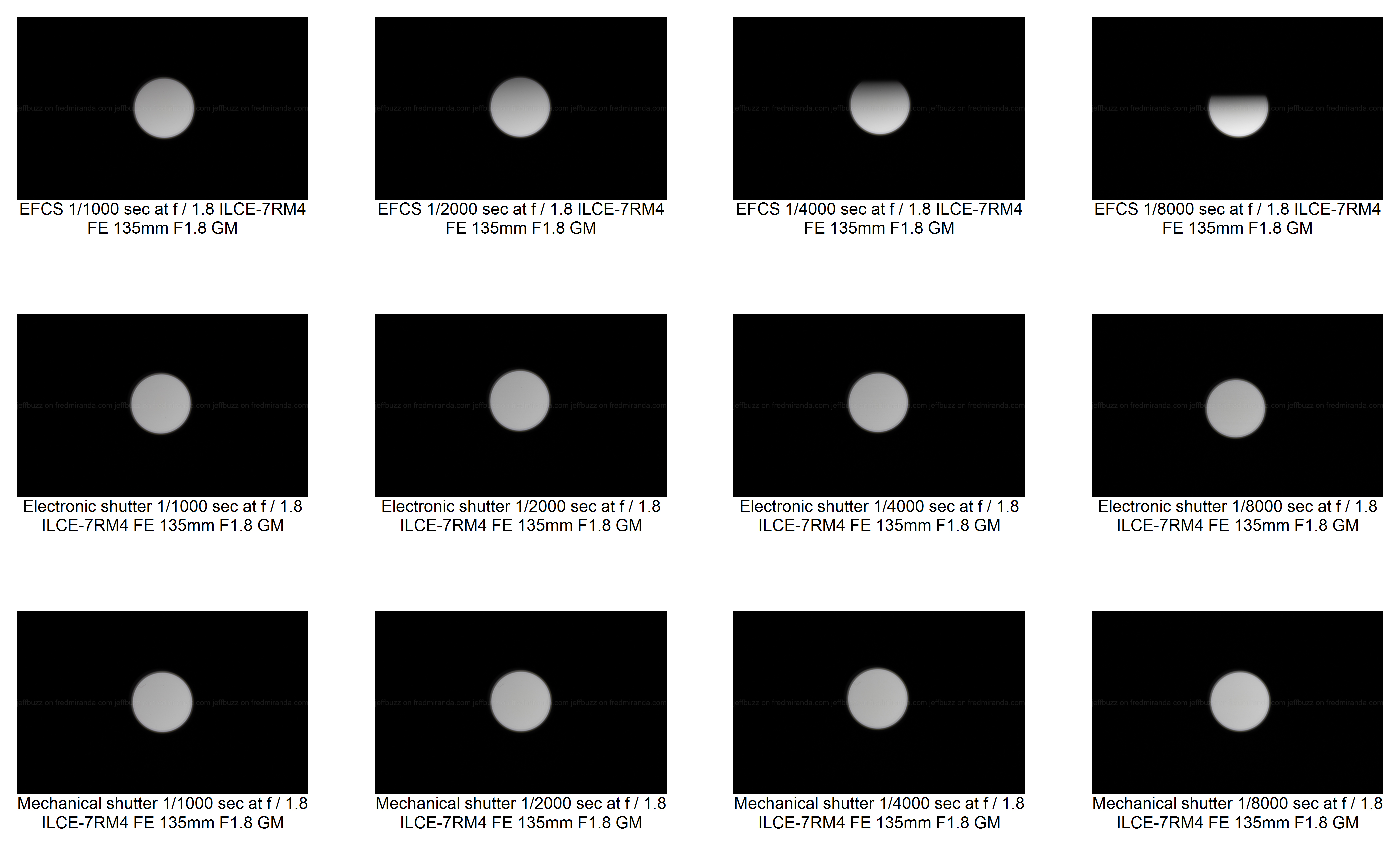
out of focus LED at 1 meter with lens focus at infinity
Edited on Aug 31, 2023 at 07:04 PM · View previous versions
out of focus LED at 1 meter with lens focus at infinity
Edited on Aug 31, 2023 at 07:04 PM · View previous versions
Aug 31, 2023 at 11:52 AM
p.1 #13Mark Galer's Video on EFCS On-or-Off
Fred Miranda wrote:
Mark has probably the most informative videos on Sony gear, but he's also, and there's no other way to put it, a Sony shill. He never says anything negative about Sony, so it's easy to miss the downsides when you hear him talk in detail about the good stuff .This video has zero to do with Sony. It is only about the advantages of EFCS and the lack of disadvantages. Nothing to do with Sony gear. You must not have watched the video.
I think it is discourteous and literally inaccurate to call him a shill. It is a misuse of the word. He is an outstanding photographer whose work is often used to illustrate optical quality, as for Ben-Q products, a great educator, and modest in person. When he reviews Sony products, he often offers qualifications and alternative products. I think he is talented, skilled, fair, and informative.I like watching Mark's videos, but it's important to remember that he's a Sony ambassador, which might create a bias.
The problem with using electronic first curtain shutter at high shutter speeds (1/2000s +) isn't just about the structured look it creates to the overall rendering. It also noticeably cuts off specular highlights, which becomes very apparent. While we can choose to ignore it, the problem still exists.
It is true that Mark is a Sony Ambassador, just as Sebastiao Salgado is on a retainer from Canon. We all have axes to grind if only because we tend to have brand allegiances and within brands allegiances to the gear that we own and to the shooting styles that we prefer (e.g., zoom vs. primes). But the video actually has nothing to do with Sony products. It is only about EFCS.
The other point I would make about this is that in the many shots he shows in the video that were taken at high speeds and wide apertures, there do not seem to be any cut-off highlights or otherwise objectionable qualities to the bokeh. So I think, as he says in the video, that visual problems with EFCS is a rare effect that is rarely seen in actual photographs versus those designed to produce the problem, and that most photographers would go through life never having a problem. And EFCS confers advantages. I guess my point is that EFCS concerns are overstated. Camera manufacturers set EFCS on by default in cameras coming out of the box.
chiron wrote
j4nu wrote
Thanks, but I've seen the effect on my own photos and it made SY 35/1.4 look closer to CV 35/1.4 Classic...Mark has probably the most informative videos on Sony gear, but he's also, and there's no other way to put it, a Sony shill. He never says anything negative about Sony, so it's easy to miss the downsides when you hear him talk in detail about the good stuff
.I think it is discourteous and literally inaccurate to call him a shill. It is a misuse of the word. He is an outstanding photographer whose work is often used to illustrate optical quality, as for Ben-Q products, a great educator, and modest in person. When he reviews Sony products, he often offers qualifications and alternative products. I think he is talented, skilled, fair, and informative.
The problem with using electronic first curtain shutter at high shutter speeds (1/2000s +) isn't just about the structured look it creates to the overall rendering. It also noticeably cuts off specular highlights, which becomes very apparent. While we can choose to ignore it, the problem still exists.
It is true that Mark is a Sony Ambassador, just as Sebastiao Salgado is on a retainer from Canon. We all have axes to grind if only because we tend to have brand allegiances and within brands allegiances to the gear that we own and to the shooting styles that we prefer (e.g., zoom vs. primes). But the video actually has nothing to do with Sony products. It is only about EFCS.
The other point I would make about this is that in the many shots he shows in the video that were taken at high speeds and wide apertures, there do not seem to be any cut-off highlights or otherwise objectionable qualities to the bokeh. So I think, as he says in the video, that visual problems with EFCS is a rare effect that is rarely seen in actual photographs versus those designed to produce the problem, and that most photographers would go through life never having a problem. And EFCS confers advantages. I guess my point is that EFCS concerns are overstated. Camera manufacturers set EFCS on by default in cameras coming out of the box.
Aug 31, 2023 at 11:54 AM
p.1 #14Mark Galer's Video on EFCS On-or-Off
chiron wrote:
Objectively worse? I also prefer the slightly more structured bokeh. The more blurred bokeh to me appears artificial, an optical effect, and a very overdone cliche. How did you do picking out the EFCS on-or-off images?
Yes. It's a limitation imposed by a cheaper shutter that's not used in Sony's higher priced cameras. The lens is designed to do better, but the shutter prevents it. When you're paying for the look of an expensive GM lens, the look shouldn't become more structured by the camera's shutter.
It's ok to prefer any bokeh, or any lens. However, it seems that Mark Galer is putting a positive spin on the fact that the shutter prevents the lens from working at its full potential. It's as if the camera designer was working against the lens designer.
NJPhotographer wrote
Well, that was informative. At 19:11 in the video, he shows — clearly — that bokeh is better with EFCS off. He admits that the difference is "not subtle". And yet he prefers *worse* bokeh with EFCS on. His subjective preference doesn't change that it's objectively worse. He tries to excuse it as being like added "clarity". But that's no excuse. Photographers spend a lot of money for beautiful bokeh, and lens designers put a lot of effort into that, so to have it diminished by a camera is unfortunate.Yes. It's a limitation imposed by a cheaper shutter that's not used in Sony's higher priced cameras. The lens is designed to do better, but the shutter prevents it. When you're paying for the look of an expensive GM lens, the look shouldn't become more structured by the camera's shutter.
It's ok to prefer any bokeh, or any lens. However, it seems that Mark Galer is putting a positive spin on the fact that the shutter prevents the lens from working at its full potential. It's as if the camera designer was working against the lens designer.
Aug 31, 2023 at 12:34 PM
p.1 #15Mark Galer's Video on EFCS On-or-Off
chiron wrote:
Mark has probably the most informative videos on Sony gear, but he's also, and there's no other way to put it, a Sony shill. He never says anything negative about Sony, so it's easy to miss the downsides when you hear him talk in detail about the good stuff .This video has zero to do with Sony. It is only about the advantages of EFCS and the lack of disadvantages. Nothing to do with Sony gear. You must not have watched the video.
I think it is discourteous and literally inaccurate to call him a shill. It is a misuse of the word. He is an outstanding photographer whose work is often used to illustrate optical quality, as for Ben-Q products, a great educator, and modest in person. When he reviews Sony products, he often offers qualifications and alternative products. I think he is talented, skilled, fair, and informative.
One of the definitions of shill is:
a person who pretends to give an impartial endorsement of something in which they themselves have an interest
and that's exactly the impression I get every time I watch his videos. I used that word because no other sony ambassador makes me feel this way... I didn't really bring up anything else about him in my comment (background, skill, achievements, ... things you mention). I actually watched the video a long time ago, but him saying that he prefers EFCS bokeh kinda eclipsed anything else I might have remembered.
Regarding EFCS bokeh, if you prefer busy bokeh, then EFCS is actually an improvement for you . Just please keep in mind not everybody does. One of the reasons I moved from APS-C to FF is that I wanted "better" (quantity and quality) bokeh, so degrading it via EFCS is detrminental to that goal...
AGeoJO wrote:
I have noticed the effect, too but significantly more noticeable and I like less using the Sigma 105mm f/1.4 under contrasty background conditions. Otherwise, the effect is barely noticeable and for sure not “uglier” vs with the EFCS off. This applies mostly for my portrait usage using slight WA, like a 35mm, standard and short tele lenses, up to 135mm. Personally, I wouldn’t turn the EFCS to off on cameras that have that. BTW, I am using the electronic shutter almost exclusively on both Sony A1 and A7r V. So, not an issue with both anyway.
Yes, you're right - it doesn't affect every photo. The problem for me was that when it hits, it can really ruin an otherwise "bokehlicious" scene... I also used mostly electronic shutter on my previous A7III. With A1 I don't have that problem anymore .
j4nu wrote
Thanks, but I've seen the effect on my own photos and it made SY 35/1.4 look closer to CV 35/1.4 Classic...Mark has probably the most informative videos on Sony gear, but he's also, and there's no other way to put it, a Sony shill. He never says anything negative about Sony, so it's easy to miss the downsides when you hear him talk in detail about the good stuff
.I think it is discourteous and literally inaccurate to call him a shill. It is a misuse of the word. He is an outstanding photographer whose work is often used to illustrate optical quality, as for Ben-Q products, a great educator, and modest in person. When he reviews Sony products, he often offers qualifications and alternative products. I think he is talented, skilled, fair, and informative.
One of the definitions of shill is:
a person who pretends to give an impartial endorsement of something in which they themselves have an interest
and that's exactly the impression I get every time I watch his videos. I used that word because no other sony ambassador makes me feel this way... I didn't really bring up anything else about him in my comment (background, skill, achievements, ... things you mention). I actually watched the video a long time ago, but him saying that he prefers EFCS bokeh kinda eclipsed anything else I might have remembered.
Regarding EFCS bokeh, if you prefer busy bokeh, then EFCS is actually an improvement for you
. Just please keep in mind not everybody does. One of the reasons I moved from APS-C to FF is that I wanted "better" (quantity and quality) bokeh, so degrading it via EFCS is detrminental to that goal...AGeoJO wrote:
I have noticed the effect, too but significantly more noticeable and I like less using the Sigma 105mm f/1.4 under contrasty background conditions. Otherwise, the effect is barely noticeable and for sure not “uglier” vs with the EFCS off. This applies mostly for my portrait usage using slight WA, like a 35mm, standard and short tele lenses, up to 135mm. Personally, I wouldn’t turn the EFCS to off on cameras that have that. BTW, I am using the electronic shutter almost exclusively on both Sony A1 and A7r V. So, not an issue with both anyway.
Yes, you're right - it doesn't affect every photo. The problem for me was that when it hits, it can really ruin an otherwise "bokehlicious" scene... I also used mostly electronic shutter on my previous A7III. With A1 I don't have that problem anymore
.Aug 31, 2023 at 12:35 PM
p.1 #16Mark Galer's Video on EFCS On-or-Off
jeffbuzz wrote:
Is it a problem? You decide.
A great example. One thing to note is that those "cut" bokeh balls will also affect the blurred areas (make them more busy), even if bokeh balls themselves are not clearly visible.
Is it a problem? You decide.
A great example. One thing to note is that those "cut" bokeh balls will also affect the blurred areas (make them more busy), even if bokeh balls themselves are not clearly visible.
Aug 31, 2023 at 12:40 PM
p.1 #17Mark Galer's Video on EFCS On-or-Off
Question regarding bokeh with macro lenses and high EFCS shutter speeds. A smooth bokeh is important but the macro lens is typically stopped down. On the other hand, I do on occasion use very high shutter speeds when it is windy (e.g. alpine flowers). Is the bokeh affected under these circumstances?
Aug 31, 2023 at 12:45 PM
p.1 #18Mark Galer's Video on EFCS On-or-Off
jeffbuzz wrote:
Is it a problem? You decide.
Yes, I know you can get this effect. Please show me a real photograph taken by you where it is a problem.
Is it a problem? You decide.
Yes, I know you can get this effect. Please show me a real photograph taken by you where it is a problem.
Aug 31, 2023 at 12:52 PM
p.1 #19Mark Galer's Video on EFCS On-or-Off
j4nu wrote:
Mark has probably the most informative videos on Sony gear, but he's also, and there's no other way to put it, a Sony shill. He never says anything negative about Sony, so it's easy to miss the downsides when you hear him talk in detail about the good stuff .This video has zero to do with Sony. It is only about the advantages of EFCS and the lack of disadvantages. Nothing to do with Sony gear. You must not have watched the video.
I think it is discourteous and literally inaccurate to call him a shill. It is a misuse of the word. He is an outstanding photographer whose work is often used to illustrate optical quality, as for Ben-Q products, a great educator, and modest in person. When he reviews Sony products, he often offers qualifications and alternative products. I think he is talented, skilled, fair, and informative.One of the definitions of shill is:
and that's exactly the impression I get every time I watch his videos. I used that word because no other sony ambassador makes me feel this way... I didn't really bring up anything else about him in my comment (background, skill, achievements, ... things you mention). I actually watched the video a long time ago, but him saying that he prefers EFCS bokeh kinda eclipsed anything else I might have remembered.
Regarding EFCS bokeh, if you prefer busy bokeh, then EFCS is actually an improvement for you . Just please keep in mind not...Show more →
Actually, the only time I remember him mentioning something about a Sony feature in this video, it was to criticize that feature. He said the Sony menus made it difficult to quickly and easily turn EFCS on and off, which he considered a problem.
chiron wrote
j4nu wrote
Thanks, but I've seen the effect on my own photos and it made SY 35/1.4 look closer to CV 35/1.4 Classic...Mark has probably the most informative videos on Sony gear, but he's also, and there's no other way to put it, a Sony shill. He never says anything negative about Sony, so it's easy to miss the downsides when you hear him talk in detail about the good stuff
.I think it is discourteous and literally inaccurate to call him a shill. It is a misuse of the word. He is an outstanding photographer whose work is often used to illustrate optical quality, as for Ben-Q products, a great educator, and modest in person. When he reviews Sony products, he often offers qualifications and alternative products. I think he is talented, skilled, fair, and informative.
Earlier quote
a person who pretends to give an impartial endorsement of something in which they themselves have an interestRegarding EFCS bokeh, if you prefer busy bokeh, then EFCS is actually an improvement for you
. Just please keep in mind not...Show more →AGeoJO wrote
I have noticed the effect, too but significantly more noticeable and I like less using the Sigma 105mm f/1.4 under contrasty background conditions. Otherwise, the effect is barely noticeable and for sure not “uglier” vs with the EFCS off. This applies mostly for my portrait usage using slight WA, like a 35mm, standard and short tele lenses, up to 135mm. Personally, I wouldn’t turn the EFCS to off on cameras that have that. BTW, I am using the electronic shutter almost exclusively on both Sony A1 and A7r V. So, not an issue with both anyway.Actually, the only time I remember him mentioning something about a Sony feature in this video, it was to criticize that feature. He said the Sony menus made it difficult to quickly and easily turn EFCS on and off, which he considered a problem.
Aug 31, 2023 at 01:00 PM
p.1 #20Mark Galer's Video on EFCS On-or-Off
NJPhotographer wrote:
Objectively worse? I also prefer the slightly more structured bokeh. The more blurred bokeh to me appears artificial, an optical effect, and a very overdone cliche. How did you do picking out the EFCS on-or-off images?Yes. It's a limitation imposed by a cheaper shutter that's not used in Sony's higher priced cameras. The lens is designed to do better, but the shutter prevents it. When you're paying for the look of an expensive GM lens, the look shouldn't become more structured by the camera's shutter.
It's ok to prefer any bokeh, or any lens. However, it seems that Mark Galer is putting a positive spin on the fact that the shutter prevents the lens from working at its full potential. It's as if the camera designer was working against the lens designer.
Actually, it is not a cheaper shutter. It is a smaller shutter.
chiron wrote
NJPhotographer wrote
Well, that was informative. At 19:11 in the video, he shows — clearly — that bokeh is better with EFCS off. He admits that the difference is "not subtle". And yet he prefers *worse* bokeh with EFCS on. His subjective preference doesn't change that it's objectively worse. He tries to excuse it as being like added "clarity". But that's no excuse. Photographers spend a lot of money for beautiful bokeh, and lens designers put a lot of effort into that, so to have it diminished by a camera is unfortunate.It's ok to prefer any bokeh, or any lens. However, it seems that Mark Galer is putting a positive spin on the fact that the shutter prevents the lens from working at its full potential. It's as if the camera designer was working against the lens designer.
Actually, it is not a cheaper shutter. It is a smaller shutter.
Aug 31, 2023 at 01:01 PM