Let see, this week it's why isn't TMax 3200 actually 3200. Last week it was wandering around with some film with the blinding speed of 6. Then the parade of expired movie film that normally settles around 250. It's all those cameras that are marked "ASA" that has him confused.
Dunno, but (I think this has already been covered) interesting to see the Type 1 focuses down to 70cm, but the Type II focuses down to 50cm.
So I'd ass-ume the Type II has a longer throw.
Desmolicious wrote:
Dunno, but (I think this has already been covered) interesting to see the Type 1 focuses down to 70cm, but the Type II focuses down to 50cm.
So I'd ass-ume the Type II has a longer throw.
You're right, the focus throw should be longer to factor that in. I might give the Type I a shot since I have the matching 40/2.8.
I received my copy of the Type II version and I'm getting color shift on both the right and left side of the frame using my Canon R6 + Rayqual adapter. I've used the Leica 35 Summarit 2.5 and Voigtlander 35 Nokton 1.4 on this camera and I've had no color shift issues. Maybe my camera sensor can't handle the 28mm. From everything I've read online, the Canon R5 and R6 shouldn't have issues with M mount wide angle lenses. Any thoughts?
mapgraphs wrote:
Try it with an inexpensive adapter that is on the thin side, the thinner the better (ie. the lens should focus past infinity)...
I tried it with an Urth adapter earlier because I thought maybe it was the adapter but the Urth adapter had the same issue - maybe just a little less pronounced.
I can take a lens that exhibits the so-called Italian Flag Effect on an M and put the same lens with a thin adapter on a Sony or Nikon and eliminate the effect... YMMV
Edit: To elaborate somewhat, one problem with edge color cast is lens registration distance. As with trying to use FSU LTM lenses on an M body (film or digital), registration distance can affect output. In the case of FSU lenses one can add or remove shims as desired, or alter the registration distance of the lens via an adapter. The profile of the lens field curvature also comes into play, depending on the point-of-focus and aperture combination. And then there is a particular sensor's well and micro lens array and cover glass thickness question... If you'd like an optical engineer's perspective on some of the issues I'd suggest checking out some of Sonar Brian's threads on RFF...
mapgraphs wrote:
I can take a lens that exhibits the so-called Italian Flag Effect on an M and put the same lens with a thin adapter on a Sony or Nikon and eliminate the effect... YMMV
But this has nothing to do with the adapter.
Your Leica M has a FSI sensor and purple/mangent color cast.
The color shift is not eliminated on your Sony or Nikon! Because of a BSI sensor, these two cameras have no purple but a slightliy green color cast. Which cannot be seen in some situations.
I just got the CV 28/2.8 Color-Skopar "Type I" style lens. It looks amazing! While the Type II lens does focus closer at 0.5m and is about 30 grams lighter, there's something about the Type I with its black-painted brass barrel and clicky aperture that I really love. It also appears even slimmer than the Type II.
Fred Miranda wrote:
I just got the CV 28/2.8 Color-Skopar "Type I" style lens. It looks amazing! While the Type II lens does focus closer at 0.5m and is about 30 grams lighter, there's something about the Type I with its black-painted brass barrel and clicky aperture that I really love. It also appears even slimmer than the Type II.
You ever thought about getting a close up filter for this lens? That would take care of the min focus distance.
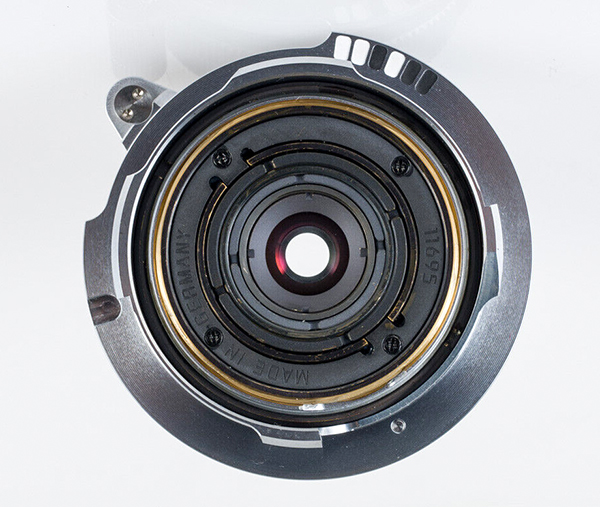
The "Summaron-M 1:5.6/2.8" lens 6-bit code works best for reducing vignetting on the Voigtlander 28/2.8 Color-Skopar lens. I've tried the "28 f/2.8 11804", "28 f/2.8 11819", "28 f/2.8 ASPH. 11606" and "28 f/5.6 11695" codes, and the last one, "28 f/5.6 11695," gives the most effective in-camera correction for vignetting.