Fred Miranda wrote:
The extreme swirling effect of the TTartisan 27mm f2.8 was not to my liking, but this is subjective as many people specifically seek lenses that produce this effect.
Yes, was one of the things that worried me when I got it, but I rarely use it for close-ups or portraits, with a 27mm f/2.8 it's hard to have some bokeh at all. In my case it's a lens for daylight street photography.
This is one of the rare close-ups I did with it:
Another thing is the flare, it can be a bit messy:
One thing that keeps me from getting one of those Voigtländer lenses for Fuji X is the lack of a (imo!) useful manual focus assist tool on Fuji bodies. I find peaking too inaccurate and punching in too slow. The other modes like the split image are also a bit gimmicky imo and you cannot place them anywhere in the frame.
I wish Fuji would add some more useful MF assist tools. The 'focus guide' on Canon RF is amazing. But even just the focus box turning from red to green on my Nikon Z7 is so much more useful and faster than what Fuji provides at the moment
Something like the Canon or Nikon solution but in the OVF of an X-Pro 4 would be crazy good. It would kinda sorta turn it into more of a 'real' rangefinder.
fjablo wrote:
One thing that keeps me from getting one of those Voigtländer lenses for Fuji X is the lack of a (imo!) useful manual focus assist tool on Fuji bodies. I find peaking too inaccurate and punching in too slow. The other modes like the split image are also a bit gimmicky imo and you cannot place them anywhere in the frame.
I wish Fuji would add some more useful MF assist tools. The 'focus guide' on Canon RF is amazing. But even just the focus box turning from red to green on my Nikon Z7 is so much more useful and faster than what Fuji provides at the moment
Something like the Canon or Nikon solution but in the OVF of an X-Pro 4 would be crazy good. It would kinda sorta turn it into more of a 'real' rangefinder. ...Show more →
Agree. I always ask if implementing a “green box” af confirmation with manual focus would be hard to implement. Would be such a simple yet effective solution.
With a big enough viewfinder, even just having a centered picture-in-picture magnified view could be good enough (Panasonic has this functionality). I find the Fuji solution of having the magnified view on the side not intuitive or comfortable to use.
I don't use any of the tools, they aren't great. I zoom in for focus. It's not ideal, but I find works best for me. If stopping down, it gets easier to zone focus. I'll just pre-focus and calculate my depth front and back. Sometimes if there's decent contrast I can focus with just the normal EVF view. It takes some getting used to and the more I shoot MF with Fuji, the easier it gets. It took me a bit to get used to Leica rangefinders with muscle memory, so I think of it like that. I am enjoying the challenge and hardly shoot AF lenses on Fuji anymore.
I shoot video with Sony and utilize their focus mapping feature when using MF cine lenses. I think it works great and it's pretty accurate. Not sure how that would translate to photography though.
fjablo wrote:
One thing that keeps me from getting one of those Voigtländer lenses for Fuji X is the lack of a (imo!) useful manual focus assist tool on Fuji bodies. I find peaking too inaccurate and punching in too slow. The other modes like the split image are also a bit gimmicky imo and you cannot place them anywhere in the frame.
I wish Fuji would add some more useful MF assist tools. The 'focus guide' on Canon RF is amazing. But even just the focus box turning from red to green on my Nikon Z7 is so much more useful and faster than what Fuji provides at the moment
Something like the Canon or Nikon solution but in the OVF of an X-Pro 4 would be crazy good. It would kinda sorta turn it into more of a 'real' rangefinder. ...Show more →
My X-T5 uses the whole viewfinder/screen when magnifying.
I'm not sure about the C/V lenses or other manual lenses with electrical contacts, but on any of the AF lenses as soon as you twist the focus ring in MF mode, it will automatically zoom in (with peaking) as the default setting. Half press shutter to zoom out.
Deuxieme wrote:
My X-T5 uses the whole viewfinder/screen when magnifying.
Yep, so you lose sight of the composition while focusing. I know many don't mind that, but I hate it
Fuji also has an option where the viewfinder is split into two images - a big one on the left showing the whole image and a small one zoomed into 100% on the bottom right. That's better, but you still have to move your eye away from the composition to assess focus.
I just think it's a bit of a shame because Fuji X could be an even better platform for these lenses (and would also make some of their own lenses more fun to use with MF)
I just got my X-S10 less than a week ago and I've been out shooting with it with my rangefinder lenses on 4 outings so far (used MS-Optics 28/2-II & 36/1.3 and CV 28/2 II & 35/1.5 so far). I'm using peaking (Red, strongest setting) and only when I really need to check focus in further detail I punch in using the joystick to see magnified view in full screen, then I half-press shutter to get out of the magnified view after I'm done checking the focus, and I re-confirm the composition and take the shot. It works pretty similarly to my Sony A9 (can use joystick in similar way there) & A7C (using AF-ON button to punch in there) and on my Sigma fp too. The way the peaking is shown in EVF is rather different on the X-S10 compared to Sony and it's closer to Sigma fp. Anyway, I'm finding it to work out pretty similarly on all of those cameras. I tend to use magnification mainly for longer focusing distances and when shooting stopped down as I find that at wide apertures at closer distances peaking is usually sufficient alone.
I like it a lot that on the Fuji it's possible to enter a name for the lens together with focal length for IBIS (at least on the X-S10) and both the FL and the lens name show up in EXIF. FL can also be set freely by entering digits so I can get exotic focal lengths like 36mm and 73mm defined precisely too. 6 names and FLs can be pre-registered (I wish there were even more slots as I have close to 30 rangefinder lenses). With Sony I have found no way to get lens name or even focal length written to EXIF (apart from using some specialized lens adapters that have electronic communication with camera) although FL can be set for IBIS from a predefined list. Sigma also doesn't have such support for getting lens name & focal length recorded in EXIF although some "note" data can be stored in EXIF when using user defined lens compensation profiles.
Today I also found CV 23/1.2 for X-mount at a very nice price (2nd hand but in excellent condition) so I picked it up. Didn't have time to use it yet but hopefully tomorrow. It's my only native X-mount lens at this point, but I have the CV 27/2 Ultron on pre-order.
Given the choice of a lens that is AF and MF, over one that is MF only, I’ll always pick the one that has the AF ability. It’s just so much more versatile and takes full advantage of the capabilities of the camera.
An out of focus image with a ‘better’ manual focus lens is not going to be better than the same image but in focus taken with a “weaker” AF lens.
Depends on what one is shooting though. Either are best for different situations.
Desmolicious wrote:
Given the choice of a lens that is AF and MF, over one that is MF only, I’ll always pick the one that has the AF ability. It’s just so much more versatile and takes full advantage of the capabilities of the camera.
An out of focus image with a ‘better’ manual focus lens is not going to be better than the same image but in focus taken with a “weaker” AF lens.
I have separate set of AF lenses (mostly in E-mount but also a couple in L-mount) and MF-only lenses (across a few mounts) for different use cases and I use the AF lenses mostly when I want to utilize AF (such as when shooting events and any kind of fast action or when I just feel like using AF).
For general walk-around shooting of mostly static subjects (which I do a lot) I most often prefer to use MF-only lenses (and as small and light as possible) that have mechanically coupled helicoids as I enjoy the process of manually focusing and shooting with those, even though I only use them on mirrorless cameras that also have AF capabilities. Focus by wire MF with AF lenses is often not quite as enjoyable for me. Since this type of shooting is typically about capturing static subjects there's no hurry and no problem with taking enough time to make sure the focus is right.
For me it's not about which lenses are better or about any difficulty in getting the focus right but more about the enjoyment of the shooting process.
Fred Miranda wrote:
If it follows the pattern of other Voigtlander lenses with a similar aperture mechanism, it should produce defined 10-point sunstars starting at f/2.8. I'm not sure how the Fuji XF 27 behaves in this aspect but in experience with other Fuji XF primes, achieving well-defined sunstars usually requires using f/8 or f/11.
With it's 7 blades, the sunstars of the XF27/2.8 are not that great. Not like the Voigtlaender lenses. The bokeh is fine when being close to the subject. It's really nice doing close ups using an extension ring.
Desmolicious wrote:
An out of focus image with a ‘better’ manual focus lens is not going to be better than the same image but in focus taken with a “weaker” AF lens.
Why would the image from the manual focus lens be out-of-focus?
Desmolicious wrote:
Given the choice of a lens that is AF and MF, over one that is MF only, I’ll always pick the one that has the AF ability. It’s just so much more versatile and takes full advantage of the capabilities of the camera.
An out of focus image with a ‘better’ manual focus lens is not going to be better than the same image but in focus taken with a “weaker” AF lens.
Some of us don't want or need versatility, but rather something that fits our personal preferences as close as possible. To me, that would be manual focus lenses in almost every case. I simply prefer to have control over what the lens is doing (or not doing) instead of trying to get the damn camera to focus at the subject instead of something else. Not to mention I hate manual focus "by wire". And I prefer metal over plastic exteriors.
An out of focus image shot with an AF lens that didn't hit target even though you got the confirmation light in the viewfinder isn't gonna be better than an in-focus image shot with a manual focus lens either. The former is quite common in my case, unfortunately (GFX wants to focus on the background no matter what you do).
Makten wrote:
Some of us don't want or need versatility, but rather something that fits our personal preferences as close as possible. To me, that would be manual focus lenses in almost every case. I simply prefer to have control over what the lens is doing (or not doing) instead of trying to get the damn camera to focus at the subject instead of something else. Not to mention I hate manual focus "by wire". And I prefer metal over plastic exteriors.
An out of focus image shot with an AF lens that didn't hit target even though you got the confirmation light in the viewfinder isn't gonna be better than an in-focus image shot with a manual focus lens either. The former is quite common in my case, unfortunately (GFX wants to focus on the background no matter what you do). ...Show more →
Indeed. I sometimes like to go out with just one manual focus lens, it's a totally different shooting experience and the extra engagement on the shooting process feels rewarding.
On Fujifilm, my previous lens for this was the Pergear 25mm f/1.8, a very good, small, cheap mechanical lens but that lacked on some key aspects that made me sell it:
- the clickless aperture ring was annoying;
- it flared easily which made it more difficult to manual focus because of the lack of contrast on some situations;
- there was a bit of play on the mount of my copy;
- not consistent QC, my copy was good but a bit decentered (right corners were softer than the left);
- innacurate and totally useless focus distance and DOF markings.
I sold it and got the TTartisan 27mm f/2.8, better quality but without the engaging manual focus experience. Also only f/2.8, something that makes me hesitate a bit more when going out with just one lens.
My hope is that the Voigtlander 27mm fixes all the problems the Pergear had, with accurate distance and DOF markings, effective coatings and good sharpness and micro-contrast to make it easier to manual focus.
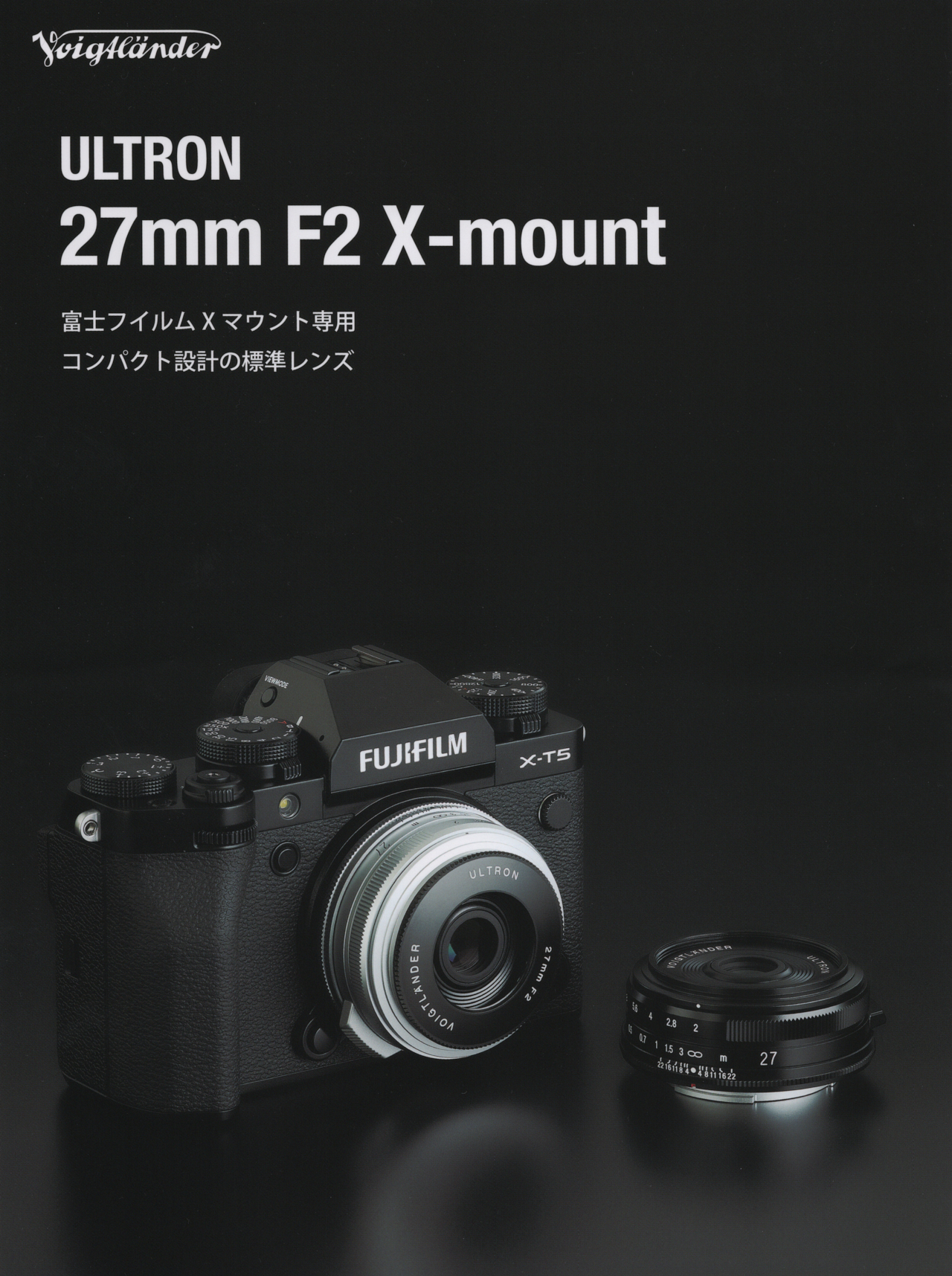
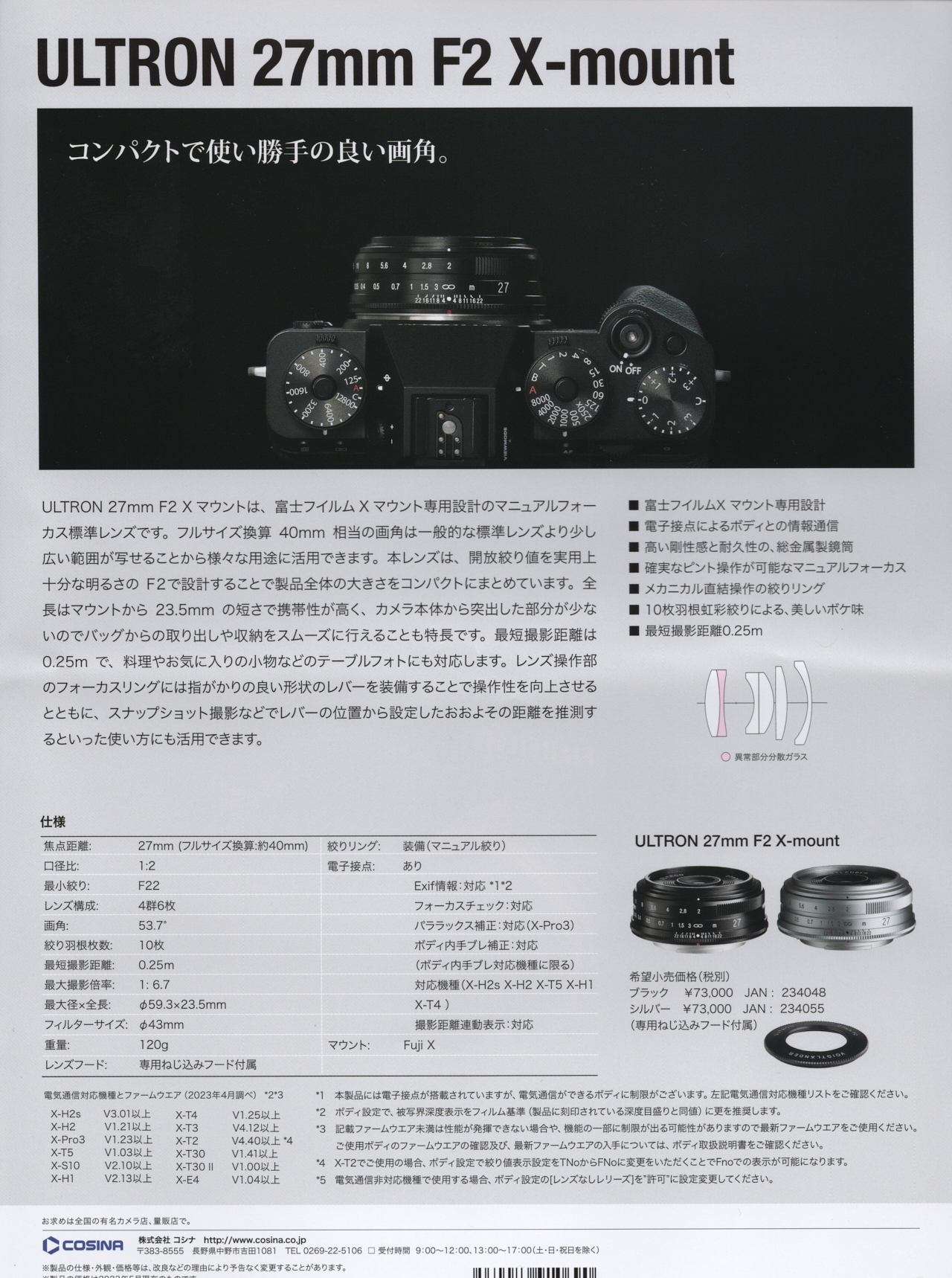
I found the Japanese leaflet for the lens at Fujiya Camera today. It shows the included dome hood as well. It's very small and looks nice.
Original scans: https://photos.app.goo.gl/JfN3H9ssQ3xH5GSV6
Sr.Cordeiro wrote:
Indeed. I sometimes like to go out with just one manual focus lens, it's a totally different shooting experience and the extra engagement on the shooting process feels rewarding.
Speaking as a person who shot manual focus-only lenses and cameras for decades and as a person who prefers to manually focus when shooting landscapes and similar (mostly) static subjects, I have a hard time understanding the appeal of only being able to manually focus this particular kind of lens.
For me, this sort of lens — a compact, pancake style, wide angle lens — seems most appropriate for things like street photography and similar. That's how I used the Fujifilm 27mm f/2.8 WR (and how I used the earlier version) on my XPro2 and now my XT5. It is — for me at least — mostly a system for when I want to work fast and light and remain unobtrusive.
Back in the day we did manage to shoot street with manual focus lenses. However, back then the standards for image quality were generally (and by necessity) much lower, so the old "f8 and be there" hyperlocal approach worked OK. If things happened quickly, as they tend to do in the street, we got good enough IQ at f/8 with slightly inaccurate focus that let us make 8" x 10" or maybe 11" x 14" prints of decent quality — though today most folks using digital gear would not be happy with those results.
But with AF I can work more quickly when necessary. The camera/lens can AF faster and more accurately than I can using either the muscle memory or close-enough-is-good-enough and/or hyperlocal approaches to manual focusing. Sometimes AF does fail in the clutch, but that's street photography.
And, of course, I can still manually focus my AF lenses in the (rare) situations in which that might produce a better result. (More likely, I might AF the spot where I expect my subject to be, then turn AF off temporarily while keeping that AF-determined focus point.)
Now, IF there was a 27mm f/2 AF lens with the quality we expect from the Fujiflm lens and the small size of this lens, I'd be interested.
gdanmitchell wrote:
Speaking as a person who shot manual focus-only lenses and cameras for decades and as a person who prefers to manually focus when shooting landscapes and similar (mostly) static subjects, I have a hard time understanding the appeal of only being able to manually focus this particular kind of lens.
For me, this sort of lens — a compact, pancake style, wide angle lens — seems most appropriate for things like street photography and similar. That's how I used the Fujifilm 27mm f/2.8 WR (and how I used the earlier version) on my XPro2 and now my XT5. It is — for me at least — mostly a system for when I want to work fast and light and remain unobtrusive.
Back in the day we did manage to shoot street with manual focus lenses. However, back then the standards for image quality were generally (and by necessity) much lower, so the old "f8 and be there" hyperlocal approach worked OK. If things happened quickly, as they tend to do in the street, we got good enough IQ at f/8 with slightly inaccurate focus that let us make 8" x 10" or maybe 11" x 14" prints of decent quality — though today most folks using digital gear would not be happy with those results.
But with AF I can work more quickly when necessary. The camera/lens can AF faster and more accurately than I can using either the muscle memory or close-enough-is-good-enough and/or hyperlocal approaches to manual focusing. Sometimes AF does fail in the clutch, but that's street photography.
And, of course, I can still manually focus my AF lenses in the (rare) situations in which that might produce a better result. (More likely, I might AF the spot where I expect my subject to be, then turn AF off temporarily while keeping that AF-determined focus point.)
Now, IF there was a 27mm f/2 AF lens with the quality we expect from the Fujiflm lens and the small size of this lens, I'd be interested.
Personally, a great part of it is that I’m still not satisfied with the current 27mm lens options out there.
I also already have lots of other small, fast AF lenses to use on the street when I don’t want to worry with manual focus (not exactly pancake, but that’s irrelevant for me as long as they’re small and light).
The fact that this Voigtlander is a pancake is not the major appeal for me, what I want is a 40mm equivalent lens with good optical quality and at least f/2, and so far this is the most promising one.
Being MF will also make it special to use, I like to have this sort of variety. Sometimes working with limitations is appealing creatively, recently I even got a old Olympus E300 with a kit lens, it’s a interesting challenge to use a slow clunky camera with a noisy low-res CCD sensor. It’s not a camera to use everyday of course, but I got some good results with it and it feels satisfying.