rscheffler wrote:
IMO it really depends on the situations you most often experience. A TC implies that the lens often isn't long enough and you're reach limited. In this case a prime with internal TC would make sense. Canon went with the zoom design to address the opposite for situations where 300 (or 420 with 1.4x TC) is just right, but the photographer frequently also requires a wider field of view for closer action. This is pretty much exactly the scenario with most sports. The field of play is clearly defined and unless restricted to an assigned spot (which can happen at larger events), the photographer is usually able to minimize reach limited situations by changing position. What can't be controlled easily is how quickly action approaches the photographer that would make a prime lens too long.
IOW, the compromises of this design unfortunately don't weigh in your favor. But will for other applications....Show more →
Very true. I never thought of it in terms of "with most sports the field of play is clearly defined". yeah if I could go into a setting and know for certain the max I would need is a 300 or 420, that would definitely change things.
As it is, my most used focal length is 840mm (600 + 1.4). I pretty much have that on one of my R5s at all times. Occasionally missing shots when the subject flies closer.
ChrisMak wrote:
Nikon really has a compelling offering for the wildlife shooter with the 400/600mm lenses with built-in 1.4x converter. They saw their chance with the switch to Z mount, and took it.
At one stage I was positive that Canon would also innovate in this area to promote their EF system, since they were also coming from behind like Nikon and had to reckon with Sony's lead.
I mean, I knew Sony was not going to add much if anything to their (very good) classic 400 and 600 lenses, but Canon already had their very advanced DO technology. I used the 400DOII for a year and it was a stellar lens. They have a quite old 500mm f4 lens so I expected a RF500mm lens first.
At one point their were rumors about a coming RF500mm f4.5DOII, but that was years ago already, and things have seemed to stagnate considerably.
I don't know what is in the works at Canon, but their very expensive 100-300mm lens seems to point towards favoring traditional (professional) strongholds like sports/wedding/events/news coverage etc.
I think you made the right choice with Nikon....Show more →
hate to hear this . I've been on the fence between Nikon and Canon for awhile now.
lots of local shooters with the "cheap" 800 f6.3 or the amazing 400/600 w/ TC.
If the main body didn't have an attached grip (Z9), I'd probably make the switch. maybe the Z8 will fix that
Duopoly wrote:
The RF 100-300mm f2.8 autofocus design tells me all Super Telephoto lenses from Canon going forward will be zooms. Canon can easily makes a 70-200mm f2.0 version of the 100-300mm 2.8 that is 10 inches long or 3 inches shorter than this lens at 5 pounds or less.
If the zoom is comparable in image quality to prime predecessors, what's the problem? (Ignoring price) In any case, I don't believe this is the end of longer primes from Canon. What Canon has shown with the RF line is that they're sensitive to a range of use cases and are willing to make small, slow lenses in addition to big monsters. That doesn't have to be restricted to zooms (for example the 600/11 and 800/11 STMs at one extreme). The 100-300 leaves a gaping opening at and under the former 300/2.8 price point that could be addressed by a semi-slow, compact prime smaller and faster than the 100-500 in that range.
A 70-200/2.0 would be shorter than the 100-300 but it would be similar diameter and still quite heavy. It would be a monopod lens for the most part and would be excessively heavy/limiting in regard to flexibility across a large range of applications. For example, over the course of a 14 hour wedding day, the size and weight would become a major burden compared to a traditional 70-200. This is a reason I've instead advocated Canon release a 70-135/2 as a companion to the 28-70/2 because it would be a much more sane and useable size and weight, likely very close to that of a 70-200/2.8.
One also has to consider that the technical *need* for a 200/2 or 300/2 (which someone suggested earlier as a 300/2.8 replacement) is nowhere near what it was when those lenses were available. We're not stuck shooting slow film or noisy sensors. I'm shooting f/4 and ISO 25600 at some youth hockey tournaments and the results are way better than I'd ever gotten on ISO 800 Fujicolor (a beautiful film during its time). In addition to the technical improvements we currently enjoy, the photography market has radically changed, to the point where the user base for a 200/2, let alone a 300/2, likely is to the point of not being able to support such production. A costly zoom on the other hand, can have broader appeal and justify development costs. Even when the Nikon 300/2.0 was available, it was a special order item (IIRC) because it was an extremely niche solution. Who is going to buy such a lens now? Most of the bokeh fettishists will complain about the likely $20K+ price and the professional market doesn't need such a lens any more (too big and cumbersome, too expensive for too niche of a solution).
nmerc_photos wrote:
Very true. I never thought of it in terms of "with most sports the field of play is clearly defined". yeah if I could go into a setting and know for certain the max I would need is a 300 or 420, that would definitely change things.
As it is, my most used focal length is 840mm (600 + 1.4). I pretty much have that on one of my R5s at all times. Occasionally missing shots when the subject flies closer.
hate to hear this . I've been on the fence between Nikon and Canon for awhile now.
lots of local shooters with the "cheap" 800 f6.3 or the amazing 400/600 w/ TC.
If the main body didn't have an attached grip (Z9), I'd probably make the switch. maybe the Z8 will fix that...Show more →
My sole reason for going with the Sony 600GM instead of spending just that bit more for the Z600mm f4TC was the Sony A1 body. I use it for all shooting and really prefer it that way. I did not see myself shooting a Z9 like body for everything, and as I shoot handheld all of the time, not for birding/wildlife with the 3250gr Z600TC either.
I use the 600GM on the A1 with a small 75gr Meike grip-extension to have decent grip, with and without the 1.4TC, and through adding the 1.4TC, I have become aware that the weight of that combo is right on the threshold for comfortable handheld shooting. Adding another 550gr for the Z9 to the combo would push it into mono/tripod territory for me.
In a few years, when the stacked sensor has made its way into all top models of the big brands, gripped and ungripped, I may think about the Nikon Z600TC again, although the Sony 600GM is véry good.
bman212121 wrote:
The question would be, if Canon does make a 200 - 500, would 200 - 500F4 without a TC be better than the 200 - 400F4 + 1.4x TC?
I would hope it would be a sharper lens because the 200-400 with TC does show some weaknesses on higher pixel density sensors.
For my uses, I'd accept the compromise of a 200-500/4 without internal TC because the difference between 500 and 560 would not be excessive and easily compensated by the higher resolution sensors available now that allow for more cropping. It would also be somewhat advantageous to have f/4 all the way to 500 over f/5.6 at 401-560mm.
Unlike the 100-300, a 200-500 is less clearly a sports-centric lens. It would considerably appeal to wildlife photographers looking for a faster alternative to the 100-500 or increased flexibility over a 400/2.8 or 600/4. IMO an internal TC would be a major selling point to that potential market. And the 200-500 would be accepted as a somewhat larger/longer lens where the size/weight penalty of an internal TC would not be as significant.
bman212121 wrote:
If you can change the size, weight, and balance of the lens and still have a significant zoom range, would occasionally flipping on a TC be a worthy tradeoff? (Comparing a 200 - 500 without it versus one with) I'm not so sure it would be but that I've never held the 200 - 400 to know how it feels.
There really isn't any change of balance with the 200-400 when the internal TC is in use versus not in use because the internal TC is always there at the back of the lens. If anything, adding a TC only helps to move weight closer to the camera and improve balance compared to the old front-heavy designs. If balance of the lens is important and there is an internal TC, it will certainly be part of that design consideration.
rscheffler wrote:
If anything, adding a TC only helps to move weight closer to the camera and improve balance compared to the old front-heavy designs. If balance of the lens is important and there is an internal TC, it will certainly be part of that design consideration.
Looking at the development of the 400/2.8 from I to III the main difference is that several large lens elements at the front in the I has been replaced by much smaller lens elements far closer to the camera in the III. The benefits to the user is a lighter lens with center of mass closer to the body. The benefit to the manufacturer is that smaller lenses are far easier to manufacture as well as far cheaper, especially the ones made of fluorite or other specialty glass that is expensive. The bottom line is a cheaper lens that the user will pay more for as it is a clearly definable improvement (not necessarily optical).
Adding a built in TC. The problem being that any TC lens element will destroy the close to perfect image of the main lens. The lens stack of the TC will 1. magnify (1.4x or 2x) the small errors left from the main lens and it has to 2. correct _all_ it has destroyed, all optical aberrations 3. as well as the flat field. 4. If the built in TC is placed behind the main lens field flattener, it has to correct the change in distance to the sensor and include a field flattener of its own. Nice challenge!
The benefit of a built in TC is that it can be optimized for the specific lens it occupies.
The normal TC´s are averaged to suite the intended but different lenses, all with slightly different residual errors (which the TC will magnify). But they are free to add to the length of the main lens as much as they need.
A zoom lens has its good and its weaker parts of its zoom range, with a significant number of lens element moving to keep the final image as well corrected as possible within the design envelope. I can only imagine how challenging it is to get a built in TC to work, especially if size and weight of the lens is of importance.
rscheffler wrote:
If the zoom is comparable in image quality to prime predecessors, what's the problem? (Ignoring price) In any case, I don't believe this is the end of longer primes from Canon. What Canon has shown with the RF line is that they're sensitive to a range of use cases and are willing to make small, slow lenses in addition to big monsters. That doesn't have to be restricted to zooms (for example the 600/11 and 800/11 STMs at one extreme). The 100-300 leaves a gaping opening at and under the former 300/2.8 price point that could be addressed by a semi-slow, compact prime smaller and faster than the 100-500 in that range.
A 70-200/2.0 would be shorter than the 100-300 but it would be similar diameter and still quite heavy. It would be a monopod lens for the most part and would be excessively heavy/limiting in regard to flexibility across a large range of applications. For example, over the course of a 14 hour wedding day, the size and weight would become a major burden compared to a traditional 70-200. This is a reason I've instead advocated Canon release a 70-135/2 as a companion to the 28-70/2 because it would be a much more sane and useable size and weight, likely very close to that of a 70-200/2.8.
One also has to consider that the technical *need* for a 200/2 or 300/2 (which someone suggested earlier as a 300/2.8 replacement) is nowhere near what it was when those lenses were available. We're not stuck shooting slow film or noisy sensors. I'm shooting f/4 and ISO 25600 at some youth hockey tournaments and the results are way better than I'd ever gotten on ISO 800 Fujicolor (a beautiful film during its time). In addition to the technical improvements we currently enjoy, the photography market has radically changed, to the point where the user base for a 200/2, let alone a 300/2, likely is to the point of not being able to support such production. A costly zoom on the other hand, can have broader appeal and justify development costs. Even when the Nikon 300/2.0 was available, it was a special order item (IIRC) because it was an extremely niche solution. Who is going to buy such a lens now? Most of the bokeh fettishists will complain about the likely $20K+ price and the professional market doesn't need such a lens any more (too big and cumbersome, too expensive for too niche of a solution). ...Show more →
Valid points. 70-150mm f2 would be more usable for many applications when size and weight are taking into consideration compared to 70-200mm f2.
My expections of super telephotos in the near future:
70-200mm f2.0 at 5.2 pounds
150-400mm f2.8 at 8.5 pounds
200-600mm f.4.0 at 9 pounds
@Z250SA Those are all great points. I perhaps should have elaborated that my point you quoted was more specifically about the 200-400 and a possible future 200-500 design. Being zooms, there is inherently a lot more glass at the front moving around than is possible to minimize compared to the recent super-tele prime redesigns. Therefore, strictly from a lens balance perspective, adding an internal TC at the rear could be seen as a benefit that helps offset some of the optical weight inherent in the front of such zoom lenses.
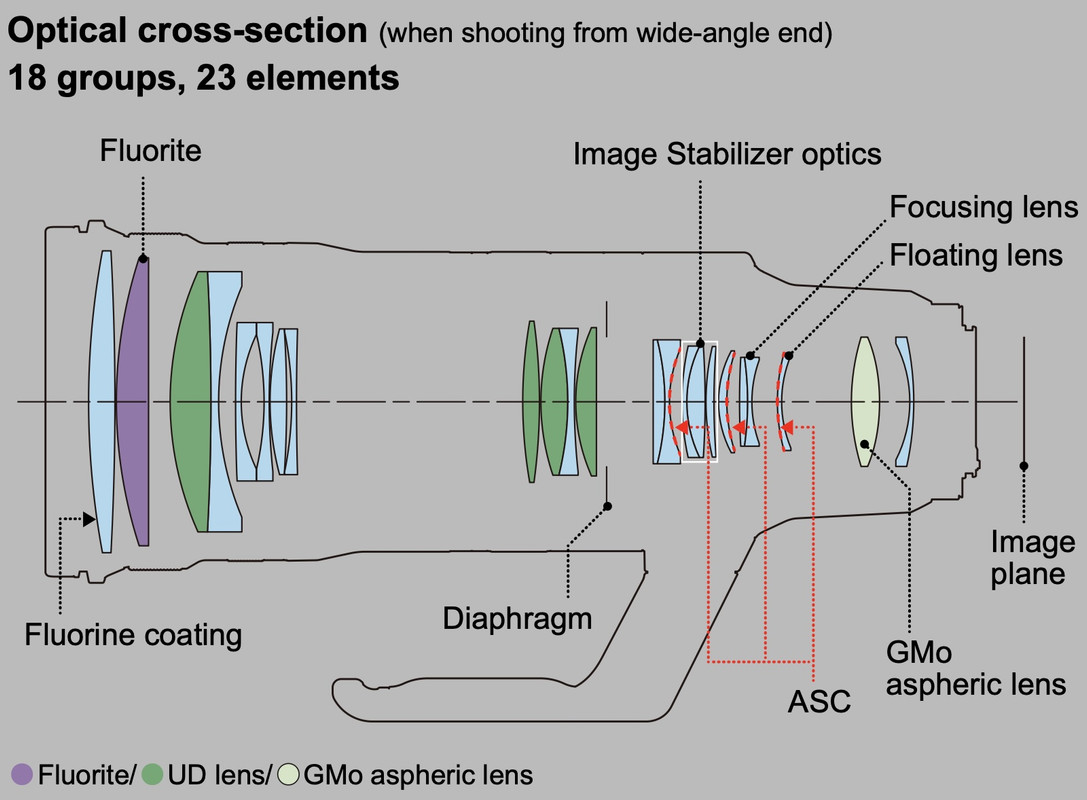
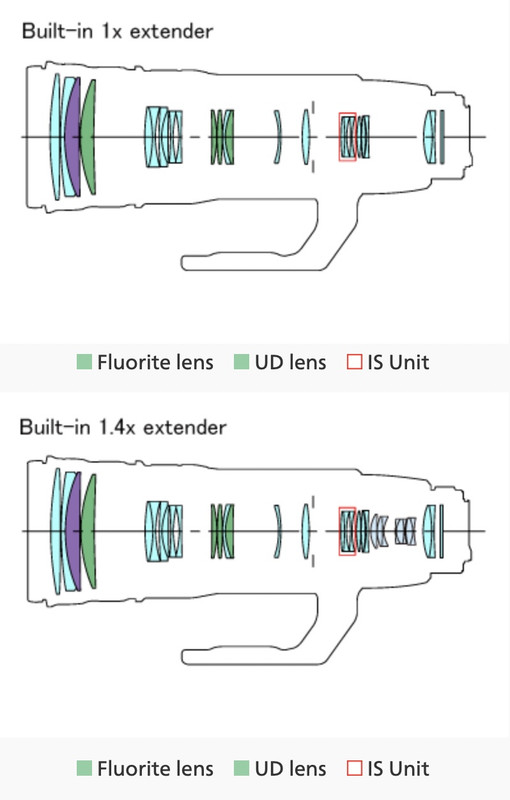
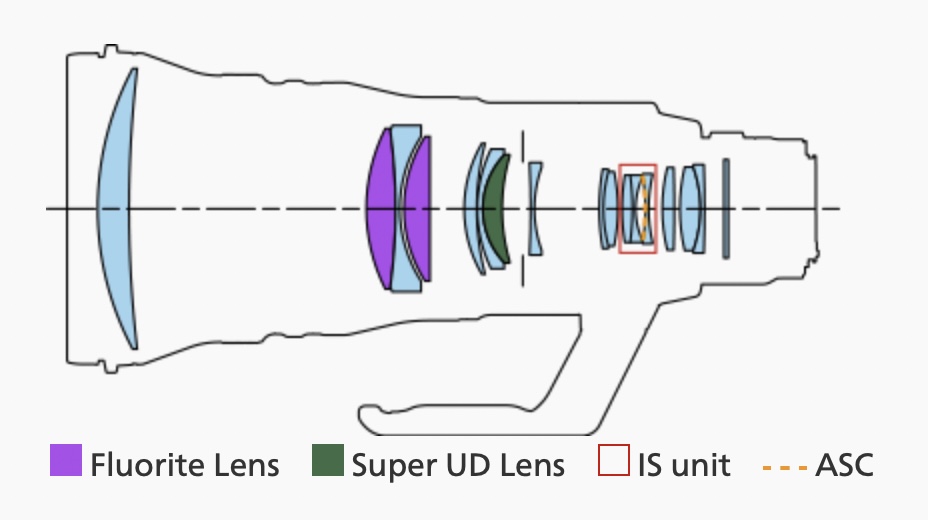
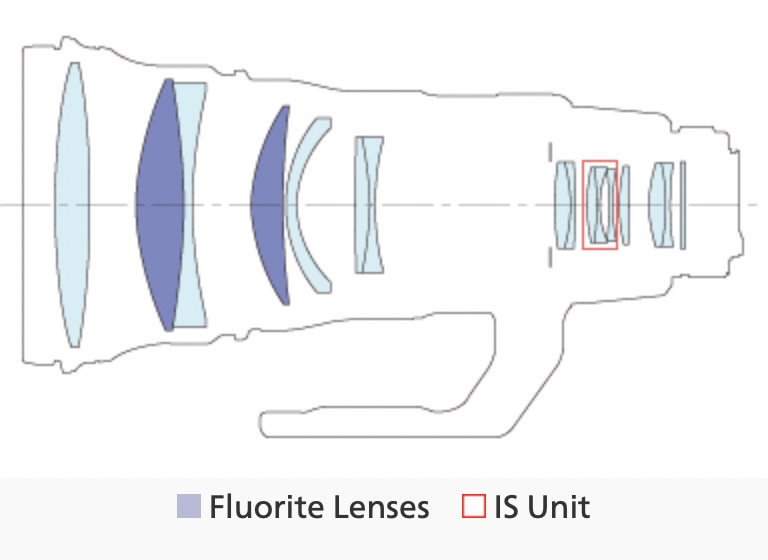
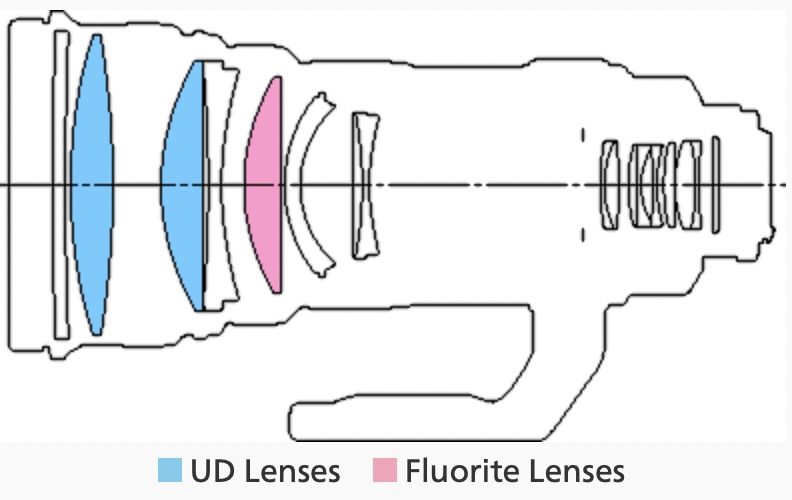
For reference, below are the optical block designs for the 100-300, 200-400 and 400/2.8 IS v3 (EF version show), IS v2 and IS v1:
Duopoly wrote:
My expections of super telephotos in the near future:
70-200mm f2.0 at 5.2 pounds
150-400mm f2.8 at 8.5 pounds
200-600mm f.4.0 at 9 pounds
Those would be interesting! I loved shooting football with the 600/4 and it would be cool to be able to do that again but with a zoom. It's the lens I probably missed most transitioning to the 200-400. Yet, I can't help wonder how many would be disappointed by the weight gain over the 600 prime? Considering the discussions here, if you stand to benefit from having a zoom (sports, perhaps large mammals), it might be an acceptable tradeoff. But for those frequently reach limited (general wildlife/birds), it might be too much compromise.
It's another reason I think 'moderate speed' super-tele zooms are more realistic than zooms in the highest speed classes. IMO f/2.8 up to 300mm is moderate speed. 200/2 would be high speed. 400/2.8 is high speed whereas 500/4 is moderate speed. Therefore I'm more inclined to believe a 200-500/4 (or 4.5) is likely to happen.
There's also the question of price. Is the target market able to support production of a trio of high speed zooms when it costs 30, 40, 50% more than already expensive high speed primes?
rscheffler wrote:
@Z250SA@ Those are all great points. I perhaps should have elaborated that my point you quoted was more specifically about the 200-400 and a possible future 200-500 design. Being zooms, there is inherently a lot more glass at the front moving around than is possible to minimize compared to the recent super-tele prime redesigns. Therefore, strictly from a lens balance perspective, adding an internal TC at the rear could be seen as a benefit that helps offset some of the optical weight inherent in the front of such zoom lenses.
For reference...
Yes, balance and center of mass is very important, especially if you are at full attention for hours.
Hahh... I felt I over extended my cheek a bit on the lens design topic. So I´m very happy to see that the 200-400 has the built in TC in front of the final image flattener.
As can be deduced from the Canon paper in the close by thread, they were pretty busy with the overlap of the floating and the focusing lenses around where a built in TC would be placed. I´d say let they who cry for and demand a built in TC design such lens themselves!
rscheffler wrote:
Therefore, strictly from a lens balance perspective, adding an internal TC at the rear could be seen as a benefit that helps offset some of the optical weight inherent in the front of such zoom lenses.
I think that's where we're thinking of two different balance points. You can see in the 200 - 400 there's a bunch of open area to put the TC into, but on the 100 - 300 there really isn't because the open area near the mount is open because both of those elements would move with the dual motors. So to put that same internal TC into that lens design, you'd need to make the lens physically longer to accommodate that. For the tripod foot, that would indeed put more glass behind the foot, and change the center balance point of the lens itself. So on a monopod / tripod, you just need to move around where it attaches to the foot.
The issue I'm more concerned about is for hand holding. All hand holding is done behind the mount, because that's where your arms are at. So the further that center point is away from your body, the more leverage the lens puts on your arms. So even if the lens is well balanced it will feel heavier the further away it is from you. You could even take a smaller lens like a 24 - 70 on a body and hold that up close. It will have a bit of heft but it's no big deal. Hold that same combination at an arm's length and it will be perceivable heavier even if it has great balance. The concern is having the internal TC on a lens is requiring the same design to put further away from your body, so it's adding to overall feel of weight versus the same lens design that is shorter and closer to your body. How much of a difference does it make? I'm not really sure. But it's an interesting trade off if it's not something you're going to be using often.
rscheffler wrote:
Those would be interesting! I loved shooting football with the 600/4 and it would be cool to be able to do that again but with a zoom. It's the lens I probably missed most transitioning to the 200-400. Yet, I can't help wonder how many would be disappointed by the weight gain over the 600 prime? Considering the discussions here, if you stand to benefit from having a zoom (sports, perhaps large mammals), it might be an acceptable tradeoff. But for those frequently reach limited (general wildlife/birds), it might be too much compromise.
It's another reason I think 'moderate speed' super-tele zooms are more realistic than zooms in the highest speed classes. IMO f/2.8 up to 300mm is moderate speed. 200/2 would be high speed. 400/2.8 is high speed whereas 500/4 is moderate speed. Therefore I'm more inclined to believe a 200-500/4 (or 4.5) is likely to happen.
There's also the question of price. Is the target market able to support production of a trio of high speed zooms when it costs 30, 40, 50% more than already expensive high speed primes?...Show more →
I agree 400mm 2.8 prime at 6.25 pounds and 600mm 4.0 prime at 6.7 pounds are better options for some. I would not mind adding 2.25 pounds to have a zoom 150-400mm 2.8 and adding 2.75 pounds for a 200-600mm f4. The current 200-400mm f4 with TC is 8 pounds but that’s because is an old design with TC.
rscheffler wrote:
Regarding price: it's clearly set in accordance to the price point established by Nikon with their equivalent lens. I'm actually somewhat surprised it didn't land higher than $10K.
I expect there will be a slower 300 DO prime released at some point to fill certain niches - smaller, lighter, less expensive. But doubt it would have a built-in TC. As I suggested earlier, I also think this will happen at 500mm, especially if a 200-500w/TC materializes.
I transitioned from a set of primes (300, 400, 600) to the 200-400 back in 2013, primarily to shoot field sports such as football. The major appeal of the zoom for me was that: I no longer had to fumble with TCs in rain/snow conditions when the gear was under a rain cover; switching the TC in/out was very fast - I could be shooting a QB scrambling out of the pocket downfield at 560mm, switch out the TC and zoom back to 200mm for a pass reception. The biggest problem I had with the primes was when action came too close on sustained plays. Unlike wildlife photographers, I was rarely reach limited. And in situations I would be, the artistic value of the images was poor (far-field action with no subject-background separation). Obviously the zoom provides a lot more compositional flexibility. The tradeoff was not as pretty background bokeh (more swirl in the image periphery) and slight loss in image quality that has become more apparent as sensor resolution increased the past few years. The 200-400's AF also isn't as super snappy as the primes, though it generally has little trouble tracking athletes once locked on.
Regarding the 100-300, I'm also a little disappointed it does not have the built-in TC. But it's probable that would have resulted in greater IQ compromises than the external TCs, plus added size, weight and of course raised the price.
As more of a field sport photographer, I'm a bit on the fence about the 100-300. I would probably use it most of the time with the 1.4x TC and if one compares Canon's MTFs for the 100-300 with and without 1.4x TC against the bare 200-400, there doesn't seem to be an optical (sharpness) advantage for the 100-300. In some respects, this is even a bit concerning about how similarly the 100-300 performs because my experience with the 200-400 has been that while it's very good on 20-24MP, it's possibly showing some age at 45MP, particularly with its internal TC.
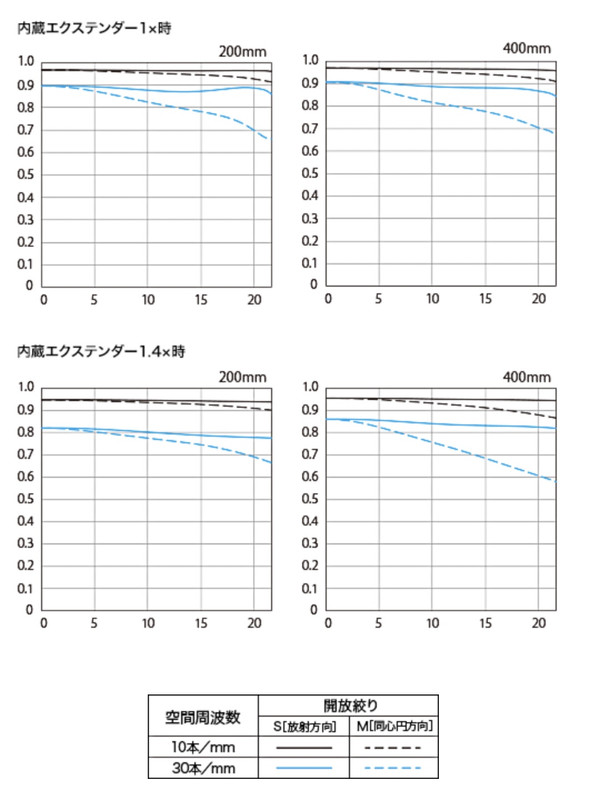
Below are MTF comparisons of the 100-300 bare and with 1.4x TC against the 200-400 bare and with internal TC:
(Unfortunately I was not able to find the EF300/2.8 IS v2 MTFs because the lens is no longer listed as a current model on the Canon sites I checked.)
Considering that about 50% of my football photos each game are with the internal 1.4x TC engaged, the 100-300 w/2x TC MTFs (below) appear to indicate it would be a step down in IQ, particularly at the long end where the 200-400 w/TC improves a little over the wide end.
The astigmatism implied by the 100-300 and 200-400 MTFs (separation of the tangential and sagittal lines as they move away from the image center) suggests that like the 200-400, the 100-300 will have some slight background bokeh swirl.
For arena and court sports, the 100-300 makes a very strong case were in many situations it could replace the need for a 70-200. One could go 24-70 or 24-105 for near action and the 100-300 (with and without TC) for everything else. The RF 70-200's TC incompatibility is just another point in favor of the 100-300 for covering that range. Of course it's a lot larger and heavier than a 70-200. This means it may not be a feasible alternative for some situations, such as shooting through photo cutouts at hockey games where a smaller, lighter, more maneuverable lens that cleanly fits the cutout opening would be a major advantage. ...Show more →
Thanks. I didn't think to look there. One thing however, at some point Canon changed how they measure or report MTFs. It used to be all their super-teles were pegged at nearly 1.0 across the image, which of course is unrealistic. This is what I'm seeing in the 300's MTFs.
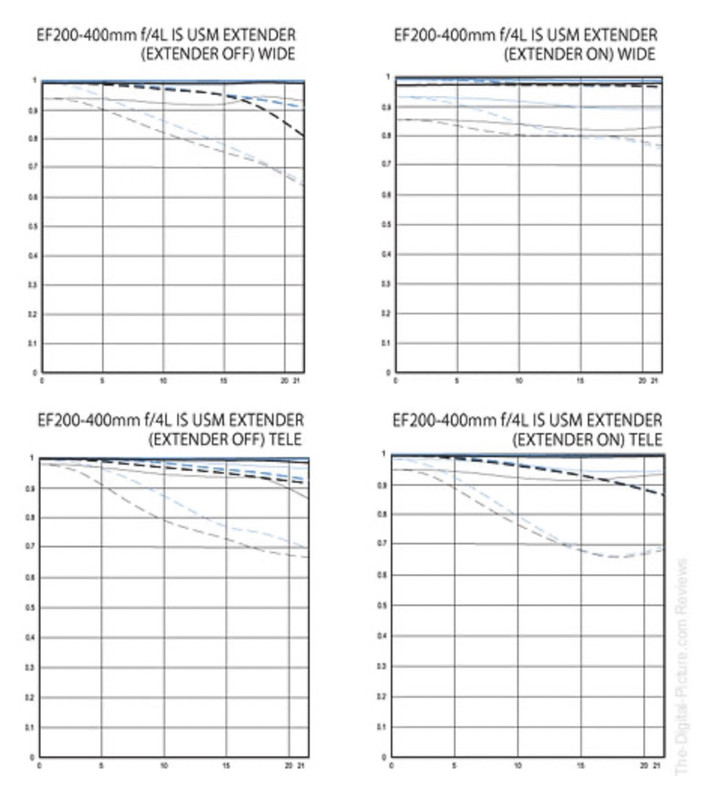
Where I'm uncertain is that the 200-400 is from a similar timeframe and if its MTFs are formulated the same as the old way, then those I posted earlier would be overly optimistic. But on the other hand, IIRC way back in 2013, Lens Rentals tested the 200-400 and found that at 400mm it was nearly as good as the primes...
Here are the MTFs of the 200-400 posted at TDP, which are likely formulated the old way:
And what I pulled from the Canon Japan site and posted earlier:
I suspect the 300/2.8IS II MTFs from TDP cannot be directly compared against the MTFs of the 100-300.
arbitrage wrote:
Weight? Yes. Size? Not really. 3” longer.
300g heavier, not the same weight either. Still massively lighter than Nikon's 120-300 at ~3.3kg and the Sigma at 3.4kg
rscheffler wrote:
Thanks. I didn't think to look there. One thing however, at some point Canon changed how they measure or report MTFs. It used to be all their super-teles were pegged at nearly 1.0 across the image, which of course is unrealistic. This is what I'm seeing in the 300's MTFs.
Where I'm uncertain is that the 200-400 is from a similar timeframe and if its MTFs are formulated the same as the old way, then those I posted earlier would be overly optimistic. But on the other hand, IIRC way back in 2013, Lens Rentals tested the 200-400 and found that at 400mm it was nearly as good as the primes...
Here are the MTFs of the 200-400 posted at TDP, which are likely formulated the old way:
Pixel Perfect wrote:
300g heavier, not the same weight either. Still massively lighter than Nikon's 120-300 at ~3.3kg and the Sigma at 3.4kg
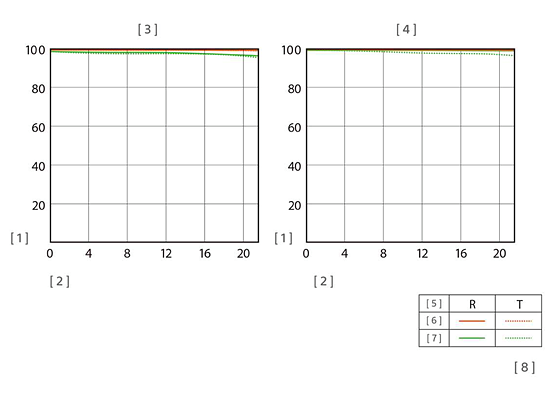
Check out the Sony 600 f/4 GM MTF
We can’t compare theoretical MTFs from different manufacturers though…
Concerning the 300/2.8 II - it’s a crazy sharp lens. I used to shoot it with the 2x III and couldn’t tell much difference vs “bare” (on the 5DSR). Now I do have the 600/4GM you’ve mentioned (on the A1, which is 100% comparable to the 5DSR) and the 300 v2 seems equally sharp or even sharper. So maybe both charts are correct. BTW I feel stupid that I sold my 300 v2 a year ago! I couldn’t care less about the 100-200 range, I have my RF70-200/2.8 for that. It’s tiny and weighs nothing.
Pixel Perfect wrote:
300g heavier, not the same weight either. Still massively lighter than Nikon's 120-300 at ~3.3kg and the Sigma at 3.4kg
Check out the Sony 600 f/4 GM MTF
Is that Sony MTF for 5 lp/mm?
The 300g difference will be somewhat reduced by need for the EF-RF adapter on the 300/2.8 IS v2. (110g for the basic unit.)
The concerns for the sharpness of any new lens is unfounded. It would be utterly stupid of Canon to manufacture lenses that wont cope with the sensors of today as there will be far higher resolution sensors available during the lifespan of these lenses. Even the ridiculed cheap-line 600 and 800 f/11 are sharp enough to produce close to perfection (sharpnesswise) even on the dense R7 sensor. Why would a big white show any such defects?
With a TC it´s up to the threshold of the photographer. Everyone has her own.


 . I've been on the fence between Nikon and Canon for awhile now.