garyvot
Offline
• • • • •
Upload & Sell: On
|
 p.2 #17 · R6 vs. R5 vs. R6II EVF stutter/lag/blackout differences when following fast action p.2 #17 · R6 vs. R5 vs. R6II EVF stutter/lag/blackout differences when following fast action | |
rscheffler wrote:
OK, I shot a daytime football game yesterday, primarily with the R5 and 200-400. I used the R6 as the second camera with a 70-200. Both in electronic shutter.
As already suggested by others, the EVF experience between the two, in respect to the complaints I had, was very similar. But there were differences.
The similarities included the effect of looking like a hand-cranked turn of the 1900s movie that gets faster and faster the longer the burst, which at the previous game I found made it more difficult to follow panning action. Still the same with the R5 but I think I've gotten somewhat used to it now.
As for differences, the previous game was at an indoor field and of course it wasn't as bright as outside. At yesterday's game, which ranged from heavy cloud cover to full sun, the R5's EVF looked better, especially in full sunlight. Just seemed brighter and easier to view (both were set to auto brightness). Tonality was smoother and more natural (both were set to high refresh rate). The R6 felt a bit 'grainy' and darker tones were blocked up. In both cameras I set the same custom Picture Style profile - Standard colors but with the contrast dialed way down to keep images open. Of course, shooting raw, this is kind of irrelevant, except for the preview Jpegs baked into the files, which is what I have Photo Mechanic set to display when I do the first round of selections. I find it gives me a better idea of what the raw file has to offer. Both cameras appear to show this custom Picture Style profile, or any of the regular ones that are chosen, applied to the EVF feed. But the R5's just looks more natural. I just compared the two again side by side here at home and indeed, the R6's EVF image looked murkier and somewhat more blocked up. When I used only the R6 last week, it was OK because I had nothing else to compare it against. I didn't know better. But yesterday, using both side by side, the difference was annoying in that I had to ignore what I saw in the R6's EVF, knowing that it would look better in the actual image files. Now I'm curious how much of a difference there would be between the R3 and R5 (ignoring for now the R3's OVF simulation option, which I thought was quite good, but I missed having the live histogram option).
CPS included a Sandisk Extreme Pro 512GB CFexpress card, which according to the Camnostics review is one of the faster cards for write performance. Buffer depth according to the estimate shown in the viewfinder was usually in the high 50s for the ISOs in use. There were some sequences where I definitely hit the buffer wall, but overall it wasn't too bad. In this respect the R6 is better for longer sustained bursts. I didn't bother to switch to cRAW, though it would have been an option.
The R5's higher resolution was kind of a toss-up, IMO. To really extract maximum resolution required perfect technique and ideal conditions. IMO this rarely happens during a football game. I was never at base ISO - I think the lowest was around 400 and highest was 3200. I used my usual 1/1600 or 1/2000 shutter speed, but probably should have cranked it up to 1/4000. The tradeoff would be higher ISOs and more noise, which would in turn reduce some degree of fine details. It was also quite windy and caused some buffeting, which at times make tracking moving players more challenging than usual. I also feel like the 200-400 is a limiting factor, too. Particularly with the 1.4x TC. It's not bad, just not as tack sharp with the TC as one might hope. Sometimes it was great, but I expect the primes are better. 45MP is nice to be able to crop ~20MP verticals. Does make me wonder a bit about shooting looser with wider lenses. Could I go back to a 400/2.8 prime? I would miss the ability to zoom wider. Maybe I could scale back my use of the TC instead.
I didn't notice any significant AF performance differences between the two and had them both set up pretty much identically. Subject and eye tracking between both was similar, meaning not as good/sticky as the R3. But while editing yesterday's photos, which were primarily with the R5, my impression was the AF shot to shot consistency was not as good as the R6's. Some of this I think would be due to the R6's lower resolution masking very slight focusing errors. Plus the conditions yesterday outside in the elements were different than a week ago at an indoor stadium. The aforementioned wind buffeting meant the AF point is not a consistently on the subject (I generally didn't use subject tracking because it would too quickly switch off the intended player in busy situations). It was also cold enough that they turned on the bench warmers and the huge propane heaters that look like jet engines on the sidelines. The heat from those wafts across midfield and causes heat wave distortions that kill image sharpness...
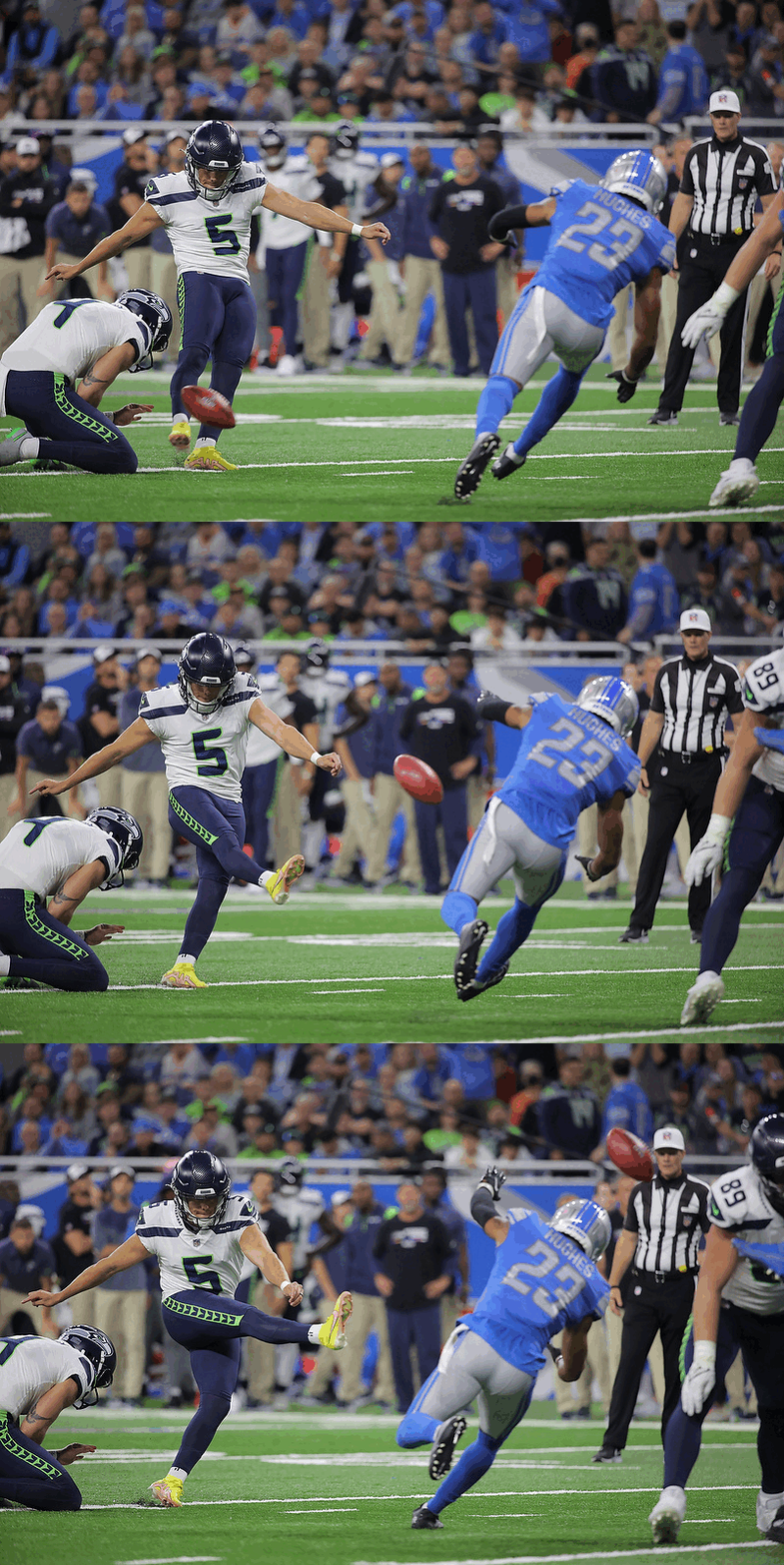
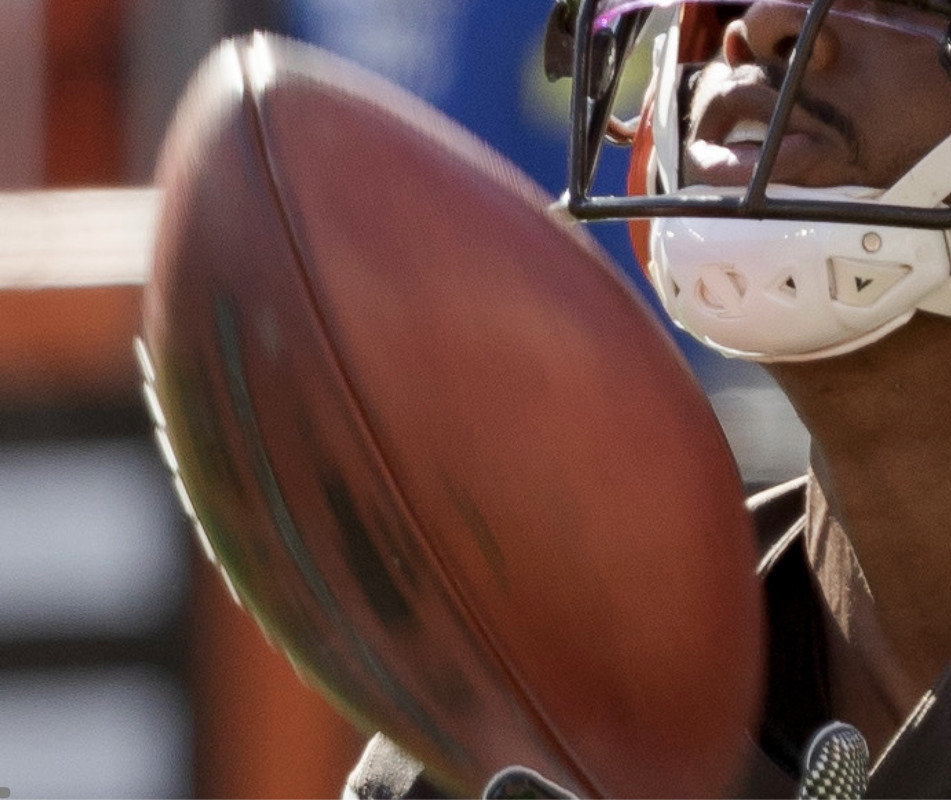
R5 rolling e-shutter effects were noticeable but I think slightly less so than with the R6. I didn't notice as much jello effect in the background when making sudden horizontal direction changes while shooting vertically. Certain situations, such as a kicker kicking the ball, showed some e-shutter distortion in the ball.
So which camera to get? Good question!
...Show more →
Excellent write up Ron.
The R6 EVF is indeed of lower resolution than that of the R5. One of the cost cutting compromises that Canon made to hit the target price point I imagine. I don't really find it problematic on its own, but I haven't had the experience of using both cameras side by side.
|