This topic is in the 2022 archive. You can read it and like its posts here. It is read only.
Archive 2022Do you take advantage of Sony's Dual Gain ISO ?
p.1 #1Do you take advantage of Sony's Dual Gain ISO ?
Early on thanks to photonstophotos.net where I initially learned about dual gain ISO, I made a habit to to check photonstophotos every time I bought a new Sony camera model to make sure I knew where Dual Gain ISO kicked in on that model. I found this approach very helpful as opposed to just allowing Auto ISO to take control especially for BIF where I need to rely upon high and higher shutter speeds particularly on overcast days. Too much noise, loss of DR and heavy cropping is not a good mix for bird photography! Of course there are many fine software techniques to abate in post, but why not start out with the best IQ in camera either way.
If you haven't paid much attention to Sony's Dual Gain ISO technology, this video might change your mind. At a minimum I think this video is an interesting approach to checking for and understanding the effect of dual gain ISO in a particular camera model for ourselves outside of looking at a chart.
If you haven't paid much attention to Sony's Dual Gain ISO technology, this video might change your mind. At a minimum I think this video is an interesting approach to checking for and understanding the effect of dual gain ISO in a particular camera model for ourselves outside of looking at a chart.
Mar 30, 2022 at 08:36 AM
p.1 #2Do you take advantage of Sony's Dual Gain ISO ?
I had heard about the duel gain iso, although I understood it, I never changed the way I shot.
When I went shooting with my a7III, and my a9, my shots at iso 500 would always take more work in processing.
I now understand why.
Thanks for the video link.
I wonder why Sony chose to use iso 400 as the reset point for the a7IV?
When I went shooting with my a7III, and my a9, my shots at iso 500 would always take more work in processing.
I now understand why.
Thanks for the video link.
I wonder why Sony chose to use iso 400 as the reset point for the a7IV?
Mar 30, 2022 at 09:05 AM
p.1 #3Do you take advantage of Sony's Dual Gain ISO ?
davev wrote:
I had heard about the duel gain iso, although I understood it, I never changed the way I shot.
When I went shooting with my a7III, and my a9, my shots at iso 500 would always take more work in processing.
I now understand why
You read up on stuff when you are buying the camera then it gets filed away with the package lol, I have something in the back of my head that remembers that on my A9 if you are pushing the iso you may as well go strength to 640 as it’s cleaner than 200 to 640 due to this factor, then it’s linear after that, I will have to Google it now to make sure I am not making it up,
Mar 30, 2022 at 09:12 AM
p.1 #5Do you take advantage of Sony's Dual Gain ISO ?
I only deliberately use the dual gain for Astro. For day to day I figured the Sony engineering chose the transition before noise becomes a problem in most cases.
The video was really not designed for smart phone resolution, just looked black to me. I wonder if anyone was triggered at the thought of him adding 16 counts to the mechanical shutter on the A1 for no reason? Doesn’t bother me, cameras are meant to be used. Seems like there are a few here trying to preserve the virginity of their A1 shutters.
The video was really not designed for smart phone resolution, just looked black to me. I wonder if anyone was triggered at the thought of him adding 16 counts to the mechanical shutter on the A1 for no reason? Doesn’t bother me, cameras are meant to be used. Seems like there are a few here trying to preserve the virginity of their A1 shutters.
Mar 30, 2022 at 09:21 AM
p.1 #6Do you take advantage of Sony's Dual Gain ISO ?
Uncle Chip wrote:
When I went shooting with my a7III, and my a9, my shots at iso 500 would always take more work in processing.
I now understand whyYou read up on stuff when you are buying the camera then it gets filed away with the package lol, I have something in the back of my head that remembers that on my A9 if you are pushing the iso you may as well go strength to 640 as it’s cleaner than 200 to 640 due to this factor, then it’s linear after that, I will have to Google it now to make sure I am not making it up,
ISO 640 was almost always my go-to setting for A9 BIF outings.
davev wrote
I had heard about the duel gain iso, although I understood it, I never changed the way I shot.When I went shooting with my a7III, and my a9, my shots at iso 500 would always take more work in processing.
I now understand why
ISO 640 was almost always my go-to setting for A9 BIF outings.
Mar 30, 2022 at 09:37 AM
p.1 #7Do you take advantage of Sony's Dual Gain ISO ?
I do often on the a7r4. If I’m not at 100 then I’m using 320 which is very useful given the high MP count. The dynamic range is still very high at this setting and seems as good as 100 was on my a7r
Mar 30, 2022 at 09:39 AM
p.1 #8Do you take advantage of Sony's Dual Gain ISO ?
tschopp wrote:
I only deliberately use the dual gain for Astro. For day to day I figured the Sony engineering chose the transition before noise becomes a problem in most cases.
The video was really not designed for smart phone resolution, just looked black to me. I wonder if anyone was triggered at the thought of him adding 16 counts to the mechanical shutter on the A1 for no reason? Doesn’t bother me, cameras are meant to be used. Seems like there are a few here trying to preserve the virginity of their A1 shutters.
I just did the test with the A1 and forgot to turn off electronic shutter. I saw a really strange noise pattern at ISO 1600 when boosted +5EV in post, probably the reason not to test with electronic shutter--but I need to retest with mech shutter to compare.
Mar 30, 2022 at 09:59 AM
p.1 #9Do you take advantage of Sony's Dual Gain ISO ?
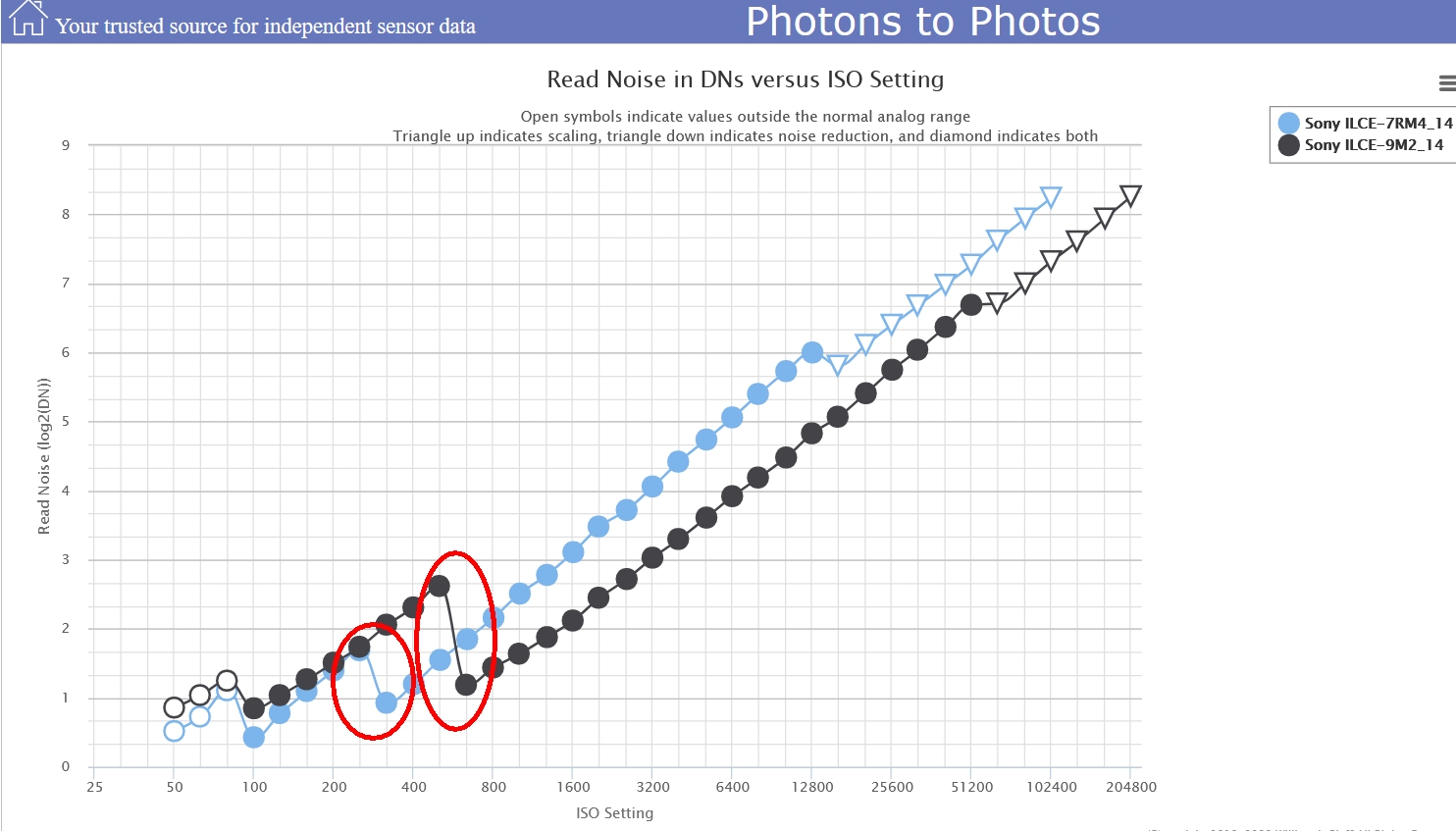
I specifically set my ISO and auto ISO range based on the dual gain SNR. Especially on the a9M2 it makes more sense to use ISO 640 rather than anything from 160 to 500.
Mar 30, 2022 at 10:10 AM

p.1 #10Do you take advantage of Sony's Dual Gain ISO ?
I am aware of this feature but I am using Auto ISO pretty much all the time and as such the point is kind of moot. But still good to know at what point the dual gain kicks in in the A1. Is there another level after ISO 500, where the sensor behaves similarly in getting another gain in noise and DR or is that it? Thank you!
Thank you also to LB for posting the thread!
Thank you also to LB for posting the thread!
Mar 30, 2022 at 10:36 AM
p.1 #11Do you take advantage of Sony's Dual Gain ISO ?
In the case of the A7R IV, it looks like one gets similar noise levels at "160 - 200 - 250" compared to "320 - 400 - 500".
Beyond this, the higher the ISO, the more noise the image gets.
This could be useful information when shooting in low light or if there is a need for a specific SS range to stop action.
Beyond this, the higher the ISO, the more noise the image gets.
This could be useful information when shooting in low light or if there is a need for a specific SS range to stop action.
Mar 30, 2022 at 10:38 AM
p.1 #12Do you take advantage of Sony's Dual Gain ISO ?
Thank you for that link and video. Learning new things is great at my age That is rather fascinating and quite interesting and now I have to change some things on my A1 and A7rIII menus!
Karl
That is rather fascinating and quite interesting and now I have to change some things on my A1 and A7rIII menus!Karl
Mar 30, 2022 at 10:47 AM
p.1 #13Do you take advantage of Sony's Dual Gain ISO ?
I basically use only 2 ISO settings on my A1:
* 100
* auto-iso (starting with 500).
* 100
* auto-iso (starting with 500).
Mar 30, 2022 at 10:50 AM
p.1 #14Do you take advantage of Sony's Dual Gain ISO ?
Uncle Chip wrote:
When I went shooting with my a7III, and my a9, my shots at iso 500 would always take more work in processing.
I now understand whyYou read up on stuff when you are buying the camera then it gets filed away with the package lol, I have something in the back of my head that remembers that on my A9 if you are pushing the iso you may as well go strength to 640 as it’s cleaner than 200 to 640 due to this factor, then it’s linear after that, I will have to Google it now to make sure I am not making it up,
https://www.photonstophotos.net/Charts/PDR_Shadow.htm#Sony%20ILCE-7RM4
davev wrote
I had heard about the duel gain iso, although I understood it, I never changed the way I shot.When I went shooting with my a7III, and my a9, my shots at iso 500 would always take more work in processing.
I now understand why
https://www.photonstophotos.net/Charts/PDR_Shadow.htm#Sony%20ILCE-7RM4
Mar 30, 2022 at 11:01 AM
p.1 #15Do you take advantage of Sony's Dual Gain ISO ?
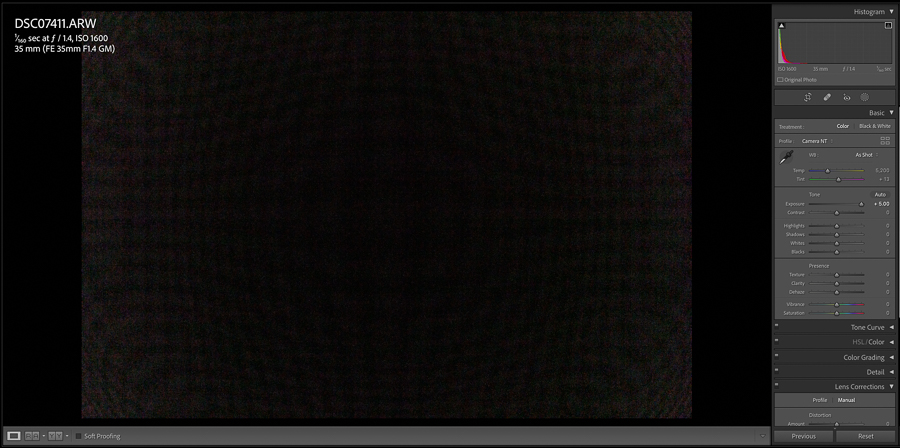
This is the strange Sony A1 noise pattern I see using the technique in the video.
ISO 1600 pushed +5EV in post. I repeated the same w/ electronic/mechanical, IBIS on/off, uncompressed/lossless compressed, no change. Maybe some other setting is causing this ? Not that it seems to make any difference with my resulting files. Just not what I was expecting.
ISO 1600 pushed +5EV in post. I repeated the same w/ electronic/mechanical, IBIS on/off, uncompressed/lossless compressed, no change. Maybe some other setting is causing this ? Not that it seems to make any difference with my resulting files. Just not what I was expecting.
Mar 30, 2022 at 11:05 AM
p.1 #16Do you take advantage of Sony's Dual Gain ISO ?
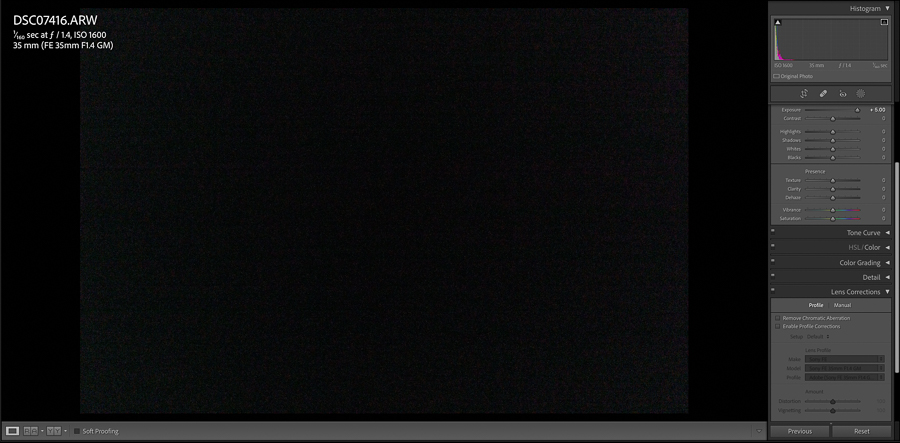
Try turning off profile corrections
LBJ2 wrote:
This is the strange Sony A1 noise pattern I see using the technique in the video.
LBJ2 wrote:
This is the strange Sony A1 noise pattern I see using the technique in the video.
Mar 30, 2022 at 11:11 AM
p.1 #17Do you take advantage of Sony's Dual Gain ISO ?
sbay wrote:
Try turning off profile corrections
✅ That did it ! Thank you.
Try turning off profile corrections
LBJ2 wrote
This is the strange Sony A1 noise pattern I see using the technique in the video.✅ That did it ! Thank you.
Mar 30, 2022 at 11:12 AM
p.1 #18Do you take advantage of Sony's Dual Gain ISO ?
j4nu wrote:
I basically use only 2 ISO settings on my A1:
* 100
* auto-iso (starting with 500).
Going to copy this strategy 😄 Thanks for the video!
I basically use only 2 ISO settings on my A1:
* 100
* auto-iso (starting with 500).
Going to copy this strategy 😄 Thanks for the video!
Mar 30, 2022 at 11:21 AM
p.1 #19Do you take advantage of Sony's Dual Gain ISO ?
Fred Miranda wrote:
In the case of the A7R IV, it looks like one gets similar noise levels at "160 - 200 - 250" compared to "320 - 400 - 500".
Beyond this, the higher the ISO, the more noise the image gets.
This could be useful information when shooting in low light or if there is a need for a specific SS range to stop action.
There is a very interesting video on Youtube from Alyn Wallace (astrophotographer) where he takes sample photos at ISO 100 - 12,800 (same exposure time), on I think it was a Sony A7sii, and compares them by adjusting by up to 5 stops in post.
Basically he found that raising anything by up to 5 stops was going to be roughly equal (noise) to shooting at the 'correct' exposure higher ISO, and that this is very valuable for Astro (and I can see for use in cityscapes etc.) since it means when there is a high luminance object in the frame (moon or lighthouse for example) then you can shoot at the lower ISO (so as not to overexpose the bright object and to retain DR) and raise in post. You will still need to shoot a high ISO image first to confirm composition and focus.
Edited on Mar 30, 2022 at 11:51 AM · View previous versions
Mar 30, 2022 at 11:22 AM
p.1 #20Do you take advantage of Sony's Dual Gain ISO ?
I once heard someone say in a youtube video that the dual gain iso could be used effectively for astro work because the second gain circuit was biased towards minimizing noise as opposed to the first gain circuit which would presumably be biased to maximizing dynamic range. I have no idea if this is true and can't be bothered to find the reference but perhaps someone here has heard of similar.
As for me, I use ISO 500 as my preferred second ISO (after 100). Shooting on the A1.
As for me, I use ISO 500 as my preferred second ISO (after 100). Shooting on the A1.
Mar 30, 2022 at 01:21 PM