This topic is in the 2022 archive. You can read it and like its posts here. It is read only.
Archive 2022Learning Leica "M", a 30 day project

p.15 #1Learning Leica "M", a 30 day project
RustyBug wrote:
The glass and the haptic come to mind, also.
One could say that you can adapt the glass to the Sony, etc. ... but, then you are compromising the glass in some regard or another.
You can adapt the lens to the SL, but then you are getting some heft in the body.
You can adapt the lens to the TL / TL2 / CL, but then you are getting the crop (which I also use).
Might also be a good question for someone like Ralph Gibson as to when / why / where he uses the EVF in conjunction with the rangefinder (M11...Show more →
How long did it take Leica to put a meter in the M? They never went auto focus with M (thank gawd) and I'm sure there was a ton of pressure to do so.
My point is I don't understand why if there are tools out there that you see through the lens (that would be pretty much everything else out there) and that does it better why choose Leica M for that. It's like using a adjustable wrench as a hammer. It can work but the hammer would be the better choice.
airfrogusmc wrote
I agree but the thing I don't get is why get an M then?One could say that you can adapt the glass to the Sony, etc. ... but, then you are compromising the glass in some regard or another.
You can adapt the lens to the SL, but then you are getting some heft in the body.
You can adapt the lens to the TL / TL2 / CL, but then you are getting the crop (which I also use).
Might also be a good question for someone like Ralph Gibson as to when / why / where he uses the EVF in conjunction with the rangefinder (M11...Show more →

How long did it take Leica to put a meter in the M? They never went auto focus with M (thank gawd) and I'm sure there was a ton of pressure to do so.
My point is I don't understand why if there are tools out there that you see through the lens (that would be pretty much everything else out there) and that does it better why choose Leica M for that. It's like using a adjustable wrench as a hammer. It can work but the hammer would be the better choice.
Mar 12, 2022 at 07:58 AM
p.15 #2Learning Leica "M", a 30 day project
Great discussion guys. Thanks for your contributions to the thread, and keeping it so positive.
I fully agree that Leica should continue to curate, and preserve, that special relationship that the M bodies and Range Finer experience provides as a tool for making images. It is unique and additive to the process.
If I were to view the EVF, or even the rear screen as my primary interface to the camera, I would indeed choose another system that does these things better. In my limited experience I have found the no other camera "lives" better with me on a daily basis. It is easy to carry with me, and a joy to shoot. Still, there are situations and subjects that I find the rear screen and EVF are good tools to have available. Knowing I have them when I want them makes it more comfortable to choose the M as my camera when I go out daily, or when I travel. I imagine that as I grow in my skills, and become more comfortable with the RF that the times when I will choose to use the EVF or Live View will diminish. For now I am glad to have the options.
-Steve-
Mar 12, 2022 at 08:09 AM
p.15 #3Learning Leica "M", a 30 day project
Day 20 Image:
We went for an evening stroll on La Jolla's main entertainment street Prospect Street. A local real estate company was hosting a free Jazz concert and serving free Champaign. The featured artist was Peter Marin, known at the "Hollywood Entrepreneur", and writer of an interesting autobiography. It was a nice event.
On walks like this, it is very easy to put the camera on a strap that is long enough to position on my lower back. Completely unobtrusive because of it and the lens small size. I can also carry another small lens in a pocket. I take both the 28mm, and 50mm CV lenses. Even my wife doesn't mind me having this setup along. She is not so tolerant of my bigger Sony setup. Still, she won't tolerate being in any of the pictures. Trying that is sure to ruin a good outing.
I choose to capture this mini concert with the Voigtlander 28mm f/2 Ultron because it was a very small venue opening up to the sidewalk. The light levels were also low, but I still wanted to a DOF large enough to capture the whole band in acceptable levels of focus. The wide FL also helped with this. I focused on the singer using the range finder. Then I looked at the DOF marking on the lens and f/4 seemed to accomplish this goal. So that what I settled on. I pushed my hand holding ability by leaning against a column on the building. I went with a SS of 1/60 sec. This is 2 X the FL of the lens and used to be easy for me, these days not so much. Luckily the singer was moving fairly slowly so I figured that 1/60 sec would also work to freeze him as well. This proved to be about 50% true as that was about the percentage of images that were acceptably sharp in my opinion. Honestly, I should probably have used 1/125 sec in this circumstance. Still learning the limits of this way of shooting. This resolved to an ISO of 1600. Plenty low for this sensor.
Yes, it is just a snapshot. But I felt it worth sharing here both because of the what I learned while shooting it, and because of the great rendering the camera imparted to the image. I continue to be impressed with how well this camera does with shadows, and tonality in general. The smoothness in tonal transitions , and detail it captures in the shadows and even the blacks adds something special to the images. So much so that it is changing the way I process my images. First I am more and more often choosing B&W for my images. But even for those I decide to settle for color I now switch to B&W to edit my White, Black, Highlight, and shadow sliders in Light Room. I find this really helps me manage these points, and see subtleties in the transitions, and more depth in the image. I then switch back to color for editing those, sharpness and other attributes. I feel I am getting better results this way. Once again learning.
Here is the image. Looking forward to your comments and suggestions on it, and the process I used it make it as always.
Enjoy,
-Steve-
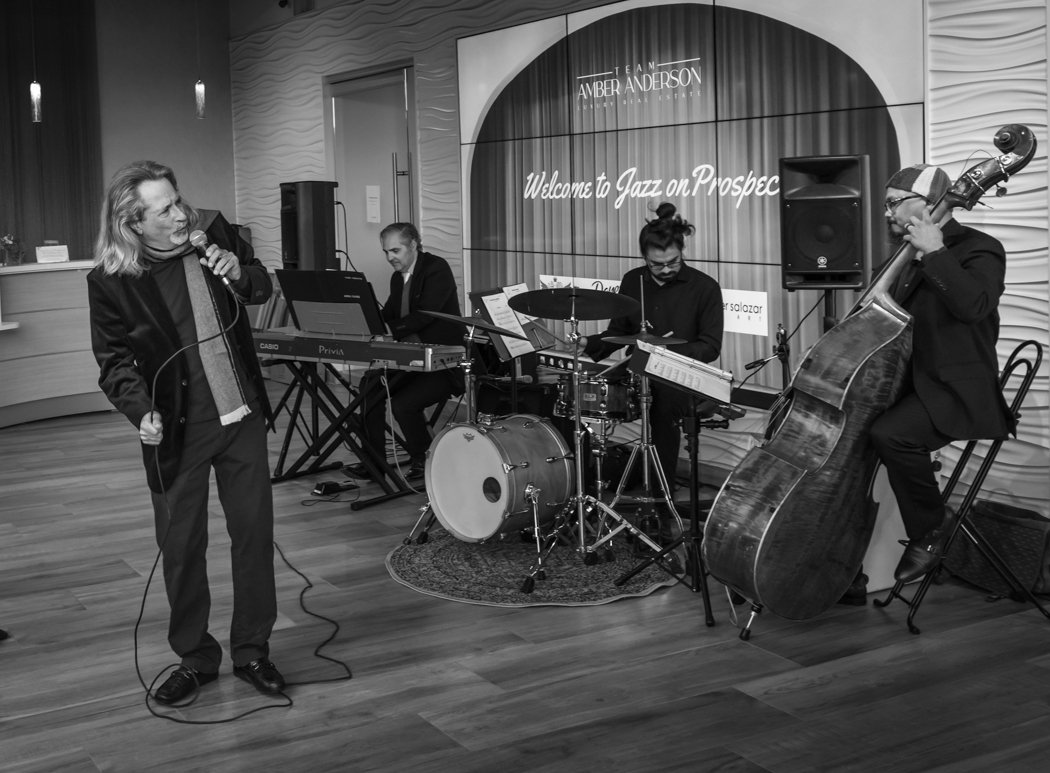
Leica M10-P, Voigtlander 28mm f/2 Ultron v1, f/4, 1/60/ sec, ISO 1600
We went for an evening stroll on La Jolla's main entertainment street Prospect Street. A local real estate company was hosting a free Jazz concert and serving free Champaign. The featured artist was Peter Marin, known at the "Hollywood Entrepreneur", and writer of an interesting autobiography. It was a nice event.
On walks like this, it is very easy to put the camera on a strap that is long enough to position on my lower back. Completely unobtrusive because of it and the lens small size. I can also carry another small lens in a pocket. I take both the 28mm, and 50mm CV lenses. Even my wife doesn't mind me having this setup along. She is not so tolerant of my bigger Sony setup. Still, she won't tolerate being in any of the pictures. Trying that is sure to ruin a good outing.
I choose to capture this mini concert with the Voigtlander 28mm f/2 Ultron because it was a very small venue opening up to the sidewalk. The light levels were also low, but I still wanted to a DOF large enough to capture the whole band in acceptable levels of focus. The wide FL also helped with this. I focused on the singer using the range finder. Then I looked at the DOF marking on the lens and f/4 seemed to accomplish this goal. So that what I settled on. I pushed my hand holding ability by leaning against a column on the building. I went with a SS of 1/60 sec. This is 2 X the FL of the lens and used to be easy for me, these days not so much. Luckily the singer was moving fairly slowly so I figured that 1/60 sec would also work to freeze him as well. This proved to be about 50% true as that was about the percentage of images that were acceptably sharp in my opinion. Honestly, I should probably have used 1/125 sec in this circumstance. Still learning the limits of this way of shooting. This resolved to an ISO of 1600. Plenty low for this sensor.
Yes, it is just a snapshot. But I felt it worth sharing here both because of the what I learned while shooting it, and because of the great rendering the camera imparted to the image. I continue to be impressed with how well this camera does with shadows, and tonality in general. The smoothness in tonal transitions , and detail it captures in the shadows and even the blacks adds something special to the images. So much so that it is changing the way I process my images. First I am more and more often choosing B&W for my images. But even for those I decide to settle for color I now switch to B&W to edit my White, Black, Highlight, and shadow sliders in Light Room. I find this really helps me manage these points, and see subtleties in the transitions, and more depth in the image. I then switch back to color for editing those, sharpness and other attributes. I feel I am getting better results this way. Once again learning.
Here is the image. Looking forward to your comments and suggestions on it, and the process I used it make it as always.
Enjoy,
-Steve-
Leica M10-P, Voigtlander 28mm f/2 Ultron v1, f/4, 1/60/ sec, ISO 1600
Mar 12, 2022 at 08:50 AM
p.15 #4Learning Leica "M", a 30 day project
Steve one thing to think about is crutches can be limiting when one needs to walk on their own. Sometime folks get to dependent on them especially in the learning stage. Learning to see in the moment and refining ones ability to capture that takes time and discipline. But once mastered is the key to consistency. Like capturing people in stride is a great discipline. Yo have to get to a point where it becomes second nature. One learns the rhythm because if I think about it I usually miss it. But from practice, practice, practice it becomes second nature. I don't even think about it because it has become a developed instinct. And that skill to see and and then be able capture in the moment is one that is constant But if I were to rely on the crutch I would never learn to walk and without learning to walk I would never be able to run.
Thats my 2 cents. And I loved working with Leica M digital so much I went totally Leica M over 5 years ago from DSLRs and I have no regrets. I do all my pro work with them and all of my personal work with them. They fit the way I see and work. It is a system, for me, that gets out of the way and lets me create without all the stuff I don't need or want on it.
Thats my 2 cents. And I loved working with Leica M digital so much I went totally Leica M over 5 years ago from DSLRs and I have no regrets. I do all my pro work with them and all of my personal work with them. They fit the way I see and work. It is a system, for me, that gets out of the way and lets me create without all the stuff I don't need or want on it.
Mar 12, 2022 at 09:26 AM
p.15 #5Learning Leica "M", a 30 day project
airfrogusmc wrote:
Steve one thing to think about is crutches can be limiting when one needs to walk on their own. Sometime folks get to dependent on them especially in the learning stage. Learning to see in the moment and refining ones ability to capture that takes time and discipline. But once mastered is the key to consistency. Like capturing people in stride is a great discipline. Yo have to get to a point where it becomes second nature. One learns the rhythm because if I think about it I usually miss it. But from practice, practice, practice it becomes second nature....Show more →
I agree and am very focused on making sure that I don't revert to known and comfortable methodologies during the project. I am using the Range Finder for pretty much all images. Except for a couple of landscape images on a tripod, my use of the rear screen is primarily to confirm focus and exposure. I am feeling the need to do this less and less as I get better. Honestly, I have always been a chimper when I shoot. This is unlikely to change. I never shot film, so have never had to deal without the ability to confirm my shots with a quick chimp.
I do plan to use the Leica Photo App to remote shoot and image, and will also use the EVF at least once also. This is a "learning Leica M" project. These features are available, so I feel I should include them in the thread at least once.
Mar 12, 2022 at 09:51 AM
p.15 #6Learning Leica "M", a 30 day project
Ya really wanna learn to use a rangefinder camera pick up an M 3, a roll of tri-x and some rodinal ha ha,,,
Mar 12, 2022 at 10:01 AM
p.15 #7Learning Leica "M", a 30 day project
airfrogusmc wrote:
Ya really wanna learn to use a rangefinder camera pick up an M 3, a roll of tri-x and some rodinal ha ha,,,
Not gonna happen. Not gonna have a land line phone, or write on papyrus rolls either...
Ya really wanna learn to use a rangefinder camera pick up an M 3, a roll of tri-x and some rodinal ha ha,,,
Not gonna happen. Not gonna have a land line phone, or write on papyrus rolls either...
Mar 12, 2022 at 10:32 AM
p.15 #8Learning Leica "M", a 30 day project
Ha ha..Just say'n. A camera with no crutches and you have a real investment in time and energy so when a mistake is made it really sinks in.
Mar 12, 2022 at 10:40 AM
p.15 #9Learning Leica "M", a 30 day project
1bwana1 wrote:
I have a question.
The M10-P offers me two options for card maintenance. I can choose to delete all files, or format the card. In my other cameras I have always just formatted when I wanted to clear all the files. Are there advantages/disadvantages when choosing one or the other on the Leica?
Sorry, I'm a day behind on comments. TBH, I don't know what real difference this makes to a typical M user.
My understanding is when you delete images, the card's hidden file directory that keeps track of everything, reallocates that space for use (though the data of the actual image is not deleted). If you only delete some of the images, the card ends up with a checkerboard-like arrangement of spaces to which it will allow new files to be written. When new images are added, some may not fit into open spaces and will be written to two or more spaces, causing some fragmentation. The card's file management system will keep track of this fragmentation. But over time, the amount of fragmentation will increase and become more complex. And the information in the hidden file system will become more complex as it keeps track of the ever increasing fragmentation. According to a FAQ by Nikon, computer OSes may also add hidden tags to data on the card. The eventual concern would be possibility of file corruption, or of filesystem corruption, which could result in loss of data/images.
When formatting a card, depending on how it's formatted, it usually just wipes/resets the entire file directory that points to the actual files. It usually does not 'zero out' the actual storage cells. Replacing the old directory with a blank new one allows new files to be written anywhere. An advantage is that as new images are added to the reformatted card, they'll probably be written sequentially without (much) fragmentation. This keeps file organization simpler. For higher performance cameras, it should mean faster write speeds and faster buffer clearing because images aren't being split-up and written to multiple fragmented spaces. Not sure if you've ever noticed how a camera's write speed slows down as the card is close to full capacity? This would be worsened if the card is extremely fragmented.
In 20+ years of shooting digitally, I mostly reformat each time after a job , event or once a card has been filled. I haven't run into any problems I know about. Back during the M9, there was some discussion about slow start up and wake times, image banding and perhaps other things. The feeling was card type/brand/model and formatting were relevant to these problems. One recommendation was to periodically format with the SD Association's formatter app to 'restore' cards to the official file system specifications. It's just a hunch, but I think a reason Leica's cameras are sometimes quite slow during start up is because they possibly do a full check of the card's file system. If a card hasn't been formatted in a while, the content of the file system could be quite complex and might delay start up and wake.
Oh, and if you didn't already know, you can figure out from the above that deleting images from the card doesn't really delete them. It deletes info in the directory pointing to those files. This is why it's usually a trivial matter to recover deleted images/files from storage devices with recovery software. So... it's something to keep in mind when you retire devices/storage. If you plan to sell such things, it would be wise to run 'secure' formatting to overwrite and/or zero out the old, 'deleted' data.
I have a question.
The M10-P offers me two options for card maintenance. I can choose to delete all files, or format the card. In my other cameras I have always just formatted when I wanted to clear all the files. Are there advantages/disadvantages when choosing one or the other on the Leica?
Sorry, I'm a day behind on comments.
TBH, I don't know what real difference this makes to a typical M user. My understanding is when you delete images, the card's hidden file directory that keeps track of everything, reallocates that space for use (though the data of the actual image is not deleted). If you only delete some of the images, the card ends up with a checkerboard-like arrangement of spaces to which it will allow new files to be written. When new images are added, some may not fit into open spaces and will be written to two or more spaces, causing some fragmentation. The card's file management system will keep track of this fragmentation. But over time, the amount of fragmentation will increase and become more complex. And the information in the hidden file system will become more complex as it keeps track of the ever increasing fragmentation. According to a FAQ by Nikon, computer OSes may also add hidden tags to data on the card. The eventual concern would be possibility of file corruption, or of filesystem corruption, which could result in loss of data/images.
When formatting a card, depending on how it's formatted, it usually just wipes/resets the entire file directory that points to the actual files. It usually does not 'zero out' the actual storage cells. Replacing the old directory with a blank new one allows new files to be written anywhere. An advantage is that as new images are added to the reformatted card, they'll probably be written sequentially without (much) fragmentation. This keeps file organization simpler. For higher performance cameras, it should mean faster write speeds and faster buffer clearing because images aren't being split-up and written to multiple fragmented spaces. Not sure if you've ever noticed how a camera's write speed slows down as the card is close to full capacity? This would be worsened if the card is extremely fragmented.
In 20+ years of shooting digitally, I mostly reformat each time after a job , event or once a card has been filled. I haven't run into any problems I know about. Back during the M9, there was some discussion about slow start up and wake times, image banding and perhaps other things. The feeling was card type/brand/model and formatting were relevant to these problems. One recommendation was to periodically format with the SD Association's formatter app to 'restore' cards to the official file system specifications. It's just a hunch, but I think a reason Leica's cameras are sometimes quite slow during start up is because they possibly do a full check of the card's file system. If a card hasn't been formatted in a while, the content of the file system could be quite complex and might delay start up and wake.
Oh, and if you didn't already know, you can figure out from the above that deleting images from the card doesn't really delete them. It deletes info in the directory pointing to those files. This is why it's usually a trivial matter to recover deleted images/files from storage devices with recovery software. So... it's something to keep in mind when you retire devices/storage. If you plan to sell such things, it would be wise to run 'secure' formatting to overwrite and/or zero out the old, 'deleted' data.
Mar 12, 2022 at 11:08 AM
p.15 #10Learning Leica "M", a 30 day project
1bwana1 wrote:
Day 20 Image:
Just a comment from my own experience covering events in low light environments that there can be a pretty big difference in the degree of subject motion blur between 1/60 and 1/125 with a 28mm lens.
In my case, first with the M9 and currently the M240, once ISO was over a specific threshold (640 and 1000 respectively, IIRC), the buffer depth was cut in half and slowed down considerably (but apparently wasn't the case with the M240-P?). To avoid this in fast-paced situations, I usually avoided working at higher than those threshold ISOs. But as a result, I was often at 1/60 and 1/45 at f/2 with the 28 Cron in indoor environments. In fluid situations, the combination of imperfect handholding technique and subject motion was often noticeable. Being able to instead use 1/125 at f/1.4 with the 28 Lux helped. But maybe I should have just traded for an M240-P or waited and spent the Lux money on an M10 instead.
Regarding the Day 20 image and without knowing the situation: I probably would have tried some at lower angles. It might have given the singer a slightly more powerful appearance.
Mar 12, 2022 at 11:38 AM
p.15 #11Learning Leica "M", a 30 day project
1bwana1 wrote:
I imagine that as I grow in my skills, and become more comfortable with the RF that the times when I will choose to use the EVF or Live View will diminish. For now I am glad to have the options.
-Steve-
Yup, the EVF will then take on a transformation toward the "specialty" tool (close focus parallax, lenses not supported by the rangefinder, etc.) ... rather than regular use.
Not a matter of "if" ... just more of a "when", as the scales tip for you as you develop your strong confidence of the RF approach.
Mar 12, 2022 at 01:33 PM
p.15 #12Learning Leica "M", a 30 day project
airfrogusmc wrote:
My point is I don't understand why if there are tools out there that you see through the lens (that would be pretty much everything else out there) and that does it better why choose Leica M for that. It's like using a adjustable wrench as a hammer. It can work but the hammer would be the better choice.
I think you are discounting the point that there are more reasons than the RF viewfinder (alone) for folks choosing the M.
Optics
Haptics
Build
Size
Durability
IQ
Simplicity
Value Retention
You mention that other systems do a better job of viewing through the lens. But, do they do a better job of all ^ those things, too?
Using the EVF or LCD in conjunction with the RF, imo just offers a little extra latitude. For me, that doesn't wholesale negate the rationale of a using superb camera system that allows for BOTH rangefinder and TTL application.
I think that the M system has far more going for it than whether a meager EVF attachment should cast an aspersion onto the rationale for getting an M. That seems a bit myopic to me. Casting aspersion onto the rationale of the M system over optional EVF use ... well, I kinda think that's a bit of disservice to the M system. Granted, the legacy of optical RF is longstanding, present and the core ... but, ummm, it IS a digital M. Why not harness that additional application it affords, if it does so without denigrating the core.
As to other systems. Which other system does a better job of allowing for BOTH a rangefinder and TTL application, in a single system?
I can't think of any. The Fuji X-Pro3 tries to present both in concept. But, it's execution is only a mediocre interpretation compared to the real thing. Other than that I'm drawing a blank.
So, in that regard ... no other system simultaneously provides BOTH approaches better than the Leica M. Just kinda depends on which side of the coin one is trying to look at things from.
Mar 12, 2022 at 01:49 PM
p.15 #13Learning Leica "M", a 30 day project
There are the other cameras in the Leica tent that see through the lens. I choose M for as much of what they don't have as what they do have. And apparently there are a lot like me out there thus the success of the M over the decades. Again lots of options on the market but If I needs a camera that I needed to see through the lens to work I wouldn't choose an M. To many better options. But there is only one Leica M. 
Mar 12, 2022 at 01:55 PM
p.15 #14Learning Leica "M", a 30 day project
airfrogusmc wrote:
There are the other cameras in the Leica tent that see through the lens. I choose M for as much of what they don't have as what they do have. And apparently there are a lot like me out there thus the success of the M over the decades. Again lots of options on the market but If I needs a camera that I needed to see through the lens to work I wouldn't choose an M. To many better options. But there is only one Leica M.
Okay, if you wanted an TTL experience (and an RF experience) ... what would you recommend, if not the EVF on the M?
Mar 12, 2022 at 01:56 PM
p.15 #15Learning Leica "M", a 30 day project
I would buy both and not try to make either something they are not. In my opinion Leica M is not and shouldn't be a one size fits all system.
Mar 12, 2022 at 01:59 PM
p.15 #16Learning Leica "M", a 30 day project
airfrogusmc wrote:
I would buy both and not try to make either something they are not. In my opinion Leica M is not and shouldn't be a one size fits all system.
It's a digital camera. I don't see having the EVF as trying to make it something it isn't. It's still a rangefinder, as it has always been. It's just now something additional ... to me, that's not trying to make it something is isn't. Just adding to what it is, with something it wasn't (historically optical attachments vs. digital attachment). I don't see where this takes away anything from the M, only adds to it (as an option). Bearing in mind the previously mentioned accessory attachments (non-digital) that it functions for where the RF limits are reached.
The fact that the Leica engineering brought it to fruition with such foresight of integration that in no way denigrates the integrity of using it without the EVF, I see no downside to having an EVF in your hip pocket ... instead of having to get an entirely different body and lenses (or adapter). Which, btw those other systems don't have native tactile aperture. So, in order to facilitate that, I have to either adapter or relinquish. Or, I can just pop on the EVF when I feel the need, or take it off when I prefer the RF application. I just don't see the downside or loss of integrity to the RF experience, just because you have an accessory in your bag for different occasions.
The catalog of attachments for the (pre-digital) Leica M system is pretty extensive ... the EVF is just the digital compilation of some of those, imo. The M has been a versatile system for a long time. The EVF is in line with that. Not sure why the yearning to restrict the M in digital form, when Leica went to historically great lengths to expand it in analog form.
Edited on Mar 12, 2022 at 02:18 PM · View previous versions
Mar 12, 2022 at 02:07 PM
p.15 #17Learning Leica "M", a 30 day project
My point and will always be my point is there are other cameras that do through the lens much better than Leica EVF. Leica M is a rangefinder and not an SLR or DSLR. I certainly don't have a problem EVF as an add on as I have stated. Again my point is there are much better TTL options out there.
Mar 12, 2022 at 02:14 PM
p.15 #18Learning Leica "M", a 30 day project
airfrogusmc wrote:
I certainly don't have a problem EVF as an add on as I have stated.
Gotcha ... sometimes it seems as though you are ardently against the EVF in all manner for the M. I must have missed that ^. My bad.

Cybercomms can be a tough gig sometimes.
I certainly don't have a problem EVF as an add on as I have stated.
Gotcha ... sometimes it seems as though you are ardently against the EVF in all manner for the M. I must have missed that ^. My bad.
Cybercomms can be a tough gig sometimes.
Mar 12, 2022 at 02:21 PM
p.15 #19Learning Leica "M", a 30 day project
No not at all. I just think for TTL there are better options and I think that is probably why many have 2 systems. If I needed that kinda thing I would 2 systems.
Mar 12, 2022 at 02:24 PM
p.15 #20Learning Leica "M", a 30 day project
Day 21 Image:
Three weeks in now. I have learned so much from working this project and the comments and suggestions posted here. So far my purchase of the Leica M10-P is proving to be everything I hoped it would be. I am comfortable now with focusing through the Range Finder, or setting up the camera for appropriately estimated Zone Focusing.
To day was a brilliant sunny day here in La Jolla. The kind that the Chamber of Commerce like to brag about. In the afternoon some thin high clouds formed to the South and East. These often light up for sunsets. But they never made it out to the West. So, I thought I would try to find a nice sunset scene to shoot facing East. The logical place seemed to me to go down to the West side of Mission Bay, and find an interesting composition looking East. I found this spot looking across the small boat anchorage toward Mission Bay Yacht Club. I can actually see this place looking down from my back yard up on Mt Soledad. But I had never in my life tried to make an image here. About time I did that. Plus I haven't done a landscape in this thread for a while.
In the end, the clouds mostly faded away. But we did get a nice soft pastel sunset to the East. There was a nice flock of migratory Ducks which had settled down for the night. I decided to shoot with the Voigtlander 75mm f/1.5 Nokton in order to compress the layers in the scene into the colorful sky. Once again the colors rendered by this lens camera combination required almost no work. The image comes out so smooth. Sharp without being crunchy, colors vibrant while staying subtle, not garish.
Typical for low light landscapes I shot this mounted on a tripod, using Live View, at base ISO 200, at F/11 for DOF, and set final exposure using shutter speed. This image is a two horizontal frames panorama stitched together in Light Room. Plenty of resolution to print large.
I hope everyone enjoys the image as much as I did taking it. It was a serene a beautiful evening down on the water.
-Steve0
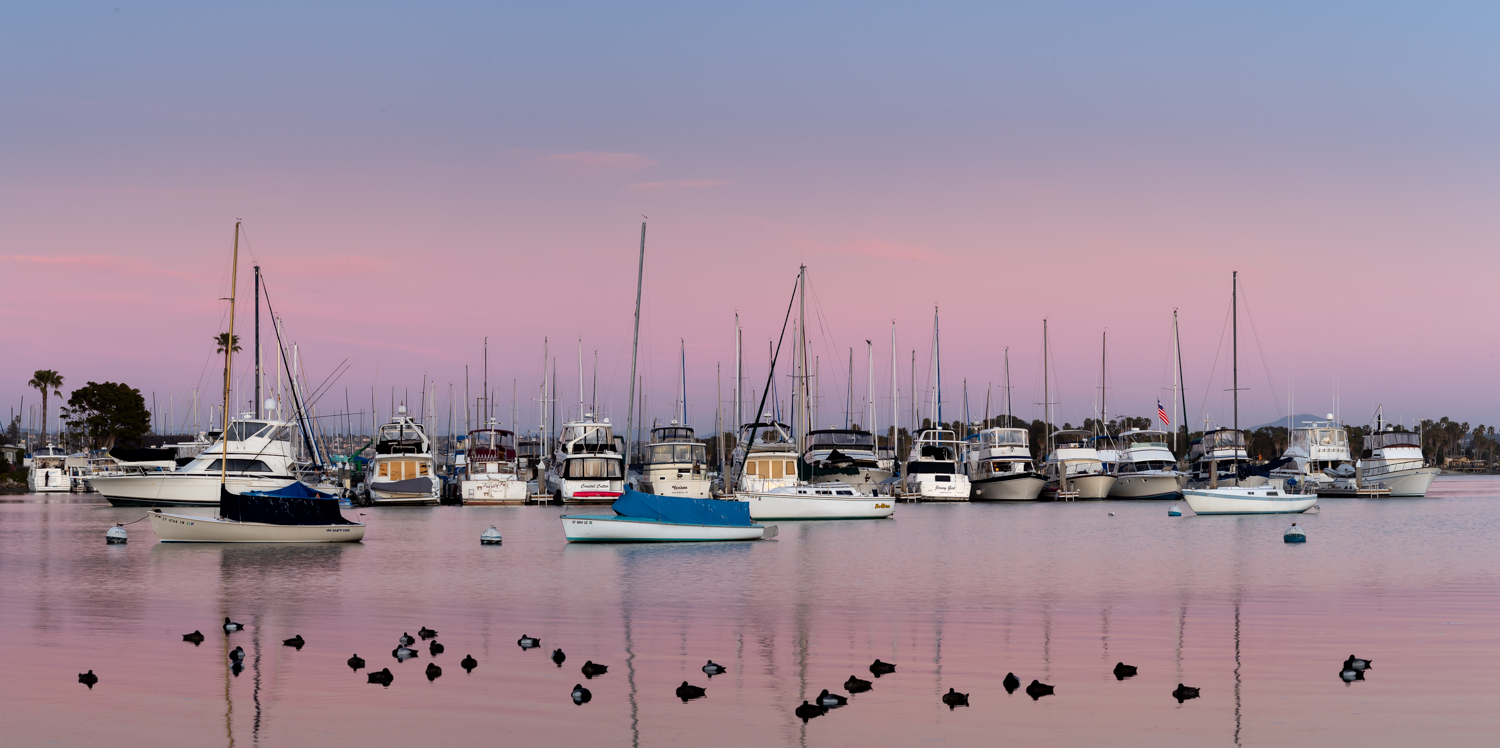
Leica M10-P, Voightlander 75mm f/1.5 Nockton II, F/11, 1/8 sec, ISO 200, AWB 2 frame Panorama from Tripod
Three weeks in now. I have learned so much from working this project and the comments and suggestions posted here. So far my purchase of the Leica M10-P is proving to be everything I hoped it would be. I am comfortable now with focusing through the Range Finder, or setting up the camera for appropriately estimated Zone Focusing.
To day was a brilliant sunny day here in La Jolla. The kind that the Chamber of Commerce like to brag about. In the afternoon some thin high clouds formed to the South and East. These often light up for sunsets. But they never made it out to the West. So, I thought I would try to find a nice sunset scene to shoot facing East. The logical place seemed to me to go down to the West side of Mission Bay, and find an interesting composition looking East. I found this spot looking across the small boat anchorage toward Mission Bay Yacht Club. I can actually see this place looking down from my back yard up on Mt Soledad. But I had never in my life tried to make an image here. About time I did that. Plus I haven't done a landscape in this thread for a while.
In the end, the clouds mostly faded away. But we did get a nice soft pastel sunset to the East. There was a nice flock of migratory Ducks which had settled down for the night. I decided to shoot with the Voigtlander 75mm f/1.5 Nokton in order to compress the layers in the scene into the colorful sky. Once again the colors rendered by this lens camera combination required almost no work. The image comes out so smooth. Sharp without being crunchy, colors vibrant while staying subtle, not garish.
Typical for low light landscapes I shot this mounted on a tripod, using Live View, at base ISO 200, at F/11 for DOF, and set final exposure using shutter speed. This image is a two horizontal frames panorama stitched together in Light Room. Plenty of resolution to print large.
I hope everyone enjoys the image as much as I did taking it. It was a serene a beautiful evening down on the water.
-Steve0
Leica M10-P, Voightlander 75mm f/1.5 Nockton II, F/11, 1/8 sec, ISO 200, AWB 2 frame Panorama from Tripod
Mar 12, 2022 at 10:27 PM