This topic is in the 2021 archive. You can read it and like its posts here. It is read only.
Archive 2021"Official" Z9 information repository
p.6 #1"Official" Z9 information repository
Do we think group AF has been replaced by wide area small now. I was surprised group was gone. Do we have any reasons for that.
Nov 16, 2021 at 10:39 PM
p.6 #2"Official" Z9 information repository
Wide area modes are not a replacement for group AF. Ricci mentioned future firmware update will add a new AF mode that will replicate the group AF mode. Not sure if they'll exactly port it from there DSLR version or if it will be something similar.
Pixel Perfect wrote:
Do we think group AF has been replaced by wide area small now. I was surprised group was gone. Do we have any reasons for that.
Pixel Perfect wrote:
Do we think group AF has been replaced by wide area small now. I was surprised group was gone. Do we have any reasons for that.
Nov 16, 2021 at 11:10 PM
p.6 #3"Official" Z9 information repository
gannis wrote:
Wide area modes are not a replacement for group AF. Ricci mentioned future firmware update will add a new AF mode that will replicate the group AF mode. Not sure if they'll exactly port it from there DSLR version or if it will be something similar.
Oh well that would be nice. I was wondering if they had changed dynamic's behaviour so say dynamic small would behave more like group.
Wide area modes are not a replacement for group AF. Ricci mentioned future firmware update will add a new AF mode that will replicate the group AF mode. Not sure if they'll exactly port it from there DSLR version or if it will be something similar.
Pixel Perfect wrote
Do we think group AF has been replaced by wide area small now. I was surprised group was gone. Do we have any reasons for that.Oh well that would be nice. I was wondering if they had changed dynamic's behaviour so say dynamic small would behave more like group.
Nov 17, 2021 at 01:36 AM
p.6 #4"Official" Z9 information repository
I dont think they have changed the Dynamic modes. Even on the Z6/7 series, the dynamic modes work similar to DSLRs and the wide AF modes were supposed to work based on closest subject priority but i guess there were some differences compared to Group...Ricci was saying the new firmware will add an option similar to the Group AF modes on the D6 that lets you customize the AF box size..
Pixel Perfect wrote:
Oh well that would be nice. I was wondering if they had changed dynamic's behaviour so say dynamic small would behave more like group.
Pixel Perfect wrote:
gannis wrote
Wide area modes are not a replacement for group AF. Ricci mentioned future firmware update will add a new AF mode that will replicate the group AF mode. Not sure if they'll exactly port it from there DSLR version or if it will be something similar.Pixel Perfect wrote
Do we think group AF has been replaced by wide area small now. I was surprised group was gone. Do we have any reasons for that.Nov 17, 2021 at 01:41 AM
p.6 #5"Official" Z9 information repository
Lance B wrote:
Did Nikon say this?
Here’s the article Lance, from back in March . "A flagship Nikon Z series mirrorless camera can be expected within the year”
https://www.dpreview.com/interviews/9636338352/interview-nikon-a-flagship-nikon-z-series-mirrorless-camera-can-be-expected-within-the-year
Inviewer question to Nikon exec: "How far away is a mirrorless equivalent to the D6?"
Nikon executive response: "A flagship Nikon Z-series mirrorless camera can be expected within the year, and is being developed with the goal of surpassing the D6. It will respond to the advanced needs of professionals. The upcoming model will debut a newly developed high-resolution stacked CMOS sensor. While this camera will be a major technological leap for still photographers of a wide variety of genres, our engineers are considering powerful video features such as 8K that respond to the needs of all kinds of content creators and professionals.”
And now, the Z9 is imminent! 
RKnecht wrote
I don't care what Nikon says, this is NOT a D5/D6 replacement.Here’s the article Lance, from back in March
. "A flagship Nikon Z series mirrorless camera can be expected within the year”https://www.dpreview.com/interviews/9636338352/interview-nikon-a-flagship-nikon-z-series-mirrorless-camera-can-be-expected-within-the-year
Inviewer question to Nikon exec: "How far away is a mirrorless equivalent to the D6?"
Nikon executive response: "A flagship Nikon Z-series mirrorless camera can be expected within the year, and is being developed with the goal of surpassing the D6. It will respond to the advanced needs of professionals. The upcoming model will debut a newly developed high-resolution stacked CMOS sensor. While this camera will be a major technological leap for still photographers of a wide variety of genres, our engineers are considering powerful video features such as 8K that respond to the needs of all kinds of content creators and professionals.”
And now, the Z9 is imminent!
Nov 17, 2021 at 05:53 AM
p.6 #6"Official" Z9 information repository
BIF and BEAF using adapted lenses by Matt Granger..The EVF looks fluid though.
Nov 17, 2021 at 08:05 AM
p.6 #7"Official" Z9 information repository
gannis wrote:
BIF and BEAF using adapted lenses by Matt Granger..The EVF looks fluid though.
Matt calling himself intermediate bird photographer may have been a bit generous looking at those tracking skills (or lack there of)
My takeaways from that video....for perched birds it is behaving very similar to A1/R5. Best when bird presents its eye to you, can get confused with spots.
Not sure about BIF....on A1/R5 the better the photographer is at providing a stable image to the AF sensor, the better tracking and potential BEAF activation works. Matt doesn't do a great job at that so who knows how it is with someone that is actually competent in keeping a bird relatively stable in the frame.
I downloaded the RAW/Jpegs and it was funny as I think Matt included one RAW he didn't intend to. All the other RAW/jpeg pairs match but one kite image is totally OOF with wing cut off in the RAW yet the jpeg is in focus and wing is present.
It is great Matt was having confidence in the adapted lenses even with TCs. Enough so that he is ordering a 500PF and maybe a big fast prime...all in F-mount.
Nov 17, 2021 at 10:03 AM
p.6 #8"Official" Z9 information repository
Matt would shoot much better if the birds were nude
Nov 17, 2021 at 10:13 AM
p.6 #9"Official" Z9 information repository
He has used Auto area AF for BIF shots :-( Wish he used 3D tracking instead...there are lot of variables in question including the black kite which itself is a tough target for BEAF as the bird is dark with dark and not so prominent eyes..
What is interesting though is there are couple of shots with ISO 5600 and ISO 4500 and these files are very much like the D850 maybe slightly nicer noise pattern and not much color cast.
arbitrage wrote:
Matt calling himself intermediate bird photographer may have been a bit generous looking at those tracking skills (or lack there of)
My takeaways from that video....for perched birds it is behaving very similar to A1/R5. Best when bird presents its eye to you, can get confused with spots.
Not sure about BIF....on A1/R5 the better the photographer is at providing a stable image to the AF sensor, the better tracking and potential BEAF activation works. Matt doesn't do a great job at that so who knows how it is with someone that is actually competent in keeping a bird relatively stable in...Show more →
What is interesting though is there are couple of shots with ISO 5600 and ISO 4500 and these files are very much like the D850 maybe slightly nicer noise pattern and not much color cast.
arbitrage wrote:
gannis wrote
BIF and BEAF using adapted lenses by Matt Granger..The EVF looks fluid though.My takeaways from that video....for perched birds it is behaving very similar to A1/R5. Best when bird presents its eye to you, can get confused with spots.
Not sure about BIF....on A1/R5 the better the photographer is at providing a stable image to the AF sensor, the better tracking and potential BEAF activation works. Matt doesn't do a great job at that so who knows how it is with someone that is actually competent in keeping a bird relatively stable in...Show more →
Nov 17, 2021 at 10:55 AM
p.6 #10"Official" Z9 information repository
one of those things going by the wayside: camera blimps.
Nov 17, 2021 at 02:39 PM
p.6 #11"Official" Z9 information repository
saaketham wrote:
Matt would shoot much better if the birds were nude

Matt would shoot much better if the birds were nude
Nov 17, 2021 at 04:45 PM
p.6 #12"Official" Z9 information repository
arbitrage wrote:
Matt calling himself intermediate bird photographer may have been a bit generous looking at those tracking skills (or lack there of)
My takeaways from that video....for perched birds it is behaving very similar to A1/R5. Best when bird presents its eye to you, can get confused with spots.
Not sure about BIF....on A1/R5 the better the photographer is at providing a stable image to the AF sensor, the better tracking and potential BEAF activation works. Matt doesn't do a great job at that so who knows how it is with someone that is actually competent in keeping a bird relatively stable in...Show more →
Well Geoff I think most of us are waiting for Steve Perry, yours or speedmaster's reviews
I know you are going to buy one as sure as the sun rises.
gannis wrote
BIF and BEAF using adapted lenses by Matt Granger..The EVF looks fluid though.My takeaways from that video....for perched birds it is behaving very similar to A1/R5. Best when bird presents its eye to you, can get confused with spots.
Not sure about BIF....on A1/R5 the better the photographer is at providing a stable image to the AF sensor, the better tracking and potential BEAF activation works. Matt doesn't do a great job at that so who knows how it is with someone that is actually competent in keeping a bird relatively stable in...Show more →
Well Geoff I think most of us are waiting for Steve Perry, yours or speedmaster's reviews
I know you are going to buy one as sure as the sun rises.
Nov 17, 2021 at 06:30 PM
p.6 #13"Official" Z9 information repository
saaketham wrote:
Matt would shoot much better if the birds were nude
Ain’t that the truth! The butt shots he had in the video were sharp! 🤣
Nov 17, 2021 at 06:53 PM
p.6 #15"Official" Z9 information repository
Some impressive bird eye AF from 1.54 onwards
Nov 18, 2021 at 11:41 PM
p.6 #16"Official" Z9 information repository
Ok, so is there an OLPF on z9, what is the verdict ?
Nov 19, 2021 at 03:57 AM
p.6 #17"Official" Z9 information repository
michal.narozny wrote:
Ok, so is there an OLPF on z9, what is the verdict ?
If you mean an anti-aliasing (AA) filter on the sensor of Z 9, then no there isn't one.
Ricci Talks (From Nikon School UK) and later at 14:52, have mentioned that there is no AA filter, the dual coating is just to reduce dust from sticking onto the sensor itself.
Nov 19, 2021 at 05:06 AM
p.6 #18"Official" Z9 information repository
What makes me not so sure about lack od AA filter is this file:
https://www.nikon-asia.com/en_Asia/learn_and_explore/brochures
There is the anti dust coatings (2 of them) but also an optical filter shown (no mention of its tyle).
https://www.nikon-asia.com/en_Asia/learn_and_explore/brochures
There is the anti dust coatings (2 of them) but also an optical filter shown (no mention of its tyle).
Nov 19, 2021 at 05:42 AM
p.6 #19"Official" Z9 information repository
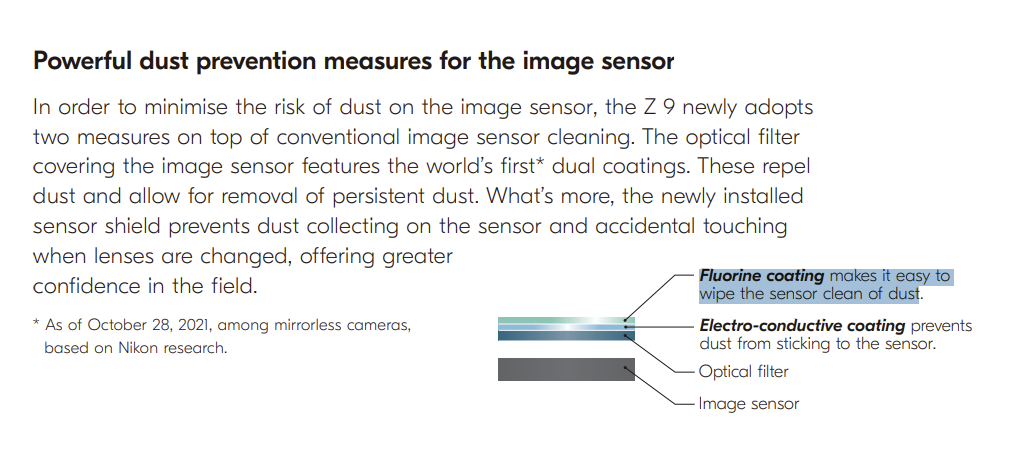
the verdict is simple there is no AA filter installed over the sensor. there is a 3 layer layer setup:
1- protective optical filter like every sensor has. NOT to be confused with an AA filter (if it was using a AA filter it would state it)
2- Electro-conductive coating prevents dust from sticking to the sensor
3- Fluorine coating makes it easy to wipe the sensor clean of dust
some things are just that simple.
1 is a simple protective optic to support the use of 2 and 3 and to keep our fingers out of access to the actual sensor. remember this no longer has a shutter
Edited on Nov 19, 2021 at 06:48 AM · View previous versions
1- protective optical filter like every sensor has. NOT to be confused with an AA filter (if it was using a AA filter it would state it)
2- Electro-conductive coating prevents dust from sticking to the sensor
3- Fluorine coating makes it easy to wipe the sensor clean of dust
some things are just that simple.
1 is a simple protective optic to support the use of 2 and 3 and to keep our fingers out of access to the actual sensor. remember this no longer has a shutter
Edited on Nov 19, 2021 at 06:48 AM · View previous versions
Nov 19, 2021 at 06:08 AM
p.6 #20"Official" Z9 information repository
michal.narozny wrote:
What makes me not so sure about lack od AA filter is this file:
https://www.nikon-asia.com/en_Asia/learn_and_explore/brochures
There is the anti dust coatings (2 of them) but also an optical filter shown (no mention of its tyle).
I can't remember where I read it but that optical filter is to filter out IR and UV (iirc most camera have nowadays). That's why there are people who do IR/UV filter to a clear filter conversion for Astrophotography called full spectrum camera conversion.
Nov 19, 2021 at 06:09 AM