This topic is in the 2021 archive. You can read it and like its posts here. It is read only.
Archive 2021Summicron-M 28mm ASPH v1 and v2
p.1 #1Summicron-M 28mm ASPH v1 and v2
In the Voigtlander 28mm f/2 Ultron II VM thread a number of references have been made to v1 of the Summicron-M 28mm ASPH, with the implication that there is a later v2 of this lens. However, the Leica Camera Wiki contains only a single entry for the Summicron-M 28mm f/2 ASPH (11604-black, 11661-silver, Production era: 2000-Current):
https://www.l-camera-forum.com/leica-wiki.en/index.php/28mm_f/2_ASPH_Summicron-M
The wiki is not always entirely accurate and, assuming that there are two versions, I’d be grateful if anyone could explain how to distinguish between them.
https://www.l-camera-forum.com/leica-wiki.en/index.php/28mm_f/2_ASPH_Summicron-M
The wiki is not always entirely accurate and, assuming that there are two versions, I’d be grateful if anyone could explain how to distinguish between them.
Oct 25, 2021 at 03:09 PM
p.1 #2Summicron-M 28mm ASPH v1 and v2
There are definitely two versions. The latest (v2) is known to have improved corner performance. Personally I have never tried either version.
Here is some info:
"What drew me to the 2nd version of the Leica 28mm f/2 Summicron ASPH was its beautiful metal hood design, similar to its other modern M-lens brethren, and its improved optics for higher resolution sensors. Now, I’m perfectly comfortable shooting 24MP digital cameras (M240, SL, Q, etc.), but it’s reassuring to know that if I were to upgrade to an SL2 or M10-R (supposedly in the works), that my favorite manual focus M-lenses can support the higher resolution sensors."
https://silaschu.com/blog/2020/4/23/quick-look-the-leica-28mm-f2-summicron-asph-v2
https://www.slack.co.uk/leica-m-resolution.html
Oct 25, 2021 at 07:39 PM
p.1 #3Summicron-M 28mm ASPH v1 and v2
genji wrote:
In the Voigtlander 28mm f/2 Ultron II VM thread a number of references have been made to v1 of the Summicron-M 28mm ASPH, with the implication that there is a later v2 of this lens. However, the Leica Camera Wiki contains only a single entry for the Summicron-M 28mm f/2 ASPH (11604-black, 11661-silver, Production era: 2000-Current):
https://www.l-camera-forum.com/leica-wiki.en/index.php/28mm_f/2_ASPH_Summicron-M
The wiki is not always entirely accurate and, assuming that there are two versions, I’d be grateful if anyone could explain how to distinguish between them.
The first version of Summicron-M 28 was introduced in year 2000 for the film Leica Ms. While it works well with later digital M bodies, it doesn't perform well on mirrorless bodies including Leica SL. I think that Leica made some small changes in the original optical formula and produced the second version, which works well with SL/SL2S. If you are only using rangefinder M bodies, as you do, the improvement of the second version is rather small. I am very happy with the first version on my M9/MM/M240 and I don't intend to use wide angle M lenses on SL/A7/Z7.
Jono Slack compared both Summicro-M 28 here: http://www.slack.co.uk/leica-m-resolution.html.
Oct 25, 2021 at 07:52 PM
p.1 #4Summicron-M 28mm ASPH v1 and v2
The 28 and 35mm Summicrons and 28mm Elmarit were tweaked a few years ago. I know the 35mm's diaphragm was upgraded from 8 to 12(?) blades. I seem to recall a mention of improved field curvature characteristic being improved on the 28s.
Oct 25, 2021 at 08:07 PM
p.1 #5Summicron-M 28mm ASPH v1 and v2
genji wrote:
In the Voigtlander 28mm f/2 Ultron II VM thread a number of references have been made to v1 of the Summicron-M 28mm ASPH, with the implication that there is a later v2 of this lens. However, the Leica Camera Wiki contains only a single entry for the Summicron-M 28mm f/2 ASPH (11604-black, 11661-silver, Production era: 2000-Current):
https://www.l-camera-forum.com/leica-wiki.en/index.php/28mm_f/2_ASPH_Summicron-M
The wiki is not always entirely accurate and, assuming that there are two versions, I’d be grateful if anyone could explain how to distinguish between them.
The biggest indicator externally would be the huge plastic hood on the previous version and the more streamlined metal one for the newer version. The 28 Elmarit and 35 cron ASPH v1 are similar in that their (smaller) plastic hoods were replaced by a streamlined metal one, but the metal hoods for those 2 lenses effectively made those 2 lenses larger (as opposed to the 28 cron). The 35lux pre-FLE hood does fit the old 28Cron, so "huge plastic hood" is not conclusive but indicative.
The Safari 28 Cron v2 has a built-in hood. I think there is a rumoured 28mm Cron v2 "Reporter" that has a built-in hood too. The first 28 Cron with a built-in hood was the one in the Lenny Kravitz "Drifter" special edition. I am not sure if this is indicative that Leica will move to built-in hoods for the 28 Cron v2 in the near future (I am all for it, but I feel the current hood offers more protection and is more user-replaceable). If the M10 Zagato 35lux FLE is anything to go by (the only 35lux with a built-in hood and AFAIK the first Leica lens under 50mm to have a built-in hood), having limited editions with built-in hoods do not necessarily translate to a newer standard model having one later on (it's been over 3 years since the Zagato and no sign of a 35lux FLE refresh)
I guess another thing to look at might be model number (11604 vs 11672), and serial numbers -> the earlier version probably stops around 42XXXXX whilst the v2 ones are probably 45XXXXX and up (IIRC mine is from 2018 and numbered 47XXXXX). I never really kept track of when the serial numbers started running from for the v2 model.
Some older 28mm Crons are not 6-bit coded. These tend to be 39XXXXX models and maybe early 40XXXXX ones (i.e. lenses pre 2006 before the M8 came out)
Then there's the difference in optics, but I guess that's hard to tell at first glance looking at the lens.
Edited on Oct 25, 2021 at 10:34 PM · View previous versions
Oct 25, 2021 at 10:15 PM
p.1 #6Summicron-M 28mm ASPH v1 and v2
Fred Miranda wrote:
There are definitely two versions. The latest (v2) is known to have improved corner performance. Personally I have never tried either version.
l
I had both. I bought the V1 when it first appeared, used it for years and was more than happy with it.
As I do not shoot landscapes wide-open, I hardly noticed the weakness in the corners.
But one day of winter in Copenhagen where the night comes in the middle of the afternoon, it shot the posted picture. When I printed it in A3+, I noticed that the corners are not perfect. Still displayed it though.
So a few years ago, having GAS, I updated to the current one. It is clearly better but I could live with the V1 if I had too.
Oct 25, 2021 at 10:33 PM
p.1 #7Summicron-M 28mm ASPH v1 and v2
I found a decent deal on a used EX+ Leica 28/2.8 Elmarit-M version IV (pre-ASPH) lens earlier this year. I started looking at price ranges between different kind of Leica 28 mm f/2.8 and also f/2.0 lenses. Using the CV 28/2.0 version I and this Elmarit lens in parallel for months now, I see no reason to pay the significant uptick charge for the 28 mm Summicron. For film with limited ISO, yes, one stop of light can make a difference in dim light or indoors. But with digital and more modern M cameras, the ISO can be tweaked easily making up for this one stop.
Regarding depth of field, I see a bigger difference between f/2.0 and slower lens speeds for closer focus wide/ultrawide at 21 mm focal length and then again at 50 mm and above, but less so in the 28 to 35 mm range.
Regarding depth of field, I see a bigger difference between f/2.0 and slower lens speeds for closer focus wide/ultrawide at 21 mm focal length and then again at 50 mm and above, but less so in the 28 to 35 mm range.
Oct 26, 2021 at 05:17 AM
p.1 #8Summicron-M 28mm ASPH v1 and v2
retrofocus wrote:
Using the CV 28/2.0 version I and this Elmarit lens in parallel for months now, I see no reason to pay the significant uptick charge for the 28 mm Summicron.
I see no reason to buy the Leica when one as the Voigt and vice-versa. We spend our money the way we want and you chose to spend your buying 2 28mm lenses.
What you are doing is called rationalization: you find a way to justify your choices and feel the need to do so in a thread about lenses you never tried and have nothing to say about.
retrofocus wrote:
Regarding depth of field, I see a bigger difference between f/2.0 and slower lens speeds for closer focus wide/ultrawide at 21 mm focal length and then again at 50 mm and above, but less so in the 28 to 35 mm range.
You should consult. Or read a book about optics.
Oct 26, 2021 at 05:30 AM
p.1 #9Summicron-M 28mm ASPH v1 and v2
Many thanks to all who have responded to my post and cleared up my confusion. Jono Slack mentions Sean Reid’s comparative review of the two versions and, since I’ve long been a subscriber to Reid Reviews, I realise that I could have checked there first. He makes essentially the same points about the two lenses that have been made in various posts in this thread:
* The two versions have different part numbers 11604 (v1) and 11672 (v2) and I see that eBay sellers frequently include the part number in their listings. So much for the Leica Wiki.
* The v2 has greater contrast and better corner performance (even on M bodies) than the v1.
* The v2 lens has been redesigned for digital sensors and with a view to performance on higher resolution sensors.
I personally don’t regard greater contrast as a strong selling point since Australian sunlight can be extremely harsh, nor am I fanatical about sharpness. But, on the other hand, I do intend to purchase a higher resolution M camera within the next three to six months, which might make the v2 more appealing.
In the meantime, the Australian CV distributor has an Ultron VM 28/2 II that I can try out. I’d previously dismissed this lens solely on the grounds that it wasn’t the APO-Lanthar 28/2 that I’d been hoping for but Fred’s review of the Ultron II is so favourable that I realised it’s worth trying.
Something that counts against the Ultron II for my use is a characteristic that has garnered overwhelming favour from reviewers and owners, namely its tiny size. Just as lenses can be too large (the Nokton 50/1.2 and 7Artisans 28/1.4 are both terrific lenses but their size discourages me from using them), they can also be too small. I fear that the Ultron II may fall into that category. Like @retrofocus I have an Elmarit-M 28/2.8 v4 which is the perfect size for me. I’m only considering the Summicron-M 28 because its rendering might be more pleasing than that of the Elmarit-M 28 I already own. Alternatively I could be content with the Elmarit, which I like very much, and wait patiently for CV to announce a 28mm APO-Lanthar.
Oct 26, 2021 at 06:00 AM
p.1 #10Summicron-M 28mm ASPH v1 and v2
Summicron-M 28/2 v1 and Elmarit-M 28/2.8 v4 have the same size but the Summicron weighs a bit more.
Oct 26, 2021 at 07:22 AM
p.1 #11Summicron-M 28mm ASPH v1 and v2
pmeheut wrote:
lI had both. I bought the V1 when it first appeared, used it for years and was more than happy with it.
As I do not shoot landscapes wide-open, I hardly noticed the weakness in the corners.
But one day of winter in Copenhagen where the night comes in the middle of the afternoon, it shot the posted picture. When I printed it in A3+, I noticed that the corners are not perfect. Still displayed it though.
So a few years ago, having GAS, I updated to the current one. It is clearly better but I could live with the V1 if I...Show more →
I could not find it but I remember you've posted a few comparisons between the two versions on the board. (showing building windows)
It showed how well the v2 performed off-axis. I think you compared to the Voigtlander 28/2 Ultron (v1) as well.
Fred Miranda wrote
There are definitely two versions. The latest (v2) is known to have improved corner performance. Personally I have never tried either version.l
As I do not shoot landscapes wide-open, I hardly noticed the weakness in the corners.
But one day of winter in Copenhagen where the night comes in the middle of the afternoon, it shot the posted picture. When I printed it in A3+, I noticed that the corners are not perfect. Still displayed it though.
So a few years ago, having GAS, I updated to the current one. It is clearly better but I could live with the V1 if I...Show more →
I could not find it but I remember you've posted a few comparisons between the two versions on the board. (showing building windows)
It showed how well the v2 performed off-axis. I think you compared to the Voigtlander 28/2 Ultron (v1) as well.
Oct 26, 2021 at 09:37 AM
p.1 #12Summicron-M 28mm ASPH v1 and v2
I remember that too, but think it was 28 Cron (not sure the version) vs. Ultron v1.
genji wrote:
I’m only considering the Summicron-M 28 because its rendering might be more pleasing than that of the Elmarit-M 28 I already own. Alternatively I could be content with the Elmarit, which I like very much, and wait patiently for CV to announce a 28mm APO-Lanthar.
Rendering is what sold me on the 28 Cron back around 9 years ago. I now have the 28 Lux but think the Cron looked smoother. Unfortunately I have no experience with 28 Elmarits of any version for comparison.
The Cron v1 has field curvature that bends towards infinity at the image edges (away from the camera). I generally found that by f/5.6 it was no longer noticeable due to DoF. But it bothered me sufficiently for wider aperture work where I wanted better flatness of field and briefly owned the Cron v2. But I had bad luck with my v2 early production copies exhibiting field curvature in the opposite direction (towards the camera) that became stronger as the lens was stopped down. That was in 2016 early in the v2 production run. Based on feedback from more recent owners, most v2 copies seem to be very flat field. But I didn't have the patience to deal with it at the time and ended up with the Lux instead. Now I'm tempted by the Ultron v2 because it's quite compact and will be very curious about your findings with it - both images and handling. Based on photos from it by Fred and others however, I'm not sure I like its background rendering characteristics at middle distances where it seems to have some swirly-ness. IIRC, it also has quite strong vignetting. This was also true of the Cron v1 but the Ultron might be stronger (but may also be a factor of the M9's ancient sensor design due to less light making its way into the peripheral pixel wells compared to the M240's shallow pixel well sensor design).
A couple other Cron v1 nitpicks (but not annoying enough to make me stop using it): it had a slightly different color signature from most other Leica-made lenses I owned alongside it. It had a slight magenta bias and was sufficiently different from mainstays such as the 50 Lux ASPH and 21 SEM that it was somewhat irritating, at least for me, and required separate WB tweaks. It also had persistently cyan/green color shift in the very corners of the image, even with 6-bit coding enabled in-camera (M9 and M240). This was mostly noticeable in very monochromatic images, such as snow, concrete, neutral surfaces, etc. Its vignetting character was nicer on the M9 than the M240, which made me wonder what Leica did to its M240 correction profile.
Oct 26, 2021 at 08:54 PM
p.1 #13Summicron-M 28mm ASPH v1 and v2
I’ll be candid—I don’t have high hopes regarding the Ultron 28/2 v2. It’s not just that I don’t like tiny lenses, it also appears that the desire to make it small has necessitated some optical compromises such as the vignetting and rendering issues you mention. Whereas the Cron 28’s lovely rendering at and near wide open is consistently remarked upon by its owners. So I’ll give the Ultron v2 a try but the Cron v2’s siren call is becoming so strong and sweet that I may not be able to resist.
Oct 27, 2021 at 04:54 AM
p.1 #14Summicron-M 28mm ASPH v1 and v2
genji wrote:
I’ll be candid—I don’t have high hopes regarding the Ultron 28/2 v2. It’s not just that I don’t like tiny lenses, it also appears that the desire to make it small has necessitated some optical compromises such as the vignetting and rendering issues you mention. Whereas the Cron 28’s lovely rendering at and near wide open is consistently remarked upon by its owners. So I’ll give the Ultron v2 a try but the Cron v2’s siren call is becoming so strong and sweet that I may not be able to resist.
I am quite happy with my Voigtander 28mm Ultron II Asph VM lens that I use on my Kolari UT sensor modified A7rII even with its vignetting (which is easy to correct in LR). I generally use the LR profile for the Leica M 28mm f2 Asph lens for my processing. It is one of my main lenses that I use for landscape work and I carry pretty much all of the time in my main kit. I am so happy that I retired and sold both my Leica R 28mm f2.8 Elmarit V2 and my Minolta CLE MC 28mm f2.8 M-Rokkor that I used on my stock A7rIII and my Kolari UT sensor modified A7rII.
Rich
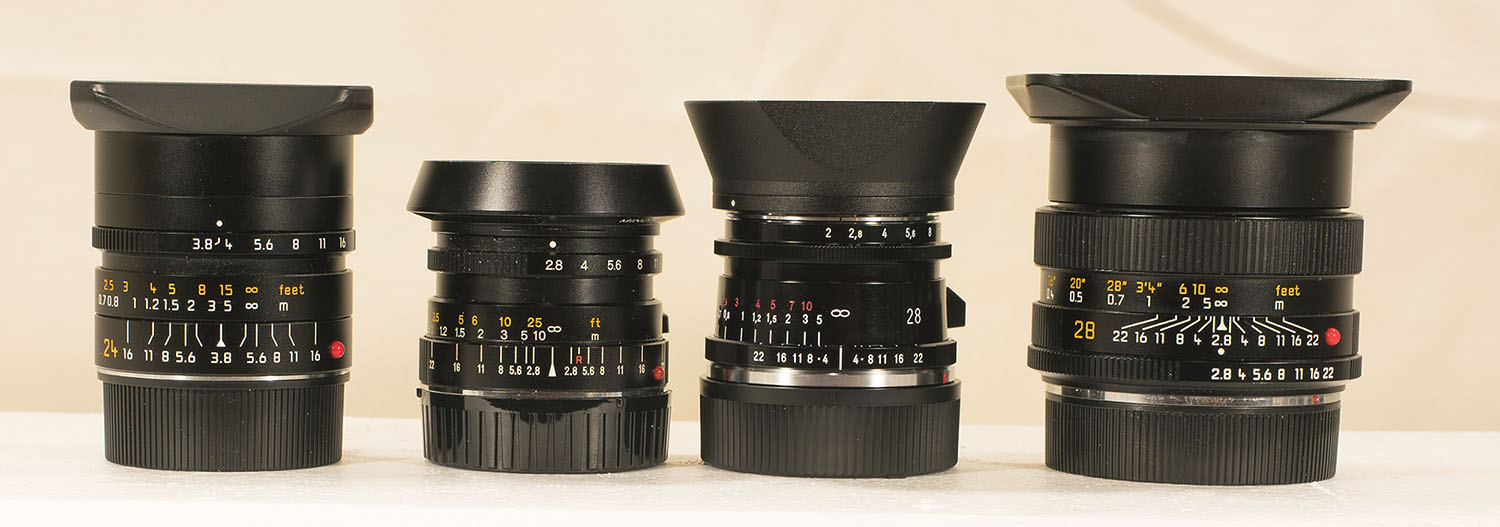
Here is a size Comparison- Leica M 24mm f3.8 Elmar Asph to the left, Minolta CLE MC 28mm f2.8 M-Rokkor, Voigtlander 28mm f2 Ultron II Asph, and Leica R 28mm f2.8 Elmarit V2
I’ll be candid—I don’t have high hopes regarding the Ultron 28/2 v2. It’s not just that I don’t like tiny lenses, it also appears that the desire to make it small has necessitated some optical compromises such as the vignetting and rendering issues you mention. Whereas the Cron 28’s lovely rendering at and near wide open is consistently remarked upon by its owners. So I’ll give the Ultron v2 a try but the Cron v2’s siren call is becoming so strong and sweet that I may not be able to resist.
I am quite happy with my Voigtander 28mm Ultron II Asph VM lens that I use on my Kolari UT sensor modified A7rII even with its vignetting (which is easy to correct in LR). I generally use the LR profile for the Leica M 28mm f2 Asph lens for my processing. It is one of my main lenses that I use for landscape work and I carry pretty much all of the time in my main kit. I am so happy that I retired and sold both my Leica R 28mm f2.8 Elmarit V2 and my Minolta CLE MC 28mm f2.8 M-Rokkor that I used on my stock A7rIII and my Kolari UT sensor modified A7rII.
Rich
Here is a size Comparison- Leica M 24mm f3.8 Elmar Asph to the left, Minolta CLE MC 28mm f2.8 M-Rokkor, Voigtlander 28mm f2 Ultron II Asph, and Leica R 28mm f2.8 Elmarit V2
Oct 27, 2021 at 05:16 AM
p.1 #15Summicron-M 28mm ASPH v1 and v2
naturephoto1 wrote:
I am quite happy with my Voigtander 28mm Ultron II Asph VM lens that I use on my Kolari UT sensor modified A7rII even with its vignetting (which is easy to correct in LR). I generally use the LR profile for the Leica M 28mm f2 Asph lens for my processing. It is one of my main lenses that I use for landscape work and I carry pretty much all of the time in my main kit. I am so happy that I retired and sold both my Leica R 28mm f2.8 Elmarit V2 and my Minolta CLE MC 28mm...Show more →
Great collection of wide lenses! I was always curious about the Leica 24 mm M-lenses but never found actual need for this focal length since I either tend to use 28 mm or directly jump to 21 mm instead. But I have used the 24 mm FL intensively with my (D)SLR full-frame cameras.
I recently compared side-by-side my CV 28/2.0 version I with my Leica 28/2.8 version IV M-lenses for landscape photography. Both lenses performed equally well in the mid aperture range. The only difference I found is that the Leica Elmarit lens is a tiny bit wider at the same 28 mm focal length. But it is a marginal difference. Both lenses are also about the same size.
genji wrote
I’ll be candid—I don’t have high hopes regarding the Ultron 28/2 v2. It’s not just that I don’t like tiny lenses, it also appears that the desire to make it small has necessitated some optical compromises such as the vignetting and rendering issues you mention. Whereas the Cron 28’s lovely rendering at and near wide open is consistently remarked upon by its owners. So I’ll give the Ultron v2 a try but the Cron v2’s siren call is becoming so strong and sweet that I may not be able to resist.Great collection of wide lenses! I was always curious about the Leica 24 mm M-lenses but never found actual need for this focal length since I either tend to use 28 mm or directly jump to 21 mm instead. But I have used the 24 mm FL intensively with my (D)SLR full-frame cameras.
I recently compared side-by-side my CV 28/2.0 version I with my Leica 28/2.8 version IV M-lenses for landscape photography. Both lenses performed equally well in the mid aperture range. The only difference I found is that the Leica Elmarit lens is a tiny bit wider at the same 28 mm focal length. But it is a marginal difference. Both lenses are also about the same size.
Oct 27, 2021 at 05:44 AM
p.1 #16Summicron-M 28mm ASPH v1 and v2
Thanks, Rich, your comparison picture is most instructive and confirms my fears regarding the size of the Ultron v2. The Elmar-M 24/3.4 is the same diameter and within a millimetre in length of both the Summicron-M v2 and Elmarit-M v4 28mm lenses, a size that I regard as ideal. The Ultron v2 will have to be stellar in multiple other ways if it’s to overcome this haptic handicap.
Oct 27, 2021 at 02:26 PM
p.1 #17Summicron-M 28mm ASPH v1 and v2
genji wrote:
Thanks, Rich, your comparison picture is most instructive and confirms my fears regarding the size of the Ultron v2. The Elmar-M 24/3.4 is the same diameter and within a millimetre in length of both the Summicron-M v2 and Elmarit-M v4 28mm lenses, a size that I regard as ideal. The Ultron v2 will have to be stellar in multiple other ways if it’s to overcome this haptic handicap.
If it is any consolation, the Voigtlander Ultron II is extremely well made, focus is extremely smooth and aperture adjustment are very close to my Leica lenses and has real heft considering its size; the lens feels great in the hands, balances extremely well on my cameras, and the finger tab is made out of metal that is very solid, even more so than my Leica WA lenses and just feels great. I found that the lens is quite sharp and even into the corners at distance if not at f2 then certainly by f2.8 or f4. It is an amazing lens certainly for the cost (about 1/5 the cost of so of a current new Leica M 28mm f2 Summicron Asph lens). It was sharper than my Leica R 28mm f2.8 Elmarit V2 into the edges and corners.
Also, if you look at the photo, the aperture ring is thinner than the Leica, but it is very close to the same location (distance from the lens mount) as the Leica M 24mm f3.8 Elmar Asph lens.
Rich
Oct 27, 2021 at 02:47 PM
p.1 #18Summicron-M 28mm ASPH v1 and v2
naturephoto1 wrote:
If it is any consolation, the Voigtlander Ultron II is extremely well made, focus is extremely smooth and aperture adjustment are very close to my Leica lenses and has real heft considering its size; the lens feels great in the hands, balances extremely well on my cameras, and the finger tab is made out of metal that is very solid, even more so than my Leica WA lenses and just feels great. I found that the lens is quite sharp and even into the corners at distance if not at f2 then certainly by f2.8 or f4. It is an...Show more →
Thanks for these observations, Rich, but “amazing lens certainly for the cost” with (what I regard as) the flaws of the Ultron v2 isn’t really the amazing that I’m looking for. Whereas an APO-Lanthar 28/2 that’s as good as the 35mm and 50mm APO-Lanthars would be both amazing and amazing for the cost. But even then I’d be inclined to regard an AL28 as a complement to rather than a replacement for a Cron 28 v2.
genji wrote
Thanks, Rich, your comparison picture is most instructive and confirms my fears regarding the size of the Ultron v2. The Elmar-M 24/3.4 is the same diameter and within a millimetre in length of both the Summicron-M v2 and Elmarit-M v4 28mm lenses, a size that I regard as ideal. The Ultron v2 will have to be stellar in multiple other ways if it’s to overcome this haptic handicap.Thanks for these observations, Rich, but “amazing lens certainly for the cost” with (what I regard as) the flaws of the Ultron v2 isn’t really the amazing that I’m looking for. Whereas an APO-Lanthar 28/2 that’s as good as the 35mm and 50mm APO-Lanthars would be both amazing and amazing for the cost. But even then I’d be inclined to regard an AL28 as a complement to rather than a replacement for a Cron 28 v2.
Oct 27, 2021 at 05:29 PM
p.1 #19Summicron-M 28mm ASPH v1 and v2
I’m warming to the Ultron. I’ll pick it up next Tuesday, give it an unprejudiced trial, and report back in this thread.
Oct 28, 2021 at 01:58 AM

p.1 #20Summicron-M 28mm ASPH v1 and v2
genji wrote:
I’m warming to the Ultron. I’ll pick it up next Tuesday, give it an unprejudiced trial, and report back in this thread.
Will be interesting to hear.
I've got the Elmarit 28/2.8 Asph II, and the Ultron catches my eye as I see the images others shoot with it. Simultaneously, I wonder about a Cron. I quite like my Elmarit for its its drawing style, but the haptic does present itself some issues for me that I can't quite seem to "become one" with.
I'm shooting on an M-P 240 (and X-Pro3 or future CL2), so I don't have the quite the same optical concerns as those shooting on FF Sony. Still, will be interesting to hear your take on it, compared to the Cron for both drawing and handling. (And then, there's the prospect of the Q for its 28mm.)
Oct 28, 2021 at 05:22 AM