This topic is in the 2021 archive. You can read it and like its posts here. It is read only.
Archive 2021Pre-order: Voigtlander APO-SKOPAR 90mm f/2.8 VM and F-mount
p.9 #1Pre-order: Voigtlander APO-SKOPAR 90mm f/2.8 VM and F-mount
That lens is on my radar in black.
Oct 17, 2021 at 01:55 PM
p.9 #2Pre-order: Voigtlander APO-SKOPAR 90mm f/2.8 VM and F-mount
Fred Miranda wrote:
[T]he distortion correction for the Sigma 90/2.8 is way less severe and IQ deterioration is minimal even when scrutinizing the edges at pixel level.
With pincushion distortion, wouldn't the effect be more visible at the most stretched, more central areas of the frame than at the edges. Perhaps very sharp detail in the center of the frame could mask that.
Oct 17, 2021 at 02:35 PM
p.9 #3Pre-order: Voigtlander APO-SKOPAR 90mm f/2.8 VM and F-mount
Fred Miranda wrote:
So L-mount shooters never get to see the uncorrected version unless they use different post-processing software apps like DxO PureRAW, RAWDigger, DNG Cleaner, etc..The cynic in me says that was Leica's plan to keep people happy with their zooms and the Q. A "show people the beautiful sausage, not how it's made" approach.The SL APO primes I've tested to date (35, 50, 90) have negligible distortion. I haven't tried the SL 28/2 APO yet though.
The SL 24-90 zoom has baked distortion correction and at 24mm and 90mm it's pretty extreme. Actually at 24mm mechanical vignetting is visible before correction. Clearly a lens designed for software correction.
Leica users are not given the choice to see this. Perhaps it's better not to know.
Lloyd chambers says the SL APO 28 has unlike the others a lot of distortion…but is still excellent after correction.
freaklikeme wrote
Fred Miranda wrote
What I find interesting is that Sony users don't get the baked "distortion" correction in LR but Leica users do.So L-mount shooters never get to see the uncorrected version unless they use different post-processing software apps like DxO PureRAW, RAWDigger, DNG Cleaner, etc..
The SL 24-90 zoom has baked distortion correction and at 24mm and 90mm it's pretty extreme. Actually at 24mm mechanical vignetting is visible before correction. Clearly a lens designed for software correction.
Leica users are not given the choice to see this. Perhaps it's better not to know.
Lloyd chambers says the SL APO 28 has unlike the others a lot of distortion…but is still excellent after correction.
Oct 17, 2021 at 02:41 PM
p.9 #4Pre-order: Voigtlander APO-SKOPAR 90mm f/2.8 VM and F-mount
zugzwang2 wrote:
With pincushion distortion, wouldn't the effect be more visible at the most stretched, more central areas of the frame than at the edges. Perhaps very sharp detail in the center of the frame could mask that.
In the case of the 90/2.8 DG DN, the correction amount is much smaller compared to the 24/2's. Also, with pincushion there is always less 'constrain crop', which means less pixel interpolating.
When checking before/after correction with the 90mm, IQ degradation is hard to detect even at pixel level (100% mag.)
I will post more info when I start the review on it.
Fred Miranda wrote
[T]he distortion correction for the Sigma 90/2.8 is way less severe and IQ deterioration is minimal even when scrutinizing the edges at pixel level.In the case of the 90/2.8 DG DN, the correction amount is much smaller compared to the 24/2's. Also, with pincushion there is always less 'constrain crop', which means less pixel interpolating.
When checking before/after correction with the 90mm, IQ degradation is hard to detect even at pixel level (100% mag.)
I will post more info when I start the review on it.
Oct 17, 2021 at 03:09 PM
p.9 #5Pre-order: Voigtlander APO-SKOPAR 90mm f/2.8 VM and F-mount
DavidBM wrote:
So L-mount shooters never get to see the uncorrected version unless they use different post-processing software apps like DxO PureRAW, RAWDigger, DNG Cleaner, etc..The cynic in me says that was Leica's plan to keep people happy with their zooms and the Q. A "show people the beautiful sausage, not how it's made" approach.The SL APO primes I've tested to date (35, 50, 90) have negligible distortion. I haven't tried the SL 28/2 APO yet though.
The SL 24-90 zoom has baked distortion correction and at 24mm and 90mm it's pretty extreme. Actually at 24mm mechanical vignetting is visible before correction. Clearly a lens designed for software correction.
Leica users are not given the choice to see this. Perhaps it's better not to know.Lloyd chambers says the SL APO 28 has unlike the others a lot of distortion…but is still excellent after correction.
I'm curious to check SL APO 28/2 DNGs to see how bad distortion is. It's negligible for the SL 35/2 APO wide angle.
With the exception of the SL 50/1.4 Lux, it is interesting that Leica SL APO primes are not auto-corrected in post. So, no Built-in Lens profile applied in LR. Not sure about the SL 28/2 APO though.
Update: Found a bunch samples here: https://www.dpreview.com/sample-galleries/8770620153/leica-apo-summicron-sl-28mm-f2-asph-sample-gallery/
Just checked and the SL 28/2 APO is currently the only APO prime to include a "Built-in profile applied" in LR. The SL 50/1.4 Lux also has an automated lens profile but all others primes do not. For this faster prime, the auto-profile mainly corrects for LaCA and does a great job. Distortion is also corrected but it's a mere +6 in LR.
There is a lack of consistency here but it looks like manufactures only include baked lens correction in their RAW files when distortion and/or LaCA exceeds what they consider to be acceptable.
BTW: Barrel distortion for the SL 28/2 APO is not low at around +18 in LR. Of course Leica shooters will never this this as it's auto-corrected in post.
Fred Miranda wrote
freaklikeme wrote
Fred Miranda wrote
What I find interesting is that Sony users don't get the baked "distortion" correction in LR but Leica users do.So L-mount shooters never get to see the uncorrected version unless they use different post-processing software apps like DxO PureRAW, RAWDigger, DNG Cleaner, etc..
The SL 24-90 zoom has baked distortion correction and at 24mm and 90mm it's pretty extreme. Actually at 24mm mechanical vignetting is visible before correction. Clearly a lens designed for software correction.
Leica users are not given the choice to see this. Perhaps it's better not to know.
I'm curious to check SL APO 28/2 DNGs to see how bad distortion is. It's negligible for the SL 35/2 APO wide angle.
With the exception of the SL 50/1.4 Lux, it is interesting that Leica SL APO primes are not auto-corrected in post. So, no Built-in Lens profile applied in LR. Not sure about the SL 28/2 APO though.
Update: Found a bunch samples here: https://www.dpreview.com/sample-galleries/8770620153/leica-apo-summicron-sl-28mm-f2-asph-sample-gallery/
Just checked and the SL 28/2 APO is currently the only APO prime to include a "Built-in profile applied" in LR. The SL 50/1.4 Lux also has an automated lens profile but all others primes do not. For this faster prime, the auto-profile mainly corrects for LaCA and does a great job. Distortion is also corrected but it's a mere +6 in LR.
There is a lack of consistency here but it looks like manufactures only include baked lens correction in their RAW files when distortion and/or LaCA exceeds what they consider to be acceptable.
BTW: Barrel distortion for the SL 28/2 APO is not low at around +18 in LR. Of course Leica shooters will never this this as it's auto-corrected in post.
Oct 17, 2021 at 03:13 PM
p.9 #6Pre-order: Voigtlander APO-SKOPAR 90mm f/2.8 VM and F-mount
Fred Miranda wrote:
So L-mount shooters never get to see the uncorrected version unless they use different post-processing software apps like DxO PureRAW, RAWDigger, DNG Cleaner, etc..The cynic in me says that was Leica's plan to keep people happy with their zooms and the Q. A "show people the beautiful sausage, not how it's made" approach.The SL APO primes I've tested to date (35, 50, 90) have negligible distortion. I haven't tried the SL 28/2 APO yet though.
The SL 24-90 zoom has baked distortion correction and at 24mm and 90mm it's pretty extreme. Actually at 24mm mechanical vignetting is visible before correction. Clearly a lens designed for software correction.
Leica users are not given the choice to see this. Perhaps it's better not to know.Lloyd chambers says the SL APO 28 has unlike the others a lot of distortion…but is still excellent after correction.I'm curious to check SL APO 28/2 DNGs to see how bad distortion is. It's negligible for the SL 35/2 APO wide angle.
With the exception of the SL 50/1.4 Lux, it is interesting that Leica SL APO primes are not auto-corrected in post. So, no Built-in Lens profile applied in LR. Not sure about the SL 28/2 APO though.
Update: Found a bunch samples here: https://www.dpreview.com/sample-galleries/8770620153/leica-apo-summicron-sl-28mm-f2-asph-sample-gallery/
Just checked and the SL 28/2 APO is currently the only APO prime to include a "Built-in profile applied" in LR. The SL 50/1.4 Lux also has an automated lens profile but all others primes...Show more →
Fred, I saw on Lloyd Chambers’ blog that he thought the veiling flare on the otherwise superb 35 and 50 APO-Summicrons was so bad that they should be recalled. Is that your experience with the 35?
DavidBM wrote
Fred Miranda wrote
freaklikeme wrote
Fred Miranda wrote
What I find interesting is that Sony users don't get the baked "distortion" correction in LR but Leica users do.So L-mount shooters never get to see the uncorrected version unless they use different post-processing software apps like DxO PureRAW, RAWDigger, DNG Cleaner, etc..
The SL 24-90 zoom has baked distortion correction and at 24mm and 90mm it's pretty extreme. Actually at 24mm mechanical vignetting is visible before correction. Clearly a lens designed for software correction.
Leica users are not given the choice to see this. Perhaps it's better not to know.
With the exception of the SL 50/1.4 Lux, it is interesting that Leica SL APO primes are not auto-corrected in post. So, no Built-in Lens profile applied in LR. Not sure about the SL 28/2 APO though.
Update: Found a bunch samples here: https://www.dpreview.com/sample-galleries/8770620153/leica-apo-summicron-sl-28mm-f2-asph-sample-gallery/
Just checked and the SL 28/2 APO is currently the only APO prime to include a "Built-in profile applied" in LR. The SL 50/1.4 Lux also has an automated lens profile but all others primes...Show more →
Fred, I saw on Lloyd Chambers’ blog that he thought the veiling flare on the otherwise superb 35 and 50 APO-Summicrons was so bad that they should be recalled. Is that your experience with the 35?
Oct 17, 2021 at 06:47 PM
p.9 #7Pre-order: Voigtlander APO-SKOPAR 90mm f/2.8 VM and F-mount
genji wrote:
So L-mount shooters never get to see the uncorrected version unless they use different post-processing software apps like DxO PureRAW, RAWDigger, DNG Cleaner, etc..The cynic in me says that was Leica's plan to keep people happy with their zooms and the Q. A "show people the beautiful sausage, not how it's made" approach.The SL APO primes I've tested to date (35, 50, 90) have negligible distortion. I haven't tried the SL 28/2 APO yet though.
The SL 24-90 zoom has baked distortion correction and at 24mm and 90mm it's pretty extreme. Actually at 24mm mechanical vignetting is visible before correction. Clearly a lens designed for software correction.
Leica users are not given the choice to see this. Perhaps it's better not to know.Lloyd chambers says the SL APO 28 has unlike the others a lot of distortion…but is still excellent after correction.I'm curious to check SL APO 28/2 DNGs to see how bad distortion is. It's negligible for the SL 35/2 APO wide angle.
With the exception of the SL 50/1.4 Lux, it is interesting that Leica SL APO primes are not auto-corrected in post. So, no Built-in Lens profile applied in LR. Not sure about the SL 28/2 APO though.
Update: Found a bunch samples here: https://www.dpreview.com/sample-galleries/8770620153/leica-apo-summicron-sl-28mm-f2-asph-sample-gallery/
Just checked and the SL 28/2 APO is currently the only APO prime to include a "Built-in profile applied" in LR. The SL 50/1.4 Lux also has an automated lens profile but all others primes do not. For this faster prime, the auto-profile mainly corrects for LaCA and does a great job. Distortion is also corrected but it's a mere +6 in LR.
There is a lack of consistency here but it looks like manufactures only include baked lens correction in their RAW files when distortion and/or LaCA exceeds what they consider to be acceptable.
BTW: Barrel distortion for the SL 28/2 APO is not low at around +18 in LR. Of course Leica shooters will never this this as it's auto-corrected in post.Fred, I saw on Lloyd Chambers’ blog that he thought the veiling flare on the otherwise superb 35 and 50 APO-Summicrons was so bad that they should be recalled. Is that your experience with the 35?
I've never tested the SL 50/2 APO (only the 50/1.4 Lux) but will check my SL 35/2 APO images against the light and get back to you.
Fred Miranda wrote
DavidBM wrote
Fred Miranda wrote
freaklikeme wrote
Fred Miranda wrote
What I find interesting is that Sony users don't get the baked "distortion" correction in LR but Leica users do.So L-mount shooters never get to see the uncorrected version unless they use different post-processing software apps like DxO PureRAW, RAWDigger, DNG Cleaner, etc..
The SL 24-90 zoom has baked distortion correction and at 24mm and 90mm it's pretty extreme. Actually at 24mm mechanical vignetting is visible before correction. Clearly a lens designed for software correction.
Leica users are not given the choice to see this. Perhaps it's better not to know.
With the exception of the SL 50/1.4 Lux, it is interesting that Leica SL APO primes are not auto-corrected in post. So, no Built-in Lens profile applied in LR. Not sure about the SL 28/2 APO though.
Update: Found a bunch samples here: https://www.dpreview.com/sample-galleries/8770620153/leica-apo-summicron-sl-28mm-f2-asph-sample-gallery/
Just checked and the SL 28/2 APO is currently the only APO prime to include a "Built-in profile applied" in LR. The SL 50/1.4 Lux also has an automated lens profile but all others primes do not. For this faster prime, the auto-profile mainly corrects for LaCA and does a great job. Distortion is also corrected but it's a mere +6 in LR.
There is a lack of consistency here but it looks like manufactures only include baked lens correction in their RAW files when distortion and/or LaCA exceeds what they consider to be acceptable.
BTW: Barrel distortion for the SL 28/2 APO is not low at around +18 in LR. Of course Leica shooters will never this this as it's auto-corrected in post.
I've never tested the SL 50/2 APO (only the 50/1.4 Lux) but will check my SL 35/2 APO images against the light and get back to you.
Oct 17, 2021 at 06:54 PM
p.9 #8Pre-order: Voigtlander APO-SKOPAR 90mm f/2.8 VM and F-mount
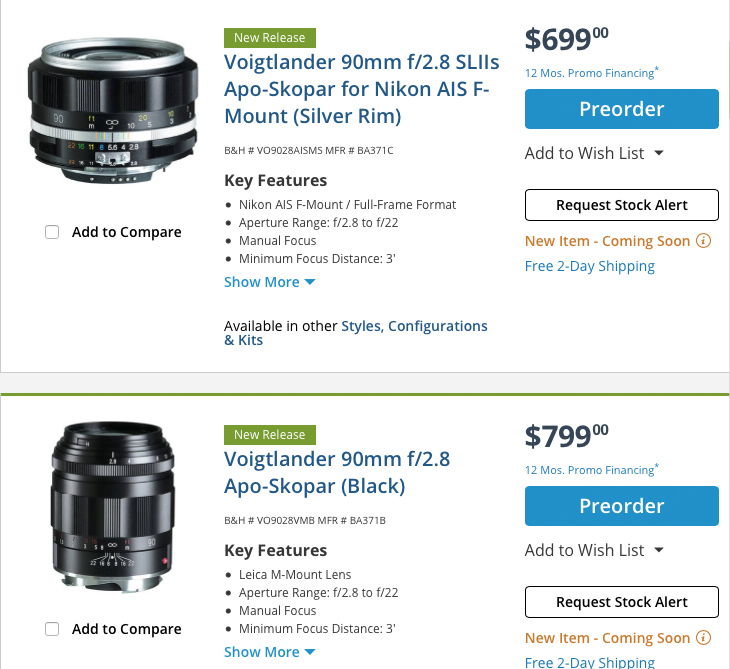
Pre-orders for the new Voigtlander 90mm f/2.8 APO-Skopar in M-mount and F-mount are now available at B&H Photo:
Link for all mounts and finishes: https://www.bhphotovideo.com/c/buy/Apo_Skopar/Ntt/Apo-Skopar
Link for all mounts and finishes: https://www.bhphotovideo.com/c/buy/Apo_Skopar/Ntt/Apo-Skopar
 |
||
 |
||
|
Oct 17, 2021 at 07:04 PM
p.9 #9Pre-order: Voigtlander APO-SKOPAR 90mm f/2.8 VM and F-mount
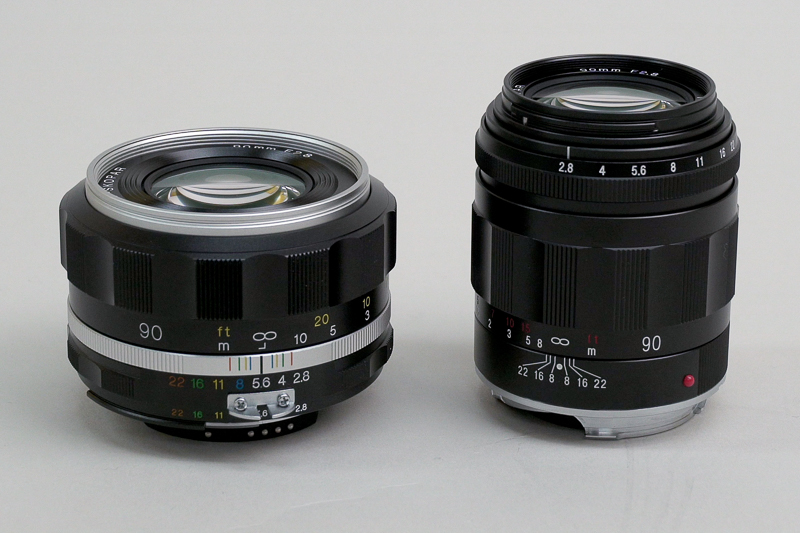
Additional pictures here:
https://dc.watch.impress.co.jp/docs/news/1358643.html
https://dc.watch.impress.co.jp/docs/news/1358643.html
|
||
 |
||
|
Oct 17, 2021 at 07:22 PM
p.9 #10Pre-order: Voigtlander APO-SKOPAR 90mm f/2.8 VM and F-mount
Fred Miranda wrote:
Additional pictures here:
https://dc.watch.impress.co.jp/docs/news/1358643.html
The F mount lens looks as though it was made in the Nikon factory 40 or 50 years ago!
Additional pictures here:
https://dc.watch.impress.co.jp/docs/news/1358643.html
The F mount lens looks as though it was made in the Nikon factory 40 or 50 years ago!
Oct 17, 2021 at 07:43 PM
p.9 #11Pre-order: Voigtlander APO-SKOPAR 90mm f/2.8 VM and F-mount
Dang, I think the F mount version may appeal more to me. I can do some film, DSLR and I already have an adapter for my Sony E mount cameras. Would cover a bit more ground than the M mount version. Kind of odd though that they withheld one aperture blade for the F mount. They were like...nope, 10 is going to far. Let's take it down a notch, it already has the looks going for it. Can't make those M mount shooters too jealous.
Oct 17, 2021 at 08:48 PM
p.9 #12Pre-order: Voigtlander APO-SKOPAR 90mm f/2.8 VM and F-mount
Exactly as planned, a retro look from a retro company - one for the Nikon MF faithful and there are plenty of them. The M version is huge by comparison. M is $1195 for Ozzies, $925 for the neato F version, extra $95 for the hood, for which a well-chosen step ring will substitute.
Oct 17, 2021 at 09:09 PM
p.9 #13Pre-order: Voigtlander APO-SKOPAR 90mm f/2.8 VM and F-mount
ReleaseDrive wrote:
Dang, I think the F mount version may appeal more to me. I can do some film, DSLR and I already have an adapter for my Sony E mount cameras. Would cover a bit more ground than the M mount version. Kind of odd though that they withheld one aperture blade for the F mount. They were like...nope, 10 is going to far. Let's take it down a notch, it already has the looks going for it. Can't make those M mount shooters too jealous.
The more blades, the more friction in an auto-aperture system. Also maybe some view of consistency with high grade F mount lenses.
Oct 17, 2021 at 09:14 PM
p.9 #14Pre-order: Voigtlander APO-SKOPAR 90mm f/2.8 VM and F-mount
philip_pj wrote:
Exactly as planned, a retro look from a retro company - one for the Nikon MF faithful and there are plenty of them. The M version is huge by comparison. M is $1195 for Ozzies, $925 for the neato F version, extra $95 for the hood, for which a well-chosen step ring will substitute.
Hi Phillip,
The M-mount version is longer but much smaller in diameter than the Nikon mount. The M-mount version is 53mm in diameter and 60mm long and uses a 39mm filter. The Nikon version is 66.3mm in diameter and 41mm long and uses a 52mm filter. The M-mount version has 10 aperture blades and weighs 250g and the Nikon version has 9 aperture blades and weighs 260g. If you are going to use these lenses on a Sony A series camera the Nikon will approach the length of the M-mount lens due to the size of the Nikon adapter vs the M-mount adapter and the weight difference between the Nikon version and the M-mount version will increase.
As to your comments regarding the hood for the M-mount version, that is a nice, it is reversible, and is apparently included with the lens which would partially explain the cost difference between both lenses.
Rich
Edited on Oct 17, 2021 at 10:31 PM · View previous versions
Oct 17, 2021 at 10:17 PM
p.9 #15Pre-order: Voigtlander APO-SKOPAR 90mm f/2.8 VM and F-mount
philip_pj wrote:
Exactly as planned, a retro look from a retro company - one for the Nikon MF faithful and there are plenty of them. The M version is huge by comparison. M is $1195 for Ozzies, $925 for the neato F version, extra $95 for the hood, for which a well-chosen step ring will substitute.
The M version comes with a hood.
Oct 17, 2021 at 10:20 PM
p.9 #16Pre-order: Voigtlander APO-SKOPAR 90mm f/2.8 VM and F-mount
Voigtlander's SLIIs versions for F mount are very sharp looking lenses. The 40 and the 58 are very sharp looking optics...I've considered them for my Nikon FM/FE for film but its hard to justify when I have great Nikkors that serve the same purpose...still, they look nice

Oct 17, 2021 at 10:23 PM
p.9 #17Pre-order: Voigtlander APO-SKOPAR 90mm f/2.8 VM and F-mount
hmm...there's a lot to digest here: I think all I can add is that, zugzwang2, you are right that pincushion distortion correction is worse than barrel distortion correction overall, because barrel distortion mostly affects the corners/edges, whereas pincushion correction destroys microcontrast deeper into the center of the image.
I can tolerate some distortion in my lenses, but it has to be to a degree where correction isn't required for most images, only perhaps say for architecture or flat horizons.
I'm starting to become concerned that manufacturers are taking software correction too far now; Lloyd used to say that there was a certain amount of native distortion which was tolerable, a sort of threshold as such, beyond which software correction just did too much damage to be acceptable. Whether Ai pushes out that threshold a little further in the future, remains to be seen Fred.
I take your point, David, that software correction may be the lesser of two evils, but I really wonder if we can trust manufacturers to make that call. I fear some manufacturer's might get tagged with the 'oh their lenses are always high distortion' label, which could hurt their reputations, and sales.
Philip, you are justified in your consternation about Zeiss, and others, deliberately omitting information in their data sheets; worse still, is when the quoted MTF graph, which of course is based on uncorrected lens data, is marketed as the true performance of the lens, even in lenses where software distortion correction is virtually mandatory for most images (just watch that 40lp/mm curve plummet!). As an aside: get Scott to weigh that Novaflex adapter for you before you buy it - I used to own it and recall it was pretty heavy.
Really, all this huge distortion nonsense we're starting to see, would be solved with curved sensors: then lenses could be small, fast and light, and 'still' high performing.
Oct 18, 2021 at 06:38 AM
p.9 #18Pre-order: Voigtlander APO-SKOPAR 90mm f/2.8 VM and F-mount
Reasons why I prefer to adapt and choose my own lens distortion…
DJK
DJK
Oct 18, 2021 at 09:27 AM
p.9 #19Pre-order: Voigtlander APO-SKOPAR 90mm f/2.8 VM and F-mount
Petegh wrote:
hmm...there's a lot to digest here: I think all I can add is that, zugzwang2, you are right that pincushion distortion correction is worse than barrel distortion correction overall, because barrel distortion mostly affects the corners/edges, whereas pincushion correction destroys microcontrast deeper into the center of the image.
I can tolerate some distortion in my lenses, but it has to be to a degree where correction isn't required for most images, only perhaps say for architecture or flat horizons.
I'm starting to become concerned that manufacturers are taking software correction too far now; Lloyd used to say that there was a...Show more →
I agree that barrel/pincushion distortion correction affects different areas of the image. So yes, we should see more IQ deterioration from barrel correction towards the corners. However, I think the 'amount' of distortion is what correlates more to loss of IQ.
The Sigma 90/2.8i has pincushion distortion and if left uncorrected, it will certainly be noticeable in most images. It needs Lightroom distortion correction amount at "-12", which although not small, it's way smaller correction than the 24/2i's "+29".
When inspecting the 90/2i's corrected/uncorrected images side by side at pixel level (100% mag.), I don't see visible resolution/contrast changes between them. So minimal deterioration for the 90mm at center, mid-field or corners. Noticeable deterioration for the 24/2i at corners.
Sigma 90/2.8 DG DN: Top (corrected), bottom (uncorrected)
hmm...there's a lot to digest here: I think all I can add is that, zugzwang2, you are right that pincushion distortion correction is worse than barrel distortion correction overall, because barrel distortion mostly affects the corners/edges, whereas pincushion correction destroys microcontrast deeper into the center of the image.
I can tolerate some distortion in my lenses, but it has to be to a degree where correction isn't required for most images, only perhaps say for architecture or flat horizons.
I'm starting to become concerned that manufacturers are taking software correction too far now; Lloyd used to say that there was a...Show more →
I agree that barrel/pincushion distortion correction affects different areas of the image. So yes, we should see more IQ deterioration from barrel correction towards the corners. However, I think the 'amount' of distortion is what correlates more to loss of IQ.
The Sigma 90/2.8i has pincushion distortion and if left uncorrected, it will certainly be noticeable in most images. It needs Lightroom distortion correction amount at "-12", which although not small, it's way smaller correction than the 24/2i's "+29".
When inspecting the 90/2i's corrected/uncorrected images side by side at pixel level (100% mag.), I don't see visible resolution/contrast changes between them. So minimal deterioration for the 90mm at center, mid-field or corners. Noticeable deterioration for the 24/2i at corners.
|
||
 |
||
|
Sigma 90/2.8 DG DN: Top (corrected), bottom (uncorrected)
Oct 18, 2021 at 09:53 AM
p.9 #20Pre-order: Voigtlander APO-SKOPAR 90mm f/2.8 VM and F-mount
BTW, I am expecting the new Voigtlander 90/2.8 APO to have way less distortion than the Sigma shown above.
______________________________
CameraQuest has the pre-orders open now:
Voigtlander M 90mm f/2.8 APO-Skopar: Black | Silver
Nikon AIS SL 90mm f/2.8 APO-Skopar: Black Rim | Silver Rim
_______________
Also available for pre-order at B&H Photo.
______________________________
CameraQuest has the pre-orders open now:
Voigtlander M 90mm f/2.8 APO-Skopar: Black | Silver
Nikon AIS SL 90mm f/2.8 APO-Skopar: Black Rim | Silver Rim
_______________
Also available for pre-order at B&H Photo.
Oct 18, 2021 at 09:58 AM