hmzimelka wrote:
Ok, I think this is just becoming a redundant discussion. The EXIF states 1 sec difference in date stamp. Clear Sky.
The above images represent exactly what I said. If you want to question my technique or the integrity of my camera and lens or lenses, then thats also fine. It's easy to replicate for those that are curious; Lock the Exposure speed and ISO, and just change the aperture from f/2 to f/2.4.
Or you can just read Bastian's review that I linked and is done very well and you don't have to rely on subjective judgments of how big the brighter area in the center actually is (the lens has at least a diameter of 24mm not really affected by vignetting, which I wouldn't call small) and subjective judgments of just how much brighter the image is. If you do try to make such judgments I would suggest at least try to match the histograms to reduce the subjectivity. It is also best to use a constant light source. By all means test your own lens for yourself. When I test mine I do get the half-stop difference or very nearly that that would be expected when you stop down to f/2.4 from wide open at f/2.
Steve Spencer wrote:
Or you can just read Bastian's review that I linked and is done very well and you don't have to rely on subjective judgments of how big the brighter area in the center actually is (the lens has at least a diameter of 24mm not really affected by vignetting, which I wouldn't call small) and subjective judgments of just how much brighter the image is. If you do try to make such judgments I would suggest at least try to match the histograms to reduce the subjectivity. It is also best to use a constant light source. By all means test your own lens for yourself. When I test mine I do get the half-stop difference or very nearly that that would be expected when you stop down to f/2.4 from wide open at f/2....Show more →
Thanks. I have read the review prior to purchasing the lens.
Matching the histogram against an evenly lit surface, focus at infinity, locked exposure. A tight centre crop of the images were used to match histograms. Best I could do was 0.35 stop exposure difference between f/2 and f/2.4 but unfortunately I wasn't shooting through photographic grade tissues...
Sorry Steve, I missed that! I'm going to chalk it up to not enough morning caffeine (although I'm not sure I can blame it on that......)
Steve Spencer wrote:
Yes, Tim. I made the same suggestion in my post above. I use center-weight metering almost exclusively with my M10 largely because I don't want metering affected by vignetting and many rangefinder lenses (like this one) have pretty high vignetting. I don't know what metering hmzimelka is using but if he is using metering in live view that may account for at least part of the differences we are reporting.
Sep 19, 2022 at 09:15 AM
Steve Spencer Offline • • • • • • • Upload & Sell: On
hmzimelka wrote:
Thanks. I have read the review prior to purchasing the lens.
Matching the histogram against an evenly lit surface, focus at infinity, locked exposure. A tight centre crop of the images were used to match histograms. Best I could do was 0.35 stop exposure difference between f/2 and f/2.4 but unfortunately I wasn't shooting through photographic grade tissues...
So, now with careful control it looks like we are talking a very small difference from the nominal aperture (namely a third of stop instead of the half stop that would be expected). We live with those sorts of exposure differences all the time. Is an f/1.2 lens a third of a stop or half a stop faster than an f/1.4 lens? Here rounding really can make an f/1.2 lens properly round only .35 stops faster or if you round the other way you can get .6 stops. I don't see any reason to quibble about such a small difference, so I am glad we have clarified that any difference between the nominal aperture and the aperture in practice on this lens is perhaps a sixth of a stop and nowhere near a half stop. For me a sixth of a stop isn't worth worrying about. It is certainly a much smaller issue, IMO, than the two to three stop vignetting in the corner and one to two stops along the wide edge. Even that for me, however isn't a big issue. With the relatively large 24mm image circle even wide open that is basically unaffected by the vignetting I find the lens very useful. Of course, YMMV.
Steve Spencer wrote:
So, now with careful control it looks like we are talking a very small difference from the nominal aperture (namely a third of stop instead of the half stop that would be expected). We live with those sorts of exposure differences all the time. Is an f/1.2 lens a third of a stop or half a stop faster than an f/1.4 lens? Here rounding really can make an f/1.2 lens properly round only .35 stops faster or if you round the other way you can get .6 stops. I don't see any reason to quibble about such a small difference, so I am glad we have clarified that any difference between the nominal aperture and the aperture in practice on this lens is perhaps a sixth of a stop and nowhere near a half stop. For me a sixth of a stop isn't worth worrying about. It is certainly a much smaller issue, IMO, than the two to three stop vignetting in the corner and one to two stops along the wide edge. Even that for me, however isn't a big issue. With the relatively large 24mm image circle even wide open that is basically unaffected by the vignetting I find the lens very useful. Of course, YMMV....Show more →
I don't mean to be nasty, but I think this disagreement really is of little value. I like the lens, it performs exceedingly well for me, is sharp with good color and contrast, is small and light, balances well on my Kolari Vision UT sensor modified A7rII and the issues are easy to deal with. Not much more that I could ask for in this focal length for my needs.
Rich
Sep 19, 2022 at 11:12 AM
Steve Spencer Offline • • • • • • • Upload & Sell: On
naturephoto1 wrote:
I don't mean to be nasty, but I think this disagreement really is of little value. I like the lens, it performs exceedingly well for me, is sharp with good color and contrast, is small and light, balances well on my Kolari Vision UT sensor modified A7rII and the issues are easy to deal with. Not much more that I could ask for in this focal length for my needs.
Rich
Hi Rich,
I agree with you as you know (I think I recommended the lens to you if I remember rightly, or perhaps it was the other way around?). For my part I was just trying to share my experience and that experience is nothing like what was described. I simply didn't want people to think the lens was something it was not.
I agree with you as you know (I think I recommended the lens to you if I remember rightly, or perhaps it was the other way around?). For my part I was just trying to share my experience and that experience is nothing like what was described. I simply didn't want people to think the lens was something it was not.
Best wishes,
Steve
Hi Steve,
I wasn't singling you out just commenting on where this discussion had gone. By the way, I paid for my lens with Cameraquest on May 6, 2021.
I wasn't singling you out just commenting on where this discussion had gone. By the way, I paid for my lens with Cameraquest on May 6, 2021.
Rich
I got one very early as well, as soon as they were shipping which is rare for me. I very well might have got it on your advice, however, and was a little slower than you because I believe mine came in July, 2021. I have always appreciated your thoughts and advice on lenses. Cheers.
The Leica lens has markedly less vignetting wide open, both in the mid-frame and corners. This was also easily seen when I did optical vignetting tests. Of course, it doesn't mean that the Ultron II isn't an f/2 lens, but as I have said previously in this thread, and as others also have found out, stopping down to f/2.4 only affects a small spot in the center (even at shorter focus distances). That wasn't the case with the Summicron.
When using the matrix light metering in my Nikon Z6UT, it often fooled the exposure (in aperture mode) creating underexposure. This didn't happen with the Summicron either. The vignetting in the Ultron II causes the illumination to decrease so sharply that I don't use the lens wide open at long focus distances, but stop down to at least f/2.4, since there is no practical gain shooting wide open.
That said, it's the only real complaint I have with this lens (apart from that it won't work on a stock Nikon Z camera).
I see the same vignetting behavior with my Nokton 50mm f/1.2, and I have seen others saying the same regarding the Ultron 35mm f/1.7.
Sep 19, 2022 at 03:31 PM
Steve Spencer Offline • • • • • • • Upload & Sell: On
LarsHP wrote:
I just revisited this thread and saw the discussion regarding vignetting.
Here's my vignetting test compared to the 28mm Summicron-M Asph II:
The Leica lens has markedly less vignetting wide open, both in the mid-frame and corners. This was also easily seen when I did optical vignetting tests. Of course, it doesn't mean that the Ultron II isn't an f/2 lens, but as I have said previously in this thread, and as others also have found out, stopping down to f/2.4 only affects a small spot in the center (even at shorter focus distances). That wasn't the case with the Summicron.
When using the matrix light metering in my Nikon Z6UT, it often fooled the exposure (in aperture mode) creating underexposure. This didn't happen with the Summicron either. The vignetting in the Ultron II causes the illumination to decrease so sharply that I don't use the lens wide open at long focus distances, but stop down to at least f/2.4, since there is no practical gain shooting wide open.
That said, it's the only real complaint I have with this lens (apart from that it won't work on a stock Nikon Z camera).
I see the same vignetting behavior with my Nokton 50mm f/1.2, and I have seen others saying the same regarding the Ultron 35mm f/1.7. ...Show more →
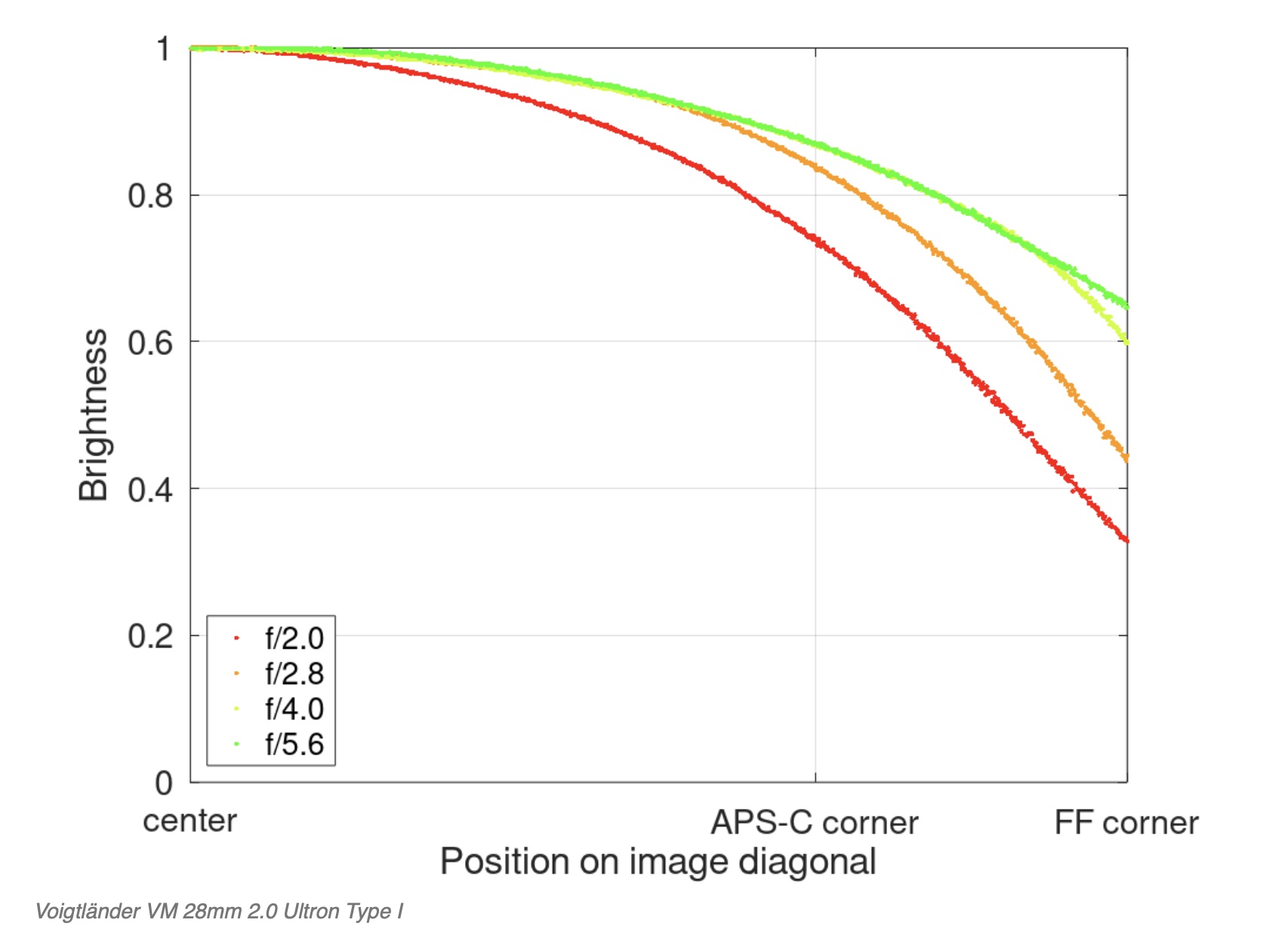
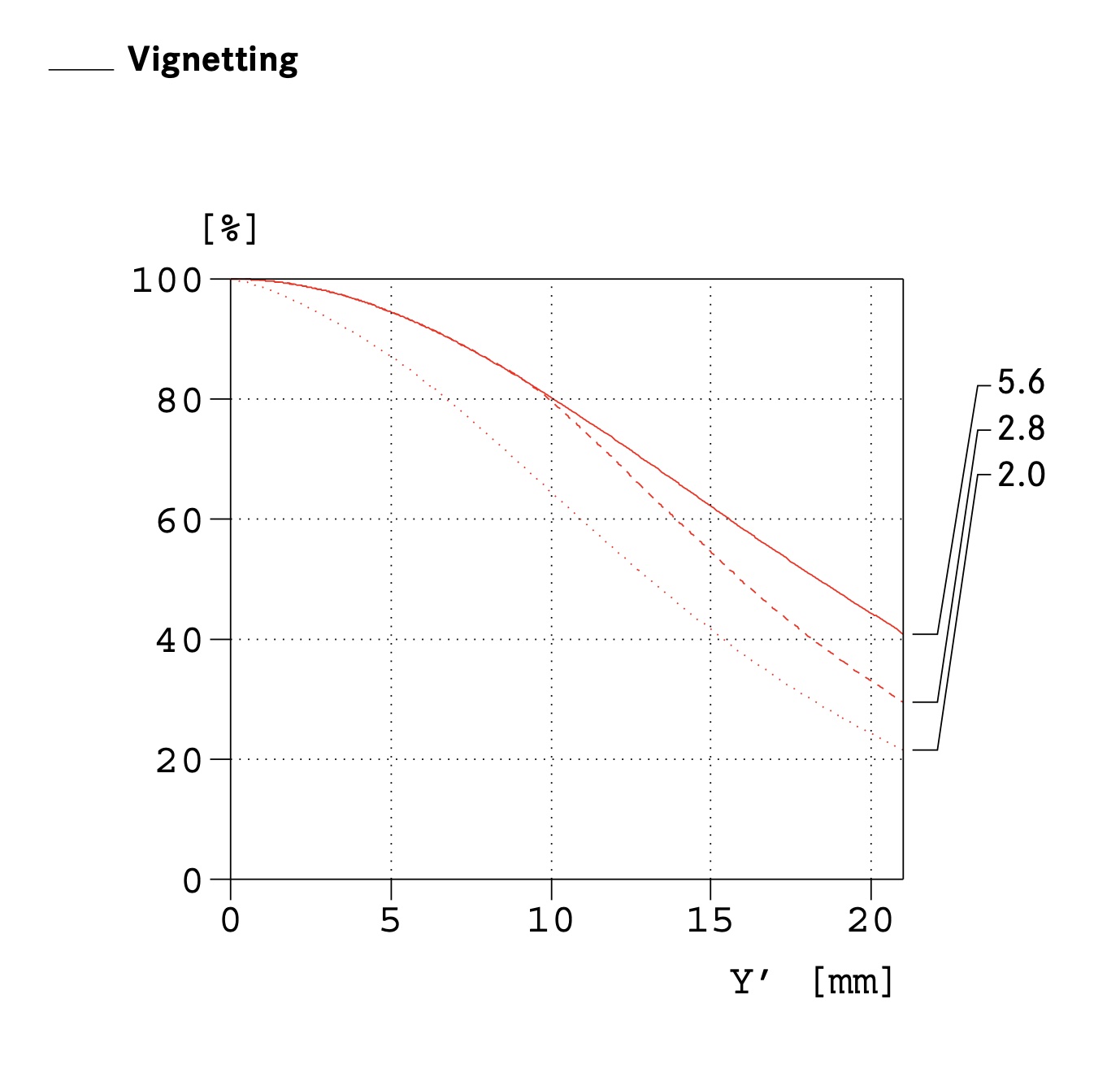
Now I remember having this same sort of conversation earlier with you Lars. I just don't see the huge difference you describe in your own vignetting shots, nor in other shots, nor in the data provided by Bastian and Leica, nor in my own shooting. I am posting below the vignetting curves that Bastian included in his review of the Voigtlander 28 f/2 II and the official vignetting curves from the Leica data sheet for the 28 summicron Asph. As you will see these measured data contradict your subjective judgements about vignetting. In my experience this claim that the Voigtlander lens has vignetting that is so bad it is a huge problem but the Leica lens does not, just isn't supported by the data or the photographic evidence. Of course one could be bothered by the vignetting of both lenses. They both have a lot of vignetting, but the claim that the Voigtlander lens is a problem while the Leica lens is not in my view is refuted by the data.
The Ultron does have an advantage I noticed when quickly testing a Summicron 28 ASPH II, that it has less vignetting at the corners from f/5.6. Not much, but noticeable and certainly preferable for my use case anyways. Lars' image shows this too. However, my use with the Summicron was with the screw on hood.
Steve Spencer wrote:
I am posting below the vignetting curves that Bastian included in his review of the Voigtlander 28 f/2 II and the official vignetting curves from the Leica data sheet for the 28 summicron Asph.
Those graphs are not directly comparable.
Part of the reason for that is that all I can measure is the whole "system" of sensor, in camera processing, lens, post processing/raw development.
Whereas - I am guessing - Leica gives data for the lens only. And even if not, their process chain is most likely different from mine.
The Leica's corner illumination at f/2.0 is roughly 21% acc. to that graph, which would translate to -2.25 EV.
That does sound surprisingly low to me, at least on digital.
On film it might very well be true though, due to the absence of pixel vignetting.
Please revisit Bastian Kratzkes optical vignetting tests. That proves my point perfectly. Even the inner middle bokeh "ball" is clearly truncated, and the truncation becomes quite extreme in the corner. That wasn't the case with the Summicron.
Comparing Bastians measurement to Leicas graph is apples to bananas. I tested the two lenses on the same camera. That's apples to apples, and it's not subjective. You can measure the illumination in various places in the frame and conclude what I say.
Steve Spencer wrote:
Now I remember having this same sort of conversation earlier with you Lars. I just don't see the huge difference you describe in your own vignetting shots, nor in other shots, nor in the data provided by Bastian and Leica, nor in my own shooting. I am posting below the vignetting curves that Bastian included in his review of the Voigtlander 28 f/2 II and the official vignetting curves from the Leica data sheet for the 28 summicron Asph. As you will see these measured data contradict your subjective judgements about vignetting. In my experience this claim that the Voigtlander lens has vignetting that is so bad it is a huge problem but the Leica lens does not, just isn't supported by the data or the photographic evidence. Of course one could be bothered by the vignetting of both lenses. They both have a lot of vignetting, but the claim that the Voigtlander lens is a problem while the Leica lens is not in my view is refuted by the data....Show more →
My test actually show that the Ultron II has less vignetting already at f/4.
hmzimelka wrote:
The Ultron does have an advantage I noticed when quickly testing a Summicron 28 ASPH II, that it has less vignetting at the corners from f/5.6. Not much, but noticeable and certainly preferable for my use case anyways. Lars' image shows this too. However, my use with the Summicron was with the screw on hood.
I should add that vignetting in my Kolari Vision Ultra Thin modified Nikon Z6 was stronger than the Leica M 240 that I tested my Summicron on. This means the vignetting (from any lens with quite short exit pupil) will be stronger in my test than yours, since you used your M10, I expect.
BastianK wrote:
Those graphs are not directly comparable.
Part of the reason for that is that all I can measure is the whole "system" of sensor, in camera processing, lens, post processing/raw development.
Whereas - I am guessing - Leica gives data for the lens only. And even if not, their process chain is most likely different from mine.
The Leica's corner illumination at f/2.0 is roughly 21% acc. to that graph, which would translate to -2.25 EV.
That does sound surprisingly low to me, at least on digital.
On film it might very well be true though, due to the absence of pixel vignetting.
Sep 20, 2022 at 04:04 AM
Steve Spencer Offline • • • • • • • Upload & Sell: On
LarsHP wrote:
Please revisit Bastian Kratzkes optical vignetting tests. That proves my point perfectly. Even the inner middle bokeh "ball" is clearly truncated, and the truncation becomes quite extreme in the corner. That wasn't the case with the Summicron.
Comparing Bastians measurement to Leicas graph is apples to bananas. I tested the two lenses on the same camera. That's apples to apples, and it's not subjective. You can measure the illumination in various places in the frame and conclude what I say.
It hardly proves your point at all and proof when we are talking about data is a word that should always be avoided. You can talk about data supporting or being consistent with your position, but data never "proves," anything, and certainly doesn't in this case. Yes, the bokeh ball test Bastian presents shows no truncation of the bokeh balls in the middle and the next distance (which he does not specify - perhaps he can tell us now) does show some truncation. This does show that that lens has strong vignetting as I think we have all maintained all along. That is not in dispute, so yes Bastian's test provides evidence for what we agree upon, but it provides exactly zero evidence for what is in dispute which is your claim that the Voigtlander 28 f/2 II has much worse vignetting than the Summicron 28 f/2 Asph and that the difference is so big and so night and day that for the Voigtlander f/2 isn't really usable and for the Summicron it is. I don't see any of the evidence being consistent with that proposition and it is the proposition that is in dispute. And in my experience that characterization of the Voigtlander is just not accurate. Now YMMV, you might find the Voigtlander unacceptable. That is fine, but I don't see any evidence (certainly in Bastian's review as he never compares the lenses) that it is that much worse than the Summicron. It may be slightly worse and that may matter to you, but these false claims that Bastian review supports the difference between the Voigtlander and the Summicron are just that a false claim.
Sep 20, 2022 at 04:40 AM
Steve Spencer Offline • • • • • • • Upload & Sell: On
LarsHP wrote:
I should add that vignetting in my Kolari Vision Ultra Thin modified Nikon Z6 was stronger than the Leica M 240 that I tested my Summicron on. This means the vignetting (from any lens with quite short exit pupil) will be stronger in my test than yours, since you used your M10, I expect.
And that means of course that your test was an apples to oranges test and that has to be considered when comparing the two lenses. And, in my view, given that the summicron in your test had a clear advantage and the difference in vignetting is small at best your own tests provide pretty strong refutation of your own position that the summicron is night and day better than the Voigtlander.
As you can see from the link I provided above, the vignetting test with the Summicron and Ultron were done on the same camera, my Z6UT. That means apples to apples and proves my point, yes.
(I have also done some optical vignetting tests that support this point, but haven't posted those.)
My point you are quoting here refers to why Bastians test shows less vignetting than my test WITH THE SAME LENS, namely the Ultron II. So, the difference in illumination between the M10 and Z6UT is sensor related (caused by the micro lenses). That explains why we can't compare his and my vignetting images.
EDIT: In the YouTube review Benj Haisch did, it is also quite evident that the bokeh balls (in the bushes) from the Ultron II are clearly oval-shaped already in the mid-frame which isn't the case with his Summicron Asph II. This is consistent with what I am saying.
Steve Spencer wrote:
And that means of course that your test was an apples to oranges test and that has to be considered when comparing the two lenses. And, in my view, given that the summicron in your test had a clear advantage and the difference in vignetting is small at best your own tests provide pretty strong refutation of your own position that the summicron is night and day better than the Voigtlander.