I just mentioned that some might appreciate getting true infinity focus at the hard stop by using an M camera. I also (mostly) shoot with an R5 and 50R.
I really need to remember when I’m posting in a regular alt thread versus one that’s cross-posted to Sony. Some strange reactions considering M is zero threat or completion to any modern mirrorless. Maybe some here bristle at the fact that a high-performing lens for E-mount also gets made for M (and are independently optimized for each sensor).
highdesertmesa wrote:
I just mentioned that some might appreciate getting true infinity focus at the hard stop by using an M camera.
Definitely a pleasure to set the focusing ring to the lens' hard stop and get perfectly focused images with the Voigtlander 35mm f/2 APO and 50/2 APO VM lenses. It does not always work though, as this is dependent on perfect calibration. For example, I've tried multiply copies of the CV 35/1.2 III and CV 21/3.5 VM lenses and could not achieve infinity focus with them in multiple Leica M bodies. Most lenses are fine though.
Fred Miranda wrote:
Definitely a pleasure to set the focusing ring to the lens' hard stop and get perfectly focused images with the Voigtlander 35mm f/2 APO and 50/2 APO VM lenses. It does not always work though, as this is dependent on perfect calibration. For example, I've tried multiply copies of the CV 35/1.2 III and CV 21/3.5 VM lenses and could not achieve infinity focus with them in multiple Leica M bodies. Most lenses are fine though.
The 21 3.5 didn’t work for me, either, so I returned it for the 21 1.4, which did work. Thankfully my 35 1.2 III also is good at infinity hard stop.
highdesertmesa wrote:
The 21 3.5 didn’t work for me, either, so I returned it for the 21 1.4, which did work. Thankfully my 35 1.2 III also is good at infinity hard stop.
It would be the first I've seen.
Since you can adapt it to the Sony, do you mind taking a picture at infinity and compare to the hard stop using the 35/1.2 III on the Leica? If you do, resize the Sony image to 40MP so we can compare the center crop at pixel level (100% mag.).
I could never find a 35/1.2 III VM copy with perfect hard stop infinity calibration.
Leica M cameras, in their current iterations, are nostalgic or legacy products (take your pick). In a real sense, they have been so since Nikon took the wind out of Leica's sails with the F cameras. There was no way for Leica to compete against that (though they tried with the R series of cameras). The current M series of cameras is basically the same as it was in the 1960s, with a different imaging system. There is no real innovation that can be applied. There won't ever be an AF version (though they could with the L mount, maybe), or will be get any sort of hybrid viewfinder. The legacy must remain "pure", I guess. I would say that the little CL is more innovative than an M10, although it, like most of the current Leica lineup, is slightly behind the curve, technologically speaking. The CL is certainly a nod to the early Leica screwmount cameras in size.
But! There is also nothing quite like shooting a rangefinder camera, with its bright optical viewfinder and small and sharp little lenses. I for one enjoy that process (though with a film M currently), but will honestly say that when speed or ease matter, or in difficult lighting situations, I will always reach for a mirrorless digital camera.
Right tool...and all that.
And, to stay on topic - I'm glad Voigtlander is punching way above their weight and coming out with really excellent lenses that can rival Leica, perhaps quality-wise and certainly price-wise!
Fred Miranda wrote:
It would be the first I've seen.
Since you can adapt it to the Sony, do you mind taking a picture at infinity and compare to the hard stop using the 35/1.2 III on the Leica? If you do, resize the Sony image to 40MP so we can compare the center crop at pixel level (100% mag.).
I could never find a 35/1.2 III VM copy with perfect hard stop infinity calibration.
I don’t have a Sony but rather a GFX 50R and R5. I have a Novoflex M for the GFX and Kipon M macro/helicoid for the R5. But since all adapters are designed to let the lens focus past infinity, this would only test if the lens on the M10-R isn’t turning far enough to actually reach infinity — the exact opposite issue I had with the 21 3.5, which quite obviously in both the Visoflex and the rangefinder was reaching infinity before the hard stop. I can use the Visoflex on the M10-R to verify the 35 1.2 III isn’t reaching infinity before the hard stop, but I don’t think that’s the issue we’re looking for here, right? That would mean my lens was incapable of infinity on the M, and I wouldn’t be getting sharp results.
Does that all make sense?
EDIT: checked the lens again today, looking at the rangefinder patch much more carefully this time. It does look like it hits perfect alignment just a hair before infinity, and I mean just barely. I took two shots at f/5.6 at hard lock and at what the rangefinder was saying was perfect infinity, and indeed the shot made according to the rangefinder was sharper. So I stand corrected on this lens. I’ll check my others more carefully, too. The 21 3.5, though, it focused much more noticeably past infinity.
highdesertmesa wrote:
I don’t have a Sony but rather a GFX 50R and R5. I have a Novoflex M for the GFX and Kipon M macro/helicoid for the R5. But since all adapters are designed to let the lens focus past infinity, this would only test if the lens on the M10-R isn’t turning far enough to actually reach infinity — the exact opposite issue I had with the 21 3.5, which quite obviously in both the Visoflex and the rangefinder was reaching infinity before the hard stop. I can use the Visoflex on the M10-R to verify the 35 1.2 III isn’t reaching infinity before the hard stop, but I don’t think that’s the issue we’re looking for here, right? That would mean my lens was incapable of infinity on the M, and I wouldn’t be getting sharp results.
Does that all make sense?
EDIT: checked the lens again today, looking at the rangefinder patch much more carefully this time. It does look like it hits perfect alignment just a hair before infinity, and I mean just barely. I took two shots at f/5.6 at hard lock and at what the rangefinder was saying was perfect infinity, and indeed the shot made according to the rangefinder was sharper. So I stand corrected on this lens. I’ll check my others more carefully, too. The 21 3.5, though, it focused much more noticeably past infinity....Show more →
If the hard stop focuses beyond infinity (like with your CV 21/3.5), it's not ideal but it's fine because at least a subject at infinity can be critically sharp.
The issue I had with my CV 35mm f/1.2 III VM copies is that the lens could never reach true infinity at the hard stop since it never reached true infinty. At first, I though Cosina optimized the hard stop for smaller apertures since the lens has focus shift but even at f/5.6 , a subject at infinity would be more in focus on the Sony compared to the Leica when comparing center crops.
If does not matter which camera you try as long as you have an adapter for the Voigtlander VM. So you could focus with your GFX or R5 on a subject at infinity distance (using high magnification to make sure), Then on your Leica, just focus the same scene using the hard stop and compare the center crops at 100%. If they are equal, that means your CV 35/1.2 III is indeed focusing correctly.
Fred Miranda wrote:
The issue I had with my CV 35mm f/1.2 III VM copies was that the lens could never reach true infinity at the hard stop on the Leica M. The hard stop never quite reached infinity. At first, I though Cosina that optimized the hard stop for smaller apertures since the lens has focus shift but even at f/5.6 my subject at infinity would be more in focus on the Sony compared to the Leica. (center)
If does not matter which camera you try as long as you have an adapter for the Voigtlander VM. So focus with your GFX or R5 on a subject at infinity distance (using high magnification to make sure), Then on your Leica, just focus the same scene using the hard stop and compare the center crops at 100%. If they are equal, that means your CV 35/1.2 III is indeed focusing correctly. If not, it's like the other copies I had....Show more →
I think since I just saw it hits infinity in the rangefinder patch slightly before the hard stop (and verified with image review), that should rule out it not reaching infinity on my M. I can try it against the GFX and R5, but each are so different from the M10-R. The 50R has undersized microlenses that seem to amplify apparent sharpness and aliasing, and the R5 has the AA filter. I’ll give it a try, though. On the M, I’ll shoot it at infinity according to the rangefinder (right before the hard stop) and infinity hard stop — then I’ll use magnified live view on another body like you said.
Another comment that perhaps not discussed or I missed it. The Sony 35mm 1.4G has a shorter minimum focusing distance (25cm) vs the Voigtlander APO (35cm).
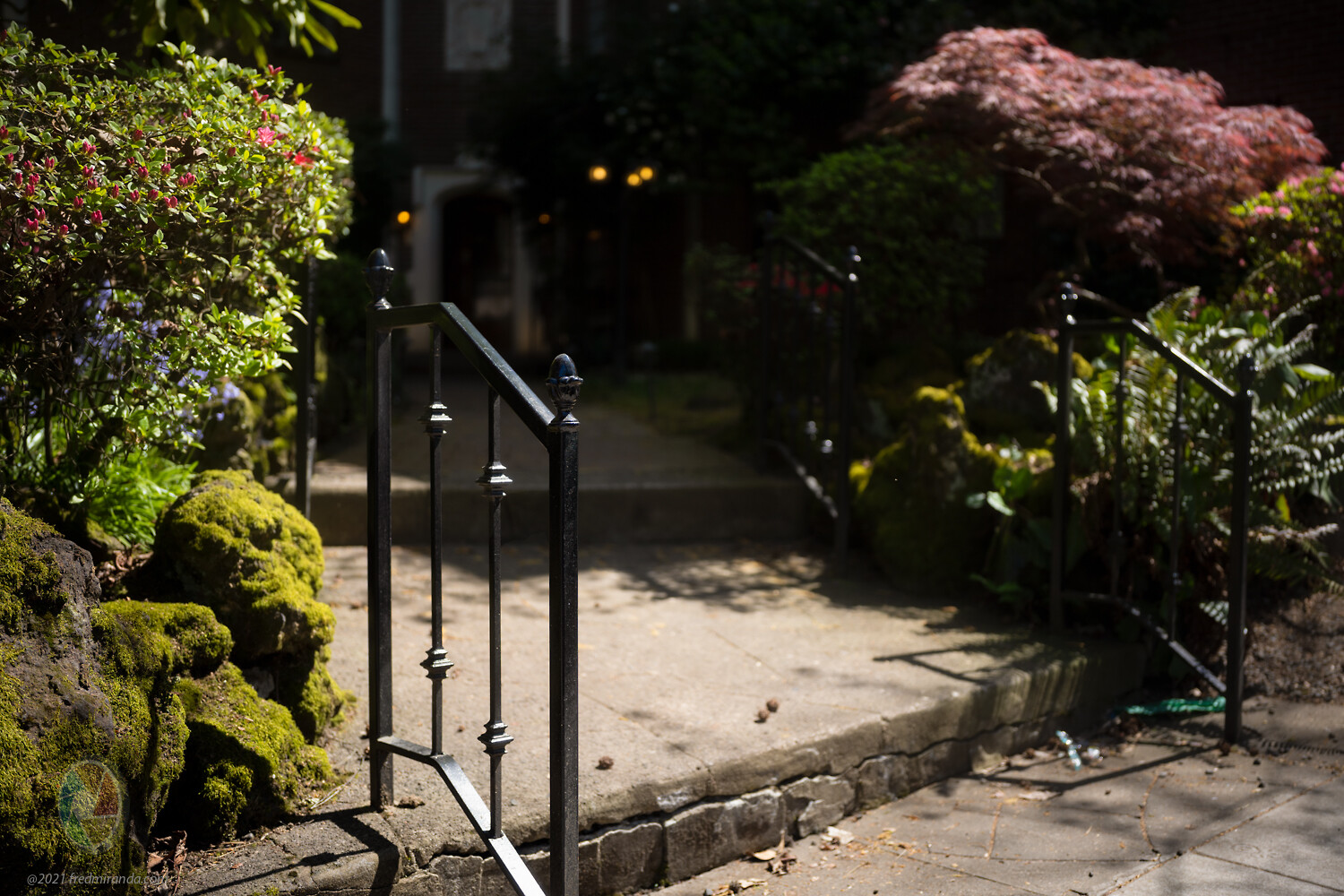
Here is a difficult high contrast scene that would be difficult for any 35mm lens.
I though the CV 35/2 APO did very well. Nice colors, resolution and rendering + zero CA wide open:
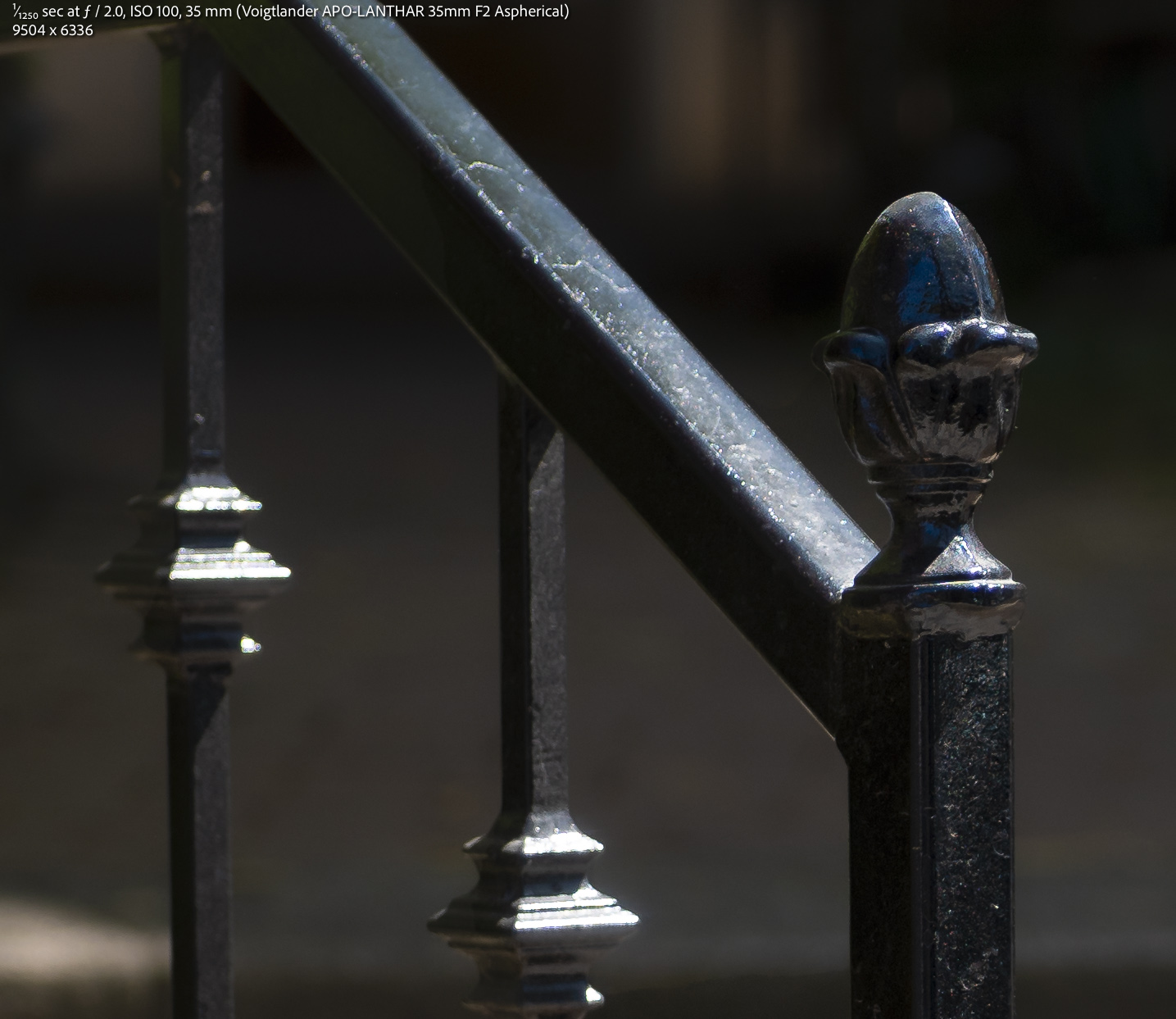
100% mag (1:1) crop from image above. Most lenses would show lots of green fringing on the defocused area and purple fringing on-axis.
Fred Miranda wrote:
Definitely a pleasure to set the focusing ring to the lens' hard stop and get perfectly focused images with the Voigtlander 35mm f/2 APO and 50/2 APO VM lenses. It does not always work though, as this is dependent on perfect calibration. For example, I've tried multiply copies of the CV 35/1.2 III and CV 21/3.5 VM lenses and could not achieve infinity focus with them in multiple Leica M bodies. Most lenses are fine though.
Not only is it dependent on the calibration of the camera, but also the manufacturing of the lens and shimming of the lens mount (in relation to it's aperture and light projection), AND more importantly...temperature. Lens hard stops are no guarantee of anything, if your lens reaches infinity focus at the hard stop and you're shooting at, say, 30 degrees Fahrenheit it is entirely possible that it won't actually reach infinity focus at, say, 90 degrees Fahrenheit (or vice versa). This is especially a problem with metal body lenses that are much more vulnerable to the effects of temperature on their focus. For those of us that do dedicated astrophotography with longer focal length lenses or telescopes you constantly have to check focus, I run autofocus routines at least once per hour when doing long imaging sessions. If you're setup to run a shooting session over an extended period of time (such as a sunset or sunrise period of 30-45 minutes) and you pull your camera/lens out of the "warm" bag, quickly focus, and then let the camera sit while you snap off exposures over that session chances are pretty high that your focus will noticeably change.
When I teach my night photography workshops the most important thing I tell the participants (when it comes to the lens) is that they should never ever rely on the lens focus distance markings and never just tape or mark the lens where you believe infinity is, it's a surefire way to never get precise infinity focus and have out of focus stars.
I am not a hard stop expert but I can share that my Zeiss lens manuals all say they don't provide an infinity hard stop to allow for the effects of temperature change.
It's a bigger issue than it appears, with good points on all sides. If the hard stop looks good you wonder if it is quite there; if you go past infinity by accident absolutely nothing ruins a landscape image more effectively. Then there is the fact that you lose DOF focusing at infinity. It's a can of worms.
How many 35s can do this well: p.22 #17
It does a little better than the 50/2 APO, which can show tiny enclosing circles of magenta on sunlit water. Something overlooked is that designers are learning with each lens they design.
DaveFP wrote:
I am not a hard stop expert but I can share that my Zeiss lens manuals all say they don't provide an infinity hard stop to allow for the effects of temperature change.
Infinity hard stop would require a constant worldwide temperature.
Zeiss would first need to find a way to provide constant worldwide temperature, and then they’d be able to provide perfectly calibrated infinity hard stop.
Or a proper UV filter is employed to mitigate the issues?
philip_pj wrote:
How many 35s can do this well: p.22 #17
It does a little better than the 50/2 APO, which can show tiny enclosing circles of magenta on sunlit water. Something overlooked is that designers are learning with each lens they design.