This topic is in the 2021 archive. You can read it and like its posts here. It is read only.
Archive 2021A1 EVF resolution -- theoretical vs actual
p.5 #1A1 EVF resolution -- theoretical vs actual
dclark wrote:
I assume the way the EVF achieves magnification 0.7 is by truncating the OLED display from 1536x2048 to 1200x1600. That is what is need to change from 0.9 to 0.7. Any other way I can devise requires some actuation of the EVF optics and/or the OLED display, which seems too unlikely to be believed. How can both magnification 0.7 be achieved and display of 1536x2048? I can't come up with a way I believe. Maybe I am not understanding something or am missing a simple explanation. As I stated above, unless there is an explanation for this, I loose confidence in the other conclusions. I hope you or someone has a good explanation.Hi Dave,
The resolution is not chaining when you go from 0.9 to 0.7 the camera is just putting a black frame around the image the black frame is 270 pixels wide. the image in the center is zoomed back and rescaled to fid in the smaller window
bestWhere did you find this information?
270 pixels? Seems like it should be different on top/bottom and on the sides for a 4:3 aspect ratio display.
"zoomed back" implies that the EVF optics are actuated. Is that what you are saying? I discounted the possibility but if the optics and/or OLED can be moved that opens up a lot of possibilities that can explain just about anything. Maybe I should not so quickly discount that possibility. I searched for some information on this but could find nothing. Not even speculation let alone a credible source.
There is no need to move anything for most of the cases. Only the High Display Quality at 0.7 magnification, and the 240/sec mode. Everything else works very well by just truncating (digital zooming) the OLED, which is pretty trivial.
Dave270 pixel is the horizontal border you can calculate the vertical border the same manner
the optics is fixed. what I meant was the image is scaled digitally (the same way you resample an image in photoshop) to fit into a smaller window with a black frame around it when you set the magnification to 0.7x.
hope this helpsI don't see how you calculate 270. If the display changes from 1536x2048 to 1200x1600, the border with be (1536-1200)/2=168 pixels at the top and bottom, and (2048-1600)/2=224 pixels on the left and right.
I agree that the display is digitally zoomed not optically zoomed to change the magnification from 0.9 to 0.7. So I still don't see how to explain the results for the High Display Quality at 0.7 magnification, and the 240/sec mode which is also at 0.7 magnification. When the magnification is 0.7 the available OLED display is reduced to 1200x1600.
224 is correct my bad 270 was a typo.
the physical resolution of the OLED panel, i.e. number of pixels never changes it is always 1536 x 2048 x 3. what changes is the image resolution fed into the display. When the image resolution is lower than physical resolution some pixels will be showing the same data this reduces the bandwidth burden on the SoC which appears to be around 190 Mpixel/sec. this is the same as setting your monitor to a lower resolution than it is capable of.
Sony's spec's are somewhat vague but my reading is that in normal mode the image sent to the finder is 2048 pixels wide, with 0.7 mag selected, some of the image is the black border. In Hi mode the image sent is 1600 pixels wide. in Hi+ mode the image sent is also 1600 pixels wide but includes the black borders that do not refresh from frame to frame thus allowing for the center region to be refreshed at 240Hz.
hope this helps
speedmaster20d wrote
dclark wrote
speedmaster20d wrote
dclark wrote
speedmaster20d wrote
as for your last question are you asking about scaling factor between 0.9 and 0.7 magnification?The resolution is not chaining when you go from 0.9 to 0.7 the camera is just putting a black frame around the image the black frame is 270 pixels wide. the image in the center is zoomed back and rescaled to fid in the smaller window
best
270 pixels? Seems like it should be different on top/bottom and on the sides for a 4:3 aspect ratio display.
"zoomed back" implies that the EVF optics are actuated. Is that what you are saying? I discounted the possibility but if the optics and/or OLED can be moved that opens up a lot of possibilities that can explain just about anything. Maybe I should not so quickly discount that possibility. I searched for some information on this but could find nothing. Not even speculation let alone a credible source.
There is no need to move anything for most of the cases. Only the High Display Quality at 0.7 magnification, and the 240/sec mode. Everything else works very well by just truncating (digital zooming) the OLED, which is pretty trivial.
Dave
the optics is fixed. what I meant was the image is scaled digitally (the same way you resample an image in photoshop) to fit into a smaller window with a black frame around it when you set the magnification to 0.7x.
hope this helps
I agree that the display is digitally zoomed not optically zoomed to change the magnification from 0.9 to 0.7. So I still don't see how to explain the results for the High Display Quality at 0.7 magnification, and the 240/sec mode which is also at 0.7 magnification. When the magnification is 0.7 the available OLED display is reduced to 1200x1600.
224 is correct my bad 270 was a typo.
the physical resolution of the OLED panel, i.e. number of pixels never changes it is always 1536 x 2048 x 3. what changes is the image resolution fed into the display. When the image resolution is lower than physical resolution some pixels will be showing the same data this reduces the bandwidth burden on the SoC which appears to be around 190 Mpixel/sec. this is the same as setting your monitor to a lower resolution than it is capable of.
Sony's spec's are somewhat vague but my reading is that in normal mode the image sent to the finder is 2048 pixels wide, with 0.7 mag selected, some of the image is the black border. In Hi mode the image sent is 1600 pixels wide. in Hi+ mode the image sent is also 1600 pixels wide but includes the black borders that do not refresh from frame to frame thus allowing for the center region to be refreshed at 240Hz.
hope this helps
Apr 09, 2021 at 10:38 AM
p.5 #2A1 EVF resolution -- theoretical vs actual
dclark wrote:
A few days ago I was shooting some test shots with the A1 and noticed that the EVF display of fabric on a patio chair started showing aliasing when I was focusing. That can be an indication that the camera has reduced EVF resolution so I decided to make some measurements.
There have been lots of reports that the EVF resolution changed when focusing, including some in this thread. There have been claims and speculations that when focusing the resolution of the EVF can drop below the "Standard" resolution (i.e. the lowest specified EVF resolution).
To see if the EVF resolution...Show more →
Yesterday when looking through the EVF (with 35GM at f1.4) I could see the resolution drop during the _day_ (quality high, AFC).
However, in the evening indoors when going to higher ISOs, I don't see it. Here the resolution stays high and doesn't drop in AFC even at f1.4.
Just wondered whether you observed something similar in your testing?
Edit:
Just went out and here I can see resolution drops. Going back indoors, rising iso to 1000 and the resolution doesn't drop but stays high. Interesting.
Apr 23, 2021 at 11:34 AM
p.5 #3A1 EVF resolution -- theoretical vs actual
I received my A1 yesterday and have already noticed this EVF "feature". In many situations it looks like the EVF image just gets much noisier with a half press of the shutter button until focus is confirmed and sometimes until slightly after that, almost like someone had increased the ISO of an image momentarily from 100 to 6400.
Not really noticeable if the background is busy, but very noticeable if there's a plain background with shadow. However, on my list of minor annoyances as I get to know the A1, this is only about mid-table
DPReview also mention the EVF limitation in its review of the A1 published yesterday: "And if you have AF-C enabled, the resolution will drop while focusing, even with the 60 fps refresh rate and the display setting set to 'high.'"
Apr 23, 2021 at 04:04 PM
p.5 #4A1 EVF resolution -- theoretical vs actual
Holger wrote:
There have been lots of reports that the EVF resolution changed when focusing, including some in this thread. There have been claims and speculations that when focusing the resolution of the EVF can drop below the "Standard" resolution (i.e. the lowest specified EVF resolution).
To see if the EVF resolution is changing, I observed changes in the EVF display while focusing on a binary Siemens Star chart. I mounted the chart on a stand and the camera and lens on a tripod and shot using a small focus spot in tracking and non-tracking mode. I checked the EVF display for all the possible combinations of EVF frame rate, EVF Display quality and EVF magnification. I used a few lenses, and looked for changes in the EVF resolution as the shooting parameters changed (PASM mode, shutter speed, f/#, ISO), I was somewhat surprised by the results, which are summarized in the table below.
I see no evidence focusing in tracking or non-tracking mode makes any difference.
I did not see any case where EVF magnification makes a difference.
I do not see any dependence on the lens used (other than DOF issues as discussed below).
When using Display Quality Standard resolution (5.76Mdot, 1200x1600) I see no indication the resolution changes between non-focusing and focusing. There is a stable pattern in the Siemens Star pattern that does not change (see example in figure 3 below), whether focusing or not. If the resolution was reduced the pattern would visibly move further out the star pattern. There have been claims and speculation that the EVF goes into a lower res mode than 1200x1600, but that seems to be wrong.
When operating in Display Quality High (9.44Mdot, 1536x2048), it gets interesting and and a bit more complicated. When not focusing, the Siemens Star display is static and there is no significant aliasing showing (see figure 2), which is characteristic of the high resolution mode of the EVF. There is of course some aliasing at the center but it well inside the area where aliasing is seen in Display Quality Standard, so I enter that in the table below as "No aliasing". When the shutter is half=pressed to start focusing, there are two ways the EVF display responds. When focusing is initiated, the star pattern quickly changes to a pattern that appears to be identical to the pattern seen when in Display Quality Standard. That low resolution aliasing pattern either quickly (fraction of a second) returns to the high resolution pattern (even though focusing continues) or continues for as long as focusing continues. Which type of response occurs depends on the f/# and focus distance.
The low resolution aliasing pattern lasts only briefly, unless the f/# is small and the distance close. That seems to indicate the camera is computing the DOF and responding based on that. If the DOF is shallow, the EVF resolution is reduced to Standard (1200x1600) and stays there as long as focusing continues. If the DOF is larger, the EVF resolution is briefly reduced to Standard and then returns to High resolution even though focusing continues. It is left as an exercise for the reader to speculate why. My speculation is that when the DOF is shallow the camera needs more computational bandwidth to compute focus and transmit signals to the lens, and steals bandwidth from EVF updates. That leads to speculation whether the camera operates at the full 120/sec focus updates in all situations. Let the speculation begin!
In a prior comment in this thread, speedmaster20d showed a video showing an example of the aliasing pattern (using a different chart) changing to a low res pattern and staying there as long as focusing continued. Although he did not give all the parameters, you can see that he was in manual mode shooting at f/1.8. That would be consistent with the above idea that shallow DOF keeps the EVF in low res mode. If he had increased the f/#, he would have seen a transition to the mode where the EVF resolution is briefly reduced and then returns to high resolution.
The response in Display Quality High was a surprise, but the response when EVF refresh rate was set to "Higher" (i.e. EVF updates at 240/sec) surprised me even more. When EVF updates is set to 240/sec, the Siemens Star alias pattern is similar to the other modes for Display Quality Standard, except that the aliasing patterns are only present on the left and right side, indicating aliasing of horizontal lines, and not at the symmetric top and bottom positions as had been the case for all the other Display Quality Standard cases. That baffles me! I tried all kinds of changes but never got any other result. That's a surprise for which I have no explanation or even a speculation. It seems to imply that the EVF resolution was reduced in the vertical direction but not the horizontal direction, which I find too bizarre to believe.
There is one other case that I do not understand. That is the Display Quality High, Magnification 0.7, mode. I assume the way the magnification is changed is by truncating the EVF OLED display. I have worked out all the methods of scaling the sensor resolution down to the EVF display resolution, and in some cases back up to display Standard at 0.9X magnification, but I see no way to display 1536x2048 on a truncated OLED. If anyone has figured that out, or has an alternative way to achieve 1536x2048 display at magnification 0.9, I would appreciate seeing how it can be done.
Sorry about the long post.
DaveYesterday when looking through the EVF (with 35GM at f1.4) I could see the resolution drop during the _day_ (quality high, AFC).
However, in the evening indoors when going to higher ISOs, I don't see it. Here the resolution stays high and doesn't drop in AFC even at f1.4.
Just wondered whether you observed something similar in your testing?
Edit:
Just went out and here I can see resolution drops. Going back indoors, rising iso to 1000 and the resolution doesn't drop but stays high. Interesting.
All the testing I did was with the Siemens Star and was inside. I did not see any effect from ISO although I did not do any extensive testing.
dclark wrote
A few days ago I was shooting some test shots with the A1 and noticed that the EVF display of fabric on a patio chair started showing aliasing when I was focusing. That can be an indication that the camera has reduced EVF resolution so I decided to make some measurements.There have been lots of reports that the EVF resolution changed when focusing, including some in this thread. There have been claims and speculations that when focusing the resolution of the EVF can drop below the "Standard" resolution (i.e. the lowest specified EVF resolution).
To see if the EVF resolution is changing, I observed changes in the EVF display while focusing on a binary Siemens Star chart. I mounted the chart on a stand and the camera and lens on a tripod and shot using a small focus spot in tracking and non-tracking mode. I checked the EVF display for all the possible combinations of EVF frame rate, EVF Display quality and EVF magnification. I used a few lenses, and looked for changes in the EVF resolution as the shooting parameters changed (PASM mode, shutter speed, f/#, ISO), I was somewhat surprised by the results, which are summarized in the table below.
I see no evidence focusing in tracking or non-tracking mode makes any difference.
I did not see any case where EVF magnification makes a difference.
I do not see any dependence on the lens used (other than DOF issues as discussed below).
When using Display Quality Standard resolution (5.76Mdot, 1200x1600) I see no indication the resolution changes between non-focusing and focusing. There is a stable pattern in the Siemens Star pattern that does not change (see example in figure 3 below), whether focusing or not. If the resolution was reduced the pattern would visibly move further out the star pattern. There have been claims and speculation that the EVF goes into a lower res mode than 1200x1600, but that seems to be wrong.
When operating in Display Quality High (9.44Mdot, 1536x2048), it gets interesting and and a bit more complicated. When not focusing, the Siemens Star display is static and there is no significant aliasing showing (see figure 2), which is characteristic of the high resolution mode of the EVF. There is of course some aliasing at the center but it well inside the area where aliasing is seen in Display Quality Standard, so I enter that in the table below as "No aliasing". When the shutter is half=pressed to start focusing, there are two ways the EVF display responds. When focusing is initiated, the star pattern quickly changes to a pattern that appears to be identical to the pattern seen when in Display Quality Standard. That low resolution aliasing pattern either quickly (fraction of a second) returns to the high resolution pattern (even though focusing continues) or continues for as long as focusing continues. Which type of response occurs depends on the f/# and focus distance.
The low resolution aliasing pattern lasts only briefly, unless the f/# is small and the distance close. That seems to indicate the camera is computing the DOF and responding based on that. If the DOF is shallow, the EVF resolution is reduced to Standard (1200x1600) and stays there as long as focusing continues. If the DOF is larger, the EVF resolution is briefly reduced to Standard and then returns to High resolution even though focusing continues. It is left as an exercise for the reader to speculate why. My speculation is that when the DOF is shallow the camera needs more computational bandwidth to compute focus and transmit signals to the lens, and steals bandwidth from EVF updates. That leads to speculation whether the camera operates at the full 120/sec focus updates in all situations. Let the speculation begin!
In a prior comment in this thread, speedmaster20d showed a video showing an example of the aliasing pattern (using a different chart) changing to a low res pattern and staying there as long as focusing continued. Although he did not give all the parameters, you can see that he was in manual mode shooting at f/1.8. That would be consistent with the above idea that shallow DOF keeps the EVF in low res mode. If he had increased the f/#, he would have seen a transition to the mode where the EVF resolution is briefly reduced and then returns to high resolution.
The response in Display Quality High was a surprise, but the response when EVF refresh rate was set to "Higher" (i.e. EVF updates at 240/sec) surprised me even more. When EVF updates is set to 240/sec, the Siemens Star alias pattern is similar to the other modes for Display Quality Standard, except that the aliasing patterns are only present on the left and right side, indicating aliasing of horizontal lines, and not at the symmetric top and bottom positions as had been the case for all the other Display Quality Standard cases. That baffles me! I tried all kinds of changes but never got any other result. That's a surprise for which I have no explanation or even a speculation. It seems to imply that the EVF resolution was reduced in the vertical direction but not the horizontal direction, which I find too bizarre to believe.
There is one other case that I do not understand. That is the Display Quality High, Magnification 0.7, mode. I assume the way the magnification is changed is by truncating the EVF OLED display. I have worked out all the methods of scaling the sensor resolution down to the EVF display resolution, and in some cases back up to display Standard at 0.9X magnification, but I see no way to display 1536x2048 on a truncated OLED. If anyone has figured that out, or has an alternative way to achieve 1536x2048 display at magnification 0.9, I would appreciate seeing how it can be done.
Sorry about the long post.
Dave
However, in the evening indoors when going to higher ISOs, I don't see it. Here the resolution stays high and doesn't drop in AFC even at f1.4.
Just wondered whether you observed something similar in your testing?
Edit:
Just went out and here I can see resolution drops. Going back indoors, rising iso to 1000 and the resolution doesn't drop but stays high. Interesting.
All the testing I did was with the Siemens Star and was inside. I did not see any effect from ISO although I did not do any extensive testing.
Apr 23, 2021 at 06:54 PM
p.5 #5A1 EVF resolution -- theoretical vs actual
dclark wrote:
There have been lots of reports that the EVF resolution changed when focusing, including some in this thread. There have been claims and speculations that when focusing the resolution of the EVF can drop below the "Standard" resolution (i.e. the lowest specified EVF resolution).
To see if the EVF resolution is changing, I observed changes in the EVF display while focusing on a binary Siemens Star chart. I mounted the chart on a stand and the camera and lens on a tripod and shot using a small focus spot in tracking and non-tracking mode. I checked the EVF display for all the possible combinations of EVF frame rate, EVF Display quality and EVF magnification. I used a few lenses, and looked for changes in the EVF resolution as the shooting parameters changed (PASM mode, shutter speed, f/#, ISO), I was somewhat surprised by the results, which are summarized in the table below.
I see no evidence focusing in tracking or non-tracking mode makes any difference.
I did not see any case where EVF magnification makes a difference.
I do not see any dependence on the lens used (other than DOF issues as discussed below).
When using Display Quality Standard resolution (5.76Mdot, 1200x1600) I see no indication the resolution changes between non-focusing and focusing. There is a stable pattern in the Siemens Star pattern that does not change (see example in figure 3 below), whether focusing or not. If the resolution was reduced the pattern would visibly move further out the star pattern. There have been claims and speculation that the EVF goes into a lower res mode than 1200x1600, but that seems to be wrong.
When operating in Display Quality High (9.44Mdot, 1536x2048), it gets interesting and and a bit more complicated. When not focusing, the Siemens Star display is static and there is no significant aliasing showing (see figure 2), which is characteristic of the high resolution mode of the EVF. There is of course some aliasing at the center but it well inside the area where aliasing is seen in Display Quality Standard, so I enter that in the table below as "No aliasing". When the shutter is half=pressed to start focusing, there are two ways the EVF display responds. When focusing is initiated, the star pattern quickly changes to a pattern that appears to be identical to the pattern seen when in Display Quality Standard. That low resolution aliasing pattern either quickly (fraction of a second) returns to the high resolution pattern (even though focusing continues) or continues for as long as focusing continues. Which type of response occurs depends on the f/# and focus distance.
The low resolution aliasing pattern lasts only briefly, unless the f/# is small and the distance close. That seems to indicate the camera is computing the DOF and responding based on that. If the DOF is shallow, the EVF resolution is reduced to Standard (1200x1600) and stays there as long as focusing continues. If the DOF is larger, the EVF resolution is briefly reduced to Standard and then returns to High resolution even though focusing continues. It is left as an exercise for the reader to speculate why. My speculation is that when the DOF is shallow the camera needs more computational bandwidth to compute focus and transmit signals to the lens, and steals bandwidth from EVF updates. That leads to speculation whether the camera operates at the full 120/sec focus updates in all situations. Let the speculation begin!
In a prior comment in this thread, speedmaster20d showed a video showing an example of the aliasing pattern (using a different chart) changing to a low res pattern and staying there as long as focusing continued. Although he did not give all the parameters, you can see that he was in manual mode shooting at f/1.8. That would be consistent with the above idea that shallow DOF keeps the EVF in low res mode. If he had increased the f/#, he would have seen a transition to the mode where the EVF resolution is briefly reduced and then returns to high resolution.
The response in Display Quality High was a surprise, but the response when EVF refresh rate was set to "Higher" (i.e. EVF updates at 240/sec) surprised me even more. When EVF updates is set to 240/sec, the Siemens Star alias pattern is similar to the other modes for Display Quality Standard, except that the aliasing patterns are only present on the left and right side, indicating aliasing of horizontal lines, and not at the symmetric top and bottom positions as had been the case for all the other Display Quality Standard cases. That baffles me! I tried all kinds of changes but never got any other result. That's a surprise for which I have no explanation or even a speculation. It seems to imply that the EVF resolution was reduced in the vertical direction but not the horizontal direction, which I find too bizarre to believe.
There is one other case that I do not understand. That is the Display Quality High, Magnification 0.7, mode. I assume the way the magnification is changed is by truncating the EVF OLED display. I have worked out all the methods of scaling the sensor resolution down to the EVF display resolution, and in some cases back up to display Standard at 0.9X magnification, but I see no way to display 1536x2048 on a truncated OLED. If anyone has figured that out, or has an alternative way to achieve 1536x2048 display at magnification 0.9, I would appreciate seeing how it can be done.
Sorry about the long post.
DaveYesterday when looking through the EVF (with 35GM at f1.4) I could see the resolution drop during the _day_ (quality high, AFC).
However, in the evening indoors when going to higher ISOs, I don't see it. Here the resolution stays high and doesn't drop in AFC even at f1.4.
Just wondered whether you observed something similar in your testing?
Edit:
Just went out and here I can see resolution drops. Going back indoors, rising iso to 1000 and the resolution doesn't drop but stays high. Interesting.All the testing I did was with the Siemens Star and was inside. I did not see any effect from ISO although I did not do any extensive testing.
Thank you. I was surprised to see that two days ago but was able to reproduce it yesterday again. Going inside produced no aliasing pattern (only a short appearance as described in your table) and then out showed it clearly, so a distincitve difference in behavior. I wonder if wave length has an influence, as just increasing SS and ISO still shows the aliasing pattern.
Edit: Yes, I think light spectrum has an influence. Just went into the lobby where it is dark under artificial light, focusing on a flower at iso 2000 - 8000 and no aliasing pattern or resolution drop a 60Hz and quality high.
Same flower close to a window with daylight and the pattern/resolution drop is visible.
Holger wrote
dclark wrote
A few days ago I was shooting some test shots with the A1 and noticed that the EVF display of fabric on a patio chair started showing aliasing when I was focusing. That can be an indication that the camera has reduced EVF resolution so I decided to make some measurements.There have been lots of reports that the EVF resolution changed when focusing, including some in this thread. There have been claims and speculations that when focusing the resolution of the EVF can drop below the "Standard" resolution (i.e. the lowest specified EVF resolution).
To see if the EVF resolution is changing, I observed changes in the EVF display while focusing on a binary Siemens Star chart. I mounted the chart on a stand and the camera and lens on a tripod and shot using a small focus spot in tracking and non-tracking mode. I checked the EVF display for all the possible combinations of EVF frame rate, EVF Display quality and EVF magnification. I used a few lenses, and looked for changes in the EVF resolution as the shooting parameters changed (PASM mode, shutter speed, f/#, ISO), I was somewhat surprised by the results, which are summarized in the table below.
I see no evidence focusing in tracking or non-tracking mode makes any difference.
I did not see any case where EVF magnification makes a difference.
I do not see any dependence on the lens used (other than DOF issues as discussed below).
When using Display Quality Standard resolution (5.76Mdot, 1200x1600) I see no indication the resolution changes between non-focusing and focusing. There is a stable pattern in the Siemens Star pattern that does not change (see example in figure 3 below), whether focusing or not. If the resolution was reduced the pattern would visibly move further out the star pattern. There have been claims and speculation that the EVF goes into a lower res mode than 1200x1600, but that seems to be wrong.
When operating in Display Quality High (9.44Mdot, 1536x2048), it gets interesting and and a bit more complicated. When not focusing, the Siemens Star display is static and there is no significant aliasing showing (see figure 2), which is characteristic of the high resolution mode of the EVF. There is of course some aliasing at the center but it well inside the area where aliasing is seen in Display Quality Standard, so I enter that in the table below as "No aliasing". When the shutter is half=pressed to start focusing, there are two ways the EVF display responds. When focusing is initiated, the star pattern quickly changes to a pattern that appears to be identical to the pattern seen when in Display Quality Standard. That low resolution aliasing pattern either quickly (fraction of a second) returns to the high resolution pattern (even though focusing continues) or continues for as long as focusing continues. Which type of response occurs depends on the f/# and focus distance.
The low resolution aliasing pattern lasts only briefly, unless the f/# is small and the distance close. That seems to indicate the camera is computing the DOF and responding based on that. If the DOF is shallow, the EVF resolution is reduced to Standard (1200x1600) and stays there as long as focusing continues. If the DOF is larger, the EVF resolution is briefly reduced to Standard and then returns to High resolution even though focusing continues. It is left as an exercise for the reader to speculate why. My speculation is that when the DOF is shallow the camera needs more computational bandwidth to compute focus and transmit signals to the lens, and steals bandwidth from EVF updates. That leads to speculation whether the camera operates at the full 120/sec focus updates in all situations. Let the speculation begin!
In a prior comment in this thread, speedmaster20d showed a video showing an example of the aliasing pattern (using a different chart) changing to a low res pattern and staying there as long as focusing continued. Although he did not give all the parameters, you can see that he was in manual mode shooting at f/1.8. That would be consistent with the above idea that shallow DOF keeps the EVF in low res mode. If he had increased the f/#, he would have seen a transition to the mode where the EVF resolution is briefly reduced and then returns to high resolution.
The response in Display Quality High was a surprise, but the response when EVF refresh rate was set to "Higher" (i.e. EVF updates at 240/sec) surprised me even more. When EVF updates is set to 240/sec, the Siemens Star alias pattern is similar to the other modes for Display Quality Standard, except that the aliasing patterns are only present on the left and right side, indicating aliasing of horizontal lines, and not at the symmetric top and bottom positions as had been the case for all the other Display Quality Standard cases. That baffles me! I tried all kinds of changes but never got any other result. That's a surprise for which I have no explanation or even a speculation. It seems to imply that the EVF resolution was reduced in the vertical direction but not the horizontal direction, which I find too bizarre to believe.
There is one other case that I do not understand. That is the Display Quality High, Magnification 0.7, mode. I assume the way the magnification is changed is by truncating the EVF OLED display. I have worked out all the methods of scaling the sensor resolution down to the EVF display resolution, and in some cases back up to display Standard at 0.9X magnification, but I see no way to display 1536x2048 on a truncated OLED. If anyone has figured that out, or has an alternative way to achieve 1536x2048 display at magnification 0.9, I would appreciate seeing how it can be done.
Sorry about the long post.
Dave
However, in the evening indoors when going to higher ISOs, I don't see it. Here the resolution stays high and doesn't drop in AFC even at f1.4.
Just wondered whether you observed something similar in your testing?
Edit:
Just went out and here I can see resolution drops. Going back indoors, rising iso to 1000 and the resolution doesn't drop but stays high. Interesting.
Thank you. I was surprised to see that two days ago but was able to reproduce it yesterday again. Going inside produced no aliasing pattern (only a short appearance as described in your table) and then out showed it clearly, so a distincitve difference in behavior. I wonder if wave length has an influence, as just increasing SS and ISO still shows the aliasing pattern.
Edit: Yes, I think light spectrum has an influence. Just went into the lobby where it is dark under artificial light, focusing on a flower at iso 2000 - 8000 and no aliasing pattern or resolution drop a 60Hz and quality high.
Same flower close to a window with daylight and the pattern/resolution drop is visible.
Apr 24, 2021 at 12:34 AM
p.5 #6A1 EVF resolution -- theoretical vs actual
Glad I found this - I have been going nuts with my A1ii where the same is happening and I also finally pinned it down to wavelength being the random factor.
Outside - resolution tanks .
Inside - with daylight , same thing.
Inside with artificial lights turned on - resolution returns.
WTF
This is rubbish really. I like to track and watch my target with the shutter half pressed and so spend most of my time in fuzzy view mode .
Anyway , good to know my A1ii is not faulty at least.
Thank you to everyone in this thread for investigating.
Dec 17, 2024 at 11:32 AM
p.5 #7A1 EVF resolution -- theoretical vs actual
Dentinke wrote:
Glad I found this - I have been going nuts with my A1ii where the same is happening and I also finally pinned it down to wavelength being the random factor.
Outside - resolution tanks .
Inside - with daylight , same thing.
Inside with artificial lights turned on - resolution returns.
WTF
This is rubbish really. I like to track and watch my target with the shutter half pressed and so spend most of my time in fuzzy view mode .
Anyway , good to know my A1ii is not faulty at least.
Thank you to everyone in this thread for investigating.
You need to understand that as available light goes down, capturing sensor data for EVF and AF needs to expose longer. At some point the EVF updates must drop below the desired speed (60Hz or 120Hz or whatever). Since the updates can no longer happen at full speed anyway, readout speed and image processing for the EVF are no longer constrained in time. So while you may no longer see a drop in resolution, you are observing a switch to a lower EVF update rate. The very same thing happens on the A1I.
Dec 17, 2024 at 12:22 PM
p.5 #8A1 EVF resolution -- theoretical vs actual
As a result of some of the discussion in this thread, and some other threads that reference it, I made some additional measurements in the High Display Quality mode to determine the camera settings at which when focusing, the display quality briefly (fraction of a second) changes from High Display Quality to Standard Display Quality and then back to High Display Quality (I will call that Model High), and when focusing EVF display quality is locked into Standard Display Quality (Mode Standard). I edited table 1 in the post Page 3, #6 as a result of the additional measurements. That revised table is also shown below.
The measurements were done as described in the earlier post. A Siemens star was observed through the EVF to make it clearly visible when the EVF display quality changed. I varied the Shutter Speed (SS), ISO, F/#, and illumination of the Siemens Star to determine what camera settings operated in Mode High and which operated in Mode Standard. I found that only the SS and ISO control EVF Display Quality. The F/# and Illumination of the scene, and consequently the EVF brightness, do not matter. The transition from Mode High to Mode Standard occurs when ISO*SS=4.
This result surprises me. I have no good explanation for it. Regardless, the discussions in this thread and others are wrong. That includes my original suggestion that it had something to do with DOF.
I did not measure how the update rate of the EVF may change, only how the resolution is changing. It is clear that when the SS gets to be long it is no longer possible to maintain even 60fps, but when the transition to lower EVF update rates occur and what the rates may be has not been measured.
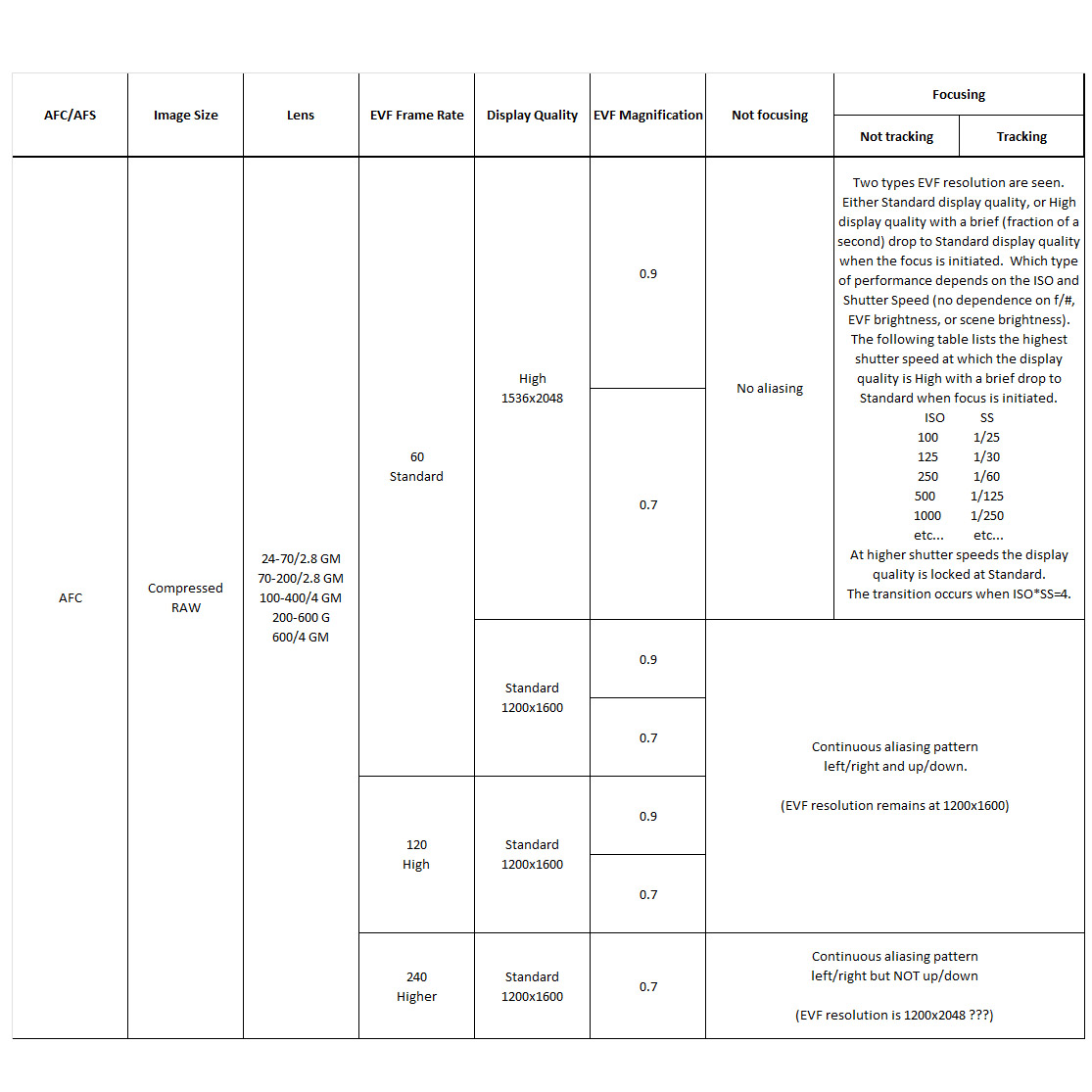
1.
Edited on Dec 19, 2024 at 08:05 PM · View previous versions
The measurements were done as described in the earlier post. A Siemens star was observed through the EVF to make it clearly visible when the EVF display quality changed. I varied the Shutter Speed (SS), ISO, F/#, and illumination of the Siemens Star to determine what camera settings operated in Mode High and which operated in Mode Standard. I found that only the SS and ISO control EVF Display Quality. The F/# and Illumination of the scene, and consequently the EVF brightness, do not matter. The transition from Mode High to Mode Standard occurs when ISO*SS=4.
This result surprises me. I have no good explanation for it. Regardless, the discussions in this thread and others are wrong. That includes my original suggestion that it had something to do with DOF.
I did not measure how the update rate of the EVF may change, only how the resolution is changing. It is clear that when the SS gets to be long it is no longer possible to maintain even 60fps, but when the transition to lower EVF update rates occur and what the rates may be has not been measured.
1.
Edited on Dec 19, 2024 at 08:05 PM · View previous versions
Dec 19, 2024 at 07:32 PM

p.5 #9A1 EVF resolution -- theoretical vs actual
dclark wrote:
As a result of some of the discussion in this thread, and some other threads that reference it, I made some additional measurements in the High Display Quality mode to determine the camera settings at which when focusing, the display quality briefly (fraction of a second) changes from High Display Quality to Standard Display Quality and then back to High Display Quality (I will call that Model High), and when focusing EVF display quality is locked into Standard Display Quality (Mode Standard). I edited table 1 in the post Page 3, #X as a result of the additional measurements. That...Show more →
Thanks for the testing and sharing these results. It is good to know how this behaves.
Dec 19, 2024 at 07:41 PM
p.5 #10A1 EVF resolution -- theoretical vs actual
dclark wrote:
As a result of some of the discussion in this thread, and some other threads that reference it, I made some additional measurements in the High Display Quality mode to determine the camera settings at which when focusing, the display quality briefly (fraction of a second) changes from High Display Quality to Standard Display Quality and then back to High Display Quality (I will call that Model High), and when focusing EVF display quality is locked into Standard Display Quality (Mode Standard). I edited table 1 in the post Page 3, #6 as a result of the additional measurements. That...Show more →
Today I tested this chart against my A1ii - unfortunately the resolution continues to drop at all of those ISO*SS=4 settings in HIGH quality mode. The behaviour is random sometimes it stays in high res until you take a shot then drops again for the next shot. Truly frustrating.
Dec 22, 2024 at 10:29 AM
p.5 #11A1 EVF resolution -- theoretical vs actual
Dentinke wrote:
The measurements were done as described in the earlier post. A Siemens star was observed through the EVF to make it clearly visible when the EVF display quality changed. I varied the Shutter Speed (SS), ISO, F/#, and illumination of the Siemens Star to determine what camera settings operated in Mode High and which operated in Mode Standard. I found that only the SS and ISO control EVF Display Quality. The F/# and Illumination of the scene, and consequently the EVF brightness, do not matter. The transition from Mode High to Mode Standard occurs when ISO*SS=4.
This result surprises me. I have no good explanation for it. Regardless, the discussions in this thread and others are wrong. That includes my original suggestion that it had something to do with DOF.
I did not measure how the update rate of the EVF may change, only how the resolution is changing. It is clear that when the SS gets to be long it is no longer possible to maintain even 60fps, but when the transition to lower EVF update rates occur and what the rates may be has not been measured.Today I tested this chart against my A1ii - unfortunately the resolution continues to drop at all of those ISO*SS=4 settings in HIGH quality mode. The behaviour is random sometimes it stays in high res until you take a shot then drops again for the next shot. Truly frustrating.
Thanks for confirming that it works the way dclark has described. Like I said earlier, you have to decide either put the EVF in standard mode in which case it won't drop in resolution and will be locked at the lower resolution or live with the drop in resolution during focussing. There is no way to keep the camera in high resolution when focussing.
dclark wrote
As a result of some of the discussion in this thread, and some other threads that reference it, I made some additional measurements in the High Display Quality mode to determine the camera settings at which when focusing, the display quality briefly (fraction of a second) changes from High Display Quality to Standard Display Quality and then back to High Display Quality (I will call that Model High), and when focusing EVF display quality is locked into Standard Display Quality (Mode Standard). I edited table 1 in the post Page 3, #6 as a result of the additional measurements. That revised table is also shown below.The measurements were done as described in the earlier post. A Siemens star was observed through the EVF to make it clearly visible when the EVF display quality changed. I varied the Shutter Speed (SS), ISO, F/#, and illumination of the Siemens Star to determine what camera settings operated in Mode High and which operated in Mode Standard. I found that only the SS and ISO control EVF Display Quality. The F/# and Illumination of the scene, and consequently the EVF brightness, do not matter. The transition from Mode High to Mode Standard occurs when ISO*SS=4.
This result surprises me. I have no good explanation for it. Regardless, the discussions in this thread and others are wrong. That includes my original suggestion that it had something to do with DOF.
I did not measure how the update rate of the EVF may change, only how the resolution is changing. It is clear that when the SS gets to be long it is no longer possible to maintain even 60fps, but when the transition to lower EVF update rates occur and what the rates may be has not been measured.
Thanks for confirming that it works the way dclark has described. Like I said earlier, you have to decide either put the EVF in standard mode in which case it won't drop in resolution and will be locked at the lower resolution or live with the drop in resolution during focussing. There is no way to keep the camera in high resolution when focussing.
Dec 22, 2024 at 11:46 AM
p.5 #12A1 EVF resolution -- theoretical vs actual
I find the dropping screen resolution (and the accompanying moire!) very distracting.
Not right on a $7,000 camera IMO.
Seems a bit of a farce to advertise 10M when people who shoot continuous AF almost never see the 10M...and also potentially see moire the whole time it's focusing.
(sometimes the moire is so bad I can't even tell if the subject is in focus until I stop focusing.)
This is why I find the Canon EVFs a better experience- they stay sharp at around 6M, never jarringly change res, and never introduce moire.
Dec 22, 2024 at 01:56 PM
p.5 #13A1 EVF resolution -- theoretical vs actual
ronno wrote:
I find the dropping screen resolution (and the accompanying moire!) very distracting.
Not right on a $7,000 camera IMO.
Seems a bit of a farce to advertise 10M when people who shoot continuous AF almost never see the 10M...and also potentially see moire the whole time it's focusing.
(sometimes the moire is so bad I can't even tell if the subject is in focus until I stop focusing.)
This is why I find the Canon EVFs a better experience- they stay sharp at around 6M, never jarringly change res, and never introduce moire.
That is not correct. You see the higher resolution when you are not focussing, but it does drop at least momentarily when you focus. That is the way it works. The Canon EVF stays at the lower resolution all the time. You can make the Sony do that too. Just set it for Standard resolution instead of High resolution. It sounds like that is what you prefer. If so, then the Sony provides no advantage, but it isn't at a disadvantage to the Canon either.
By the way, the moire is only when dclark is shooting a test chart and he is using that to allow him to see the resolution of the EVF. It is not something that happens in normal shooting except really rarely and it likely would on the Canon too.
Dec 22, 2024 at 02:44 PM
p.5 #14A1 EVF resolution -- theoretical vs actual
Steve Spencer wrote:
The measurements were done as described in the earlier post. A Siemens star was observed through the EVF to make it clearly visible when the EVF display quality changed. I varied the Shutter Speed (SS), ISO, F/#, and illumination of the Siemens Star to determine what camera settings operated in Mode High and which operated in Mode Standard. I found that only the SS and ISO control EVF Display Quality. The F/# and Illumination of the scene, and consequently the EVF brightness, do not matter. The transition from Mode High to Mode Standard occurs when ISO*SS=4.
This result surprises me. I have no good explanation for it. Regardless, the discussions in this thread and others are wrong. That includes my original suggestion that it had something to do with DOF.
I did not measure how the update rate of the EVF may change, only how the resolution is changing. It is clear that when the SS gets to be long it is no longer possible to maintain even 60fps, but when the transition to lower EVF update rates occur and what the rates may be has not been measured.Today I tested this chart against my A1ii - unfortunately the resolution continues to drop at all of those ISO*SS=4 settings in HIGH quality mode. The behaviour is random sometimes it stays in high res until you take a shot then drops again for the next shot. Truly frustrating.Thanks for confirming that it works the way dclark has described. Like I said earlier, you have to decide either put the EVF in standard mode in which case it won't drop in resolution and will be locked at the lower resolution or live with the drop in resolution during focussing. There is no way to keep the camera in high resolution when focussing.
Um , no that's not what I confirmed. I confirmed that on the A1ii the numbers in the chart for ISO and Shutter make no different to when the resolution stays high or not. Something else is causing the resolution to drop or not to drop and it is usually the type of ambient lighting in the scene - daylight or artificial light or a mix.
Dentinke wrote
dclark wrote
As a result of some of the discussion in this thread, and some other threads that reference it, I made some additional measurements in the High Display Quality mode to determine the camera settings at which when focusing, the display quality briefly (fraction of a second) changes from High Display Quality to Standard Display Quality and then back to High Display Quality (I will call that Model High), and when focusing EVF display quality is locked into Standard Display Quality (Mode Standard). I edited table 1 in the post Page 3, #6 as a result of the additional measurements. That revised table is also shown below.The measurements were done as described in the earlier post. A Siemens star was observed through the EVF to make it clearly visible when the EVF display quality changed. I varied the Shutter Speed (SS), ISO, F/#, and illumination of the Siemens Star to determine what camera settings operated in Mode High and which operated in Mode Standard. I found that only the SS and ISO control EVF Display Quality. The F/# and Illumination of the scene, and consequently the EVF brightness, do not matter. The transition from Mode High to Mode Standard occurs when ISO*SS=4.
This result surprises me. I have no good explanation for it. Regardless, the discussions in this thread and others are wrong. That includes my original suggestion that it had something to do with DOF.
I did not measure how the update rate of the EVF may change, only how the resolution is changing. It is clear that when the SS gets to be long it is no longer possible to maintain even 60fps, but when the transition to lower EVF update rates occur and what the rates may be has not been measured.
Um , no that's not what I confirmed. I confirmed that on the A1ii the numbers in the chart for ISO and Shutter make no different to when the resolution stays high or not. Something else is causing the resolution to drop or not to drop and it is usually the type of ambient lighting in the scene - daylight or artificial light or a mix.
Dec 22, 2024 at 02:56 PM
p.5 #15A1 EVF resolution -- theoretical vs actual
Steve Spencer wrote:
ronno wrote
I find the dropping screen resolution (and the accompanying moire!) very distracting.Not right on a $7,000 camera IMO.
Seems a bit of a farce to advertise 10M when people who shoot continuous AF almost never see the 10M...and also potentially see moire the whole time it's focusing.
(sometimes the moire is so bad I can't even tell if the subject is in focus until I stop focusing.)
This is why I find the Canon EVFs a better experience- they stay sharp at around 6M, never jarringly change res, and never introduce moire.
By the way, the moire is only when dclark is shooting a test chart...Show more →
My observations of moire have nothing to do with somebody shooting a test chart. I’m talking about my experience, I own the camera.
Also, the Canon at 6M looks far better than the Sony does at the lower setting. Also, as I said no moire with the Canons.
Try them side-by-side…I have both and it is obvious.
Dec 22, 2024 at 03:05 PM
p.5 #16A1 EVF resolution -- theoretical vs actual
Dentinke wrote:
The measurements were done as described in the earlier post. A Siemens star was observed through the EVF to make it clearly visible when the EVF display quality changed. I varied the Shutter Speed (SS), ISO, F/#, and illumination of the Siemens Star to determine what camera settings operated in Mode High and which operated in Mode Standard. I found that only the SS and ISO control EVF Display Quality. The F/# and Illumination of the scene, and consequently the EVF brightness, do not matter. The transition from Mode High to Mode Standard occurs when ISO*SS=4.
This result surprises me. I have no good explanation for it. Regardless, the discussions in this thread and others are wrong. That includes my original suggestion that it had something to do with DOF.
I did not measure how the update rate of the EVF may change, only how the resolution is changing. It is clear that when the SS gets to be long it is no longer possible to maintain even 60fps, but when the transition to lower EVF update rates occur and what the rates may be has not been measured.Today I tested this chart against my A1ii - unfortunately the resolution continues to drop at all of those ISO*SS=4 settings in HIGH quality mode. The behaviour is random sometimes it stays in high res until you take a shot then drops again for the next shot. Truly frustrating.Thanks for confirming that it works the way dclark has described. Like I said earlier, you have to decide either put the EVF in standard mode in which case it won't drop in resolution and will be locked at the lower resolution or live with the drop in resolution during focussing. There is no way to keep the camera in high resolution when focussing.Um , no that's not what I confirmed. I confirmed that on the A1ii the numbers in the chart for ISO and Shutter make no different to when the resolution stays high or not. Something else is causing the resolution to drop or not to drop and it is usually the type of ambient lighting in the scene - daylight or artificial light or a mix.
Can you explain more what you found then? The chart says that the resolution always drops. Sometimes just briefly if the shutter speed is slow enough and sometimes much longer if the shutter speed is fast enough. Are you finding something different, and if so what? Are you saying that in some cases the resolution doesn't drop and if so are you sure it didn't briefly drop and you just missed it? I think you and dclark are both saying that it always drops when focussing, you are just reporting different circumstances that affect how long it drops, but correct me if I am wrong. I don't doubt that you can both be right. High shutter speeds compared to ISO and the type of light could affect how long it drops, but I don't think anyone is saying it affects whether it drops.
Steve Spencer wrote
Dentinke wrote
dclark wrote
As a result of some of the discussion in this thread, and some other threads that reference it, I made some additional measurements in the High Display Quality mode to determine the camera settings at which when focusing, the display quality briefly (fraction of a second) changes from High Display Quality to Standard Display Quality and then back to High Display Quality (I will call that Model High), and when focusing EVF display quality is locked into Standard Display Quality (Mode Standard). I edited table 1 in the post Page 3, #6 as a result of the additional measurements. That revised table is also shown below.The measurements were done as described in the earlier post. A Siemens star was observed through the EVF to make it clearly visible when the EVF display quality changed. I varied the Shutter Speed (SS), ISO, F/#, and illumination of the Siemens Star to determine what camera settings operated in Mode High and which operated in Mode Standard. I found that only the SS and ISO control EVF Display Quality. The F/# and Illumination of the scene, and consequently the EVF brightness, do not matter. The transition from Mode High to Mode Standard occurs when ISO*SS=4.
This result surprises me. I have no good explanation for it. Regardless, the discussions in this thread and others are wrong. That includes my original suggestion that it had something to do with DOF.
I did not measure how the update rate of the EVF may change, only how the resolution is changing. It is clear that when the SS gets to be long it is no longer possible to maintain even 60fps, but when the transition to lower EVF update rates occur and what the rates may be has not been measured.
Can you explain more what you found then? The chart says that the resolution always drops. Sometimes just briefly if the shutter speed is slow enough and sometimes much longer if the shutter speed is fast enough. Are you finding something different, and if so what? Are you saying that in some cases the resolution doesn't drop and if so are you sure it didn't briefly drop and you just missed it? I think you and dclark are both saying that it always drops when focussing, you are just reporting different circumstances that affect how long it drops, but correct me if I am wrong. I don't doubt that you can both be right. High shutter speeds compared to ISO and the type of light could affect how long it drops, but I don't think anyone is saying it affects whether it drops.
Dec 22, 2024 at 03:05 PM
p.5 #17A1 EVF resolution -- theoretical vs actual
Dentinke wrote:
The measurements were done as described in the earlier post. A Siemens star was observed through the EVF to make it clearly visible when the EVF display quality changed. I varied the Shutter Speed (SS), ISO, F/#, and illumination of the Siemens Star to determine what camera settings operated in Mode High and which operated in Mode Standard. I found that only the SS and ISO control EVF Display Quality. The F/# and Illumination of the scene, and consequently the EVF brightness, do not matter. The transition from Mode High to Mode Standard occurs when ISO*SS=4.
This result surprises me. I have no good explanation for it. Regardless, the discussions in this thread and others are wrong. That includes my original suggestion that it had something to do with DOF.
I did not measure how the update rate of the EVF may change, only how the resolution is changing. It is clear that when the SS gets to be long it is no longer possible to maintain even 60fps, but when the transition to lower EVF update rates occur and what the rates may be has not been measured.Today I tested this chart against my A1ii - unfortunately the resolution continues to drop at all of those ISO*SS=4 settings in HIGH quality mode. The behaviour is random sometimes it stays in high res until you take a shot then drops again for the next shot. Truly frustrating.Thanks for confirming that it works the way dclark has described. Like I said earlier, you have to decide either put the EVF in standard mode in which case it won't drop in resolution and will be locked at the lower resolution or live with the drop in resolution during focussing. There is no way to keep the camera in high resolution when focussing.Um , no that's not what I confirmed. I confirmed that on the A1ii the numbers in the chart for ISO and Shutter make no different to when the resolution stays high or not. Something else is causing the resolution to drop or not to drop and it is usually the type of ambient lighting in the scene - daylight or artificial light or a mix.
I will have an A1II shortly. I will test it using the same methodology so we have a comparison of the A1 and the A1II.
Steve Spencer wrote
Dentinke wrote
dclark wrote
As a result of some of the discussion in this thread, and some other threads that reference it, I made some additional measurements in the High Display Quality mode to determine the camera settings at which when focusing, the display quality briefly (fraction of a second) changes from High Display Quality to Standard Display Quality and then back to High Display Quality (I will call that Model High), and when focusing EVF display quality is locked into Standard Display Quality (Mode Standard). I edited table 1 in the post Page 3, #6 as a result of the additional measurements. That revised table is also shown below.The measurements were done as described in the earlier post. A Siemens star was observed through the EVF to make it clearly visible when the EVF display quality changed. I varied the Shutter Speed (SS), ISO, F/#, and illumination of the Siemens Star to determine what camera settings operated in Mode High and which operated in Mode Standard. I found that only the SS and ISO control EVF Display Quality. The F/# and Illumination of the scene, and consequently the EVF brightness, do not matter. The transition from Mode High to Mode Standard occurs when ISO*SS=4.
This result surprises me. I have no good explanation for it. Regardless, the discussions in this thread and others are wrong. That includes my original suggestion that it had something to do with DOF.
I did not measure how the update rate of the EVF may change, only how the resolution is changing. It is clear that when the SS gets to be long it is no longer possible to maintain even 60fps, but when the transition to lower EVF update rates occur and what the rates may be has not been measured.
I will have an A1II shortly. I will test it using the same methodology so we have a comparison of the A1 and the A1II.
Dec 22, 2024 at 03:07 PM
p.5 #18A1 EVF resolution -- theoretical vs actual
ronno wrote:
Not right on a $7,000 camera IMO.
Seems a bit of a farce to advertise 10M when people who shoot continuous AF almost never see the 10M...and also potentially see moire the whole time it's focusing.
(sometimes the moire is so bad I can't even tell if the subject is in focus until I stop focusing.)
This is why I find the Canon EVFs a better experience- they stay sharp at around 6M, never jarringly change res, and never introduce moire.That is not correct. You see the higher resolution when you are not focussing, but it does drop at least momentarily when you focus. That is the way it works. The Canon EVF stays at the lower resolution all the time. You can make the Sony do that too. Just set it for Standard resolution instead of High resolution. It sounds like that is what you prefer. If so, then the Sony provides no advantage, but it isn't at a disadvantage to the Canon either.
By the way, the moire is only when dclark is shooting a test chart and he is using that to allow him to see the resolution of the EVF. It is not something that happens in normal shooting except really rarely and it likely would on the Canon too.My observations of moire have nothing to do with somebody shooting a test chart. I’m talking about my experience, I own the camera.
Also, the Canon at 6M looks far better than the Sony does at the lower setting. Also, as I said no moire with the Canons.
Try them side-by-side…I have both and it is obvious.
I have and I literally see it differently. I much prefer the Sony EVF and I don't see moire in shooting as I said above. None of us should assume that what we see is the same experience that everyone else has.
Steve Spencer wrote
ronno wrote
I find the dropping screen resolution (and the accompanying moire!) very distracting.Not right on a $7,000 camera IMO.
Seems a bit of a farce to advertise 10M when people who shoot continuous AF almost never see the 10M...and also potentially see moire the whole time it's focusing.
(sometimes the moire is so bad I can't even tell if the subject is in focus until I stop focusing.)
This is why I find the Canon EVFs a better experience- they stay sharp at around 6M, never jarringly change res, and never introduce moire.
By the way, the moire is only when dclark is shooting a test chart and he is using that to allow him to see the resolution of the EVF. It is not something that happens in normal shooting except really rarely and it likely would on the Canon too.
Also, the Canon at 6M looks far better than the Sony does at the lower setting. Also, as I said no moire with the Canons.
Try them side-by-side…I have both and it is obvious.
I have and I literally see it differently. I much prefer the Sony EVF and I don't see moire in shooting as I said above. None of us should assume that what we see is the same experience that everyone else has.
Dec 22, 2024 at 03:07 PM
p.5 #19A1 EVF resolution -- theoretical vs actual
Steve Spencer wrote:
Not right on a $7,000 camera IMO.
Seems a bit of a farce to advertise 10M when people who shoot continuous AF almost never see the 10M...and also potentially see moire the whole time it's focusing.
(sometimes the moire is so bad I can't even tell if the subject is in focus until I stop focusing.)
This is why I find the Canon EVFs a better experience- they stay sharp at around 6M, never jarringly change res, and never introduce moire.That is not correct. You see the higher resolution when you are not focussing, but it does drop at least momentarily when you focus.
And thus if you focus continuously while shooting (as many people do with these high fps cameras!), then it's fuzzy the whole time.
The Canon at 6M is not fuzzy, nor inducing moire.
ronno wrote
I find the dropping screen resolution (and the accompanying moire!) very distracting.Not right on a $7,000 camera IMO.
Seems a bit of a farce to advertise 10M when people who shoot continuous AF almost never see the 10M...and also potentially see moire the whole time it's focusing.
(sometimes the moire is so bad I can't even tell if the subject is in focus until I stop focusing.)
This is why I find the Canon EVFs a better experience- they stay sharp at around 6M, never jarringly change res, and never introduce moire.
And thus if you focus continuously while shooting (as many people do with these high fps cameras!), then it's fuzzy the whole time.
The Canon at 6M is not fuzzy, nor inducing moire.
Dec 22, 2024 at 03:17 PM
p.5 #20A1 EVF resolution -- theoretical vs actual
ronno wrote:
Not right on a $7,000 camera IMO.
Seems a bit of a farce to advertise 10M when people who shoot continuous AF almost never see the 10M...and also potentially see moire the whole time it's focusing.
(sometimes the moire is so bad I can't even tell if the subject is in focus until I stop focusing.)
This is why I find the Canon EVFs a better experience- they stay sharp at around 6M, never jarringly change res, and never introduce moire.That is not correct. You see the higher resolution when you are not focussing, but it does drop at least momentarily when you focus.
And thus if you focus continuously while shooting (as many people do with these high fps cameras!), then it's fuzzy the whole time.
The Canon at 6M is not fuzzy, nor inducing moire.
No it isn't fuzzy to my eye, it is just lower resolution (than the High resolution setting and not lower resolution than the Canon) and as I have said repeatedly I don't see any moire in regular shooting except very rarely. Again don't assume what you see is what other people see.
Steve Spencer wrote
ronno wrote
I find the dropping screen resolution (and the accompanying moire!) very distracting.Not right on a $7,000 camera IMO.
Seems a bit of a farce to advertise 10M when people who shoot continuous AF almost never see the 10M...and also potentially see moire the whole time it's focusing.
(sometimes the moire is so bad I can't even tell if the subject is in focus until I stop focusing.)
This is why I find the Canon EVFs a better experience- they stay sharp at around 6M, never jarringly change res, and never introduce moire.
And thus if you focus continuously while shooting (as many people do with these high fps cameras!), then it's fuzzy the whole time.
The Canon at 6M is not fuzzy, nor inducing moire.
No it isn't fuzzy to my eye, it is just lower resolution (than the High resolution setting and not lower resolution than the Canon) and as I have said repeatedly I don't see any moire in regular shooting except very rarely. Again don't assume what you see is what other people see.
Dec 22, 2024 at 03:20 PM