snapsy
Online
• • • • • •
Upload & Sell: On
|
 p.3 #8 · A1 EVF resolution -- theoretical vs actual p.3 #8 · A1 EVF resolution -- theoretical vs actual | |
dclark wrote:
A few days ago I was shooting some test shots with the A1 and noticed that the EVF display of fabric on a patio chair started showing aliasing when I was focusing. That can be an indication that the camera has reduced EVF resolution so I decided to make some measurements.
There have been lots of reports that the EVF resolution changed when focusing, including some in this thread. There have been claims and speculations that when focusing the resolution of the EVF can drop below the "Standard" resolution (i.e. the lowest specified EVF resolution).
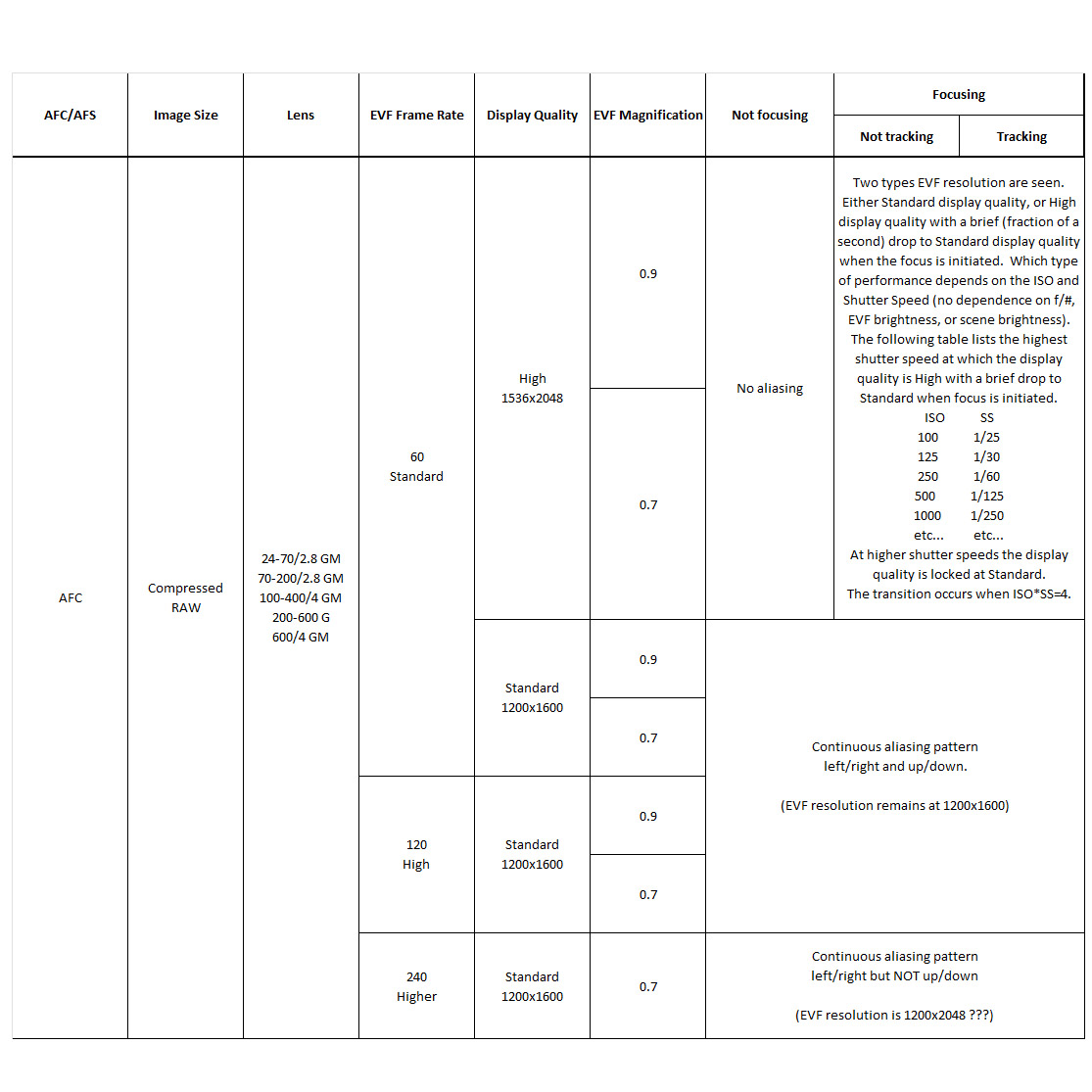
To see if the EVF resolution is changing, I observed changes in the EVF display while focusing on a binary Siemens Star chart. I mounted the chart on a stand and the camera and lens on a tripod and shot using a small focus spot in tracking and non-tracking mode. I checked the EVF display for all the possible combinations of EVF frame rate, EVF Display quality and EVF magnification. I used a few lenses, and looked for changes in the EVF resolution as the shooting parameters changed (PASM mode, shutter speed, f/#, ISO), I was somewhat surprised by the results, which are summarized in the table below.
I see no evidence focusing in tracking or non-tracking mode makes any difference.
I did not see any case where EVF magnification makes a difference.
I do not see any dependence on the lens used (other than DOF issues as discussed below).
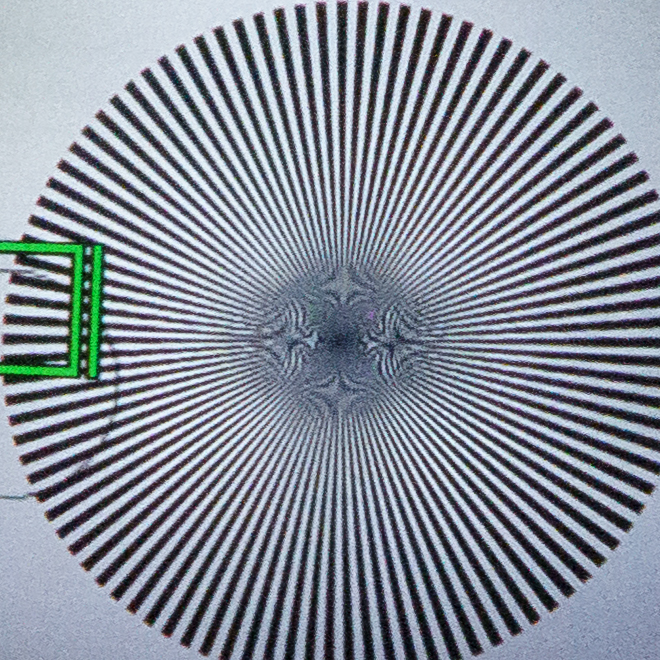
When using Display Quality Standard resolution (5.76Mdot, 1200x1600) I see no indication the resolution changes between non-focusing and focusing. There is a stable pattern in the Siemens Star pattern that does not change (see example in figure 3 below), whether focusing or not. If the resolution was reduced the pattern would visibly move further out the star pattern. There have been claims and speculation that the EVF goes into a lower res mode than 1200x1600, but that seems to be wrong.
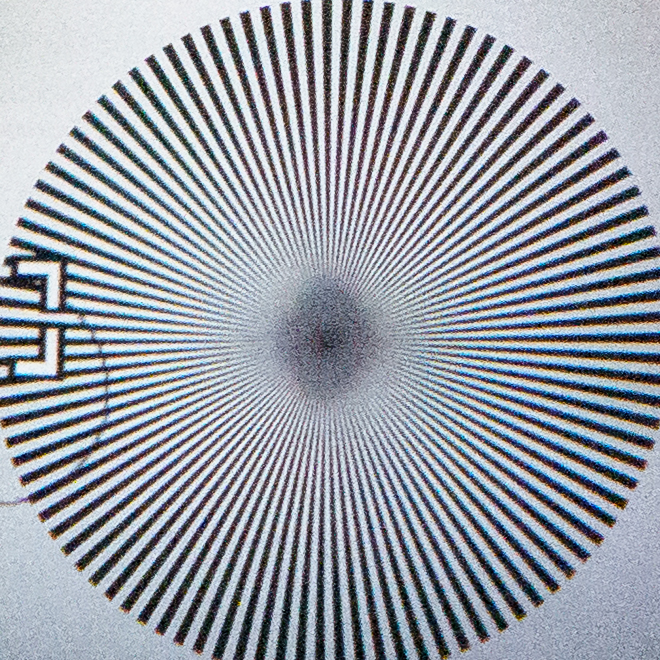
When operating in Display Quality High (9.44Mdot, 1536x2048), it gets interesting and and a bit more complicated. When not focusing, the Siemens Star display is static and there is no significant aliasing showing (see figure 2), which is characteristic of the high resolution mode of the EVF. There is of course some aliasing at the center but it well inside the area where aliasing is seen in Display Quality Standard, so I enter that in the table below as "No aliasing". When the shutter is half=pressed to start focusing, there are two ways the EVF display responds. When focusing is initiated, the star pattern quickly changes to a pattern that appears to be identical to the pattern seen when in Display Quality Standard. That low resolution aliasing pattern either quickly (fraction of a second) returns to the high resolution pattern (even though focusing continues) or continues for as long as focusing continues. Which type of response occurs depends on the f/# and focus distance.
The low resolution aliasing pattern lasts only briefly, unless the f/# is small and the distance close. That seems to indicate the camera is computing the DOF and responding based on that. If the DOF is shallow, the EVF resolution is reduced to Standard (1200x1600) and stays there as long as focusing continues. If the DOF is larger, the EVF resolution is briefly reduced to Standard and then returns to High resolution even though focusing continues. It is left as an exercise for the reader to speculate why. My speculation is that when the DOF is shallow the camera needs more computational bandwidth to compute focus and transmit signals to the lens, and steals bandwidth from EVF updates. That leads to speculation whether the camera operates at the full 120/sec focus updates in all situations. Let the speculation begin!
In a prior comment in this thread, speedmaster20d showed a video showing an example of the aliasing pattern (using a different chart) changing to a low res pattern and staying there as long as focusing continued. Although he did not give all the parameters, you can see that he was in manual mode shooting at f/1.8. That would be consistent with the above idea that shallow DOF keeps the EVF in low res mode. If he had increased the f/#, he would have seen a transition to the mode where the EVF resolution is briefly reduced and then returns to high resolution.
The response in Display Quality High was a surprise, but the response when EVF refresh rate was set to "Higher" (i.e. EVF updates at 240/sec) surprised me even more. When EVF updates is set to 240/sec, the Siemens Star alias pattern is similar to the other modes for Display Quality Standard, except that the aliasing patterns are only present on the left and right side, indicating aliasing of horizontal lines, and not at the symmetric top and bottom positions as had been the case for all the other Display Quality Standard cases. That baffles me! I tried all kinds of changes but never got any other result. That's a surprise for which I have no explanation or even a speculation. It seems to imply that the EVF resolution was reduced in the vertical direction but not the horizontal direction, which I find too bizarre to believe.
There is one other case that I do not understand. That is the Display Quality High, Magnification 0.7, mode. I assume the way the magnification is changed is by truncating the EVF OLED display. I have worked out all the methods of scaling the sensor resolution down to the EVF display resolution, and in some cases back up to display Standard at 0.9X magnification, but I see no way to display 1536x2048 on a truncated OLED. If anyone has figured that out, or has an alternative way to achieve 1536x2048 display at magnification 0.9, I would appreciate seeing how it can be done.
Sorry about the long post.
Dave
...Show more →
Fantastic work Dave. The effects you're observing on the EVF for the scenarios you tried are likely the result of the sensor readout being altered while focusing to increase the readout rate and thus supply more samples to the AF system. This likely means switching to a binned or line skipped mode. The axis-specific aliasing for the 240fps mode is probably a secondary binning/line skipping mode that further compromises the sensor resolution that's fed to the EVF, although it might also indicate an altered readout strategy related to the horizontally-arranged PDAF pixels/rows.
The DOF-specific behavior is intriguing. If I had to guess I'd say the focusing system is altering its sampling rate based on what it feels is necessary. With large DOF the camera can allow itself to react to subject movement and changes more slowly before risking losing focus, thus can get by with a lower sampling rate, with the converse being true for smaller DOF. There's also a small possibility the difference relates to the efficacy of the phase AF pixels at various apertures.
|



 .
.