This topic is in the 2021 archive. You can read it and like its posts here. It is read only.
Archive 2021Sony 35 GM vs Sigma 35 f2 DG DN
p.4 #1Sony 35 GM vs Sigma 35 f2 DG DN
Chris Crevasse wrote:
Mystik wrote
Both were shot at F2 so the difference you are seeing is a matter of the wider FOV shooting from the same position. Wider FOV, means narrower DOF from the same shooting distance. You can of course make up the difference by stepping closer and getting an equivalent subject framing....by shooting from a closer distance, you get higher degree of blur.This applies to the samples provided by the OP as well.
Edit: OP congrats on the baby!
Yes wider. Sorry misspoke
Feb 22, 2021 at 06:52 PM
p.4 #2Sony 35 GM vs Sigma 35 f2 DG DN
tsdevine wrote:
Forgetting the Sigma's field curvature, talking lenses in general, it would seem optical vignetting in the corners is a restriction of the projected image on the sensor, not completely different than when you partially close aperture blades. So I find it interesting that one increases depth of field, and the other doesn't.
I have so much to learn about optics....thanks Fred.
For example, I think my CV 65 sharpens up in the corners at wider apertures compared to my Sigma 65. I also see more optical vignetting in the CV compared to the Sigma....is that just pure coincidence?
However, away from center (off-axis), the blur difference is even more pronounced since the GM's rendering is more homogenous (smooth across the frame) while images from the Sigma wide open tend to sharpen up towards the corners at mid-distance. (Common with 35mm primes)At infinity, the Sigma 35/2 DG DN is indeed flat-field but at closer distance (2-5m), there is rearward FC which may cause the further away OOF corners to be "more in focus" compared to the center area.
I believe that optical vignetting mainly affects the shape of the specular highlights but also causes DOF changes.
But optical vignetting does cause an increase in DOF in the corners, with a resultant effect on bokeh...
Forgetting the Sigma's field curvature, talking lenses in general, it would seem optical vignetting in the corners is a restriction of the projected image on the sensor, not completely different than when you partially close aperture blades. So I find it interesting that one increases depth of field, and the other doesn't.
I have so much to learn about optics....thanks Fred.
Fred Miranda wrote
tsdevine wrote
If both lenses are flat field (big assumption), is the same property that causes cat's eye (optical vignetting) also apt to cause the same lenses to sharpen up in the corners more, as you describe? In other words can you predict the apparent sharpening of corners by looking at how much optical vignetting is exhibited by a lens? Is there any correlation, and if so, are there other factors that can make it better or worse?For example, I think my CV 65 sharpens up in the corners at wider apertures compared to my Sigma 65. I also see more optical vignetting in the CV compared to the Sigma....is that just pure coincidence?
Fred Miranda wrote
The GM is slightly narrower in FOV and that impacts the amount of "blur" when comparing both lenses at same distance and aperture. So, from this comparison, it's expected to see a bit more blur from the 35/1.4 GM @f/2 around the center area.However, away from center (off-axis), the blur difference is even more pronounced since the GM's rendering is more homogenous (smooth across the frame) while images from the Sigma wide open tend to sharpen up towards the corners at mid-distance. (Common with 35mm primes)
I believe that optical vignetting mainly affects the shape of the specular highlights but also causes DOF changes.
But optical vignetting does cause an increase in DOF in the corners, with a resultant effect on bokeh...
Feb 22, 2021 at 08:07 PM
p.4 #3Sony 35 GM vs Sigma 35 f2 DG DN
Ah, so I was right (maybe not in this specific case, but in general)?
DavidBM wrote:
tsdevine wrote
Forgetting the Sigma's field curvature, talking lenses in general, it would seem optical vignetting in the corners is a restriction of the projected image on the sensor, not completely different than when you partially close aperture blades. So I find it interesting that one increases depth of field, and the other doesn't.I have so much to learn about optics....thanks Fred.
Fred Miranda wrote
tsdevine wrote
If both lenses are flat field (big assumption), is the same property that causes cat's eye (optical vignetting) also apt to cause the same lenses to sharpen up in the corners more, as you describe? In other words can you predict the apparent sharpening of corners by looking at how much optical vignetting is exhibited by a lens? Is there any correlation, and if so, are there other factors that can make it better or worse?For example, I think my CV 65 sharpens up in the corners at wider apertures compared to my Sigma 65. I also see more optical vignetting in the CV compared to the Sigma....is that just pure coincidence?
Fred Miranda wrote
The GM is slightly narrower in FOV and that impacts the amount of "blur" when comparing both lenses at same distance and aperture. So, from this comparison, it's expected to see a bit more blur from the 35/1.4 GM @f/2 around the center area.However, away from center (off-axis), the blur difference is even more pronounced since the GM's rendering is more homogenous (smooth across the frame) while images from the Sigma wide open tend to sharpen up towards the corners at mid-distance. (Common with 35mm primes)
I believe that optical vignetting mainly affects the shape of the specular highlights but also causes DOF changes.
Feb 22, 2021 at 08:09 PM
p.4 #4Sony 35 GM vs Sigma 35 f2 DG DN
tsdevine wrote:
Ah, so I was right (maybe not in this specific case, but in general)?
I have so much to learn about optics....thanks Fred.
For example, I think my CV 65 sharpens up in the corners at wider apertures compared to my Sigma 65. I also see more optical vignetting in the CV compared to the Sigma....is that just pure coincidence?
However, away from center (off-axis), the blur difference is even more pronounced since the GM's rendering is more homogenous (smooth across the frame) while images from the Sigma wide open tend to sharpen up towards the corners at mid-distance. (Common with 35mm primes)At infinity, the Sigma 35/2 DG DN is indeed flat-field but at closer distance (2-5m), there is rearward FC which may cause the further away OOF corners to be "more in focus" compared to the center area.
I believe that optical vignetting mainly affects the shape of the specular highlights but also causes DOF changes.But optical vignetting does cause an increase in DOF in the corners, with a resultant effect on bokeh...
I think it's a combination of FC and optical vignetting. Depending on distance, the Sigma 35/2 at f/2 can have corners that look like they were shot at f/2.8-3.2
Here is the link showing the FC at close distance (about 2.5m):
https://www.fredmiranda.com/forum/topic/1686080/0#15492664
Ah, so I was right (maybe not in this specific case, but in general)?
DavidBM wrote
tsdevine wrote
Forgetting the Sigma's field curvature, talking lenses in general, it would seem optical vignetting in the corners is a restriction of the projected image on the sensor, not completely different than when you partially close aperture blades. So I find it interesting that one increases depth of field, and the other doesn't.I have so much to learn about optics....thanks Fred.
Fred Miranda wrote
tsdevine wrote
If both lenses are flat field (big assumption), is the same property that causes cat's eye (optical vignetting) also apt to cause the same lenses to sharpen up in the corners more, as you describe? In other words can you predict the apparent sharpening of corners by looking at how much optical vignetting is exhibited by a lens? Is there any correlation, and if so, are there other factors that can make it better or worse?For example, I think my CV 65 sharpens up in the corners at wider apertures compared to my Sigma 65. I also see more optical vignetting in the CV compared to the Sigma....is that just pure coincidence?
Fred Miranda wrote
The GM is slightly narrower in FOV and that impacts the amount of "blur" when comparing both lenses at same distance and aperture. So, from this comparison, it's expected to see a bit more blur from the 35/1.4 GM @f/2 around the center area.However, away from center (off-axis), the blur difference is even more pronounced since the GM's rendering is more homogenous (smooth across the frame) while images from the Sigma wide open tend to sharpen up towards the corners at mid-distance. (Common with 35mm primes)
I believe that optical vignetting mainly affects the shape of the specular highlights but also causes DOF changes.
I think it's a combination of FC and optical vignetting. Depending on distance, the Sigma 35/2 at f/2 can have corners that look like they were shot at f/2.8-3.2
Here is the link showing the FC at close distance (about 2.5m):
https://www.fredmiranda.com/forum/topic/1686080/0#15492664
Feb 22, 2021 at 08:23 PM
p.4 #5Sony 35 GM vs Sigma 35 f2 DG DN
Interesting to see that GM has smoother bokeh @ f/2 than Sigma 35I and Bigma has smoother bokeh @ f/1.4 than GM. IMO Bigma wins on bokeh / rendering and GM wins on sharpness. Both lenses are extremely good.
Edited on Feb 22, 2021 at 08:54 PM · View previous versions
Edited on Feb 22, 2021 at 08:54 PM · View previous versions
Feb 22, 2021 at 08:29 PM
p.4 #6Sony 35 GM vs Sigma 35 f2 DG DN
DavidBM wrote:
I have so much to learn about optics....thanks Fred.
For example, I think my CV 65 sharpens up in the corners at wider apertures compared to my Sigma 65. I also see more optical vignetting in the CV compared to the Sigma....is that just pure coincidence?
However, away from center (off-axis), the blur difference is even more pronounced since the GM's rendering is more homogenous (smooth across the frame) while images from the Sigma wide open tend to sharpen up towards the corners at mid-distance. (Common with 35mm primes)At infinity, the Sigma 35/2 DG DN is indeed flat-field but at closer distance (2-5m), there is rearward FC which may cause the further away OOF corners to be "more in focus" compared to the center area.
I believe that optical vignetting mainly affects the shape of the specular highlights but also causes DOF changes.But optical vignetting does cause an increase in DOF in the corners, with a resultant effect on bokeh...
---------------------------------------------
tsdevine wrote:
Ah, so I was right (maybe not in this specific case, but in general)?
I have so much to learn about optics....thanks Fred.
For example, I think my CV 65 sharpens up in the corners at wider apertures compared to my Sigma 65. I also see more optical vignetting in the CV compared to the Sigma....is that just pure coincidence?
However, away from center (off-axis), the blur difference is even more pronounced since the GM's rendering is more homogenous (smooth across the frame) while images from the Sigma wide open tend to sharpen up towards the corners at mid-distance. (Common with 35mm primes)At infinity, the Sigma 35/2 DG DN is indeed flat-field but at closer distance (2-5m), there is rearward FC which may cause the further away OOF corners to be "more in focus" compared to the center area.
I believe that optical vignetting mainly affects the shape of the specular highlights but also causes DOF changes.But optical vignetting does cause an increase in DOF in the corners, with a resultant effect on bokeh...
Here is an example showing changes in DOF towards the the corners compared to the out of focus center when the subject if focused at mid-distance:
Entire scene
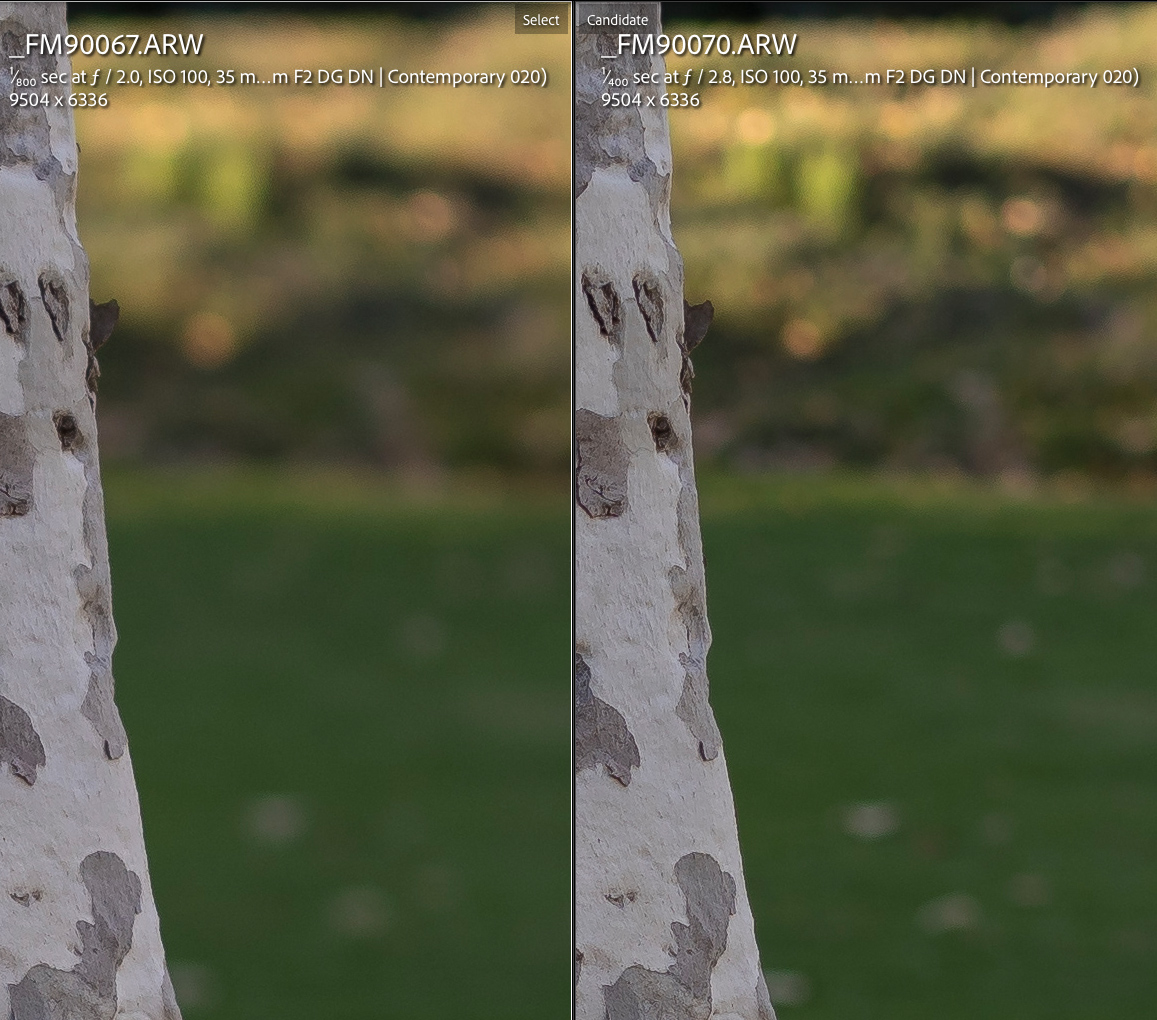
Around the center area: f/2 vs f/2.8
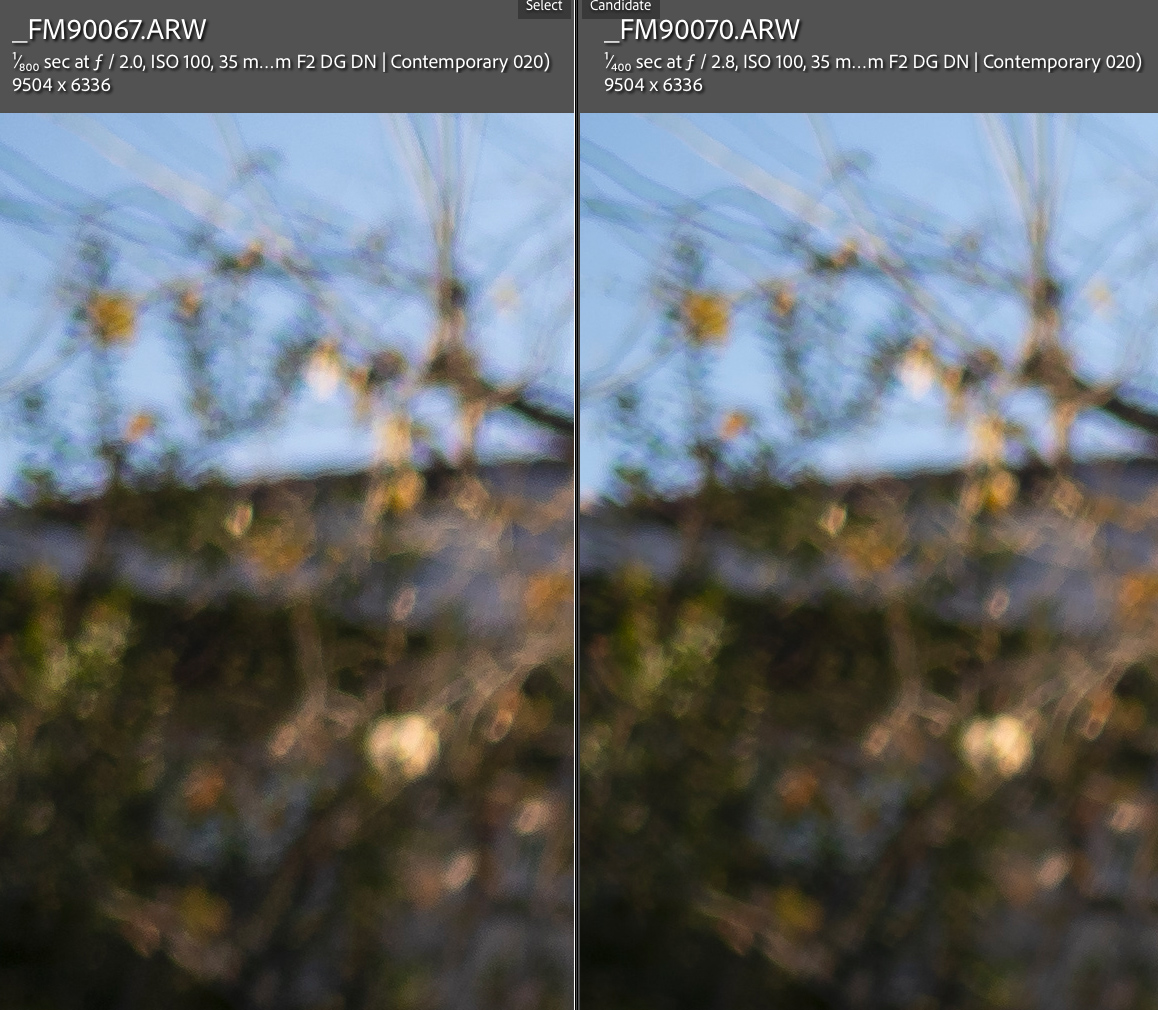
At upper right corner (1:1): The f/2 crop looks similar to f/2.8 due to increase in DOF towards the corners. (likely caused by FC + OV)
tsdevine wrote
Forgetting the Sigma's field curvature, talking lenses in general, it would seem optical vignetting in the corners is a restriction of the projected image on the sensor, not completely different than when you partially close aperture blades. So I find it interesting that one increases depth of field, and the other doesn't.I have so much to learn about optics....thanks Fred.
Fred Miranda wrote
tsdevine wrote
If both lenses are flat field (big assumption), is the same property that causes cat's eye (optical vignetting) also apt to cause the same lenses to sharpen up in the corners more, as you describe? In other words can you predict the apparent sharpening of corners by looking at how much optical vignetting is exhibited by a lens? Is there any correlation, and if so, are there other factors that can make it better or worse?For example, I think my CV 65 sharpens up in the corners at wider apertures compared to my Sigma 65. I also see more optical vignetting in the CV compared to the Sigma....is that just pure coincidence?
Fred Miranda wrote
The GM is slightly narrower in FOV and that impacts the amount of "blur" when comparing both lenses at same distance and aperture. So, from this comparison, it's expected to see a bit more blur from the 35/1.4 GM @f/2 around the center area.However, away from center (off-axis), the blur difference is even more pronounced since the GM's rendering is more homogenous (smooth across the frame) while images from the Sigma wide open tend to sharpen up towards the corners at mid-distance. (Common with 35mm primes)
I believe that optical vignetting mainly affects the shape of the specular highlights but also causes DOF changes.
---------------------------------------------
tsdevine wrote:
Ah, so I was right (maybe not in this specific case, but in general)?
DavidBM wrote
tsdevine wrote
Forgetting the Sigma's field curvature, talking lenses in general, it would seem optical vignetting in the corners is a restriction of the projected image on the sensor, not completely different than when you partially close aperture blades. So I find it interesting that one increases depth of field, and the other doesn't.I have so much to learn about optics....thanks Fred.
Fred Miranda wrote
tsdevine wrote
If both lenses are flat field (big assumption), is the same property that causes cat's eye (optical vignetting) also apt to cause the same lenses to sharpen up in the corners more, as you describe? In other words can you predict the apparent sharpening of corners by looking at how much optical vignetting is exhibited by a lens? Is there any correlation, and if so, are there other factors that can make it better or worse?For example, I think my CV 65 sharpens up in the corners at wider apertures compared to my Sigma 65. I also see more optical vignetting in the CV compared to the Sigma....is that just pure coincidence?
Fred Miranda wrote
The GM is slightly narrower in FOV and that impacts the amount of "blur" when comparing both lenses at same distance and aperture. So, from this comparison, it's expected to see a bit more blur from the 35/1.4 GM @f/2 around the center area.However, away from center (off-axis), the blur difference is even more pronounced since the GM's rendering is more homogenous (smooth across the frame) while images from the Sigma wide open tend to sharpen up towards the corners at mid-distance. (Common with 35mm primes)
I believe that optical vignetting mainly affects the shape of the specular highlights but also causes DOF changes.
Here is an example showing changes in DOF towards the the corners compared to the out of focus center when the subject if focused at mid-distance:
 |
||
 |
||
|
Entire scene
Around the center area: f/2 vs f/2.8
At upper right corner (1:1): The f/2 crop looks similar to f/2.8 due to increase in DOF towards the corners. (likely caused by FC + OV)
Feb 22, 2021 at 08:33 PM
p.4 #7Sony 35 GM vs Sigma 35 f2 DG DN
Yes, makes perfect sense that field curvature could cause this, along with OV which I thought in theory might increase DoF.
Feb 22, 2021 at 08:39 PM
p.4 #8Sony 35 GM vs Sigma 35 f2 DG DN
Fred Miranda wrote:
I have so much to learn about optics....thanks Fred.
For example, I think my CV 65 sharpens up in the corners at wider apertures compared to my Sigma 65. I also see more optical vignetting in the CV compared to the Sigma....is that just pure coincidence?
However, away from center (off-axis), the blur difference is even more pronounced since the GM's rendering is more homogenous (smooth across the frame) while images from the Sigma wide open tend to sharpen up towards the corners at mid-distance. (Common with 35mm primes)At infinity, the Sigma 35/2 DG DN is indeed flat-field but at closer distance (2-5m), there is rearward FC which may cause the further away OOF corners to be "more in focus" compared to the center area.
I believe that optical vignetting mainly affects the shape of the specular highlights but also causes DOF changes.But optical vignetting does cause an increase in DOF in the corners, with a resultant effect on bokeh...---------------------------------------------
I have so much to learn about optics....thanks Fred.
For example, I think my CV 65 sharpens up in the corners at wider apertures compared to my Sigma 65. I also see more optical vignetting in the CV compared to the Sigma....is that just pure coincidence?At infinity, the Sigma 35/2 DG DN is indeed flat-field but at closer distance (2-5m), there is rearward FC which may cause the further away OOF corners to be "more in focus" compared to the center area.
I believe that optical vignetting mainly affects the shape of the specular highlights but also causes DOF changes.But optical vignetting does cause an increase in DOF in the corners, with a resultant effect on bokeh...Here is an example showing changes in DOF towards the the corners compared to the out of focus center when the subject if focused at mid-distance:
Fred, How come it doesn't do this with other lenses like Bigma 35? Bokeh balls on Bigma suggests that it has optical vignetting, but corners don't seem to get sharp, as seen in this example. Sharp corner almost make it look like a fake computational photography bokeh.
DavidBM wrote
tsdevine wrote
Forgetting the Sigma's field curvature, talking lenses in general, it would seem optical vignetting in the corners is a restriction of the projected image on the sensor, not completely different than when you partially close aperture blades. So I find it interesting that one increases depth of field, and the other doesn't.I have so much to learn about optics....thanks Fred.
Fred Miranda wrote
tsdevine wrote
If both lenses are flat field (big assumption), is the same property that causes cat's eye (optical vignetting) also apt to cause the same lenses to sharpen up in the corners more, as you describe? In other words can you predict the apparent sharpening of corners by looking at how much optical vignetting is exhibited by a lens? Is there any correlation, and if so, are there other factors that can make it better or worse?For example, I think my CV 65 sharpens up in the corners at wider apertures compared to my Sigma 65. I also see more optical vignetting in the CV compared to the Sigma....is that just pure coincidence?
Fred Miranda wrote
The GM is slightly narrower in FOV and that impacts the amount of "blur" when comparing both lenses at same distance and aperture. So, from this comparison, it's expected to see a bit more blur from the 35/1.4 GM @f/2 around the center area.However, away from center (off-axis), the blur difference is even more pronounced since the GM's rendering is more homogenous (smooth across the frame) while images from the Sigma wide open tend to sharpen up towards the corners at mid-distance. (Common with 35mm primes)
I believe that optical vignetting mainly affects the shape of the specular highlights but also causes DOF changes.
tsdevine wrote
Ah, so I was right (maybe not in this specific case, but in general)?DavidBM wrote
tsdevine wrote
Forgetting the Sigma's field curvature, talking lenses in general, it would seem optical vignetting in the corners is a restriction of the projected image on the sensor, not completely different than when you partially close aperture blades. So I find it interesting that one increases depth of field, and the other doesn't.I have so much to learn about optics....thanks Fred.
Fred Miranda wrote
tsdevine wrote
If both lenses are flat field (big assumption), is the same property that causes cat's eye (optical vignetting) also apt to cause the same lenses to sharpen up in the corners more, as you describe? In other words can you predict the apparent sharpening of corners by looking at how much optical vignetting is exhibited by a lens? Is there any correlation, and if so, are there other factors that can make it better or worse?For example, I think my CV 65 sharpens up in the corners at wider apertures compared to my Sigma 65. I also see more optical vignetting in the CV compared to the Sigma....is that just pure coincidence?
I believe that optical vignetting mainly affects the shape of the specular highlights but also causes DOF changes.
Fred, How come it doesn't do this with other lenses like Bigma 35? Bokeh balls on Bigma suggests that it has optical vignetting, but corners don't seem to get sharp, as seen in this example. Sharp corner almost make it look like a fake computational photography bokeh.
Feb 22, 2021 at 08:52 PM
p.4 #9Sony 35 GM vs Sigma 35 f2 DG DN
ramesesthe2nd wrote:
I have so much to learn about optics....thanks Fred.
For example, I think my CV 65 sharpens up in the corners at wider apertures compared to my Sigma 65. I also see more optical vignetting in the CV compared to the Sigma....is that just pure coincidence?At infinity, the Sigma 35/2 DG DN is indeed flat-field but at closer distance (2-5m), there is rearward FC which may cause the further away OOF corners to be "more in focus" compared to the center area.
I believe that optical vignetting mainly affects the shape of the specular highlights but also causes DOF changes.But optical vignetting does cause an increase in DOF in the corners, with a resultant effect on bokeh...---------------------------------------------
I have so much to learn about optics....thanks Fred.
I believe that optical vignetting mainly affects the shape of the specular highlights but also causes DOF changes.But optical vignetting does cause an increase in DOF in the corners, with a resultant effect on bokeh...Here is an example showing changes in DOF towards the the corners compared to the out of focus center when the subject if focused at mid-distance:Fred, How come it doesn't do this with other lenses like Bigma 35? Bokeh balls on Bigma suggests that it has optical vignetting, but corners don't seem to get sharp, as seen in this example. Sharp corner almost make it look like a fake computational photography bokeh.
Likely lower field curvature at mid distance. (In the case of the Sigma 35/1.2)
Fred Miranda wrote
DavidBM wrote
tsdevine wrote
Forgetting the Sigma's field curvature, talking lenses in general, it would seem optical vignetting in the corners is a restriction of the projected image on the sensor, not completely different than when you partially close aperture blades. So I find it interesting that one increases depth of field, and the other doesn't.I have so much to learn about optics....thanks Fred.
Fred Miranda wrote
tsdevine wrote
If both lenses are flat field (big assumption), is the same property that causes cat's eye (optical vignetting) also apt to cause the same lenses to sharpen up in the corners more, as you describe? In other words can you predict the apparent sharpening of corners by looking at how much optical vignetting is exhibited by a lens? Is there any correlation, and if so, are there other factors that can make it better or worse?For example, I think my CV 65 sharpens up in the corners at wider apertures compared to my Sigma 65. I also see more optical vignetting in the CV compared to the Sigma....is that just pure coincidence?
I believe that optical vignetting mainly affects the shape of the specular highlights but also causes DOF changes.
tsdevine wrote
Ah, so I was right (maybe not in this specific case, but in general)?DavidBM wrote
tsdevine wrote
Forgetting the Sigma's field curvature, talking lenses in general, it would seem optical vignetting in the corners is a restriction of the projected image on the sensor, not completely different than when you partially close aperture blades. So I find it interesting that one increases depth of field, and the other doesn't.I have so much to learn about optics....thanks Fred.
Fred Miranda wrote
At infinity, the Sigma 35/2 DG DN is indeed flat-field but at closer distance (2-5m), there is rearward FC which may cause the further away OOF corners to be "more in focus" compared to the center area.I believe that optical vignetting mainly affects the shape of the specular highlights but also causes DOF changes.
Likely lower field curvature at mid distance. (In the case of the Sigma 35/1.2)
Feb 22, 2021 at 08:59 PM
p.4 #10Sony 35 GM vs Sigma 35 f2 DG DN
Thanks to the author of the post for this great set of comparisons  . I wasn't expecting the Sigma to be so close to the GM rendering in out-of-focus rendering at f2. Having a prime lens at this focal lenght is not yet a priority for me as I still have a few gaps in my kit to fill and I am not settled to AF so, I am curious to discover in the next months how the APO CV will compare to these 2 lenses...
 Feb 23, 2021 at 12:32 AM

p.4 #11Sony 35 GM vs Sigma 35 f2 DG DN
Anyone still has a Rx1r or mk 2 to compare with the Sigma in terms of the transition area? I think they are very close.
Feb 23, 2021 at 12:47 AM
p.4 #12Sony 35 GM vs Sigma 35 f2 DG DN
gordec wrote:
I'd be more interested in seeing a Sigma 35/2 vs Sony 35/1.8 comparison. From the pictures so far, I think the Sigma is a better overall lens. I think prospective buyers would be looking at these 2 instead of the 35 GM. If you know you want the GM, you are not thinking about the Sigma anyways.
Isn't there another thread on that? From what I recall the Sigma bested it in general, especially rendering and transitions which was the weak point for the FE 35/1.8. It seemed like a no brainier to go with the Sigma, though it did slightly lose in some categories.
GM isn't just about cost, but also size and weight.
Feb 23, 2021 at 02:07 AM
p.4 #13Sony 35 GM vs Sigma 35 f2 DG DN
ramesesthe2nd wrote:
I have so much to learn about optics....thanks Fred.
For example, I think my CV 65 sharpens up in the corners at wider apertures compared to my Sigma 65. I also see more optical vignetting in the CV compared to the Sigma....is that just pure coincidence?At infinity, the Sigma 35/2 DG DN is indeed flat-field but at closer distance (2-5m), there is rearward FC which may cause the further away OOF corners to be "more in focus" compared to the center area.
I believe that optical vignetting mainly affects the shape of the specular highlights but also causes DOF changes.But optical vignetting does cause an increase in DOF in the corners, with a resultant effect on bokeh...---------------------------------------------
I have so much to learn about optics....thanks Fred.
I believe that optical vignetting mainly affects the shape of the specular highlights but also causes DOF changes.But optical vignetting does cause an increase in DOF in the corners, with a resultant effect on bokeh...Here is an example showing changes in DOF towards the the corners compared to the out of focus center when the subject if focused at mid-distance:Fred, How come it doesn't do this with other lenses like Bigma 35? Bokeh balls on Bigma suggests that it has optical vignetting, but corners don't seem to get sharp, as seen in this example. Sharp corner almost make it look like a fake computational photography bokeh.
Because most lenses have a relatively similar amount of optical vignetting wide open. So that by the time you have stopped the Bigma down to f1.4 or 2 to compare with lower lenses, the optical vignetting is mich reduced.
If you are looking at the Bigma wide open, we don’t have a 1.2/35 with less optical vignetting to compare it with.
Fred Miranda wrote
DavidBM wrote
tsdevine wrote
Forgetting the Sigma's field curvature, talking lenses in general, it would seem optical vignetting in the corners is a restriction of the projected image on the sensor, not completely different than when you partially close aperture blades. So I find it interesting that one increases depth of field, and the other doesn't.I have so much to learn about optics....thanks Fred.
Fred Miranda wrote
tsdevine wrote
If both lenses are flat field (big assumption), is the same property that causes cat's eye (optical vignetting) also apt to cause the same lenses to sharpen up in the corners more, as you describe? In other words can you predict the apparent sharpening of corners by looking at how much optical vignetting is exhibited by a lens? Is there any correlation, and if so, are there other factors that can make it better or worse?For example, I think my CV 65 sharpens up in the corners at wider apertures compared to my Sigma 65. I also see more optical vignetting in the CV compared to the Sigma....is that just pure coincidence?
I believe that optical vignetting mainly affects the shape of the specular highlights but also causes DOF changes.
tsdevine wrote
Ah, so I was right (maybe not in this specific case, but in general)?DavidBM wrote
tsdevine wrote
Forgetting the Sigma's field curvature, talking lenses in general, it would seem optical vignetting in the corners is a restriction of the projected image on the sensor, not completely different than when you partially close aperture blades. So I find it interesting that one increases depth of field, and the other doesn't.I have so much to learn about optics....thanks Fred.
Fred Miranda wrote
At infinity, the Sigma 35/2 DG DN is indeed flat-field but at closer distance (2-5m), there is rearward FC which may cause the further away OOF corners to be "more in focus" compared to the center area.I believe that optical vignetting mainly affects the shape of the specular highlights but also causes DOF changes.
Because most lenses have a relatively similar amount of optical vignetting wide open. So that by the time you have stopped the Bigma down to f1.4 or 2 to compare with lower lenses, the optical vignetting is mich reduced.
If you are looking at the Bigma wide open, we don’t have a 1.2/35 with less optical vignetting to compare it with.
Feb 23, 2021 at 02:09 AM
p.4 #14Sony 35 GM vs Sigma 35 f2 DG DN
Anyone using this Sigma 35/2 with a Mark I A7s? How’s the eyeAF on still subjects?
Feb 23, 2021 at 02:51 AM
p.4 #15Sony 35 GM vs Sigma 35 f2 DG DN
I really enjoy the color rendition on the Sigma, but the Sony is more pleasing in rendering and OOF rendering. You can't have both it seems haha.
Feb 23, 2021 at 03:07 AM
p.4 #16Sony 35 GM vs Sigma 35 f2 DG DN
Eruditass wrote:
Isn't there another thread on that? From what I recall the Sigma bested it in general, especially rendering and transitions which was the weak point for the FE 35/1.8. It seemed like a no brainier to go with the Sigma, though it did slightly lose in some categories.
GM isn't just about cost, but also size and weight.
Yes here is the thread: https://www.fredmiranda.com/forum/topic/1685214
gordec wrote
I'd be more interested in seeing a Sigma 35/2 vs Sony 35/1.8 comparison. From the pictures so far, I think the Sigma is a better overall lens. I think prospective buyers would be looking at these 2 instead of the 35 GM. If you know you want the GM, you are not thinking about the Sigma anyways.GM isn't just about cost, but also size and weight.
Yes here is the thread: https://www.fredmiranda.com/forum/topic/1685214
Feb 23, 2021 at 03:07 AM
p.4 #17Sony 35 GM vs Sigma 35 f2 DG DN
Why would this be of importance? For those of is who don’t scrutinize in this way.
Fred Miranda wrote:
I have so much to learn about optics....thanks Fred.
For example, I think my CV 65 sharpens up in the corners at wider apertures compared to my Sigma 65. I also see more optical vignetting in the CV compared to the Sigma....is that just pure coincidence?
However, away from center (off-axis), the blur difference is even more pronounced since the GM's rendering is more homogenous (smooth across the frame) while images from the Sigma wide open tend to sharpen up towards the corners at mid-distance. (Common with 35mm primes)At infinity, the Sigma 35/2 DG DN is indeed flat-field but at closer distance (2-5m), there is rearward FC which may cause the further away OOF corners to be "more in focus" compared to the center area.
I believe that optical vignetting mainly affects the shape of the specular highlights but also causes DOF changes.But optical vignetting does cause an increase in DOF in the corners, with a resultant effect on bokeh...---------------------------------------------
I have so much to learn about optics....thanks Fred.
For example, I think my CV 65 sharpens up in the corners at wider apertures compared to my Sigma 65. I also see more optical vignetting in the CV compared to the Sigma....is that just pure coincidence?At infinity, the Sigma 35/2 DG DN is indeed flat-field but at closer distance (2-5m), there is rearward FC which may cause the further away OOF corners to be "more in focus" compared to the center area.
I believe that optical vignetting mainly affects the shape of the specular highlights but also causes DOF changes.But optical vignetting does cause an increase in DOF in the corners, with a resultant effect on bokeh...Here is an example showing changes in DOF towards the the corners compared to the out of focus center when the subject if focused at mid-distance:
Fred Miranda wrote:
DavidBM wrote
tsdevine wrote
Forgetting the Sigma's field curvature, talking lenses in general, it would seem optical vignetting in the corners is a restriction of the projected image on the sensor, not completely different than when you partially close aperture blades. So I find it interesting that one increases depth of field, and the other doesn't.I have so much to learn about optics....thanks Fred.
Fred Miranda wrote
tsdevine wrote
If both lenses are flat field (big assumption), is the same property that causes cat's eye (optical vignetting) also apt to cause the same lenses to sharpen up in the corners more, as you describe? In other words can you predict the apparent sharpening of corners by looking at how much optical vignetting is exhibited by a lens? Is there any correlation, and if so, are there other factors that can make it better or worse?For example, I think my CV 65 sharpens up in the corners at wider apertures compared to my Sigma 65. I also see more optical vignetting in the CV compared to the Sigma....is that just pure coincidence?
Fred Miranda wrote
The GM is slightly narrower in FOV and that impacts the amount of "blur" when comparing both lenses at same distance and aperture. So, from this comparison, it's expected to see a bit more blur from the 35/1.4 GM @f/2 around the center area.However, away from center (off-axis), the blur difference is even more pronounced since the GM's rendering is more homogenous (smooth across the frame) while images from the Sigma wide open tend to sharpen up towards the corners at mid-distance. (Common with 35mm primes)
I believe that optical vignetting mainly affects the shape of the specular highlights but also causes DOF changes.
tsdevine wrote
Ah, so I was right (maybe not in this specific case, but in general)?DavidBM wrote
tsdevine wrote
Forgetting the Sigma's field curvature, talking lenses in general, it would seem optical vignetting in the corners is a restriction of the projected image on the sensor, not completely different than when you partially close aperture blades. So I find it interesting that one increases depth of field, and the other doesn't.I have so much to learn about optics....thanks Fred.
Fred Miranda wrote
tsdevine wrote
If both lenses are flat field (big assumption), is the same property that causes cat's eye (optical vignetting) also apt to cause the same lenses to sharpen up in the corners more, as you describe? In other words can you predict the apparent sharpening of corners by looking at how much optical vignetting is exhibited by a lens? Is there any correlation, and if so, are there other factors that can make it better or worse?For example, I think my CV 65 sharpens up in the corners at wider apertures compared to my Sigma 65. I also see more optical vignetting in the CV compared to the Sigma....is that just pure coincidence?
I believe that optical vignetting mainly affects the shape of the specular highlights but also causes DOF changes.
Feb 23, 2021 at 08:55 AM
p.4 #18Sony 35 GM vs Sigma 35 f2 DG DN
I would think it would only be important to those that find it important. Similar to cat's eye, some people are bothered by it and some people aren't.
KarmaKramer wrote:
Why would this be of importance? For those of is who don’t scrutinize in this way.
Fred Miranda wrote
DavidBM wrote
tsdevine wrote
Forgetting the Sigma's field curvature, talking lenses in general, it would seem optical vignetting in the corners is a restriction of the projected image on the sensor, not completely different than when you partially close aperture blades. So I find it interesting that one increases depth of field, and the other doesn't.I have so much to learn about optics....thanks Fred.
Fred Miranda wrote
tsdevine wrote
If both lenses are flat field (big assumption), is the same property that causes cat's eye (optical vignetting) also apt to cause the same lenses to sharpen up in the corners more, as you describe? In other words can you predict the apparent sharpening of corners by looking at how much optical vignetting is exhibited by a lens? Is there any correlation, and if so, are there other factors that can make it better or worse?For example, I think my CV 65 sharpens up in the corners at wider apertures compared to my Sigma 65. I also see more optical vignetting in the CV compared to the Sigma....is that just pure coincidence?
I believe that optical vignetting mainly affects the shape of the specular highlights but also causes DOF changes.
tsdevine wrote
Ah, so I was right (maybe not in this specific case, but in general)?DavidBM wrote
tsdevine wrote
Forgetting the Sigma's field curvature, talking lenses in general, it would seem optical vignetting in the corners is a restriction of the projected image on the sensor, not completely different than when you partially close aperture blades. So I find it interesting that one increases depth of field, and the other doesn't.I have so much to learn about optics....thanks Fred.
Fred Miranda wrote
At infinity, the Sigma 35/2 DG DN is indeed flat-field but at closer distance (2-5m), there is rearward FC which may cause the further away OOF corners to be "more in focus" compared to the center area.I believe that optical vignetting mainly affects the shape of the specular highlights but also causes DOF changes.
Feb 23, 2021 at 09:56 AM
p.4 #19Sony 35 GM vs Sigma 35 f2 DG DN
This was really prominent on the old Canon 35mm f2 - not the more recent IS version, the original one. It was very bothersome to me with that lens, although I still really enjoyed the lens and have a lot of great photos with it (on a 5D and 5DII, back in the day). At least with my recollection of images from that lens, it's unsettling to see a sharp central area, a soft mid-ground and to then have the corners suddenly become quite sharp.
By comparison, this effect with the new Sigma f2 is very modest and shouldn't interfere with the enjoyment of that lens, unless you're focused on these types of things. I consider the effect to be an optical/mechanical imperfection. In general, I much prefer flat field lenses.
KarmaKramer wrote:
Why would this be of importance? For those of is who don’t scrutinize in this way.
I have so much to learn about optics....thanks Fred.
For example, I think my CV 65 sharpens up in the corners at wider apertures compared to my Sigma 65. I also see more optical vignetting in the CV compared to the Sigma....is that just pure coincidence?At infinity, the Sigma 35/2 DG DN is indeed flat-field but at closer distance (2-5m), there is rearward FC which may cause the further away OOF corners to be "more in focus" compared to the center area.
I believe that optical vignetting mainly affects the shape of the specular highlights but also causes DOF changes.But optical vignetting does cause an increase in DOF in the corners, with a resultant effect on bokeh...---------------------------------------------
I have so much to learn about optics....thanks Fred.
I believe that optical vignetting mainly affects the shape of the specular highlights but also causes DOF changes.But optical vignetting does cause an increase in DOF in the corners, with a resultant effect on bokeh...Here is an example showing changes in DOF towards the the corners compared to the out of focus center when the subject if focused at mid-distance:
By comparison, this effect with the new Sigma f2 is very modest and shouldn't interfere with the enjoyment of that lens, unless you're focused on these types of things. I consider the effect to be an optical/mechanical imperfection. In general, I much prefer flat field lenses.
KarmaKramer wrote:
Why would this be of importance? For those of is who don’t scrutinize in this way.
Fred Miranda wrote
DavidBM wrote
tsdevine wrote
Forgetting the Sigma's field curvature, talking lenses in general, it would seem optical vignetting in the corners is a restriction of the projected image on the sensor, not completely different than when you partially close aperture blades. So I find it interesting that one increases depth of field, and the other doesn't.I have so much to learn about optics....thanks Fred.
Fred Miranda wrote
tsdevine wrote
If both lenses are flat field (big assumption), is the same property that causes cat's eye (optical vignetting) also apt to cause the same lenses to sharpen up in the corners more, as you describe? In other words can you predict the apparent sharpening of corners by looking at how much optical vignetting is exhibited by a lens? Is there any correlation, and if so, are there other factors that can make it better or worse?For example, I think my CV 65 sharpens up in the corners at wider apertures compared to my Sigma 65. I also see more optical vignetting in the CV compared to the Sigma....is that just pure coincidence?
I believe that optical vignetting mainly affects the shape of the specular highlights but also causes DOF changes.
tsdevine wrote
Ah, so I was right (maybe not in this specific case, but in general)?DavidBM wrote
tsdevine wrote
Forgetting the Sigma's field curvature, talking lenses in general, it would seem optical vignetting in the corners is a restriction of the projected image on the sensor, not completely different than when you partially close aperture blades. So I find it interesting that one increases depth of field, and the other doesn't.I have so much to learn about optics....thanks Fred.
Fred Miranda wrote
At infinity, the Sigma 35/2 DG DN is indeed flat-field but at closer distance (2-5m), there is rearward FC which may cause the further away OOF corners to be "more in focus" compared to the center area.I believe that optical vignetting mainly affects the shape of the specular highlights but also causes DOF changes.
Feb 23, 2021 at 10:28 AM
p.4 #20Sony 35 GM vs Sigma 35 f2 DG DN
scalanc2 wrote:
 All three?
Haha nice catch. For some reason I saw the Sigma 'I' series in there, but It was the Sigma 1.2 at f/2. So, I can most definitely confirm that I like the bokeh of the Sigma 1.2 wide open better than at f/2...
Dave Sanders wrote
The extra-sized pictures helped... For bokeh I scrolled over and just went down and picked favourites without any idea which lens was which. To my eyes, the Sigma is the best in terms of OOF rendering. All three are, in all honestly, great. I wouldn't be upset with any of them...well, unless you told me I had to carry the Sigma and the sacrifice I had to make was the 1/2 litre of beer I usually carry...that might upset meHaha nice catch. For some reason I saw the Sigma 'I' series in there, but It was the Sigma 1.2 at f/2. So, I can most definitely confirm that I like the bokeh of the Sigma 1.2 wide open better than at f/2...
Feb 23, 2021 at 10:46 AM