I have a question about the aperture mechanism and focusing: Does the Sigma 35/2 AF at working aperture? Or, does it open and close the iris for every time I half press the shutter (or in any other way) and ask the camera to focus?
If it open up, focus and then closes again, is there then a delay before the camera can be fired or is it a snappy, instant closing down action?
The different images entered the page... Maybe somebody can tell me now?
Jonas B wrote:
Somewhere at page 3 I had this question:
I have a question about the aperture mechanism and focusing: Does the Sigma 35/2 AF at working aperture? Or, does it open and close the iris for every time I half press the shutter (or in any other way) and ask the camera to focus?
If it open up, focus and then closes again, is there then a delay before the camera can be fired or is it a snappy, instant closing down action?
The different images entered the page... Maybe somebody can tell me now?
The aperture closes down to the working aperture right before taking the shot. I don't notice any delay. It appears to take the shot as fast as I can push the button. It also does so silently, as far as I can tell.
The Sigma 35mm f/2 DG DN's optical design shows a great balance between resolution and rendering. As we've seen in the infinity tests, it offers excellent resolution and contrast at long distance while at close-distance and especially MFD, there is a small impact in resolution caused by residual spherical aberration (RSA). I view this optical compromise as great news as RSA always improves out of focus rendering and any impact in resolution and contrast can be off-set but stopping the lens down one or two stops.
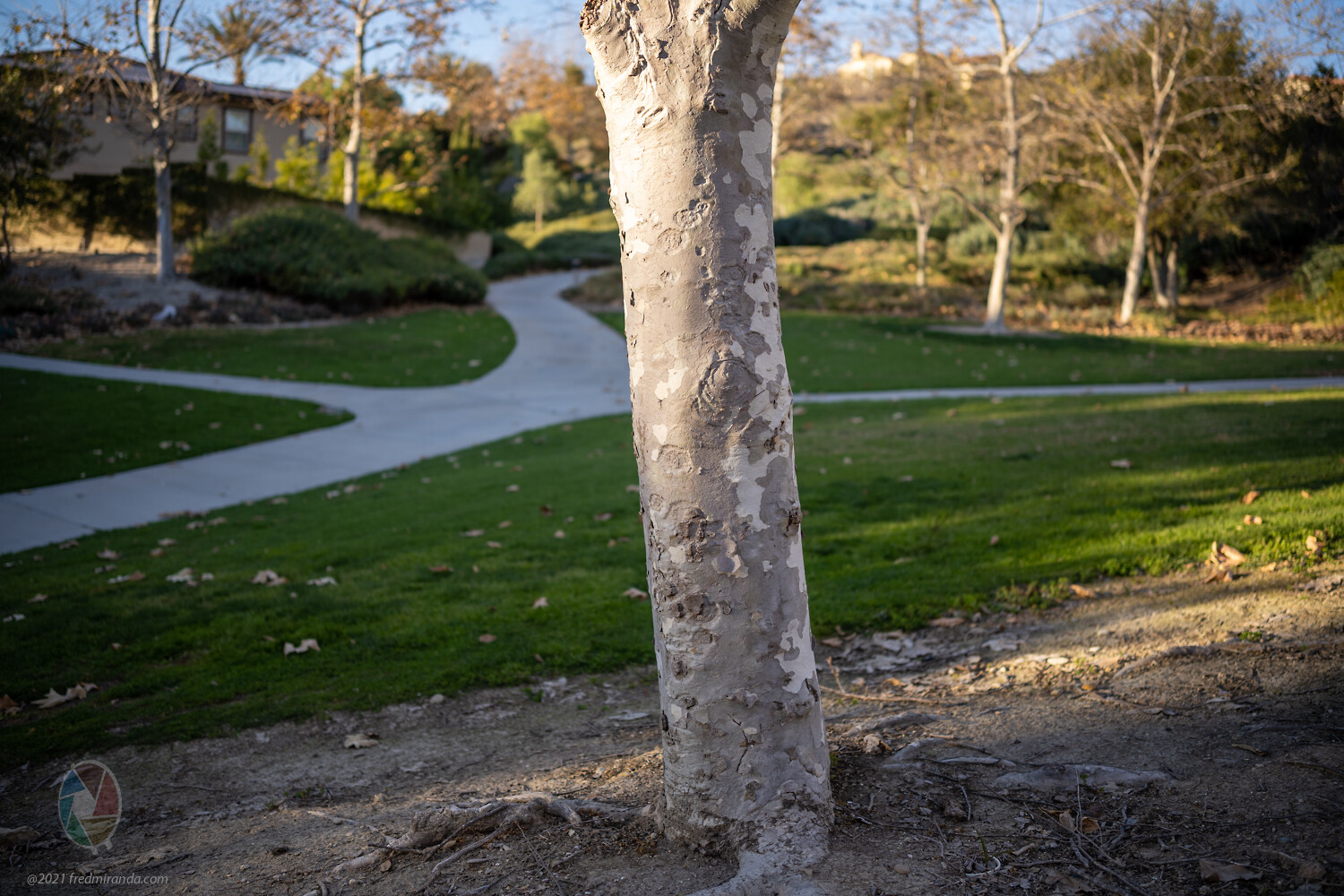
The Sigma 35/2 DG DN's focus transition zone is smooth, especially at close distance where spherical aberration and blur makes rendering very pleasant. It remains smooth at mid and long distance where the transition zone is part of the overall background rendering, but I see less uniformity where the out of focus corners area appear slightly shaper than the center due to optical vignetting. The latter not only affects the shape of specular highlights off-axis (cat-eye instead of round) but it also deepens depth of field towards the corners. Unfortunately this ill-effect is common with 35mm lenses and therefore just average for this lens.
Overall, although not fully uniform, rendering is a strength for this lens for its smooth transition zone and low axial CA.
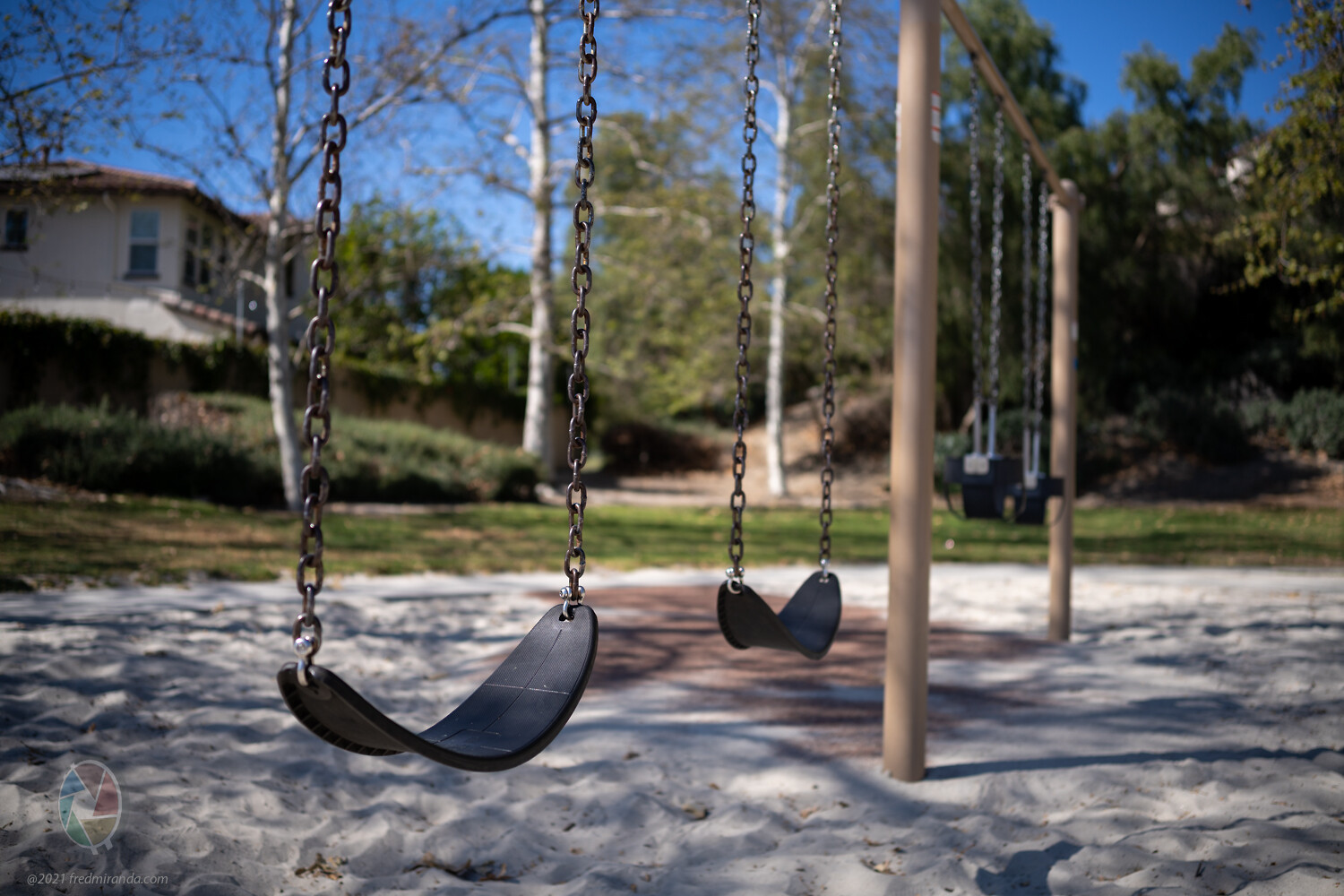
Here are some samples showing rendering with the subject focused at different distances:
At 0.35m
At 0.55m
At 2m
At 2.5m
At 2.5m
At 4m
At 3m. (look at how the OOF corners appear slightly shaper than the center area)
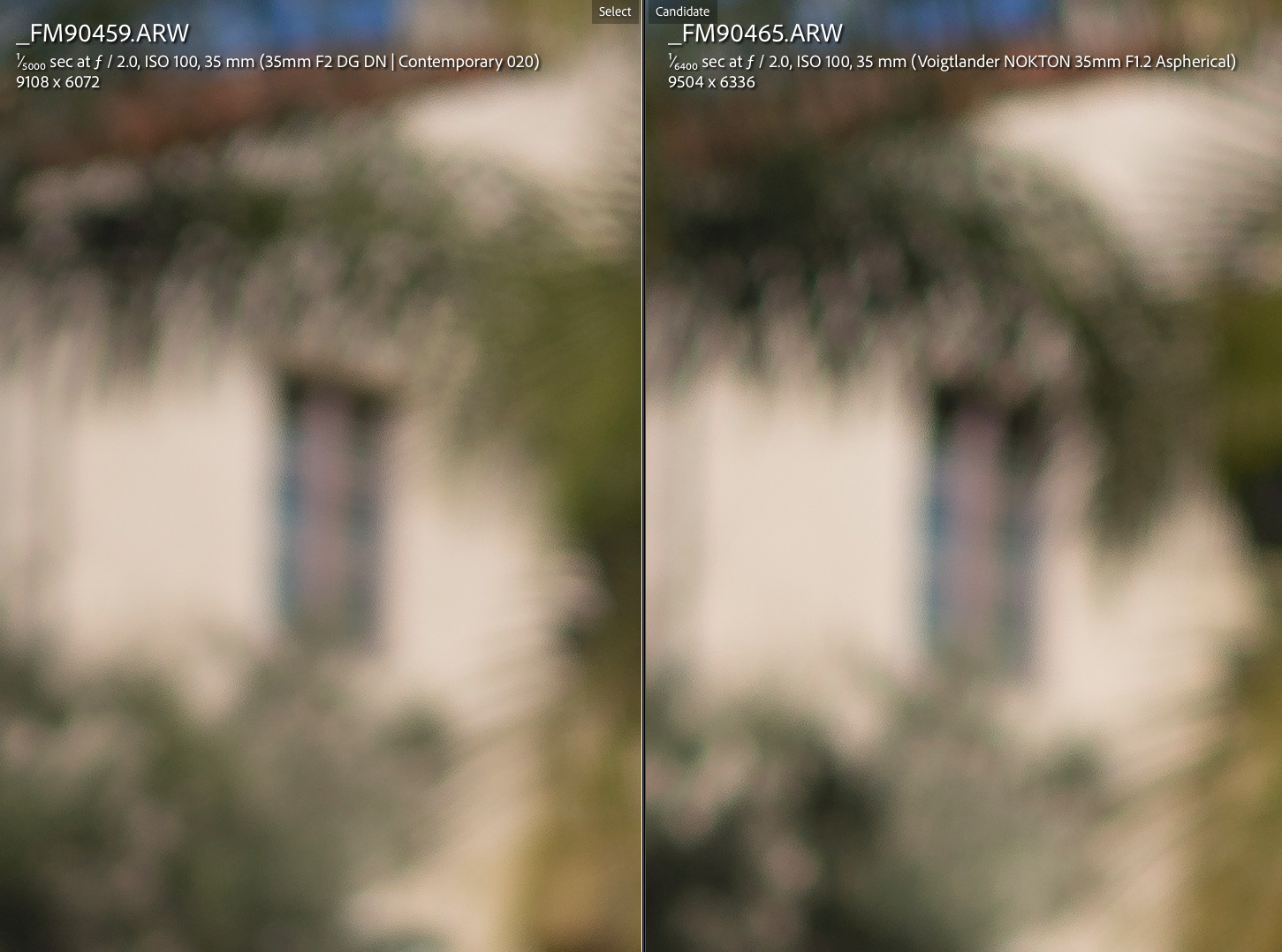
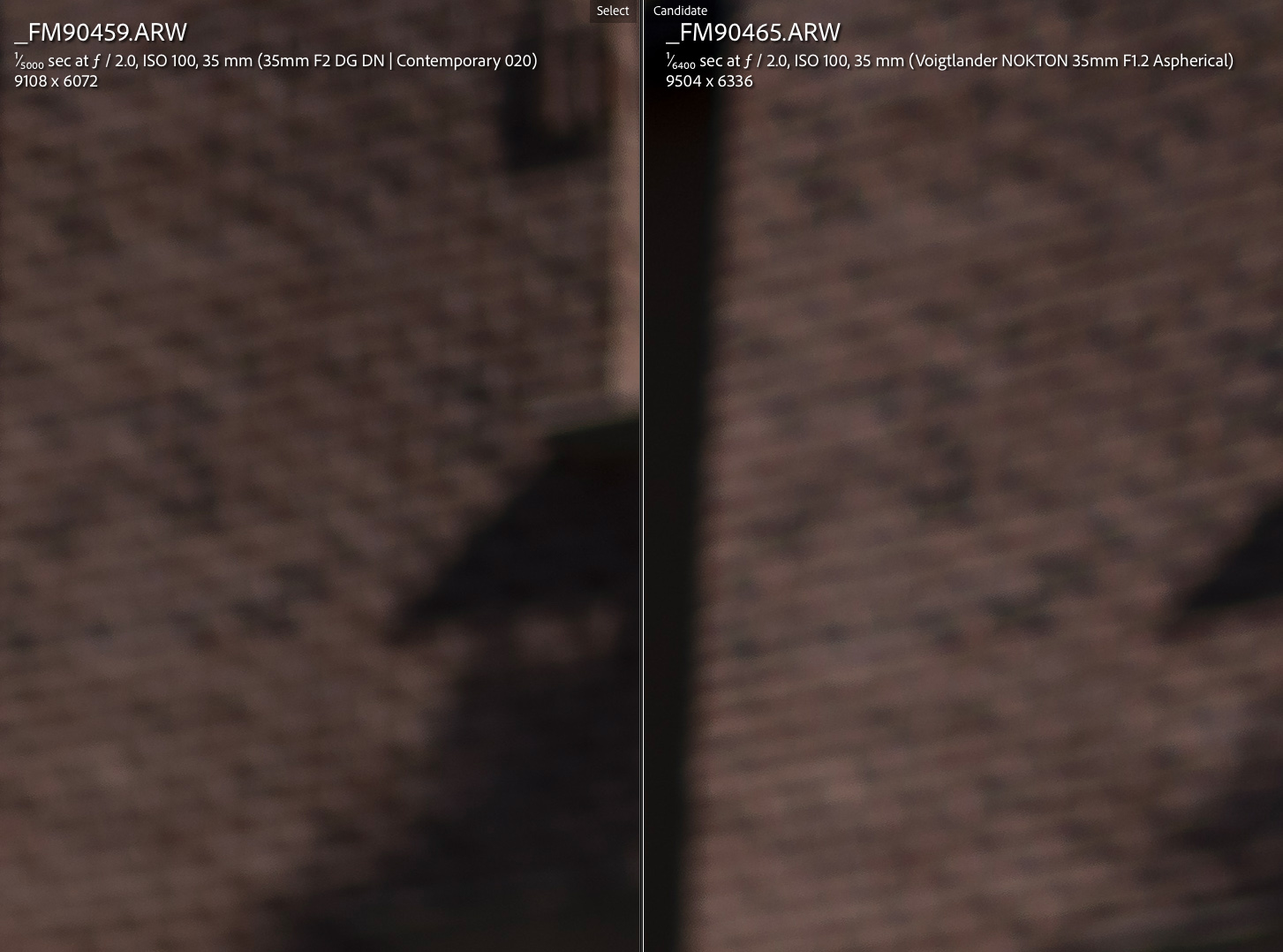
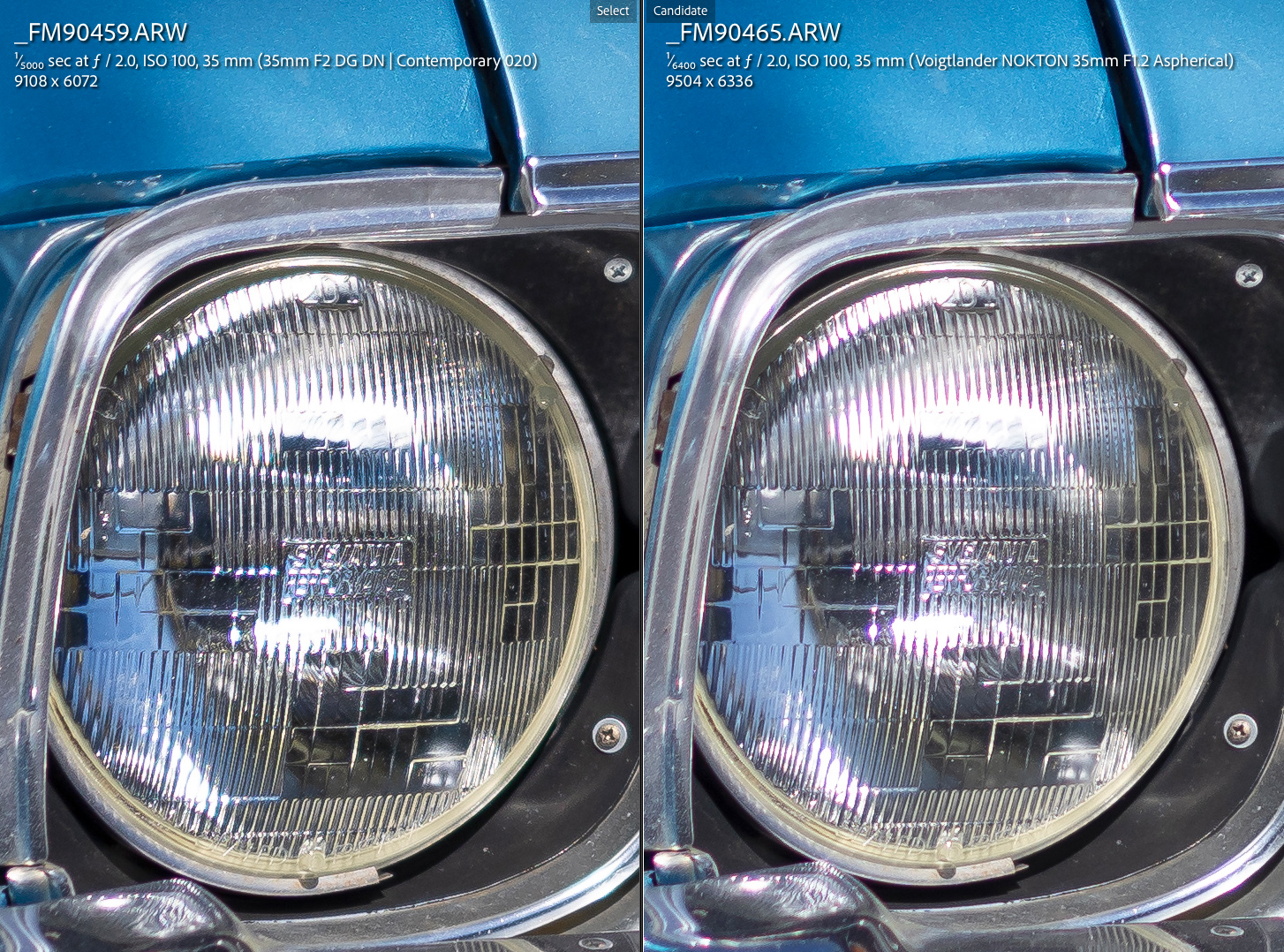
Rendering compared to Voigtlander 35mm f/1.2 III @f/2
The Voigtlander 35mm f/1.2 III Nokton E-mount is less corrected for spherical aberration compared to the Sigma so I was expecting even better rendering for the former. However, when comparing them side by side with same framing, I found that both lenses have smooth and pleasant rendering.
When both wide open, the Sigma 35mm f/2 DG DN is much better corrected for axial aberration and that's still the case when both are set to f/2.
The Voigtlander 35mm f/1.2's FOV is a bit narrower than 35mm at ~35.5mm while the Sigma is wider (~32.5mm). At same distance the Voigtlander would benefit from extra blur so when comparing them side by side, so I tried to frame the scene below as close as possible.
Overall, the Sigma 35mm f/2 DG DN is well corrected for lateral CA, longitudinal (axial) CA and purple fringing.
You will still see some axial CA in very high contrast light (like reflected metal) but it's still well controlled.
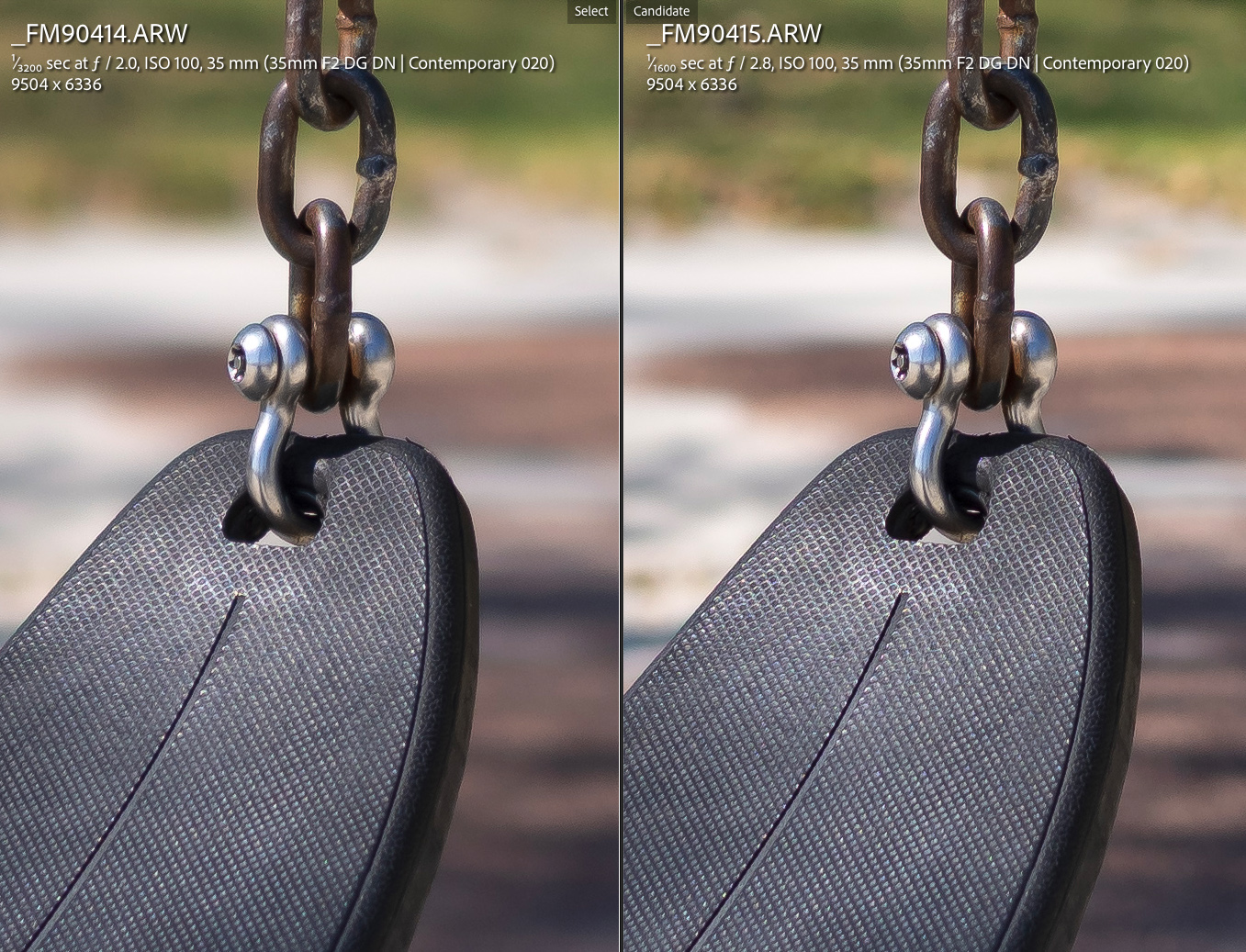
Here is a sample:
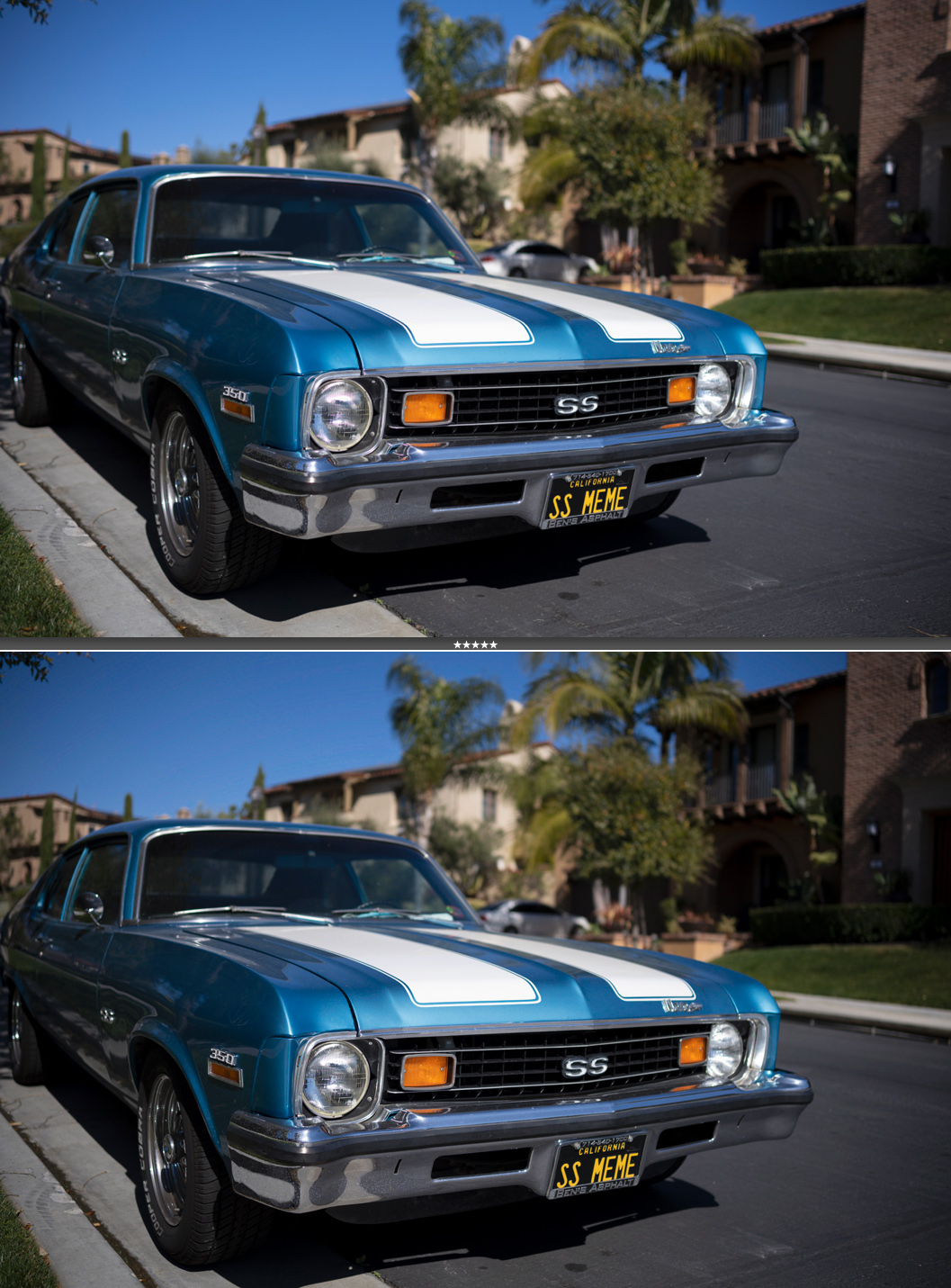
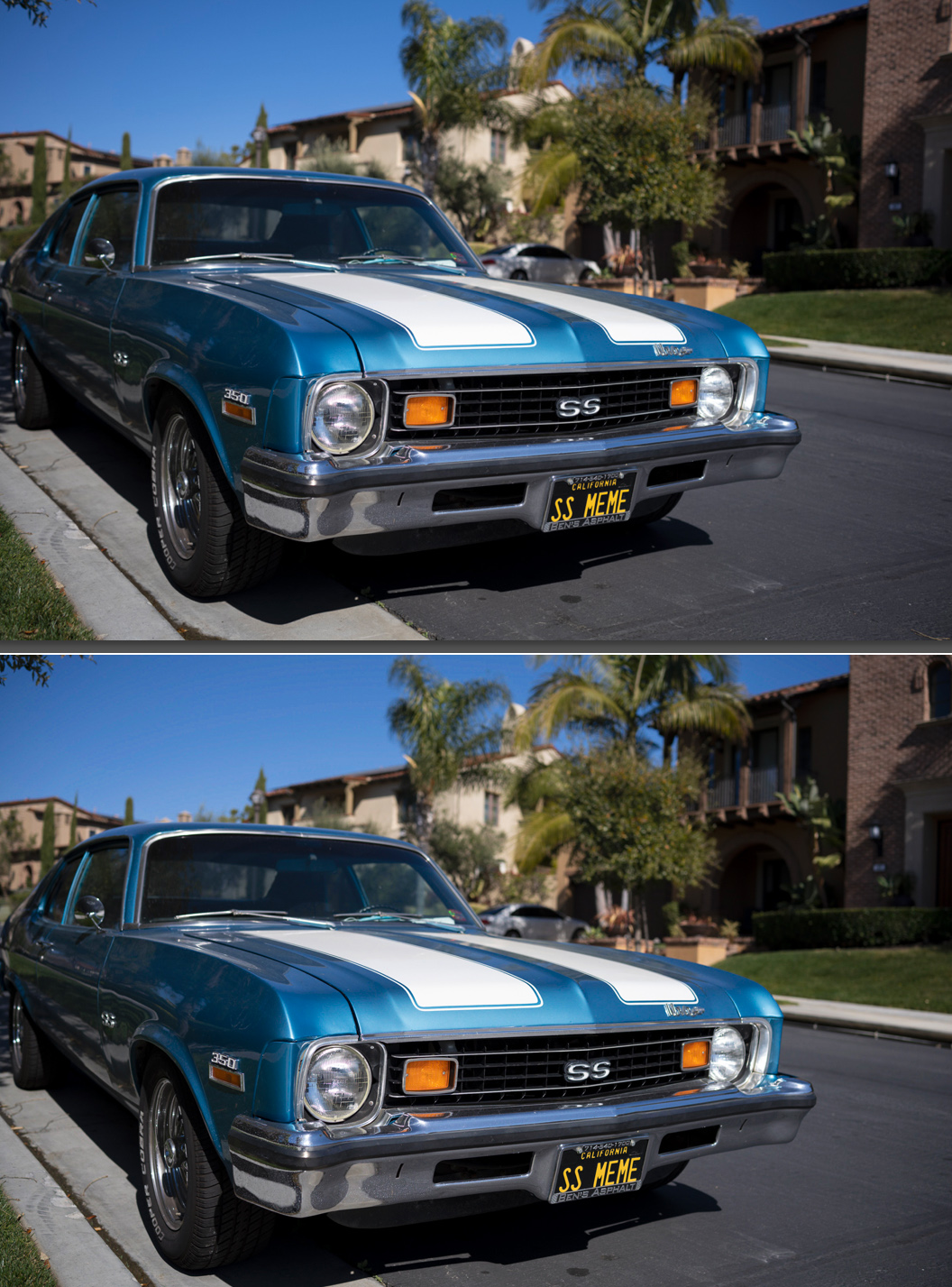
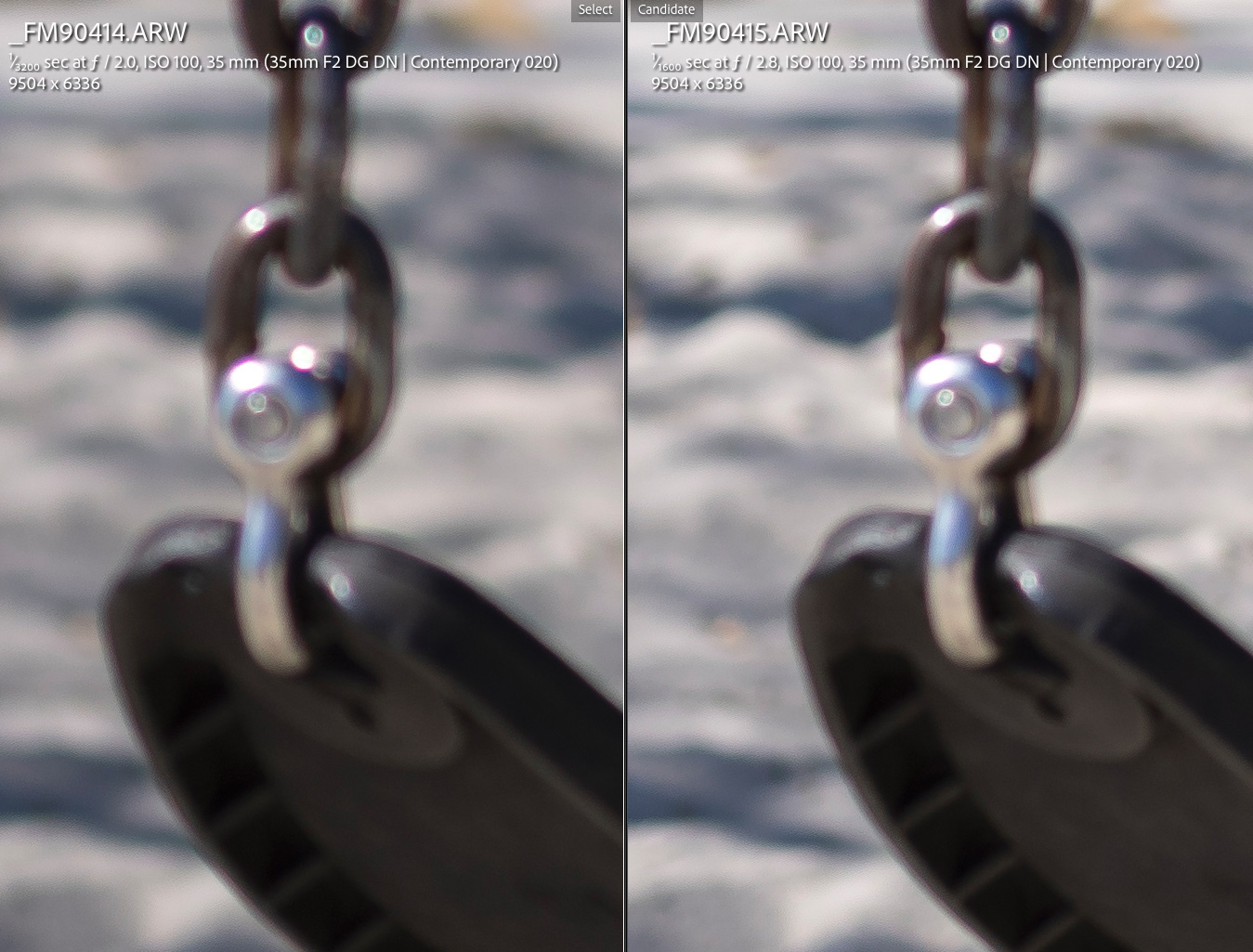
Focused area at f/2 and f/2.8: Not a hint of purple fringing
f/2 vs f/2.8: OOF area in front of focused area - Usually there will be some color error in high contrast areas like this. Axial CA is almost gone at f/2.8
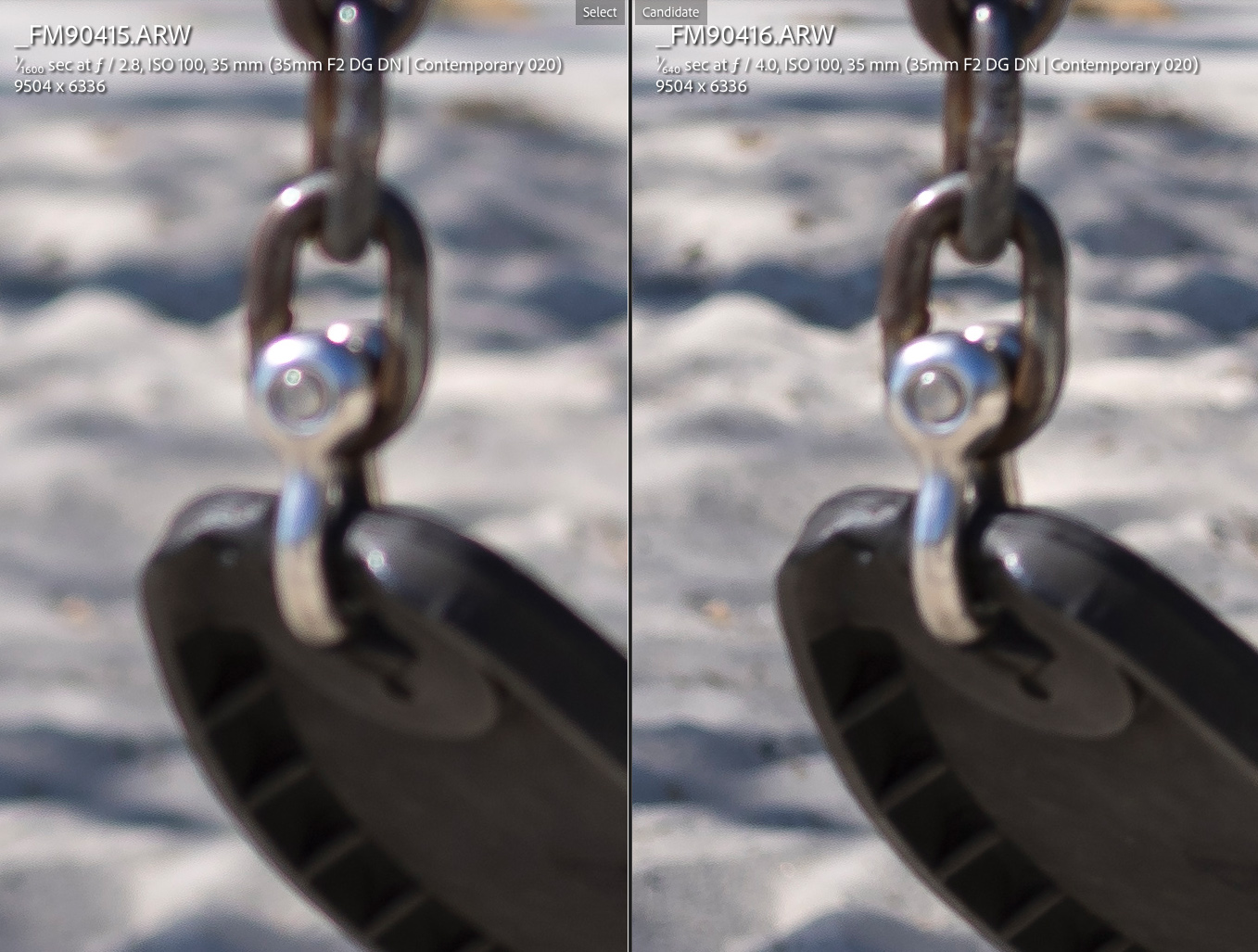
f/2.8 vs f/4: Only traces of Axial CA at f/4
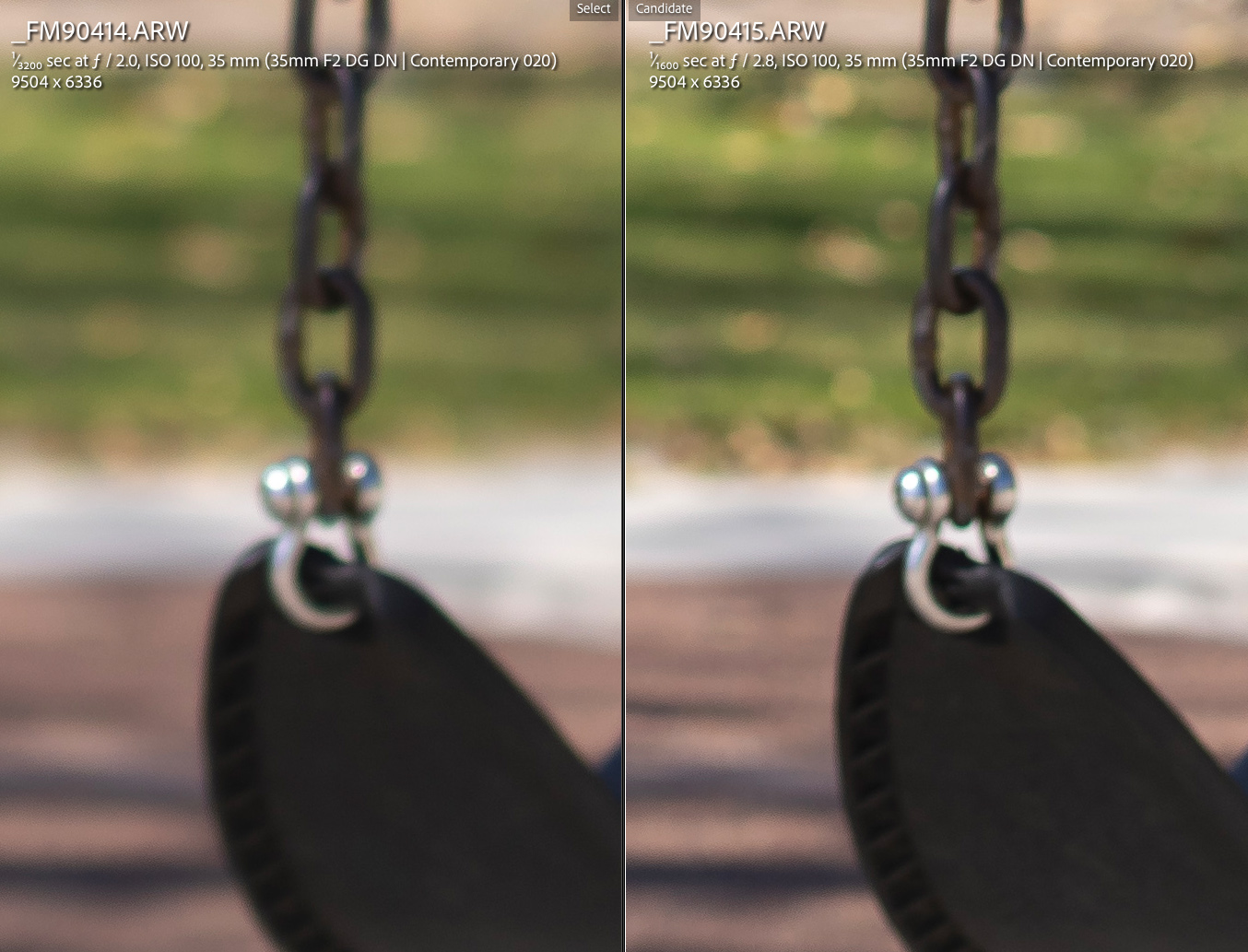
f/2 vs f/2.8: OOF area behind the focused area - Usually there will be some color error in high contrast areas like this. Axial CA is almost gone at f/2.8
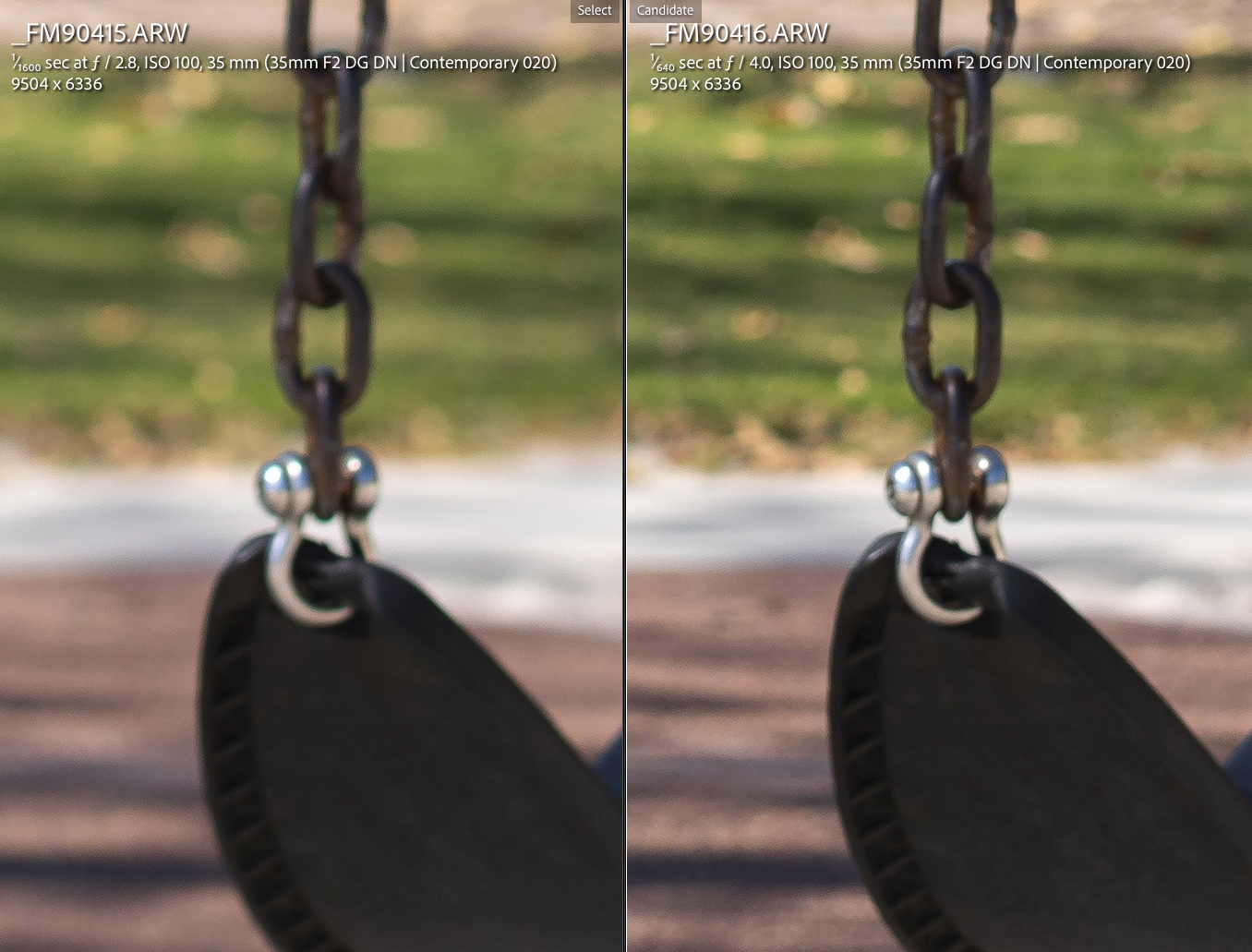
f/2.8 vs f/4: Only traces of Axial CA at f/4
No in-camera or post-processing correction for lateral CA (although there is a built-in profile in LR that can't be removed). Overall very low LACA
Jonas B wrote:
Somewhere at page 3 I had this question:
I have a question about the aperture mechanism and focusing: Does the Sigma 35/2 AF at working aperture? Or, does it open and close the iris for every time I half press the shutter (or in any other way) and ask the camera to focus?
If it open up, focus and then closes again, is there then a delay before the camera can be fired or is it a snappy, instant closing down action?
The different images entered the page... Maybe somebody can tell me now?
Hi Jonas,
It depends:
On the A7R IV, If you set Aperture Drive in AF to "Focus Priority", the aperture will remain wide open until the shutter is released.
However, if you set it to "Standard", it will focus at f/2 and quickly go back to the working aperture before releasing the shutter button.
"Silent Priority" is not supported with this lens.
photosbyjaron wrote:
The aperture closes down to the working aperture right before taking the shot. I don't notice any delay. It appears to take the shot as fast as I can push the button. It also does so silently, as far as I can tell.
Thank you!
Fred Miranda wrote:
It depends:
On the A7R IV, If you set Aperture Drive in AF to "Focus Priority", the aperture will remain wide open until the shutter is released.
However, if you set it to "Standard", it will focus at f/2 and quickly go back to the working aperture before releasing the shutter button.
"Silent Priority" is not supported with this lens.
...and thanks again! ... both for this explanation and the review which I have followed.
I've had my copy for 2 days now. Overall I'm happy. It's lovely to hold and use but from MFD to about 1m it seems very soft anywhere away from the centre. I'm wondering if it's a fault with my copy or to be expected.
For those who have used this lens and the Sigma 45/2.8, what's your take on the two? The AF limitations on the 45/2.8 are keeping me from trying that one out. The 35/2 looks pretty good from a rendering standpoint.
grahamgibson wrote:
For those who have used this lens and the Sigma 45/2.8, what's your take on the two? The AF limitations on the 45/2.8 are keeping me from trying that one out. The 35/2 looks pretty good from a rendering standpoint.
Sigma 35/2 DG DN vs Sigma 45/2.8 DG DN:
AF:
Sigma 35 is fast and accurate in both AF-S and AF-C.
Sigma 45 is fast but not accurate, especially in AF-C (tracking, due to high SA).
Sunstar:
Sigma 35: It captures beautiful 18-point sunstars at f/20 and f/22.
Sigma 45: Same aperture mechanism as the Sigma 24/3.5 and their 14-point sunstars are a bit fuzzy even at f/22.
Rendering:
Sigma 35: Very pleasant rendering with smooth transition zone (Slight SA).
Sigma 45: This lens was designed with rendering as priority, so transition zone is smoother.
Color Error:
Both are well corrected for axial and lateral CA. The 45 does even better.
Resolution/Contrast:
Sigma 35: Excellent performance across the field even wide open (superb at f/4).
Sigma 45: Very good resolution across the field starting at f/4.
Field curvature:
Sigma 35: Pretty much flat-field with no detectable curvature at infinity.
Sigma 45: Slight wavy curvature.
Optical Vignetting:
Sigma 35: It's average and the only negative for this lens so far. There is some swirling (due to cat-eye) and rendering unevenness wide open. Much improved at f/2.5 though.
Sigma 45/2.8: Not an issue with well behaved OV.
Flare resistance:
Both lenses have good veiling resistance but ghosting is noticeable in backlit scenes.
grahamgibson wrote:
For those who have used this lens and the Sigma 45/2.8, what's your take on the two? The AF limitations on the 45/2.8 are keeping me from trying that one out. The 35/2 looks pretty good from a rendering standpoint.
The 35 is great, but if you want to go as minimal as possible, the 45 gets even more compact and the optical quality is great. Mounted to my a7c, it's a "fits in a jacket pocktet" type set-up. Not that the 35 is necessarily large....its just not as compact as the 45. These days the only thing I shoot are my kids and I honestly find the AF fine because I don't often shoot them near MFD.
Mystik wrote:
The 35 is great, but if you want to go as minimal as possible, the 45 gets even more compact and the optical quality is great. Mounted to my a7c, it's a "fits in a jacket pocktet" type set-up. Not that the 35 is necessarily large....its just not as compact as the 45. These days the only thing I shoot are my kids and I honestly find the AF fine because I don't often shoot them near MFD.
Yes, agree. The 35mm f/2 + 65mm f/2 or 45mm f/2.8 DG DN when carrying one lens. It's worth mentioning that 35mm f/2 DG DN is noticeably wider than 35mm.
Fred Miranda wrote:
It's worth mentioning that 35mm f/2 DG DN is noticeably wider than 35mm.
Fred, in terms of perceived actual focal length, how much wider would you estimate it to be? If I were heading the engineering team, hitting 35mm on the head would be a team goal!
onthebeam wrote:
Fred, in terms of perceived actual focal length, how much wider would you estimate it to be? If I were heading the engineering team, hitting 35mm on the head would be a team goal!
I'd say 32.5 to 33mm at infinity. (Similar to RX1's Sonnar 35/2)
For many shooters this is not a negative though.
For a general purpose walk-around lens as I suspect most of us are using this as, a little wider FOV is a positive. More working distance when you aren't in control of the space. You can always crop slightly if needed.
For the typical use cases of something like the Sigma 35 1.2 or 35 GM, I definitely prefer a true 35mm.
Understood, but for those of us who have been shooting for years at focal lengths we rely on, many would argue it should be a given that 35 = 35. I'm fortunate to have a dozen lenses for Sony and held onto a select few superb Canon and Nikon lenses, too.
For my most comfortable work flow, I'll occasionally choose my 28 if I want a slightly wider prime, and frequently use my 16-35 GM if I wish to choose within the range. Depending on subject, my awesome 24mm f1.8 GM most often gets the call when wide-primin'.
It's great to have the discipline of a fixed focal length, not to mention the quality that the best primes are known for. You've got to hand it to to Batis. It's not afraid to proudly and rightfully call itself a 25!
Sorry to threadjack. Back to the show in progress!