p.2 #1 · Sony A1 speed, CFExpress Type A Vs UHS ii
shibutg wrote:
I came up with that number from recent A7R4 shoot. In continuous shoot, all my files (Compressed RAW) were 50.7MB
That is with speed Hi+ where the A7R4 drops to 12bit. Sony was quoted somewhere that the A1 doesn't do that. My higher figure would be for 14bit files.
p.2 #2 · Sony A1 speed, CFExpress Type A Vs UHS ii
Daran wrote:
Also your formula seems wrong. AFAIK the "Maximum number of shots to fill buffer" includes whatever has already been offloaded while shooting.
That's definitely up for discussion, thanks for the suggestion.
I was thinking, let's say, 155 shots are max shot per sony at 30 fps for Uncompressed, that means it takes 5.167 seconds to reach 155 shots at 30 fps. during that period card was writing at a lower speed (I don't know that speed is), at the end of 5.167 seconds, if the card was writing at a lower speed of 50%, then 4846MB left to write from a full buffer, so at that point maximum buffer capacity is 4846MB. That's what i used in this calculations, we can definitely come up with better calculations and all the suggestions.
I took at look at your spreadsheet. I added a second set of rows that follow the computations I outlined above. I can't return the modified version to you the same way you sent it to me, so I have created a shared OneDrive folder that allows files to be shared. The link to the folder is below. SharedFile
Let me know if there are problems getting access to the file.
You will see I set the buffer size to be the same for all computations. The size of the buffer is determined by the first set of calculations and then set to be the same for all other calculations. I also followed your method of setting computed cells to yellow, so the only ones that are input by the user are uncolored. You will also see that I computed the file size for all files except the first one. I set the uncompressed RAW to be 44MB as per the discussion above. I agree with Daran's comment that may be too small. We won't know for a few more days, but I would expect compressed RAW to be about 50MB at 30 fps, and maybe a bit bigger at 20 fps since I believe it goes from 12 to 14 bits. That needs to be checked. If they are the same size at 30fps and 20fps, the problem, as I have set it up, is over constrained.
In a couple of days we should have better data and may need to make some adjustments.
p.2 #4 · Sony A1 speed, CFExpress Type A Vs UHS ii
dclark wrote:
I took at look at your spreadsheet. I added a second set of rows that follow the computations I outlined above. I can't return the modified version to you the same way you sent it to me, so I have created a shared OneDrive folder that allows files to be shared. The link to the folder is below. SharedFile
Let me know if there are problems getting access to the file.
Thanks Dave, this link is not working, anyone else can access?
p.2 #8 · Sony A1 speed, CFExpress Type A Vs UHS ii
Chaliel wrote:
Are all these data for using only one card?
So what if you use both cards at the same time, both uncompressed raw?
Should be about the same speed and you'd get two copies of everything. Pitty the software doesn't allow to take turns using the cards to aggregate the speed.
p.2 #9 · Sony A1 speed, CFExpress Type A Vs UHS ii
Sony lossy compressed raw is always 1byte per pixel, in addition comes a lot of image information and jpeg previews. There is no 12bit vs 14bit, first step is converting the data to 11bit using a non linear curve before delta compression. For 16 consecutive pixels in each channel, delta compression stores 11bit max and min values, 2 4bit indices of the min and max pixel and uses 7bit deltas for the other pixels. So for 16 pixels you get 11bit * 2 + 4bit * 2 + 7bit * 14 = 128bits or exactly 8 bits per pixel.
p.2 #10 · Sony A1 speed, CFExpress Type A Vs UHS ii
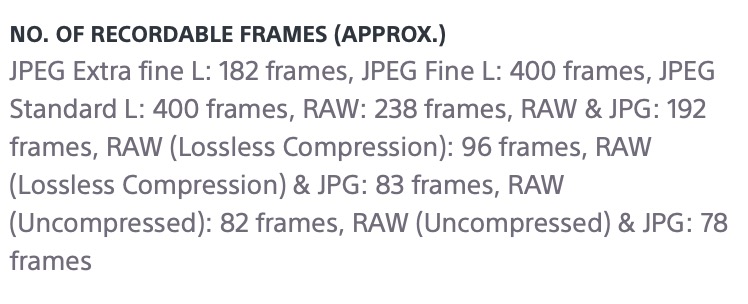
Does anyone have a reference to where Sony said the buffer is 155 shots at 30FPS? When I read the official Sony specs on any of the Sony.xxx websites the only RAW compressed buffer they quote is 238. There is no mention of FPS.
Up thread someone mentions 155 at 30FPS Uncompressed but the A1 can't shoot at 30FPS uncompressed. 30FPS is only lossy compressed.
But I know it has been mentioned numerous times on the A1 threads so just wanted to find out where Sony has published that 155 number.
p.2 #11 · Sony A1 speed, CFExpress Type A Vs UHS ii
arbitrage wrote:
Does anyone have a reference to where Sony said the buffer is 155 shots at 30FPS? When I read the official Sony specs on any of the Sony.xxx websites the only RAW compressed buffer they quote is 238. There is no mention of FPS.
Up thread someone mentions 155 at 30FPS Uncompressed but the A1 can't shoot at 30FPS uncompressed. 30FPS is only lossy compressed.
But I know it has been mentioned numerous times on the A1 threads so just wanted to find out where Sony has published that 155 number.
Sony.com.
"155 full-frame compressed RAW images"^21
21 then says: "Hi+" continuous shooting mode, compressed RAW, CFexpress Type A memory card. Sony tests.
Thanks...I guess I never really read through all of those feature thumbnails as I instead went to the more detailed specs. Odd that they don't clarify the FPS in this table:
p.2 #13 · Sony A1 speed, CFExpress Type A Vs UHS ii
arbitrage wrote:
Does anyone have a reference to where Sony said the buffer is 155 shots at 30FPS? When I read the official Sony specs on any of the Sony.xxx websites the only RAW compressed buffer they quote is 238. There is no mention of FPS.
Up thread someone mentions 155 at 30FPS Uncompressed but the A1 can't shoot at 30FPS uncompressed. 30FPS is only lossy compressed.
But I know it has been mentioned numerous times on the A1 threads so just wanted to find out where Sony has published that 155 number.
Continuous shooting at up to 30fps
High-speed readout from the 50.1-megapixel image sensor and a large buffer memory makes it possible to shoot up to approximately 165 full-frame JPEG images or 155 full-frame compressed RAW images at up to 30 frames per second with the electronic shutter while maintaining full AF and AE tracking performance. This can be a huge confidence-booster when timing is critical for sports and other moving subjects.
Continuous shooting at up to 30fps
High-speed readout from the 50.1-megapixel image sensor and a large buffer memory makes it possible to shoot up to approximately 165 full-frame JPEG images or 155 full-frame compressed RAW images at up to 30 frames per second with the electronic shutter while maintaining full AF and AE tracking performance. This can be a huge confidence-booster when timing is critical for sports and other moving subjects.
Would that have been enough frames for when I buffered out the 1DXII on that SEO back in 2017?
p.2 #16 · Sony A1 speed, CFExpress Type A Vs UHS ii
Chaliel wrote:
Are all these data for using only one card?
So what if you use both cards at the same time, both uncompressed raw?
That's a great question, I haven't seen anywhere Sony saying anything about speed when using both cards at the same time. I assume the buffer capacity is shared between the two slots, so when using both cards, number of shots will be reduced quite a bit, that's my guess.
p.2 #18 · Sony A1 speed, CFExpress Type A Vs UHS ii
Maybe I figured out why Sony specs both 155 and 238 frames.
If you look at the spreadsheet I posted, if you input the 155 frames at 30fps spec for compressed RAW, the calculated number of frames for compressed RAW at 20 fps is 238.
It would be kind of weird that Sony lists the specs for 20fps in the spec sheet for a camera that is touted for its 30fps speed, but maybe that is what they did.
p.2 #19 · Sony A1 speed, CFExpress Type A Vs UHS ii
dclark wrote:
Maybe I figured out why Sony specs both 155 and 238 frames.
If you look at the spreadsheet I posted, if you input the 155 frames at 30fps spec for compressed RAW, the calculated number of frames for compressed RAW at 20 fps is 238.
It would be kind of weird that Sony lists the specs for 20fps in the spec sheet for a camera that is touted for its 30fps speed, but maybe that is what they did.
Dave
That sounds reasonable to me Dave.
30FPS is sort of a bonus mode with a number of caveats so it would make sense that the table I posted is based on 20FPS. Remember on the A9, Sony never used an H+ (H*) terminology but they do on their other cameras as those H+ modes come with slideshow and some other issues.
30FPS on the A1:
1) Only lossy compressed
2) EVF drops to 120 (no 240)
3) EVF eye-point goes to the zoomed out version
4) EVF quality drops to 5 M pixels from the 9M full resolution.
p.2 #20 · Sony A1 speed, CFExpress Type A Vs UHS ii
arbitrage wrote:
That sounds reasonable to me Dave.
30FPS is sort of a bonus mode with a number of caveats so it would make sense that the table I posted is based on 20FPS. Remember on the A9, Sony never used an H+ (H*) terminology but they do on their other cameras as those H+ modes come with slideshow and some other issues.
30FPS on the A1:
1) Only lossy compressed
2) EVF drops to 120 (no 240)
3) EVF eye-point goes to the zoomed out version
4) EVF quality drops to 5 M pixels from the 9M full resolution.
Yes, but it would sure help if they were more specific in their specifications.
It is a bit reassuring that the spreadsheet seems to have computed the 20fps spec accurately using the 30fps spec. That supports the idea that the method is correct and the write rate onto the CF-A card is correct. The rate onto the UHS-II has got to be pretty close, so it increases my expectation that the results for the UHS-II are also right.
Since I don't expect to use 30fps often I am reassured that the UHS-II cards will be fine for most of my use cases.