p.1 #1 · Sony A1 speed, CFExpress Type A Vs UHS ii
I'm trying to figure out what will be the performance difference between CF Express type A and UHS ii card with this new beast. I never thought about this much until I saw the CF Express card's ridiculous price.
I'm trying to understand this, please add your input, thanks
Per Sony,
- A1 can shoot, 155 total frames (Full frame compressed RAW) at 30 fps,
-CF Express type A Card (write speed 700 MB/sec), I assume compressed RAW for this camera is ~44MB, if so, 155 shots makes up to 6820MB and will take up to (to clear up the buffer completely) 9.7 seconds to write on a CFExpress 700MB/sec card and 22.7 Seconds to write on a UHS ii (300MB/sec) card. To shoot 155 at 30 fps, it will take 5.2 seconds, so it will take an additional 4.5 (9.7- 5.2) seconds to write on a CFE card and additional 17.5 (22.7- 5.2) seconds to write on a UHSii card, and buffer clears, correct? I assume the writing on the card starts simultaneously with the start of shooting
-What if I shoot at 20 fps? I guess the buffer doesn't change and I can shoot up to 155 total frames continuously, correct? Or, can do more continuous shots as the buffer clears while shooting at slower rate?
Feb 02, 2021 at 05:08 PM
TopPixel Offline • • [X]
p.1 #2 · Sony A1 speed, CFExpress Type A Vs UHS ii
The buffer is 238 RAW compressed and 14-bit when shooting in 20 fps mode and 155 RAW compressed and 12-bit when shooting in 30 fps mode. I think the 20 fps mode is much more practical than 30 fps.
p.1 #4 · Sony A1 speed, CFExpress Type A Vs UHS ii
You pose an interesting question which we will need to wait for more information to give a reliable answer. We can learn a bit from what is seen with the A9 and the A7S3 (same electronics as the A1?).
The A9 it is rated at 240 images at 20fps. If you hold down the shutter until the buffer fills you find there are ~205 frames in the buffer (hard to get exactly but a bit over 200). That means about 35 have already been written to the card by the time the buffer filled. The file size is ~23-24MB/frame, so 35*23.5MB were written in 240/20 seconds, which is ~69MB/sec. That is about half the rated speed of the camera writing onto the card. That means while the buffer is filling, speed writing to the card is cut in half.
I tried to test this on my A7S3 but could not get the buffer to fill. I was writing 25MB files to the card at 10 fps and the buffer never seemed to have any files when I released the button. The writing speed to the card was about >250MB/sec which is near the rated speed of the card (300MB/sec). That would seem to indicate that the new dual processor electronics can match the writing speed of the UHS-II cards. Can it match the rated write speed of the cf express A? We will have to wait to see.
If we assume the A1 writes at full card speed while the buffer is filling and after it is filled, and we assume the 155 frames is for the CF Express, and the file size is 44MB, then:
- it takes 155/30 = 5.17 sec to fill the buffer
- as the buffer is filling, files are being written to the card at a rate of 700/44 = 15.9 files/sec
- that means a net of 30-15.9 = 14.1 files/sec are accumulating in the buffer
- during that time 14.1*5.17 = 73 files have accumulated in the buffer
- the buffer is 44*73 = 3200 MB
- it will take and additional 3200/700 = 4.6 sec to clear the buffer.
That is the same as you calculated.
For the UHS-II:
- as the buffer is filling, files are being written to the card at a rate of 300/44 = 6.8 files/sec
- that means a net of 30-6.8 = 23.2 files/sec are accumulating in the buffer
- it will take 3200/(23.2*44) = 3.13 sec to fill the buffer
- during the 3.13 seconds, 30*3.13 = 93 frames will be captured before the buffer fills.
- it will take an additional 3200/300 = 10.7 sec to clear the buffer.
Additional conclusion:
- at 16.9 frames/sec the buffer will never fill with a CF Express type A card.
- at 6.8 frames/sec the buffer will never fill with a UHS-II card.
You can easily make adjustments to the assumptions to make alternative calculations. We will need to await more information to make better calculations.
p.1 #6 · Sony A1 speed, CFExpress Type A Vs UHS ii
dclark wrote:
BTW, I make a lot of errors, so check everything.
Dave
Thanks Dave, this answers most of the questions I've. I will put together these info into an excel sheet and will keep adding and refine as others add more info. Definitely I will share it with you guys. I never looked in to this as a necessity, now I think we need more information to chose between these two cards for specific usage. it wasn't big deal to shoot with A9/UHS ii cards, now with a 50MP sensor we need more information. I don't want to spend a lot of money for CFE cards if I can live with UHS II.
p.1 #7 · Sony A1 speed, CFExpress Type A Vs UHS ii
for 600 and 260:
If we assume the A1 writes at full card speed while the buffer is filling and after it is filled, and we assume the 155 frames is for the CF Express, and the file size is 44MB, then:
- it takes 155/30 = 5.17 sec to fill the buffer
- as the buffer is filling, files are being written to the card at a rate of 600/44 = 13.6 files/sec
- that means a net of 30-15.9 = 16.4 files/sec are accumulating in the buffer
- during that time 16.4*5.17 = 85 files have accumulated in the buffer
- the buffer is 44*85 = 3731 MB
- it will take and additional 3731/600 = 6.2 sec to clear the buffer.
For the UHS-II:
- as the buffer is filling, files are being written to the card at a rate of 260/44 = 5.9 files/sec
- that means a net of 30-6.8 = 24.0 files/sec are accumulating in the buffer
- it will take 3731/(24.0*44) = 3.52 sec to fill the buffer
- during the 3.52 seconds, 30*3.52 = 106 frames will be captured before the buffer fills.
- it will take an additional 3731/300 = 14.3 sec to clear the buffer.
Additional conclusion:
- at 13.6 frames/sec the buffer will never fill with a CF Express type A card.
- at 5.9 frames/sec the buffer will never fill with a UHS-II card.
Another way to look at these results is, if you shoot short bursts of 3.5 sec or less at 30 fps, or bursts of 20.5 sec or less at 15 fps, and don't average more than 5.9 frames/sec, you will never fill the buffer with a UHS-II card.
I can live with that to avoid purchasing a $400 card that may be $200 in a few months.
p.1 #8 · Sony A1 speed, CFExpress Type A Vs UHS ii
Thanks David.
I think that cements my decision to wait on buying CFe-A until I at least try my UHS-II cards in the camera. No big rush to overspend on CFe-A as prices will likely be much lower in 6 months anyways.
Your calculations for the Cfe-A card match up very close to what I saw on some of the videos...I counted about 5-6 seconds for the buffer to clear in a few of the tests that are out there.
FWIW, the fastest the R5 can clear a full buffer is about 6s also so CFe-B isn't giving it much benefit over our nice tiny Cfe-A cards. There are some CFe-B cards that take more around 10-15s to clear like my Transcend. Of course there may end up being some slower CFe-A cards in the future...Sony is usually top ranked for speed on any card they make.
p.1 #9 · Sony A1 speed, CFExpress Type A Vs UHS ii
arbitrage wrote:
Thanks David.
I think that cements my decision to wait on buying CFe-A until I at least try my UHS-II cards in the camera. No big rush to overspend on CFe-A as prices will likely be much lower in 6 months anyways.
Your calculations for the Cfe-A card match up very close to what I saw on some of the videos...I counted about 5-6 seconds for the buffer to clear in a few of the tests that are out there.
FWIW, the fastest the R5 can clear a full buffer is about 6s also so CFe-B isn't giving it much benefit over our nice tiny Cfe-A cards. There are some CFe-B cards that take more around 10-15s to clear like my Transcend. Of course there may end up being some slower CFe-A cards in the future...Sony is usually top ranked for speed on any card they make....Show more →
Smart move and mine as well. Let’s wait and see what we get. I don’t need that shooting speed of 30 FPS and I think very few do unless they spray and pray which I’m definitely not that guy.
p.1 #10 · Sony A1 speed, CFExpress Type A Vs UHS ii
I have not been paying too much attention but I figure twice the speed over our Tough cards today which I’m okay with. I love to be fast as hell but how much are we going to just throw money at and not just have a cup of coffee and wait. I personally like to see that test
p.1 #11 · Sony A1 speed, CFExpress Type A Vs UHS ii
The speed improvement may be in the workflow, which @GMPhotography mentioned about the cup of coffee, I expect the CFE-* like the XQD cards to be more reliable as well.
I wonder what the transfer rate would be from an CFE-A card in the body via USBC compared to Sony Tough SD card.
p.1 #12 · Sony A1 speed, CFExpress Type A Vs UHS ii
A benefit is that with the A1 and 20fps you get 14 bits instead of the A9’s 12. Also the write out of buffer to the card is much faster too. Substantially less time waiting for the card to clear the buffer.
p.1 #13 · Sony A1 speed, CFExpress Type A Vs UHS ii
arbitrage wrote:
Thanks David.
I think that cements my decision to wait on buying CFe-A until I at least try my UHS-II cards in the camera. No big rush to overspend on CFe-A as prices will likely be much lower in 6 months anyways.
Your calculations for the Cfe-A card match up very close to what I saw on some of the videos...I counted about 5-6 seconds for the buffer to clear in a few of the tests that are out there.
FWIW, the fastest the R5 can clear a full buffer is about 6s also so CFe-B isn't giving it much benefit over our nice tiny Cfe-A cards. There are some CFe-B cards that take more around 10-15s to clear like my Transcend. Of course there may end up being some slower CFe-A cards in the future...Sony is usually top ranked for speed on any card they make....Show more →
In the video I posted above the guy testing buffer clearing speed. ICFE-A exactly 5 times faster and Sony's top SD!
p.1 #14 · Sony A1 speed, CFExpress Type A Vs UHS ii
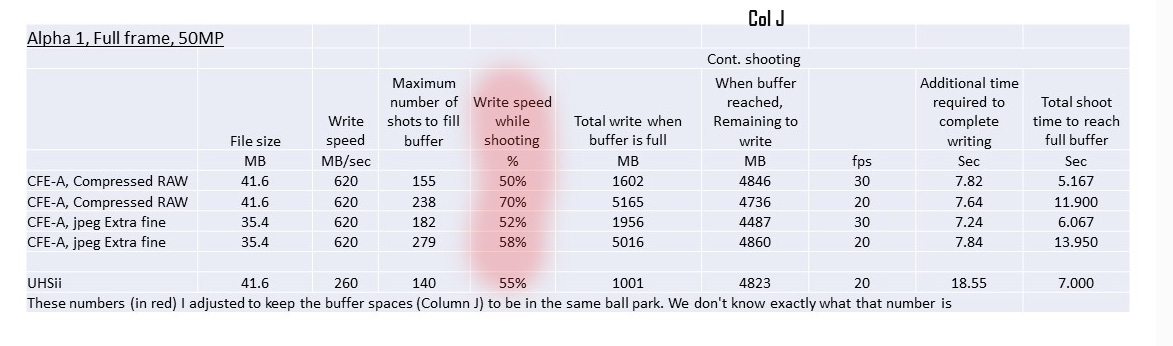
I put together the information we have from this thread. Looks like it will take approximately 7 seconds to finish the writing on CFE-A card after full buffer is reached, and 19 seconds on a UHS ii card, these numbers are not super accurate, just a comparison. I guess I can afford to wait that additional 12 seconds until CFE-A price drops
Additionally when I used the same calculations for APSC mode, it looks like you can shoot uninterrupted for a very long time with CFE Card, and ~450 shots with UHS ii cards.
I've attached a jpeg of the excel sheet. I will be happy to share the excel file if anyone want to check, I'm not sure I can upload excel file here.
p.1 #16 · Sony A1 speed, CFExpress Type A Vs UHS ii
shibutg wrote:
I put together the information we have from this thread. Looks like it will take approximately 7 seconds to finish the writing on CFE-A card after full buffer is reached, and 19 seconds on a UHS ii card, these numbers are not super accurate, just a comparison. I guess I can afford to wait that additional 12 seconds until CFE-A price drops
Additionally when I used the same calculations for APSC mode, it looks like you can shoot uninterrupted for a very long time with CFE Card, and ~450 shots with UHS ii cards.
I've attached a jpeg of the excel sheet. I will be happy to share the excel file if anyone want to check, I'm not sure I can upload excel file here. ...Show more →
I don't understand your spreadsheet. Can you drop a copy in a DropBox folder and let us have access? If you need help with that, send me a PM.
p.1 #18 · Sony A1 speed, CFExpress Type A Vs UHS ii
shibutg wrote:
I've attached a jpeg of the excel sheet. I will be happy to share the excel file if anyone want to check, I'm not sure I can upload excel file here.
I don't think your figure of 44.1MB is adequate for a compressed 50MP file. The A7R4 creates files of 61MB for compressed 61MP images.
p.1 #19 · Sony A1 speed, CFExpress Type A Vs UHS ii
shibutg wrote:
I've attached a jpeg of the excel sheet. I will be happy to share the excel file if anyone want to check, I'm not sure I can upload excel file here.
Also your formula seems wrong. AFAIK the "Maximum number of shots to fill buffer" includes whatever has already been offloaded while shooting.