inksandpaper
Offline
•
Upload & Sell: Off
|
 p.2 #15 · Sensor and lens tilt and how to DIY adjust your equipment p.2 #15 · Sensor and lens tilt and how to DIY adjust your equipment | |
Fred Miranda wrote:
Samuel @inksandpaper@,
Perhaps I missed this information somewhere but where did you get the the paper rolls to hold the shims in place securely?
Hi Fred, I made them myself, cut from a sheet of regular 80gsm/20lb laser paper. About 1-1.5" long, 3/8/" wide. Rolled along the short edge. It might help to start with 1/2" wide and then trim down to get a perfect it. The roll has to be very tight, it's a little tricky to form a good leading edge curl for the roll, takes a few tries. It's hard with dry finger skin. You might find it helpful to use a thin rod to assist you in forming the leading edge curl rather than doing that freehand. I save them afterwards for future lenses so I don't have to keep making new ones. Alternatively, you can use a thick plastic bristle from a brush, or the wire of a paper clip.
I have a Minolta 200/2.8 that needs adjustment in two screw areas. How many millimeters would you guess this asymmetry seems to be? 0.1, 0.2, 0.3, 0.4mm, etc.?
Also, is it right to think that the softer corner is the one that require shim(s)?
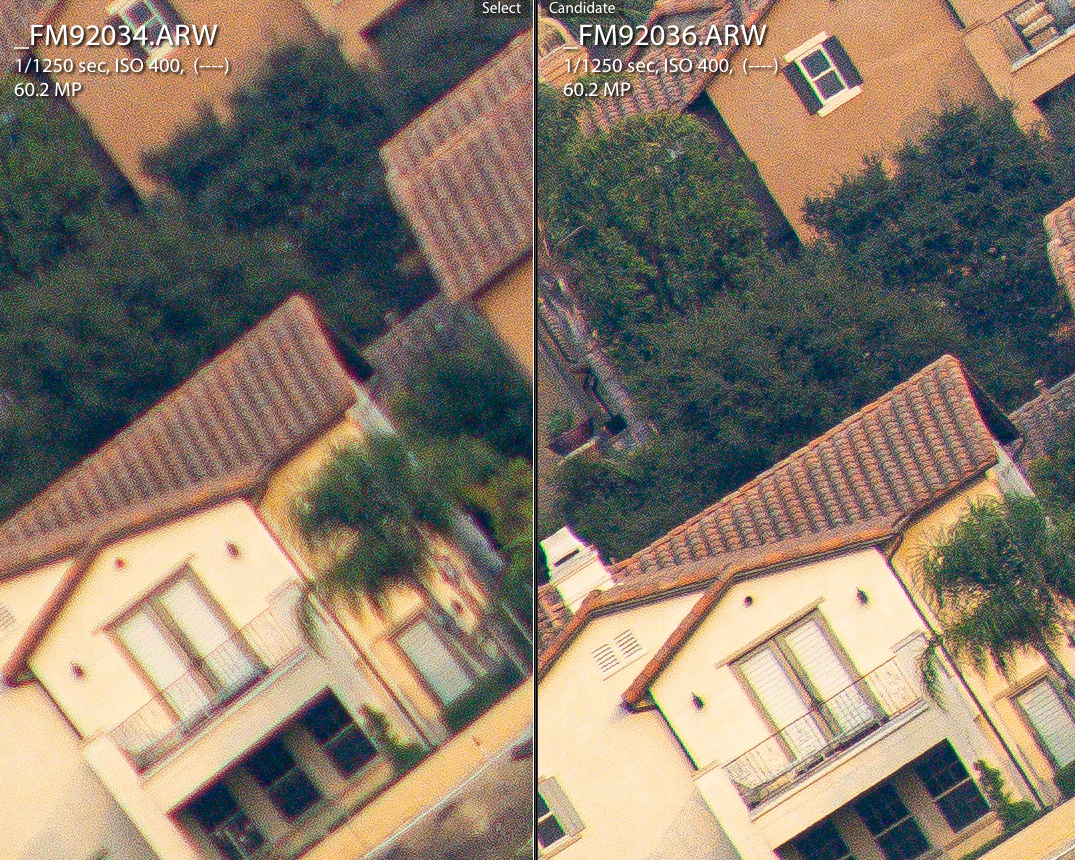
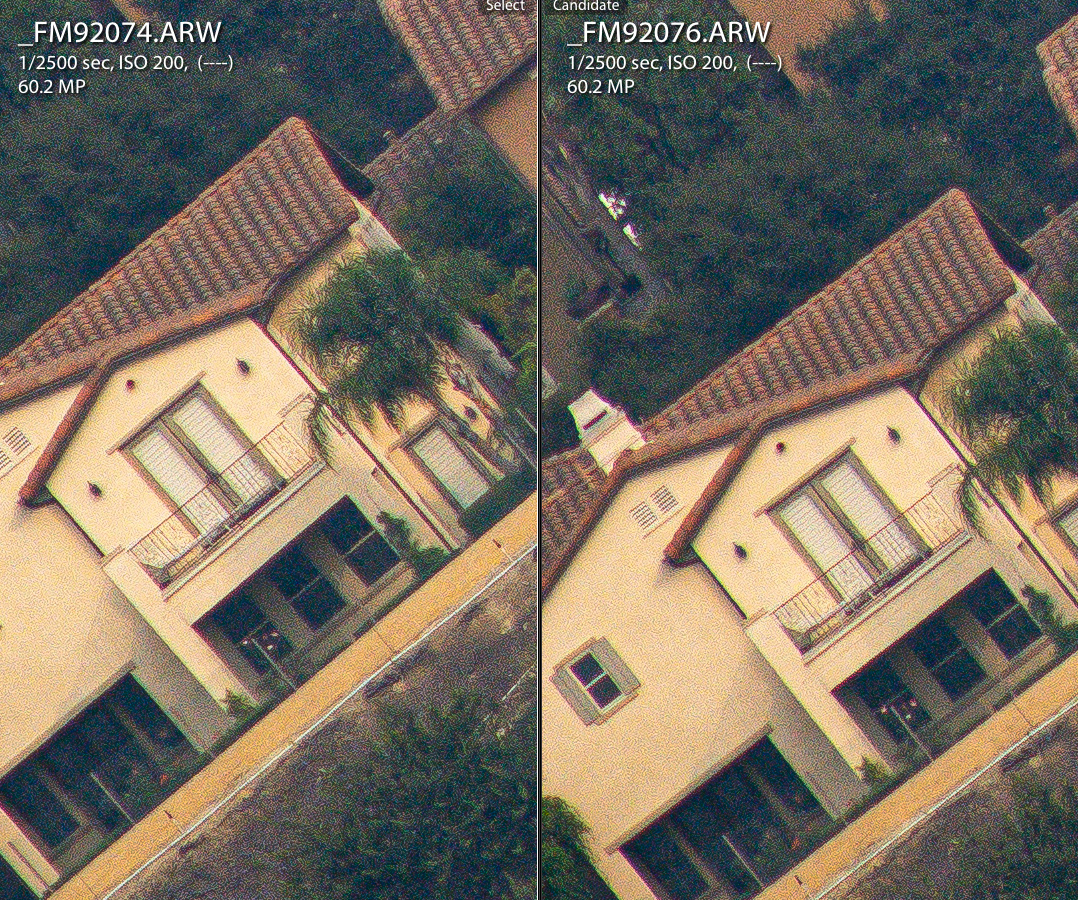
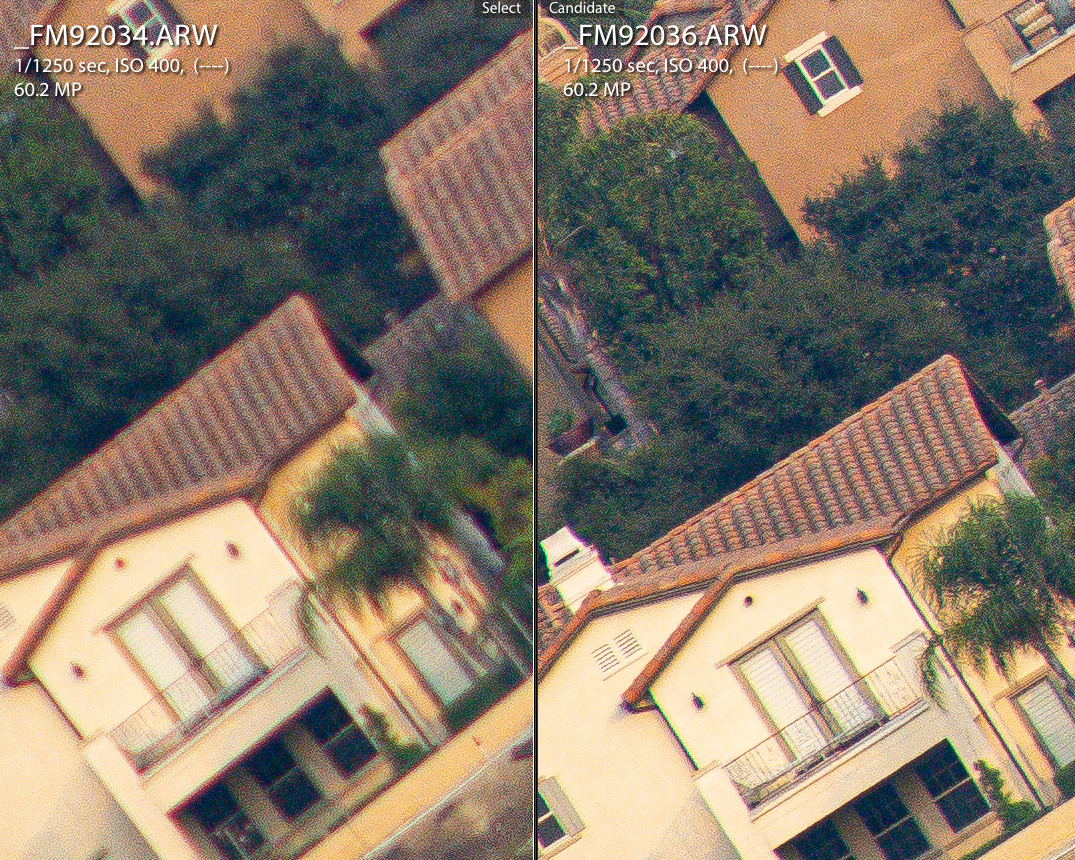
This is they worse side (bottom left) for this specific lens:
There is no way for anyone to tell from these two crops. But that's certainly not 1000 microns (1mm) of skew, let alone 4000 microns worth. We need to be able to see the focus plane. You first need to establish if the lens is decentered or if there is focus plane skew. One way to tell is if you refocus on the bottom left corner, does it come into focus? If it never does, it is likely due to decentering and shimming isn't going to help. You're in luck if refocusing there allows it to come into good focus as expected for the corner of that lens. If there is continuous detail near to far, you should also look for the plane of focus and observe how it bends from edge to edge of the frame. Is it nearer on the left side or the right side? We need to observe the entire frame for that, you can't see it by looking at a tiny portion of the corners only.
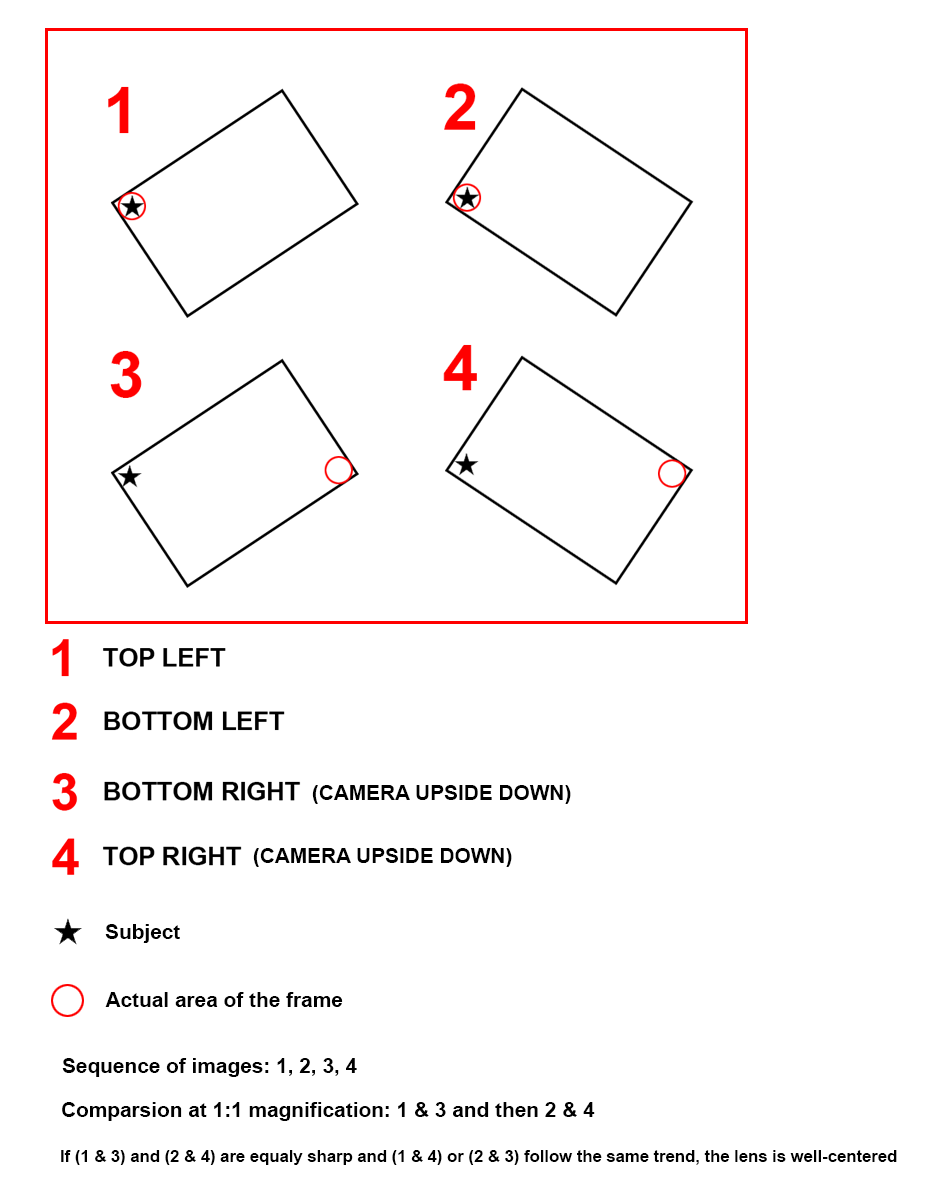
Also, don't hold the camera at an angle like this. I don't know what angle the camera is at. You need to break down the focus plane skew into tilt (vertical direction) and swing (horizontal direction). The skew can be in any direction of 360 degrees (in reference to the face of the mount) and there's no way to easily tell that when the camera is rotated like this. Rather, do your test shoot with the camera level, for horizontal and then vertical orientation. Put the plane of focus through the centre of the frame, so it goes from center left edge to center right edge, like what you see in my running track test example. Then you can see the swing and the tilt of the lens clearly. The sum of the two will give you the actual skew of the focus plane and angular direction. But you don't need to know the latter usually, because you shim the lens mount screws in pairs, I'm assuming their position on your lens is orientated in the shape of a square. If the lens is swung, you shim only the top left and bottom left screw, or only the top right and bottom right screw. You do them in pairs, putting the same shim thickness under each adjacent pair of screws. You don't ever want to leave one part of the mount unsupported and thus cause it to bend and warp when the screws are tightened. Shim in pairs, always. If it is tilted, you shim in pairs again, top right and left, or bottom right and left screws. If the lens is both tilted and swung, you still shim in pairs again, three screws in total are affected. E.g. top two screws and both left side screws - so the top left screw position gets the combined tilt+swing shim thickness applied. This way you don't have to worry about computing the skew orientation if it is not orthogonal to the sensor.
You also need to know how far everything is from you in the scene. How far is that building from you in feet/miles? What about the building behind it? And the tree in front of the house? What object is in focus on the left edge, what distance is that to the camera? What object is in focus on the right edge, how far away is that from the camera? Then you use the formula to compute focus distance to extension at the sensor plane for each side for camera horizontal and vertical orientation. The difference is the amount of swing and tilt that is present. Can't guess by just looking at these two crops without knowing the focus distance.
https://www.dyxum.com/lenses/Minolta-AF-200mm-F2.8-G-APO-HS_lens78.html

Yikes, if this is the lens you are trying to shim, the mount screw positions don't look orthogonal to the sensor, using the focus distance display and red dot bayonet mating marker as a reference point for the orientation of the lens. I'm not sure. I don't have this lens. It might be slightly offset only, and maybe you can get away by assuming it isn't. Plus a little trial and error is usually needed to get to the optimum adjustment anyway, which would negate this issue somewhat.
|