tiggy
Offline
• •
Upload & Sell: On
|
 p.1 #1 · Side by side comparison of 600mm F/11 versus 600mm f/4 in the woods p.1 #1 · Side by side comparison of 600mm F/11 versus 600mm f/4 in the woods | |
This is going to sound crazy, but the 600mm f/11 is good enough that I had to take it out with me along with my 600mm f/4 to prove to myself which one would be better to take along on hikes.
Of course this is a bit like apples and oranges, because the f/4 is so big, it’s pretty inconvenient. On the other hand, the f/11 is so slow in autofocus that it’s not at all practical for moving subjects. My wife and I both had the experience of having a series of birds land on branches, and every one of them had taken off before the 600 f/11 would achieve focus. Pretty comical. So if I’m doing action, it’s going to be f/4, and if I need to be light in weight, it’s going to be the f/11. But what about in the juicy middle, when you’re taking pictures of things that aren’t flying while off on a hike. Which is going to get me the best results versus the load carried?
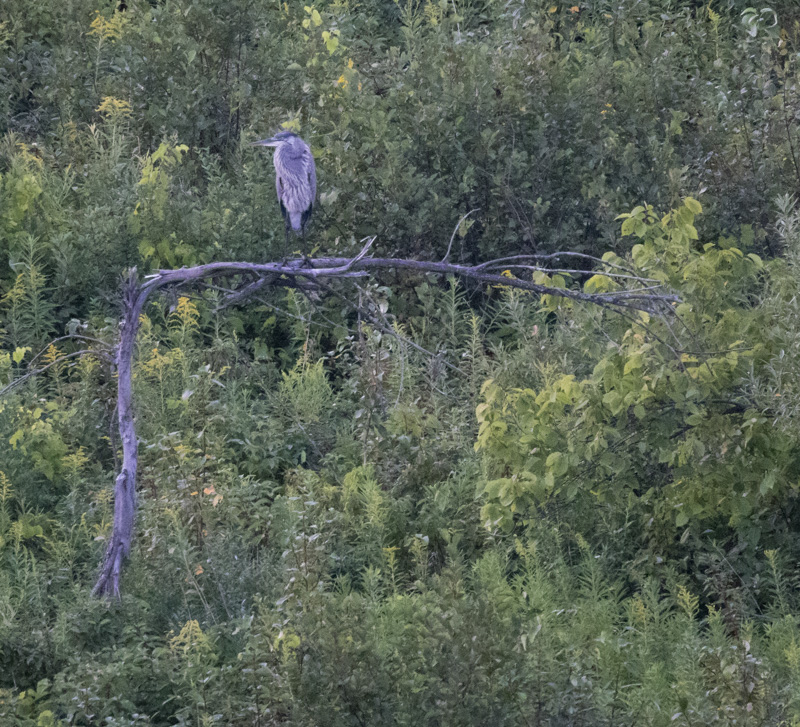
I hiked up into the woods a half mile with a couple R5s until I found a shaded in area that seemed like a good test case. I shot a dead snag from about 35 yards away. The dark weighed against the f/11, but this was the more realistic set of conditions for me. At f/11, the exposure at 200/th of a second wound up being 12800 ISO (the max I had the camera set). These were all shot handheld, which became an issue when the teleconverters came out. I had to pick the best of several with the f/11 lens.
Here is a crop of that image at 1:1 pixels… It’s not bad for an f/11 $700 lens at ISO 12800. [See Image 1]
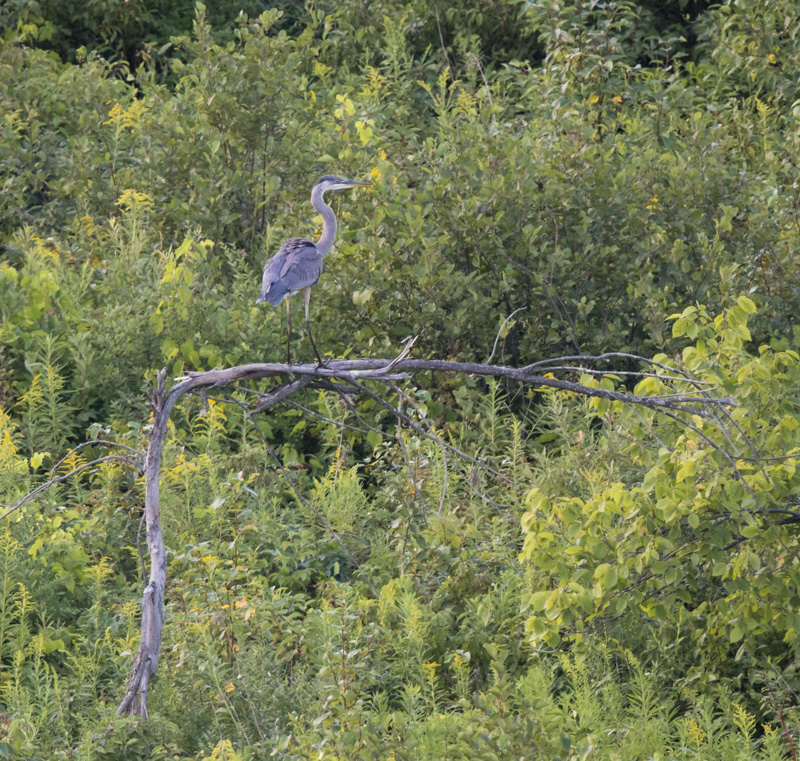
And here is the f/4’s equivalent shot. I kept the aperture at f/11, along with all other settings… [See Image 2]
A pixel peeper would say this is definitely better, but a normal person would likely shrug. Of course, the advantage of the f/4 lens isn’t that you can take it out and arbitrarily set it to f/11 for no good reason other than to compare it to another lens so hobbled. So here is the 1:1 crop of the f/4 600mm at f/5.6 due to the 1.4x teleconverter, which is actually how I’d shoot it in the woods. Note this is still at ISO 12800, which with previous cameras I had locked out, but with the R5 is the “new 6400."
[See image 3]
Putting on a 1.4x teleconverter on each respectively, we get these shots…
Here is a crop at 1:1 of the f/11 lens shot at f/16...
[See image 4]
…and here is a crop at 1:1 of the f/4 lens shot at f/16…
[See image 5]
If you zoom in to see, the detail on the f/4 is much, much better. Of course, the f/11 lens is underexposed here due to metering vagaries.
Just for kicks, here’s the f/11 lens at f/22 with a 2x teleconverter. It’s not pretty…. [See image 6]
So, as Saint Roger of Cicala would say: So what did we learn here today?
1) Amazingly, a $13,000 lens performs better than a $700 lens, provided you’re looking at image quality and not back ache.
2) We learned that taking the bare 600mm f/11 lens out into the woods is probably the best option if we don’t anticipate shooting moving critters. It is just easy to bring. The F/4 is so honking big that it’ll be the only thing you bring, so you’ll miss everything else.
3) If we need more reach than that, the 600mm F/11 won’t really do it well versus speedier options.
4) The sorts of wildlife places I frequent are pretty dark, and there are significant parts of the day where you just won’t get these results with ISO 12800. I shudder to think of the 6-figure ISOs you’d need at 6:30 a.m. The F/4 is really the only option then.
5) Canon did a couple things wildly well here. A - They squished down a 600mm capacity into a package close to the size of a Pringles can. They did this by sticking in a DO element; and also by creating the funny trombone mechanism. B - They made that funny lens have amazing image quality when shooting still objects in OK-ish light - for the price. This isn’t something I’d have expected from Canon or Sigma or Tamron. I'd expect it more from Dr. Seuss.

Image 1: F/11 lens bare

Image 2: F/4 lens at f/11 bare

Image 3: f/4 lens at f/5.6 with 1.4x TC

Image 4: f/11 lens at f/16 with 1.4x TC

Image 5: f/4 lens at f/16 with 1.4x TC

Image 6: f/11 lens at f/22 with 2x teleconverter
|