This topic is in the 2020 archive. You can read it and like its posts here. It is read only.
Archive 2020Detached wings: silent shutter issue (A7iii)?
p.1 #1Detached wings: silent shutter issue (A7iii)?
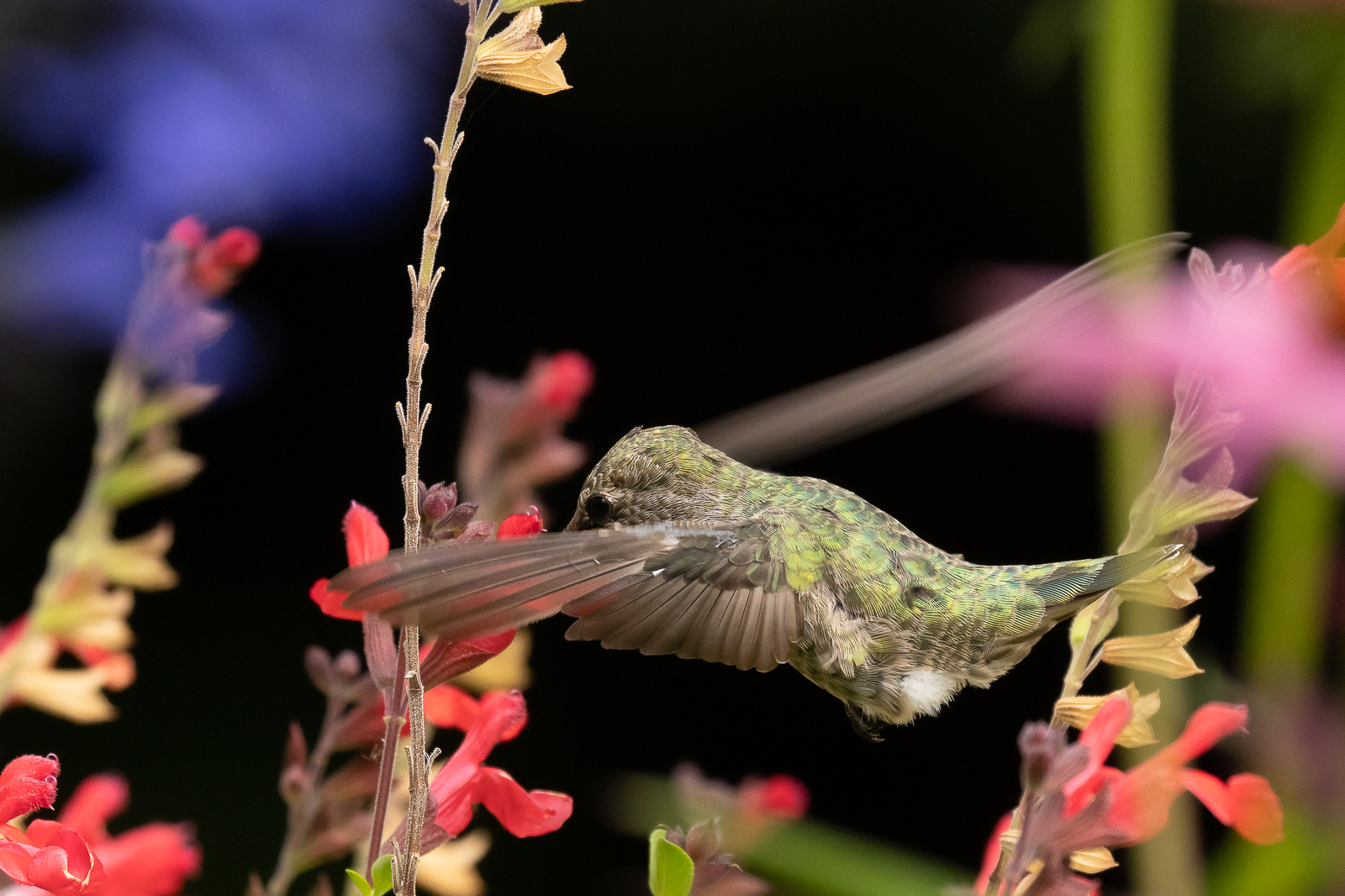
I was shooting hummingbirds yesterday with an A7iii and the FE 200-600mm. Several images had odd detached wings like the below. Settings were 1/2000, f/6.3, ISO 640. I assume this was a result of the way the electronic shutter scans but wanted to confirm and see if others had similar issue?

Aug 06, 2020 at 05:15 AM
p.1 #2Detached wings: silent shutter issue (A7iii)?
Yup, that's it. A fascinating photo, though.
Aug 06, 2020 at 05:34 AM
p.1 #3Detached wings: silent shutter issue (A7iii)?
Got it, thanks for the confirmation!
Aug 06, 2020 at 05:52 AM
p.1 #4Detached wings: silent shutter issue (A7iii)?
The other thing to watch out for with silent shutter is banding in the presence of certain kinds of lights, such as LEDs. Not generally an issue if you're only doing nature photography, but I wouldn't use silent shutter in any situation where LED lights are present unless you calculate the correct shutter speed to avoid it. See https://phillipreeve.net/blog/limitations-of-the-electronic-shutter-function/
Aug 06, 2020 at 05:57 AM
p.1 #5Detached wings: silent shutter issue (A7iii)?
Thanks for posting the sample! A creative use of the silent shutter! 
otisjackson wrote:
I was shooting hummingbirds yesterday with an A7iii and the FE 200-600mm. Several images had odd detached wings like the below. Settings were 1/2000, f/6.3, ISO 640. I assume this was a result of the way the electronic shutter scans but wanted to confirm and see if others had similar issue?
Aug 06, 2020 at 06:00 AM
p.1 #7Detached wings: silent shutter issue (A7iii)?
That is one cool shot!!! Silent shutter is needed at feeders since they spook easily. I keep forgetting to put my A7III on silent. But then when I do the hummers seem to never come back!
Aug 06, 2020 at 08:32 AM
p.1 #8Detached wings: silent shutter issue (A7iii)?
I know it's not the picture you wanted, but it's still really, really cool.
Aug 06, 2020 at 10:55 AM
p.1 #9Detached wings: silent shutter issue (A7iii)?
This is a very nice example of how an image can have disconnected elements if the shutter is slow. The A7R3 electronic shutter sweeps down the image (up the sensor) in either 1/15 or 1/30 sec, depending on whether you are in compressed or uncompressed mode (i.e. 14 or 12 bit). Hummingbirds can flap their wings from top to bottom in less than 1/30 sec. Your shutter speed is 1/2000 so the width of the shutter slit that is sweeping down the image is only 30/2000 = 1.5% of the height of the sensor (~80 pixels). As the slit traversed downward it first caught the wings at the top of their motion. As the wings moved downward, the shutter slit continued to capture an image of the wing until the wing out ran the shutter and detached about half way down. The shutter continued to move downward and eventually caught up as the wings were at the bottom of their stroke. This is an extreme example of rolling shutter distortion.
Regardless of the explanation, it's a cool image.
Dave
Edited on Aug 13, 2020 at 08:56 PM · View previous versions
Regardless of the explanation, it's a cool image.
Dave
Edited on Aug 13, 2020 at 08:56 PM · View previous versions
Aug 13, 2020 at 08:29 PM
p.1 #10Detached wings: silent shutter issue (A7iii)?
It could be that you caught that rare moment in which a hummer sheds his old wings in favor of the new ones. 
Aug 13, 2020 at 08:52 PM
p.1 #11Detached wings: silent shutter issue (A7iii)?
Is this a case of rolling shutter? Why do airplane propellers photographed in flight appear curved?
Aug 13, 2020 at 09:21 PM
p.1 #12Detached wings: silent shutter issue (A7iii)?
dalite wrote:
Is this a case of rolling shutter? Why do airplane propellers photographed in flight appear curved?
The shutter (mechanical or electronic) moves from the bottom to the top of the sensor (*). It takes some time to traverse that distance. Mechanical shutters typically take 1/250 to 1/300 sec. Electronic shutters are slower and are typically 1/15 sec to 1/60 sec, with the Sony A9 being exceptionally fast at 1/160 sec. The speed of electronic shutters is limited by the ability of the readout electronics to read all the pixels in a row, digitize the signals, and store the result.
Since the shutter moves from the bottom of the sensor to the top, that means it moves from the top of the image to the bottom (the lens inverts the image). That means the top of the image is read earlier than the bottom. As the shutter moves down the image the subject may be moving so the top of the image shows it a bit earlier than the middle and the bottom is even later. If you look at an image of a rotating propeller you can see that the curvature is due to the time shift from top to bottom. The slower the shutter, the larger the time difference from top to bottom, and the more it is curved.
Dave
(*) So far as I know this is true for all digital cameras. Film camera shutters moved from left to right or right to left and was dependent on how the shutter was cocked by advancing the film.
Aug 13, 2020 at 10:04 PM
p.1 #13Detached wings: silent shutter issue (A7iii)?
Whenever I feel the need to trip out I just put my RIV into ES and go into the backyard to shoot hummers 

Aug 14, 2020 at 05:09 AM