This topic is in the 2020 archive. You can read it and like its posts here. It is read only.
Archive 2020R5 members review thread
p.8 #1R5 members review thread
John_TX wrote:
Some things I've found bothersome - not sure if there are fixes or some words of wisdom for these?
1. IS always runs with an IS lens attached (adapted EF at least) and lens IS set to ON. The only time it doesn't is if you're in the menus or the camera goes to sleep. This is going to really run down the battery and I don't want to continually adjust the IS switch or have the camera mostly in sleep. Oddly enough the IBIS controls disappear when an IS lens is attached. By comparison, an adapted EF lens on Sony functions just as it does on a Canon DSLR rather than running continuously.Yes that is a bit of a pain, isn't it. If you press the Menu or Playback button on the R the IS will shut off for a EF lenses only, which is still no fun. I don't have an R5 to test that.
This won't work for an an RF lens. It will continue to run until it times put or you power it off manually. Even if you turn the IS switch off on an RF lens something is running in there. It is not stabilizing but something is running.
There were some complaints about this here and other sites when R and RP came out. I was one of them. Seemed about 50/50 from ticked off to not caring. I can't remember the conversation but I think RF IS uses less power. TeamSpeed said the R's battery exceeded the specs. I'm reading reports of pretty decent battery life for the R5. I'm not trying to justify it.
I'm not an expert on this so I can't say one way or another. It would have been nice if the EF lenses shut off after 2 seconds
like they do on a DSLR. The seamless transition using EF lenses on R bodies Canon claimed wasn't completely seamless.Let me make sure I understand this correctly - I don't have an R5, but am interested in ordering one soon, so if the R5 is on, with a RF or EF lens attached that has IS turned on, if I take some photos, do not turn off the camera, and then sling the camera over my shoulder and do some hiking, the IBIS and lens IS both keep running with the R5? If so, wouldn't the bouncing around eventually tear up the IBIS & IS in that position or at least waste significant battery power? What if the camera...Show more →
A FW update was requested for the R and it didn't happen. Some hoped the R5 would have it. I don't know about the IBIS. There are no specific menus I could find for it. The RF lenses got FW updates to work with IBIS so my guess is this works together. If you aren't focusing the IS may not be doing anything when slung over your back. It is just floating the assembly until you AF. I'm just guessing here.
There are a series of powering down options and can get it to shut down in 30 seconds. I have to step out for a while and when I get back I'l explain how they work.
Again for an EF lens you can press the menu or playback to shut IS off.
Zenon Char wrote
Greg Schneider wrote
First day with the R5. So far it's amazing, basically the spec I've wanted for years but with all the Canon ergonomics, UI and system around it.Some things I've found bothersome - not sure if there are fixes or some words of wisdom for these?
1. IS always runs with an IS lens attached (adapted EF at least) and lens IS set to ON. The only time it doesn't is if you're in the menus or the camera goes to sleep. This is going to really run down the battery and I don't want to continually adjust the IS switch or have the camera mostly in sleep. Oddly enough the IBIS controls disappear when an IS lens is attached. By comparison, an adapted EF lens on Sony functions just as it does on a Canon DSLR rather than running continuously.
This won't work for an an RF lens. It will continue to run until it times put or you power it off manually. Even if you turn the IS switch off on an RF lens something is running in there. It is not stabilizing but something is running.
There were some complaints about this here and other sites when R and RP came out. I was one of them. Seemed about 50/50 from ticked off to not caring. I can't remember the conversation but I think RF IS uses less power. TeamSpeed said the R's battery exceeded the specs. I'm reading reports of pretty decent battery life for the R5. I'm not trying to justify it.
I'm not an expert on this so I can't say one way or another. It would have been nice if the EF lenses shut off after 2 seconds
like they do on a DSLR. The seamless transition using EF lenses on R bodies Canon claimed wasn't completely seamless.
A FW update was requested for the R and it didn't happen. Some hoped the R5 would have it. I don't know about the IBIS. There are no specific menus I could find for it. The RF lenses got FW updates to work with IBIS so my guess is this works together. If you aren't focusing the IS may not be doing anything when slung over your back. It is just floating the assembly until you AF. I'm just guessing here.
There are a series of powering down options and can get it to shut down in 30 seconds. I have to step out for a while and when I get back I'l explain how they work.
Again for an EF lens you can press the menu or playback to shut IS off.
Aug 10, 2020 at 07:47 AM
p.8 #2R5 members review thread
Regarding IBIS with an EF IS lens, it seems to be always enabled, with the options actually hidden in the menus when an IS lens is mounted. It also seems to run even with the IS lens switch off. Tested this with my 600 which was absolutely being stabilized by something even with the lens switch off...pretty sure I'm not that steady normally. 
One positive finding is with the LP-E6NH battery now at 40% I'm still seeing a green H+ 12fps mechanical mode, so perhaps it doesn't revert to lower fps right at the 60% mark as indicated by Canon (indoors).
In video, is there a way to display more information once recording starts? Obviously access to changing quality via the Q button doesn't make sense, but as soon as video recording starts even your histogram disappears and can't be brought back via the info button unless you stop recording.
Aug 10, 2020 at 08:29 AM
p.8 #3R5 members review thread
shot my first assignment on Saturday with the camera. Quite a good experience. 1700 images on 1 battery in hot weather (>33 degrees celcius). Focus was great with the eyes on people and super fast. Not everything is in focus of course, but the keeper rate is way higher than the 5D4.
Still need to get the muscle memory to have it working. No real downsides, but I do need to find my way around proper editing (sharpness settings, default contrast, etc.)
Made a custom LR profile which makes the converted DNG files a bit compatible with the 5D4, color wise (you can try it if you like: https://www.evertdoorn.nl/client/R5test.dcp )
I like that the regular shutter and electronic first shutter are rather quiet as well
Edited on Aug 10, 2020 at 09:21 AM · View previous versions
Aug 10, 2020 at 09:10 AM
p.8 #4R5 members review thread
Thank you both for the clarifications. I sure would like to hear Canon's reasons for having IBIS/IS setup the way it currently appears to function.
Aug 10, 2020 at 09:17 AM
p.8 #5R5 members review thread
Greg Schneider wrote:
3. Histogram display position is terrible being just off center to the top right vs in the bottom RHS corner on Sony. At least you can make it smaller, but it's not great for composing.
I wonder if it's still based on the embedded JPEG thumbnail image, or on the RAW.
Good report though, thanks for honest feedback.
Aug 10, 2020 at 09:26 AM
p.8 #6R5 members review thread
I'd be interested in the R5's Focus Stacking function / results?
Aug 10, 2020 at 09:33 AM
p.8 #7R5 members review thread
Zenon Char wrote:
Some things I've found bothersome - not sure if there are fixes or some words of wisdom for these?
1. IS always runs with an IS lens attached (adapted EF at least) and lens IS set to ON. The only time it doesn't is if you're in the menus or the camera goes to sleep. This is going to really run down the battery and I don't want to continually adjust the IS switch or have the camera mostly in sleep. Oddly enough the IBIS controls disappear when an IS lens is attached. By comparison, an adapted EF lens on Sony functions just as it does on a Canon DSLR rather than running continuously.Yes that is a bit of a pain, isn't it. If you press the Menu or Playback button on the R the IS will shut off for a EF lenses only, which is still no fun. I don't have an R5 to test that.
This won't work for an an RF lens. It will continue to run until it times put or you power it off manually. Even if you turn the IS switch off on an RF lens something is running in there. It is not stabilizing but something is running.
There were some complaints about this here and...Show more →
If you go into Menu or Playback and the lens IS shuts off does it immediately start up again as soon as you exit Menu or Playback? If it stays off then I could see a quick into and out of the Menu or Playback to have the IS off until you need it again.
Greg Schneider wrote
First day with the R5. So far it's amazing, basically the spec I've wanted for years but with all the Canon ergonomics, UI and system around it.Some things I've found bothersome - not sure if there are fixes or some words of wisdom for these?
1. IS always runs with an IS lens attached (adapted EF at least) and lens IS set to ON. The only time it doesn't is if you're in the menus or the camera goes to sleep. This is going to really run down the battery and I don't want to continually adjust the IS switch or have the camera mostly in sleep. Oddly enough the IBIS controls disappear when an IS lens is attached. By comparison, an adapted EF lens on Sony functions just as it does on a Canon DSLR rather than running continuously.
This won't work for an an RF lens. It will continue to run until it times put or you power it off manually. Even if you turn the IS switch off on an RF lens something is running in there. It is not stabilizing but something is running.
There were some complaints about this here and...Show more →
If you go into Menu or Playback and the lens IS shuts off does it immediately start up again as soon as you exit Menu or Playback? If it stays off then I could see a quick into and out of the Menu or Playback to have the IS off until you need it again.
Aug 10, 2020 at 09:36 AM
p.8 #8R5 members review thread
arbitrage wrote:
Some things I've found bothersome - not sure if there are fixes or some words of wisdom for these?
1. IS always runs with an IS lens attached (adapted EF at least) and lens IS set to ON. The only time it doesn't is if you're in the menus or the camera goes to sleep. This is going to really run down the battery and I don't want to continually adjust the IS switch or have the camera mostly in sleep. Oddly enough the IBIS controls disappear when an IS lens is attached. By comparison, an adapted EF lens on Sony functions just as it does on a Canon DSLR rather than running continuously.Yes that is a bit of a pain, isn't it. If you press the Menu or Playback button on the R the IS will shut off for a EF lenses only, which is still no fun. I don't have an R5 to test that.
This won't work for an an RF lens. It will continue to run until it times put or you power it off manually. Even if you turn the IS switch off on an RF lens something is running in there. It is not stabilizing but something is running.
There were some complaints about this here and other sites when R and RP came out. I was one of them. Seemed about 50/50 from ticked off to not caring. I can't remember the conversation but I think RF IS uses less power. TeamSpeed said the R's battery exceeded the specs. I'm reading reports of pretty decent battery life for the R5. I'm not trying to justify it.
I'm not an expert on this so I can't say one way or another. It would have been nice if the EF lenses shut off after 2 seconds
like they do on a DSLR. The seamless transition using EF lenses on R bodies Canon claimed wasn't completely seamless.If you go into Menu or Playback and the lens IS shuts off does it immediately start up again as soon as you exit Menu or Playback? If it stays off then I could see a quick into and out of the Menu or Playback to have the IS off until you need it again.
Starts immediately once you exit the menu again. It's a head scratcher...
Zenon Char wrote
Greg Schneider wrote
First day with the R5. So far it's amazing, basically the spec I've wanted for years but with all the Canon ergonomics, UI and system around it.Some things I've found bothersome - not sure if there are fixes or some words of wisdom for these?
1. IS always runs with an IS lens attached (adapted EF at least) and lens IS set to ON. The only time it doesn't is if you're in the menus or the camera goes to sleep. This is going to really run down the battery and I don't want to continually adjust the IS switch or have the camera mostly in sleep. Oddly enough the IBIS controls disappear when an IS lens is attached. By comparison, an adapted EF lens on Sony functions just as it does on a Canon DSLR rather than running continuously.
This won't work for an an RF lens. It will continue to run until it times put or you power it off manually. Even if you turn the IS switch off on an RF lens something is running in there. It is not stabilizing but something is running.
There were some complaints about this here and other sites when R and RP came out. I was one of them. Seemed about 50/50 from ticked off to not caring. I can't remember the conversation but I think RF IS uses less power. TeamSpeed said the R's battery exceeded the specs. I'm reading reports of pretty decent battery life for the R5. I'm not trying to justify it.
I'm not an expert on this so I can't say one way or another. It would have been nice if the EF lenses shut off after 2 seconds
like they do on a DSLR. The seamless transition using EF lenses on R bodies Canon claimed wasn't completely seamless.
Starts immediately once you exit the menu again. It's a head scratcher...
Aug 10, 2020 at 10:04 AM
p.8 #9R5 members review thread
thanks for all the reviews, gives me something to read while waiting for B&H to get some more
(email from them yesterday was not encouraging)
(email from them yesterday was not encouraging)
Aug 10, 2020 at 10:06 AM
p.8 #10R5 members review thread
Greg Schneider wrote:
Some things I've found bothersome - not sure if there are fixes or some words of wisdom for these?
1. IS always runs with an IS lens attached (adapted EF at least) and lens IS set to ON. The only time it doesn't is if you're in the menus or the camera goes to sleep. This is going to really run down the battery and I don't want to continually adjust the IS switch or have the camera mostly in sleep. Oddly enough the IBIS controls disappear when an IS lens is attached. By comparison, an adapted EF lens on Sony functions just as it does on a Canon DSLR rather than running continuously.Yes that is a bit of a pain, isn't it. If you press the Menu or Playback button on the R the IS will shut off for a EF lenses only, which is still no fun. I don't have an R5 to test that.
This won't work for an an RF lens. It will continue to run until it times put or you power it off manually. Even if you turn the IS switch off on an RF lens something is running in there. It is not stabilizing but something is running.
There were some complaints about this here and other sites when R and RP came out. I was one of them. Seemed about 50/50 from ticked off to not caring. I can't remember the conversation but I think RF IS uses less power. TeamSpeed said the R's battery exceeded the specs. I'm reading reports of pretty decent battery life for the R5. I'm not trying to justify it.
I'm not an expert on this so I can't say one way or another. It would have been nice if the EF lenses shut off after 2 seconds
like they do on a DSLR. The seamless transition using EF lenses on R bodies Canon claimed wasn't completely seamless.If you go into Menu or Playback and the lens IS shuts off does it immediately start up again as soon as you exit Menu or Playback? If it stays off then I could see a quick into and out of the Menu or Playback to have the IS off until you need it again.Starts immediately once you exit the menu again. It's a head scratcher...
There should be a firmware fix for that. I hope Canon is listening. I usually turn off my camera as soon as I'm done taking a series, but for those times that the action is unpredictable and fluid, you just can't do that!
arbitrage wrote
Zenon Char wrote
Greg Schneider wrote
First day with the R5. So far it's amazing, basically the spec I've wanted for years but with all the Canon ergonomics, UI and system around it.Some things I've found bothersome - not sure if there are fixes or some words of wisdom for these?
1. IS always runs with an IS lens attached (adapted EF at least) and lens IS set to ON. The only time it doesn't is if you're in the menus or the camera goes to sleep. This is going to really run down the battery and I don't want to continually adjust the IS switch or have the camera mostly in sleep. Oddly enough the IBIS controls disappear when an IS lens is attached. By comparison, an adapted EF lens on Sony functions just as it does on a Canon DSLR rather than running continuously.
This won't work for an an RF lens. It will continue to run until it times put or you power it off manually. Even if you turn the IS switch off on an RF lens something is running in there. It is not stabilizing but something is running.
There were some complaints about this here and other sites when R and RP came out. I was one of them. Seemed about 50/50 from ticked off to not caring. I can't remember the conversation but I think RF IS uses less power. TeamSpeed said the R's battery exceeded the specs. I'm reading reports of pretty decent battery life for the R5. I'm not trying to justify it.
I'm not an expert on this so I can't say one way or another. It would have been nice if the EF lenses shut off after 2 seconds
like they do on a DSLR. The seamless transition using EF lenses on R bodies Canon claimed wasn't completely seamless.
There should be a firmware fix for that. I hope Canon is listening. I usually turn off my camera as soon as I'm done taking a series, but for those times that the action is unpredictable and fluid, you just can't do that!
Aug 10, 2020 at 10:08 AM
p.8 #11R5 members review thread
aae991 wrote:
Some things I've found bothersome - not sure if there are fixes or some words of wisdom for these?
1. IS always runs with an IS lens attached (adapted EF at least) and lens IS set to ON. The only time it doesn't is if you're in the menus or the camera goes to sleep. This is going to really run down the battery and I don't want to continually adjust the IS switch or have the camera mostly in sleep. Oddly enough the IBIS controls disappear when an IS lens is attached. By comparison, an adapted EF lens on Sony functions just as it does on a Canon DSLR rather than running continuously.Yes that is a bit of a pain, isn't it. If you press the Menu or Playback button on the R the IS will shut off for a EF lenses only, which is still no fun. I don't have an R5 to test that.
This won't work for an an RF lens. It will continue to run until it times put or you power it off manually. Even if you turn the IS switch off on an RF lens something is running in there. It is not stabilizing but something is running.
There were some complaints about this here and other sites when R and RP came out. I was one of them. Seemed about 50/50 from ticked off to not caring. I can't remember the conversation but I think RF IS uses less power. TeamSpeed said the R's battery exceeded the specs. I'm reading reports of pretty decent battery life for the R5. I'm not trying to justify it.
I'm not an expert on this so I can't say one way or another. It would have been nice if the EF lenses shut off after 2 seconds
like they do on a DSLR. The seamless transition using EF lenses on R bodies Canon claimed wasn't completely seamless.If you go into Menu or Playback and the lens IS shuts off does it immediately start up again as soon as you exit Menu or Playback? If it stays off then I could see a quick into and out of the Menu or Playback to have the IS off until you need it again.Starts immediately once you exit the menu again. It's a head scratcher...There should be a firmware fix for that. I hope Canon is listening. I usually turn off my camera as soon as I'm done taking a series, but for those times that the action is unpredictable and fluid, you just can't do that!
I certainly hope Canon takes more action on feedback from the R5 given the splash they're trying to make, and much greater uptake in the marketplace for this body. This was an issue with the original R that was never addressed despite complaints.
Greg Schneider wrote
arbitrage wrote
Zenon Char wrote
Greg Schneider wrote
First day with the R5. So far it's amazing, basically the spec I've wanted for years but with all the Canon ergonomics, UI and system around it.Some things I've found bothersome - not sure if there are fixes or some words of wisdom for these?
1. IS always runs with an IS lens attached (adapted EF at least) and lens IS set to ON. The only time it doesn't is if you're in the menus or the camera goes to sleep. This is going to really run down the battery and I don't want to continually adjust the IS switch or have the camera mostly in sleep. Oddly enough the IBIS controls disappear when an IS lens is attached. By comparison, an adapted EF lens on Sony functions just as it does on a Canon DSLR rather than running continuously.
This won't work for an an RF lens. It will continue to run until it times put or you power it off manually. Even if you turn the IS switch off on an RF lens something is running in there. It is not stabilizing but something is running.
There were some complaints about this here and other sites when R and RP came out. I was one of them. Seemed about 50/50 from ticked off to not caring. I can't remember the conversation but I think RF IS uses less power. TeamSpeed said the R's battery exceeded the specs. I'm reading reports of pretty decent battery life for the R5. I'm not trying to justify it.
I'm not an expert on this so I can't say one way or another. It would have been nice if the EF lenses shut off after 2 seconds
like they do on a DSLR. The seamless transition using EF lenses on R bodies Canon claimed wasn't completely seamless.
I certainly hope Canon takes more action on feedback from the R5 given the splash they're trying to make, and much greater uptake in the marketplace for this body. This was an issue with the original R that was never addressed despite complaints.
Aug 10, 2020 at 10:15 AM
p.8 #12R5 members review thread
Greg Schneider wrote:
Some things I've found bothersome - not sure if there are fixes or some words of wisdom for these?
1. IS always runs with an IS lens attached (adapted EF at least) and lens IS set to ON. The only time it doesn't is if you're in the menus or the camera goes to sleep. This is going to really run down the battery and I don't want to continually adjust the IS switch or have the camera mostly in sleep. Oddly enough the IBIS controls disappear when an IS lens is attached. By comparison, an adapted EF lens on Sony functions just as it does on a Canon DSLR rather than running continuously.Yes that is a bit of a pain, isn't it. If you press the Menu or Playback button on the R the IS will shut off for a EF lenses only, which is still no fun. I don't have an R5 to test that.
This won't work for an an RF lens. It will continue to run until it times put or you power it off manually. Even if you turn the IS switch off on an RF lens something is running in there. It is not stabilizing but something is running.
There were some complaints about this here and other sites when R and RP came out. I was one of them. Seemed about 50/50 from ticked off to not caring. I can't remember the conversation but I think RF IS uses less power. TeamSpeed said the R's battery exceeded the specs. I'm reading reports of pretty decent battery life for the R5. I'm not trying to justify it.
I'm not an expert on this so I can't say one way or another. It would have been nice if the EF lenses shut off after 2 seconds
like they do on a DSLR. The seamless transition using EF lenses on R bodies Canon claimed wasn't completely seamless.If you go into Menu or Playback and the lens IS shuts off does it immediately start up again as soon as you exit Menu or Playback? If it stays off then I could see a quick into and out of the Menu or Playback to have the IS off until you need it again.Starts immediately once you exit the menu again. It's a head scratcher...There should be a firmware fix for that. I hope Canon is listening. I usually turn off my camera as soon as I'm done taking a series, but for those times that the action is unpredictable and fluid, you just can't do that!I certainly hope Canon takes more action on feedback from the R5 given the splash they're trying to make, and much greater uptake in the marketplace for this body. This was an issue with the original R that was never addressed despite complaints.
That does worry me. Over on the Sony side, there are numerous reports of the 200-600 not playing well with the A7R4. Sony has yet to completely address that from what I can tell. As an owner of the A7R4, it has stopped me from even considering that lens. Marketing and PR departments need to work more closely with the tech folks! Then again, what do we buyers know?

aae991 wrote
Greg Schneider wrote
arbitrage wrote
Zenon Char wrote
Greg Schneider wrote
First day with the R5. So far it's amazing, basically the spec I've wanted for years but with all the Canon ergonomics, UI and system around it.Some things I've found bothersome - not sure if there are fixes or some words of wisdom for these?
1. IS always runs with an IS lens attached (adapted EF at least) and lens IS set to ON. The only time it doesn't is if you're in the menus or the camera goes to sleep. This is going to really run down the battery and I don't want to continually adjust the IS switch or have the camera mostly in sleep. Oddly enough the IBIS controls disappear when an IS lens is attached. By comparison, an adapted EF lens on Sony functions just as it does on a Canon DSLR rather than running continuously.
This won't work for an an RF lens. It will continue to run until it times put or you power it off manually. Even if you turn the IS switch off on an RF lens something is running in there. It is not stabilizing but something is running.
There were some complaints about this here and other sites when R and RP came out. I was one of them. Seemed about 50/50 from ticked off to not caring. I can't remember the conversation but I think RF IS uses less power. TeamSpeed said the R's battery exceeded the specs. I'm reading reports of pretty decent battery life for the R5. I'm not trying to justify it.
I'm not an expert on this so I can't say one way or another. It would have been nice if the EF lenses shut off after 2 seconds
like they do on a DSLR. The seamless transition using EF lenses on R bodies Canon claimed wasn't completely seamless.
That does worry me. Over on the Sony side, there are numerous reports of the 200-600 not playing well with the A7R4. Sony has yet to completely address that from what I can tell. As an owner of the A7R4, it has stopped me from even considering that lens. Marketing and PR departments need to work more closely with the tech folks! Then again, what do we buyers know?
Aug 10, 2020 at 10:17 AM
p.8 #13R5 members review thread
aae991 wrote:
There should be a firmware fix for that. I hope Canon is listening. I usually turn off my camera as soon as I'm done taking a series, but for those times that the action is unpredictable and fluid, you just can't do that!
I haven't deliberately turned off a 1D series except when prompted by the cleaning cycle. They just doze in my bag until grabbed and they're immediate ready for action.
I don't like this new power-hungry aspect of mirrorless cameras...
Aug 10, 2020 at 10:45 AM
p.8 #14R5 members review thread
The constantly powered on IBIS/IS is a deal killer for me. I am wanting to order two R5's to replace aging 5D3 & 5D4 but will continue to make due with the 5D's until this is resolved. It costs a premium to replace the IS system in lenses, I can only imagine how much it is for the IBIS system. No thanks, I don't need something constantly running and its a PITA to constantly do something silly like going into the menu or manually having to turn the camera off. This seems like a pretty basic functionality snafu which would seem to be easy to fix via firmware.
Aug 10, 2020 at 11:29 AM
p.8 #15R5 members review thread
Zenon Char wrote:
Some things I've found bothersome - not sure if there are fixes or some words of wisdom for these?
1. IS always runs with an IS lens attached (adapted EF at least) and lens IS set to ON. The only time it doesn't is if you're in the menus or the camera goes to sleep. This is going to really run down the battery and I don't want to continually adjust the IS switch or have the camera mostly in sleep. Oddly enough the IBIS controls disappear when an IS lens is attached. By comparison, an adapted EF lens on Sony functions just as it does on a Canon DSLR rather than running continuously.Yes that is a bit of a pain, isn't it. If you press the Menu or Playback button on the R the IS will shut off for a EF lenses only, which is still no fun. I don't have an R5 to test that.
This won't work for an an RF lens. It will continue to run until it times put or you power it off manually. Even if you turn the IS switch off on an RF lens something is running in there. It is not stabilizing but something is running.
There were some complaints about this here and other sites when R and RP came out. I was one of them. Seemed about 50/50 from ticked off to not caring. I can't remember the conversation but I think RF IS uses less power. TeamSpeed said the R's battery exceeded the specs. I'm reading reports of pretty decent battery life for the R5. I'm not trying to justify it.
I'm not an expert on this so I can't say one way or another. It would have been nice if the EF lenses shut off after 2 seconds
like they do on a DSLR. The seamless transition using EF lenses on R bodies Canon claimed wasn't completely seamless.Let me make sure I understand this correctly - I don't have an R5, but am interested in ordering one soon, so if the R5 is on, with a RF or EF lens attached that has IS turned on, if I take some photos, do not turn off the camera, and then sling the camera over my shoulder and do some hiking, the IBIS and lens IS both keep running with the R5? If so, wouldn't the bouncing around eventually tear up the IBIS & IS in that position or at least waste significant battery power? What if the camera goes to sleep? Does sleep mode turn off all IBIS & IS?
Canon - please add a firmware option so that both IBIS & lens IS (on both RF & EF) lenses can be set to start and stop with auto focus, just how it works with EF DSLR's.A FW update was requested for the R and it didn't happen. Some hoped the R5 would have it. I don't know about the IBIS. There are no specific menus I could find for it. The RF lenses got FW updates to work with IBIS so my guess is this works together. If you aren't focusing the IS may not be doing anything when slung over your back. It is just floating the assembly until you AF. I'm just guessing here.
There are a series of powering down options and can get it to shut down...Show more →
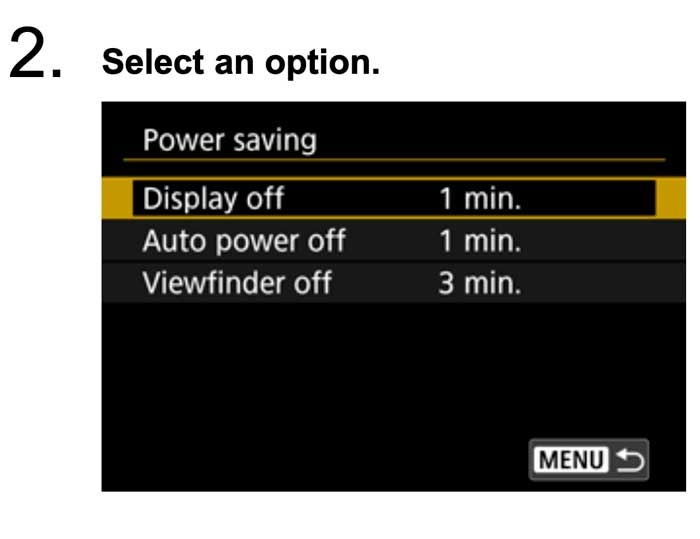
The minimum is actually 45 seconds. Sorry about that. I forgot about the display timer. Attached is the power settings menu. The Display off timer starts first. Minimum setting is 15 seconds. Then the Auto Power off starts and the minimum is 30 seconds for a total of 45. If something gets close to the EVF sensor like your hand before the camera powers off then the camera wakes up and the cycle repeats.
VF off. The VF always shuts off in about 6 seconds when you pull the camera away from your face. I haven't tested it but I assume the off timer is there in case the VF is obstructed and the system continues to run. I can't find another use for it.
Thanks to a few questions from arbitrage I'm going to change a few things up. My other concern is EVF wakeup lag. It is pretty bad with the R. One second can be a lifetime for birding. Some suggested to press the shutter or BBF to wake it up but I'm still faster. Still a delay.
You can disable the EVF sensor from switching between the Display and EVF automatically. The sensor still works for the EVF on its own. I'm going to do this manually and use the M-Fn button. I'll toggle to the Display when I need to. You can assign other buttons as well.
Now the LCD is not running all of the time and using up battery power. I'm going to Disable the Auto power off. Also the EVF is not running unless the camera is at your face. Now if I press the Shutter or BBF the EVF is awake and ready to go as soon as it gets to my eye. I also found it faster to manually toggle between the Display and the EVF than using the EVF sensor.
Of course my test were on the Canon R. The R5 may have faster response times. I also disabled Image Review on my R a long time ago and will on my R5
There is also a separate menu called ECO mode. This darkens the Display after 2 seconds if the camera is not used and then the screen shuts off after 10 seconds. I have not used it but just tried it. If you Enable it the Display and EVF timers are greyed out. The Display shut off after 10 seconds but the camera won't power off. Similar to me disabling the power off. I'll mess around with it and see if it adds any value to my plan.
John_TX wrote
Zenon Char wrote
Greg Schneider wrote
First day with the R5. So far it's amazing, basically the spec I've wanted for years but with all the Canon ergonomics, UI and system around it.Some things I've found bothersome - not sure if there are fixes or some words of wisdom for these?
1. IS always runs with an IS lens attached (adapted EF at least) and lens IS set to ON. The only time it doesn't is if you're in the menus or the camera goes to sleep. This is going to really run down the battery and I don't want to continually adjust the IS switch or have the camera mostly in sleep. Oddly enough the IBIS controls disappear when an IS lens is attached. By comparison, an adapted EF lens on Sony functions just as it does on a Canon DSLR rather than running continuously.
This won't work for an an RF lens. It will continue to run until it times put or you power it off manually. Even if you turn the IS switch off on an RF lens something is running in there. It is not stabilizing but something is running.
There were some complaints about this here and other sites when R and RP came out. I was one of them. Seemed about 50/50 from ticked off to not caring. I can't remember the conversation but I think RF IS uses less power. TeamSpeed said the R's battery exceeded the specs. I'm reading reports of pretty decent battery life for the R5. I'm not trying to justify it.
I'm not an expert on this so I can't say one way or another. It would have been nice if the EF lenses shut off after 2 seconds
like they do on a DSLR. The seamless transition using EF lenses on R bodies Canon claimed wasn't completely seamless.
Canon - please add a firmware option so that both IBIS & lens IS (on both RF & EF) lenses can be set to start and stop with auto focus, just how it works with EF DSLR's.
There are a series of powering down options and can get it to shut down...Show more →
The minimum is actually 45 seconds. Sorry about that. I forgot about the display timer. Attached is the power settings menu. The Display off timer starts first. Minimum setting is 15 seconds. Then the Auto Power off starts and the minimum is 30 seconds for a total of 45. If something gets close to the EVF sensor like your hand before the camera powers off then the camera wakes up and the cycle repeats.
VF off. The VF always shuts off in about 6 seconds when you pull the camera away from your face. I haven't tested it but I assume the off timer is there in case the VF is obstructed and the system continues to run. I can't find another use for it.
Thanks to a few questions from arbitrage I'm going to change a few things up. My other concern is EVF wakeup lag. It is pretty bad with the R. One second can be a lifetime for birding. Some suggested to press the shutter or BBF to wake it up but I'm still faster. Still a delay.
You can disable the EVF sensor from switching between the Display and EVF automatically. The sensor still works for the EVF on its own. I'm going to do this manually and use the M-Fn button. I'll toggle to the Display when I need to. You can assign other buttons as well.
Now the LCD is not running all of the time and using up battery power. I'm going to Disable the Auto power off. Also the EVF is not running unless the camera is at your face. Now if I press the Shutter or BBF the EVF is awake and ready to go as soon as it gets to my eye. I also found it faster to manually toggle between the Display and the EVF than using the EVF sensor.
Of course my test were on the Canon R. The R5 may have faster response times. I also disabled Image Review on my R a long time ago and will on my R5
There is also a separate menu called ECO mode. This darkens the Display after 2 seconds if the camera is not used and then the screen shuts off after 10 seconds. I have not used it but just tried it. If you Enable it the Display and EVF timers are greyed out. The Display shut off after 10 seconds but the camera won't power off. Similar to me disabling the power off. I'll mess around with it and see if it adds any value to my plan.
Aug 10, 2020 at 11:43 AM
p.8 #16R5 members review thread
I'm not finding much use with ECO mode. After the screen goes to sleep and you press the shutter or BBF the screen wakes up first which is no good. That would be the same using the other power saving options. If you enable the EFV sensor then it wakes the LCD up first unless the camera it as you eye which is not practical for birding, etc. If you disable it then you can tell the camera to wake the EVF up first.
Aug 10, 2020 at 11:59 AM
p.8 #17R5 members review thread
Chimping wrote:
I'm specifically looking for comparisons with the 1DX, 1DXII and Sony A9, both in how quickly the camera locks on to a moving subject (i.e. BIF), how well it tracks and whether the images are razor sharp on your computer monitor.I can’t comment on the A9, but I can give you my thoughts on the R5 compared to the 1DX, 1DX Mark II, and 5DsR in regard to BIF.
I should also say that I sold my 1DX a few years ago, and I sold my 1DX Mark II earlier this year, so I’m unable to do a direct side-by-side comparison.
The EF lenses I’ve used on the R5 so far are the EF 100-400mm f/4.5-5.6L II, EF 300mm f/2.8L II, and the Canon 600mm f/4L II with the 2x III. I also had AF servo enabled (obviously), and I had my AF parameters set to “automatic” (the camera determined the best AF settings for the job).
I shot for approximately 1.5 hours last Saturday with the R5 and 600mm f/4L II, with attached 2x III (handheld), at a bird conservation site near my home city. The light was getting dark, so I shot wide open at f/8. There was a heavy wind too, which made the overall shooting experience crappy. My images are not post worthy; I stayed out shooting simply because I wanted to see what the camera was capable of.
Shooting the R5 with this lens combination yielded significantly more in-focus images than my 1DX, 1DX Mark II, or 5DsR could have ever delivered. I was constantly blown away by the consistency of the hit rate, especially with using such a long focal length handheld. The R5 was able to track fairly fast-moving birds, such as black-necked stilts and forster’s terns, with ease; the AF point locked onto the birds’ eyes during flight and, so long as my shutter speed was fast enough, delivered very sharp in-focus images (focus directly on the eye). The camera was even able to continue accurately tracking when a group of black-necked stilts flew behind some reeds and then emerged on the other side.
I always used AF point expansion whilst using my DSLRs for BIF. With such a long focal length (1200mm), it made it difficult to always keep birds in the viewfinder while tracking, as well as keep the focus point on their eyes. Even when I was on target, I still wouldn’t get every frame in focus. The R5, with its animal eye-AF, pretty much made the experience like shooting fish in a barrel. Animal eye-AF is the future – there is just no contest.
It felt like the R5 takes longer than the 1DX Mark II to move through the entire focus range (at least with the attached 600mm and 2x on), however. If I had to go from infinity to near focus, or vice versa, the process felt slow, much like using the 5DsR. I found myself using the focus limiter on the lens a lot more. If focus was already in the ballpark of where I needed it, the camera instantly locked on and stayed consistent until I stopped shooting. If focus was way out, then the camera had to search through the focus range which meant I lost the moment. The 1DX & 1DX Mark II, from my recollection, seem to be able to drive the lens faster overall.
Yesterday, while out for a walk with my wife and our new puppy, I had on the EF 100-400 II. We ran across a belted kingfisher near a local pond. The kingfisher had landed on a nearby branch. The R5 with 100-400 locked on focus easily, and the autofocus was able to accurately follow the bird as it dove off the branch (in the opposite direction from where I was facing, much to my chagrin – I got some nice in-focus shots of its ass).
When my wife and I returned from our walk I threw my 300mm f/2.8L II on the R5 for some puppy photos in our backyard. Again, as you’d expect, it focused very fast and accurately. I had no complaints.
In summation, the R5 works very well with the EF glass I’ve tried with it. I suspect most modern EF lenses (version IIs and newer) will work just as well, if not better, than using them natively on a DSLR. I have no hesitation in saying that I got better and more consistent results using my EF lenses on the R5 than using them on my DSLRs.
Other observations:
• I have no complaints coming from the optical viewfinder of the 1DX Mark II to the EVF of the R5. The image is crisp and clear, and the 120 fps refresh rate is wonderful. I did not feel like it hindered me while panning. Also, in regard to blackout, neither the mechanical or electronic shutter were a problem in terms of tracking; either mode work just fine for subject tracking. This camera is a completely different machine from the original R.
• If you’re using long lenses, do yourself a favor and buy the battery grip. While the R5 is a comfortable camera, I still prefer the size and handling of the bigger DSLR bodies. This is subjective, however.
• High ISO noise is very well controlled. I had been predominately using the 5DsR since selling my 1DX Mark II, and the R5 is definitely an improvement. Shadow recovery is also better than the 5DsR’s.
• CFExpress cards get hot! While the card got really warm, I didn’t experience any heat warnings with the camera, even after consistently shooting many bursts at 20 fps.
• Battery life seems to be better than what it’s rated at (at least for my type of shooting). After 1400+ images I still had more than 50%.
• There seems to be a bit of flex/play with the articulating screen; it makes me feel a bit uneasy about its overall durability.
• I don’t shoot video, so I can’t comment on that feature set.
• I kind of want to purchase a second R5 now.Can you describe what you mean automatic. Thanks
I had my AF parameters set to “automatic” (the camera determined the best AF settings for the job).Hi - no problem.
The camera has different case scenarios for tracking speed and AF point switching speed within the autofocus, similar to what most high end DSLRs have had since the original 1DX.
The R5 adds an “automatic” case scenario where the camera figures out the best AF parameters to set based on what and how you’re shooting.
I hope this helps.
Right. I wanted to be sure we were taking about the same thing. A Mode that replaced cases 5 and 6.
Zenon Char wrote
Chimping wrote
johnvanr wrote
For those using EF long glass on the R5, can you please let us know how focusing speed and accuracy compare with which cameras you used the EF lenses on before. Or even with which camera/lens combos you can compare speed and accuracy with.I'm specifically looking for comparisons with the 1DX, 1DXII and Sony A9, both in how quickly the camera locks on to a moving subject (i.e. BIF), how well it tracks and whether the images are razor sharp on your computer monitor.
I should also say that I sold my 1DX a few years ago, and I sold my 1DX Mark II earlier this year, so I’m unable to do a direct side-by-side comparison.
The EF lenses I’ve used on the R5 so far are the EF 100-400mm f/4.5-5.6L II, EF 300mm f/2.8L II, and the Canon 600mm f/4L II with the 2x III. I also had AF servo enabled (obviously), and I had my AF parameters set to “automatic” (the camera determined the best AF settings for the job).
I shot for approximately 1.5 hours last Saturday with the R5 and 600mm f/4L II, with attached 2x III (handheld), at a bird conservation site near my home city. The light was getting dark, so I shot wide open at f/8. There was a heavy wind too, which made the overall shooting experience crappy. My images are not post worthy; I stayed out shooting simply because I wanted to see what the camera was capable of.
Shooting the R5 with this lens combination yielded significantly more in-focus images than my 1DX, 1DX Mark II, or 5DsR could have ever delivered. I was constantly blown away by the consistency of the hit rate, especially with using such a long focal length handheld. The R5 was able to track fairly fast-moving birds, such as black-necked stilts and forster’s terns, with ease; the AF point locked onto the birds’ eyes during flight and, so long as my shutter speed was fast enough, delivered very sharp in-focus images (focus directly on the eye). The camera was even able to continue accurately tracking when a group of black-necked stilts flew behind some reeds and then emerged on the other side.
I always used AF point expansion whilst using my DSLRs for BIF. With such a long focal length (1200mm), it made it difficult to always keep birds in the viewfinder while tracking, as well as keep the focus point on their eyes. Even when I was on target, I still wouldn’t get every frame in focus. The R5, with its animal eye-AF, pretty much made the experience like shooting fish in a barrel. Animal eye-AF is the future – there is just no contest.
It felt like the R5 takes longer than the 1DX Mark II to move through the entire focus range (at least with the attached 600mm and 2x on), however. If I had to go from infinity to near focus, or vice versa, the process felt slow, much like using the 5DsR. I found myself using the focus limiter on the lens a lot more. If focus was already in the ballpark of where I needed it, the camera instantly locked on and stayed consistent until I stopped shooting. If focus was way out, then the camera had to search through the focus range which meant I lost the moment. The 1DX & 1DX Mark II, from my recollection, seem to be able to drive the lens faster overall.
Yesterday, while out for a walk with my wife and our new puppy, I had on the EF 100-400 II. We ran across a belted kingfisher near a local pond. The kingfisher had landed on a nearby branch. The R5 with 100-400 locked on focus easily, and the autofocus was able to accurately follow the bird as it dove off the branch (in the opposite direction from where I was facing, much to my chagrin – I got some nice in-focus shots of its ass).
When my wife and I returned from our walk I threw my 300mm f/2.8L II on the R5 for some puppy photos in our backyard. Again, as you’d expect, it focused very fast and accurately. I had no complaints.
In summation, the R5 works very well with the EF glass I’ve tried with it. I suspect most modern EF lenses (version IIs and newer) will work just as well, if not better, than using them natively on a DSLR. I have no hesitation in saying that I got better and more consistent results using my EF lenses on the R5 than using them on my DSLRs.
Other observations:
• I have no complaints coming from the optical viewfinder of the 1DX Mark II to the EVF of the R5. The image is crisp and clear, and the 120 fps refresh rate is wonderful. I did not feel like it hindered me while panning. Also, in regard to blackout, neither the mechanical or electronic shutter were a problem in terms of tracking; either mode work just fine for subject tracking. This camera is a completely different machine from the original R.
• If you’re using long lenses, do yourself a favor and buy the battery grip. While the R5 is a comfortable camera, I still prefer the size and handling of the bigger DSLR bodies. This is subjective, however.
• High ISO noise is very well controlled. I had been predominately using the 5DsR since selling my 1DX Mark II, and the R5 is definitely an improvement. Shadow recovery is also better than the 5DsR’s.
• CFExpress cards get hot! While the card got really warm, I didn’t experience any heat warnings with the camera, even after consistently shooting many bursts at 20 fps.
• Battery life seems to be better than what it’s rated at (at least for my type of shooting). After 1400+ images I still had more than 50%.
• There seems to be a bit of flex/play with the articulating screen; it makes me feel a bit uneasy about its overall durability.
• I don’t shoot video, so I can’t comment on that feature set.
• I kind of want to purchase a second R5 now.
I had my AF parameters set to “automatic” (the camera determined the best AF settings for the job).
The camera has different case scenarios for tracking speed and AF point switching speed within the autofocus, similar to what most high end DSLRs have had since the original 1DX.
The R5 adds an “automatic” case scenario where the camera figures out the best AF parameters to set based on what and how you’re shooting.
I hope this helps.
Right. I wanted to be sure we were taking about the same thing. A Mode that replaced cases 5 and 6.
Aug 10, 2020 at 12:03 PM
p.8 #18R5 members review thread
arbitrage wrote:
Some things I've found bothersome - not sure if there are fixes or some words of wisdom for these?
1. IS always runs with an IS lens attached (adapted EF at least) and lens IS set to ON. The only time it doesn't is if you're in the menus or the camera goes to sleep. This is going to really run down the battery and I don't want to continually adjust the IS switch or have the camera mostly in sleep. Oddly enough the IBIS controls disappear when an IS lens is attached. By comparison, an adapted EF lens on Sony functions just as it does on a Canon DSLR rather than running continuously.Yes that is a bit of a pain, isn't it. If you press the Menu or Playback button on the R the IS will shut off for a EF lenses only, which is still no fun. I don't have an R5 to test that.
This won't work for an an RF lens. It will continue to run until it times put or you power it off manually. Even if you turn the IS switch off on an RF lens something is running in there. It is not stabilizing but something is running.
There were some complaints about this here and other sites when R and RP came out. I was one of them. Seemed about 50/50 from ticked off to not caring. I can't remember the conversation but I think RF IS uses less power. TeamSpeed said the R's battery exceeded the specs. I'm reading reports of pretty decent battery life for the R5. I'm not trying to justify it.
I'm not an expert on this so I can't say one way or another. It would have been nice if the EF lenses shut off after 2 seconds
like they do on a DSLR. The seamless transition using EF lenses on R bodies Canon claimed wasn't completely seamless.If you go into Menu or Playback and the lens IS shuts off does it immediately start up again as soon as you exit Menu or Playback? If it stays off then I could see a quick into and out of the Menu or Playback to have the IS off until you need it again.
On my EF 100-400. If I press playback or menu the IS shuts off. As soon as you press either button and the LCD returns to LV the IS activates. Or you can press the shutter or BBF to activate the IS.
So if anyone is a chimper you can shut the IS off that way with your EF lenses.
Zenon Char wrote
Greg Schneider wrote
First day with the R5. So far it's amazing, basically the spec I've wanted for years but with all the Canon ergonomics, UI and system around it.Some things I've found bothersome - not sure if there are fixes or some words of wisdom for these?
1. IS always runs with an IS lens attached (adapted EF at least) and lens IS set to ON. The only time it doesn't is if you're in the menus or the camera goes to sleep. This is going to really run down the battery and I don't want to continually adjust the IS switch or have the camera mostly in sleep. Oddly enough the IBIS controls disappear when an IS lens is attached. By comparison, an adapted EF lens on Sony functions just as it does on a Canon DSLR rather than running continuously.
This won't work for an an RF lens. It will continue to run until it times put or you power it off manually. Even if you turn the IS switch off on an RF lens something is running in there. It is not stabilizing but something is running.
There were some complaints about this here and other sites when R and RP came out. I was one of them. Seemed about 50/50 from ticked off to not caring. I can't remember the conversation but I think RF IS uses less power. TeamSpeed said the R's battery exceeded the specs. I'm reading reports of pretty decent battery life for the R5. I'm not trying to justify it.
I'm not an expert on this so I can't say one way or another. It would have been nice if the EF lenses shut off after 2 seconds
like they do on a DSLR. The seamless transition using EF lenses on R bodies Canon claimed wasn't completely seamless.
On my EF 100-400. If I press playback or menu the IS shuts off. As soon as you press either button and the LCD returns to LV the IS activates. Or you can press the shutter or BBF to activate the IS.
So if anyone is a chimper you can shut the IS off that way with your EF lenses.
Aug 10, 2020 at 12:10 PM
p.8 #19R5 members review thread
Greg Schneider wrote:
Regarding IBIS with an EF IS lens, it seems to be always enabled, with the options actually hidden in the menus when an IS lens is mounted. It also seems to run even with the IS lens switch off. Tested this with my 600 which was absolutely being stabilized by something even with the lens switch off...pretty sure I'm not that steady normally.
It won't shut off if you press the menu or playback button? See post 18 on this page.
Edited on Aug 10, 2020 at 01:31 PM · View previous versions
Aug 10, 2020 at 12:14 PM
p.8 #20R5 members review thread
aae991 wrote:
Some things I've found bothersome - not sure if there are fixes or some words of wisdom for these?
1. IS always runs with an IS lens attached (adapted EF at least) and lens IS set to ON. The only time it doesn't is if you're in the menus or the camera goes to sleep. This is going to really run down the battery and I don't want to continually adjust the IS switch or have the camera mostly in sleep. Oddly enough the IBIS controls disappear when an IS lens is attached. By comparison, an adapted EF lens on Sony functions just as it does on a Canon DSLR rather than running continuously.Yes that is a bit of a pain, isn't it. If you press the Menu or Playback button on the R the IS will shut off for a EF lenses only, which is still no fun. I don't have an R5 to test that.
This won't work for an an RF lens. It will continue to run until it times put or you power it off manually. Even if you turn the IS switch off on an RF lens something is running in there. It is not stabilizing but something is running.
There were some complaints about this here and other sites when R and RP came out. I was one of them. Seemed about 50/50 from ticked off to not caring. I can't remember the conversation but I think RF IS uses less power. TeamSpeed said the R's battery exceeded the specs. I'm reading reports of pretty decent battery life for the R5. I'm not trying to justify it.
I'm not an expert on this so I can't say one way or another. It would have been nice if the EF lenses shut off after 2 seconds
like they do on a DSLR. The seamless transition using EF lenses on R bodies Canon claimed wasn't completely seamless.If you go into Menu or Playback and the lens IS shuts off does it immediately start up again as soon as you exit Menu or Playback? If it stays off then I could see a quick into and out of the Menu or Playback to have the IS off until you need it again.Starts immediately once you exit the menu again. It's a head scratcher...There should be a firmware fix for that. I hope Canon is listening. I usually turn off my camera as soon as I'm done taking a series, but for those times that the action is unpredictable and fluid, you just can't do that!
It starts whenever the LCD is in LV.
Greg Schneider wrote
arbitrage wrote
Zenon Char wrote
Greg Schneider wrote
First day with the R5. So far it's amazing, basically the spec I've wanted for years but with all the Canon ergonomics, UI and system around it.Some things I've found bothersome - not sure if there are fixes or some words of wisdom for these?
1. IS always runs with an IS lens attached (adapted EF at least) and lens IS set to ON. The only time it doesn't is if you're in the menus or the camera goes to sleep. This is going to really run down the battery and I don't want to continually adjust the IS switch or have the camera mostly in sleep. Oddly enough the IBIS controls disappear when an IS lens is attached. By comparison, an adapted EF lens on Sony functions just as it does on a Canon DSLR rather than running continuously.
This won't work for an an RF lens. It will continue to run until it times put or you power it off manually. Even if you turn the IS switch off on an RF lens something is running in there. It is not stabilizing but something is running.
There were some complaints about this here and other sites when R and RP came out. I was one of them. Seemed about 50/50 from ticked off to not caring. I can't remember the conversation but I think RF IS uses less power. TeamSpeed said the R's battery exceeded the specs. I'm reading reports of pretty decent battery life for the R5. I'm not trying to justify it.
I'm not an expert on this so I can't say one way or another. It would have been nice if the EF lenses shut off after 2 seconds
like they do on a DSLR. The seamless transition using EF lenses on R bodies Canon claimed wasn't completely seamless.
It starts whenever the LCD is in LV.
Aug 10, 2020 at 12:15 PM