p.3 #1 · M10-R Thoughts from Steve Huff - Full of It
retrofocus wrote:
Main reason why people currently are hesitant to upgrade is the hefty price tag of > $8K. I understood that increasing ISO to higher levels is supposedly not an issue with the M10-R and shouldn't create much noise. And shooting very fast lenses wide open with any kind of rangefinder camera is a bit of hit and miss - here the EVF is a must.
Leica M bodies were always expensive. The reason for not upgrading is more than $$ this time.
p.3 #2 · M10-R Thoughts from Steve Huff - Full of It
This discussion has me thinking I might want to try out the M10-R sooner than later. I like the challenge of RF'ing wide open at 40.89 MPs hand held. I am able to RF at F0.95 fairy effectively hand held in good light at high shutter speeds with the 24MP M10, something that most people seem to complain about needing Live View or the Visoflex. Wonder if I could do the same with 40.89 MPs. Sounds maybe impossible, but then again I was told Street would be impossible at 50mm F0.95.
p.3 #3 · M10-R Thoughts from Steve Huff - Full of It
BTW, after seeing Sean Reid put the M10-R through his typical comparison tests and wide angle test with a 21mm, Sean is saying the M10-R/M are now his favorite digital rangefinders. From what his comparisons show, the four sensor design changes Leica applied to the 40.89 MP sensor seem to be paying off ( my words not his) E.g, increased sensor active light sensitive surface area, new pixel surface can capture up to 10% more photons for better DR, dual gain tech applied to inhibit more noise associated with smaller pixels and lastly the pixel shape was made to be more symmetrical which lets in more light coming from angles ( maybe why the 21mm did so well in Sean's test).
p.3 #4 · M10-R Thoughts from Steve Huff - Full of It
Well it would be good to see whether you can make use of the additional microcontrast that is potentially available.
For a worthwhile comparison we’d be looking at an SL2 + SL Summicron (or recent Canikon, or Sony equivalent) with an M10R + 50mm M APO (say, to give it a sporting chance) and any 24Mpx M with the same M lens.
Aug 14, 2020 at 03:52 PM
Steve Spencer Offline • • • • • • • Upload & Sell: On
p.3 #5 · M10-R Thoughts from Steve Huff - Full of It
Fred Miranda wrote:
Photonstophotos just posted their M10-R dynamic range results: Link
Expected results based on the bump in resolution without any 'dual gain' tech added to the sensor...
so...
No increase in DR or shadow detail (SNR) over the M10. Quite the contrary.
I think this is really a glass half full vs. half empty sort of thing. The DR by ISO looks almost identical to the M10, so no increase in DR or better high ISO performance. You could also say, however, that they increased the resolution without any drop in DR or high ISO performance. Both ways of looking at it are accurate.
Even though I will probably get the M10 because it is cheaper for my use which includes using it for travel I think I would appreciate the extra resolution. For example, 2 years ago I went on a seven week trip to China. I took at the time a Batis 18 f/2.8, a Zeiss Loxia 25 f/2.4, a Voigtlander 40 f/1.2, and a Zeiss Loxia 85 f/2.4 along with my Sony A7r II. If I still had my M10, I would have used a similar set of lenses and taken the M10 and it is interesting to think how often I would have appreciated the higher resolution of the M10R. About 25% of my shots were with the Batis 18 or Loxia 25, and over half of those were from a tripod. I obviously couldn't have used a rangefinder for any of those shots and the ones on the tripod would have benefitted from the extra resolution of the M10R. Almost all the shots with the Voigtlander 40 would have been taken with a 35mm lens and I would have used the rangefinder. A good number of the 85mm shots (25% or so), however, would have been taken with a 75 or 90mm lens and I would have appreciated the higher resolution both for a bit of cropping and just to be able to print bigger. In fact, my favorite shot from that trip posted below is a great example. I shot it handheld (there was no place for a tripod) and I had to crop a bit because I couldn't get as close as I would have liked, but I have printed this shot large 12 X 16 that I am glad I shot it on a 42MP sensor. With the M10 or M10R I would have pulled out the Visoflex for this shot and I think it is the sort of thing for which I would appreciate the extra resolution of the M10R. This is just thinking through my use and of course YMMV.
p.3 #6 · M10-R Thoughts from Steve Huff - Full of It
LBJ2 wrote:
BTW, after seeing Sean Reid put the M10-R through his typical comparison tests and wide angle test with a 21mm, Sean is saying the M10-R/M are now his favorite digital rangefinders. From what his comparisons show, the four sensor design changes Leica applied to the 40.89 MP sensor seem to be paying off ( my words not his) E.g, increased sensor active light sensitive surface area, new pixel surface can capture up to 10% more photons for better DR, dual gain tech applied to inhibit more noise associated with smaller pixels and lastly the pixel shape was made to be more symmetrical which lets in more light coming from angles ( maybe why the 21mm did so well in Sean's test)....Show more →
I know many reviewers are raving about the extra DR and SNR from the new "R", but it does not seem to be the case.
It's like Steve Spencer wrote. It's formidable that the higher MP sensor didn't have worse performance but it's not better. Notice the DR graph does not show any evidence of dual gain tech either...
Basically same as M10 with slight lower DR after ISO 200 and before ISO 400.
Aug 14, 2020 at 10:11 PM
Steve Spencer Offline • • • • • • • Upload & Sell: On
p.3 #7 · M10-R Thoughts from Steve Huff - Full of It
I know many reviewers are raving about the extra DR and SNR from the new "R", but it does not seem to be the case.
It's like Steve Spencer wrote. It's formidable that the higher MP sensor didn't have worse performance but it's not better. Notice the DR graph does not show any evidence of dual gain tech either...
Basically same as M10 with slight lower DR after ISO 200 and before ISO 400.
Hi Fred,
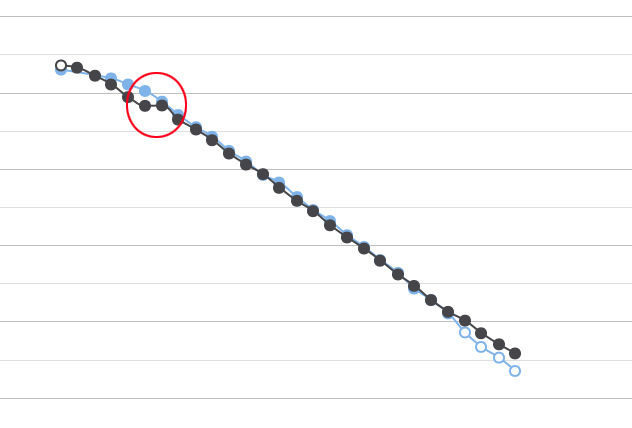
I agree with everything you said here, but I do see evidence of dual gain tech between ISO 320 and ISO 400. It looks a lot like the dual gain tech in the Nikon Z7. It isn't a huge bump, but it does seem to be there. Here is the shadow improvement numbers for the M10R and the Z7. Look how similar they are with a similar bump between ISO 320 and ISO 400:
I know many reviewers are raving about the extra DR and SNR from the new "R", but it does not seem to be the case.
It's like Steve Spencer wrote. It's formidable that the higher MP sensor didn't have worse performance but it's not better. Notice the DR graph does not show any evidence of dual gain tech either...
Basically same as M10 with slight lower DR after ISO 200 and before ISO 400.
Hi Fred:
As you know, I am very happy with my 24MP M10 as is-- full stop. But I do one day want to try my hand at RF'ing 40.89 MP at F0.95 !
Leica took similar design objective that Sony did between the 42 MP A7RIII sensor and 61MP A7rIV which was to "maintain" DR and ISO performance given the smaller pixels on the 61 MP sensor compared to the 42MP sensor.
Same scenario with 24MP M10 and 40.89 MP M10-R, only in the case of Leica they told us the four technical design changes applied to maintain similar M10 24MP DR and ISO results on the smaller pixel 40.89 MP sensor.
As far as better? I've also read some of the M10R DR claims. Not sure what their point of reference is ...maybe more along the lines of impressive DR for such a small pixel?
Is M10-R Dual Gain applied or not? *According to Stephen Daniels "Dual Gain technology applied starting from ISO 125"
To your point, are we able to see evidence starting from ISO 125? Along with Photonstophotos, and Reid Reviews, I've been following another source of lab test results for Leica rangefinders to include the M10-R for anyone that might be interested.
"The in-camera JPEGs (above) have average dynamic range and it's easy to lose very bright highlight detail, but the DNG files have a much wider tonal range and we could recover almost all the cloud detail in this image. (Image credit: Rod Lawton / Digital Camera World)"
I know many reviewers are raving about the extra DR and SNR from the new "R", but it does not seem to be the case.
It's like Steve Spencer wrote. It's formidable that the higher MP sensor didn't have worse performance but it's not better. Notice the DR graph does not show any evidence of dual gain tech either...
Basically same as M10 with slight lower DR after ISO 200 and before ISO 400.
Agreed. DR is about the same between M240, M10, and M10-R. Main difference between the cameras is higher resolution with the M10-R (which we discussed with its pros and potential cons) and higher ISO performance with M10 and M10-R. After seeing this, I am really happy that I have bought the M-E 240. I have no need for ISO higher than 3200 and simply make 24 MP work for me for a while to come. And if I really need high resolution, I can always go back to my A7R for now.
p.3 #10 · M10-R Thoughts from Steve Huff - Full of It
Steve Spencer wrote:
I think this is really a glass half full vs. half empty sort of thing. The DR by ISO looks almost identical to the M10, so no increase in DR or better high ISO performance. You could also say, however, that they increased the resolution without any drop in DR or high ISO performance. Both ways of looking at it are accurate.
Even though I will probably get the M10 because it is cheaper for my use which includes using it for travel I think I would appreciate the extra resolution. For example, 2 years ago I went on a seven week trip to China. I took at the time a Batis 18 f/2.8, a Zeiss Loxia 25 f/2.4, a Voigtlander 40 f/1.2, and a Zeiss Loxia 85 f/2.4 along with my Sony A7r II. If I still had my M10, I would have used a similar set of lenses and taken the M10 and it is interesting to think how often I would have appreciated the higher resolution of the M10R. About 25% of my shots were with the Batis 18 or Loxia 25, and over half of those were from a tripod. I obviously couldn't have used a rangefinder for any of those shots and the ones on the tripod would have benefitted from the extra resolution of the M10R. Almost all the shots with the Voigtlander 40 would have been taken with a 35mm lens and I would have used the rangefinder. A good number of the 85mm shots (25% or so), however, would have been taken with a 75 or 90mm lens and I would have appreciated the higher resolution both for a bit of cropping and just to be able to print bigger. In fact, my favorite shot from that trip posted below is a great example. I shot it handheld (there was no place for a tripod) and I had to crop a bit because I couldn't get as close as I would have liked, but I have printed this shot large 12 X 16 that I am glad I shot it on a 42MP sensor. With the M10 or M10R I would have pulled out the Visoflex for this shot and I think it is the sort of thing for which I would appreciate the extra resolution of the M10R. This is just thinking through my use and of course YMMV....Show more →
p.3 #11 · M10-R Thoughts from Steve Huff - Full of It
retrofocus wrote:
Agreed. DR is about the same between M240, M10, and M10-R. Main difference between the cameras is higher resolution with the M10-R (which we discussed with its pros and potential cons) and higher ISO performance with M10 and M10-R. After seeing this, I am really happy that I have bought the M-E 240. I have no need for ISO higher than 3200 and simply make 24 MP work for me for a while to come. And if I really need high resolution, I can always go back to my A7R for now.
Yes, they are in the same ballpark. However, according to Photonstophotos, there was a more significant DR improvement from M240 to M10. About 1-stop after ISO 1600 and ranging from 1/2 to 2/3 stop at lower ISO settings.
p.3 #12 · M10-R Thoughts from Steve Huff - Full of It
Steve Spencer wrote:
Hi Fred,
I agree with everything you said here, but I do see evidence of dual gain tech between ISO 320 and ISO 400. It looks a lot like the dual gain tech in the Nikon Z7. It isn't a huge bump, but it does seem to be there. Here is the shadow improvement numbers for the M10R and the Z7. Look how similar they are with a similar bump between ISO 320 and ISO 400:
Thanks for pointing it out!
It seems to be the case and it happens at around ISO 320 as you mentioned. Not a big gain but enough to match the M10's dynamic range afterwards.
I don't blame Leica for their clever marketing but the M10-R fine print should read:
"We were able to increase linear resolution by 29% with no significant impact to DR compared to previous models"
It's a victory nonetheless and a better sensor compared to the one on their SL2 and Q2 bodies.





 But I do one day want to try my hand at RF'ing 40.89 MP at F0.95 !