p.2 #1 · M10-R Thoughts from Steve Huff - Full of It
It makes complete commercial sense for Leica to make the M10R. The chassis was already there. The processor is unchanged. All they've done is adapt the rather brilliant sensor from the M10M with a bayer array to shut up the group (me included) who have been calling for a higher resolution M.
You'd think by the way some people react that Leica has started clubbing baby seals for the leather cover. The 24MP is still there. The M240 platform is still there. All you have is more choice and Leica has another revenue stream.
And for the record, from just a few shots, as my house is currently in danger of collapsing into the ocean and I'm somewhat time poor, the M10R has improved resolution and noise performance AND dynamic range over the M10. Leica don't often lead the pack with technology (a few of the SL specs did) but they might this time. The sensor is fabulous.
p.2 #3 · M10-R Thoughts from Steve Huff - Full of It
Speaking of Steve Huff...have you guys seen his videos of him talking to the dead/spirits? I accidentally stumbled on to it one day. He has a whole YouTube channel.
I’ve always thought of him as a camera reviewer but to each his own...here’s the link.
p.2 #4 · M10-R Thoughts from Steve Huff - Full of It
I'm going to chime in here. I don't know Steve, but I have owned a Q, Q2, SL and SL2 (briefly). Something to my eye looks different in the way the 47MP sensor of the SL2 and Q2 renders. Yes, it has more resolution, but the images, although technically superior, seem to be missing something intangible.
Right now I have the following, FWIW:
Original SL
35mm APO Summicron-SL
50mm APO Summicron-SL
50mm Summilux-SL
I also own the a7r iv and the a9ii - also technically better than the SL. I just like the images coming off the 24MP sensor of the SL better.
The answer is that the new sensors tend to be better technically. It can take a bit of time for the raw processor of your choice to catch up or your processing workflow to adapt to it.
p.2 #6 · M10-R Thoughts from Steve Huff - Full of It
I can understand thinking the M10-R doesn't really make sense for the sort of street shooting and environmental portraiture that so many folks have traditionally associated with Leica. That's the sort of shooting where less megapixels and better per-pixel perfomance makes a lot of sense.
However if you think of why the Leica camera exists in the first place, and Leica clearly remembers, the M10-R makes perfect sense. The original Leica was designed specifically to be a smaller camera for hiking and landscape shots and the M10-R is as ideal for that as any Leica body could be today.
I personally agree with Steve on how nice 24MP cameras seem to render (and that's not unique to Leica, I find the same in other systems too, the mid-MP bodies have a better balance in rendering compared to the high MP bodies which often render in a very clinical manner)
p.2 #7 · M10-R Thoughts from Steve Huff - Full of It
mawz wrote:
I can understand thinking the M10-R doesn't really make sense for the sort of street shooting and environmental portraiture that so many folks have traditionally associated with Leica. That's the sort of shooting where less megapixels and better per-pixel perfomance makes a lot of sense.
However if you think of why the Leica camera exists in the first place, and Leica clearly remembers, the M10-R makes perfect sense. The original Leica was designed specifically to be a smaller camera for hiking and landscape shots and the M10-R is as ideal for that as any Leica body could be today.
I personally agree with Steve on how nice 24MP cameras seem to render (and that's not unique to Leica, I find the same in other systems too, the mid-MP bodies have a better balance in rendering compared to the high MP bodies which often render in a very clinical manner)...Show more →
In some aspects I agree. There is one place where I do love using a high MP sensor and it's for doing high contrast monochrome conversions. Having the added sharpness and resolution can make for some very dramatic images.
p.2 #8 · M10-R Thoughts from Steve Huff - Full of It
The main limitation with 40Mpx is the absence of ibis, which means that the extra pixels are wasted unless you are constantly shooting in bright sunlight or on a tripod, which rather goes against the point of an M.
Furthermore, the regular M lenses top out at 24Mpx. That’s not to say that they will be harmed by a higher Mpx sensor, but the returns are diminished.
So a 24Mpx sensor with a better noise profile / dynamic range would have been preferable other than in marketing terms.
p.2 #9 · M10-R Thoughts from Steve Huff - Full of It
Goodrich wrote:
The main limitation with 40Mpx is the absence of ibis, which means that the extra pixels are wasted unless you are constantly shooting in bright sunlight or on a tripod, which rather goes against the point of an M.
Furthermore, the regular M lenses top out at 24Mpx. That’s not to say that they will be harmed by a higher Mpx sensor, but the returns are diminished.
Any images and comparison to prove this? Because according to you, the Leica Monochrom would be a waste of resolution too, the optics not up to the task...
p.2 #11 · M10-R Thoughts from Steve Huff - Full of It
Often IBIS can be extremely useful. That does not mean, however that not having it limits usable resolution. Good handholding technique can add a few stops to the shooting envelope as can bracing the camera against something. Even breathing techniques can help.
p.2 #12 · M10-R Thoughts from Steve Huff - Full of It
Goodrich wrote:
Furthermore, the regular M lenses top out at 24Mpx. That’s not to say that they will be harmed by a higher Mpx sensor, but the returns are diminished.
No they don't. Where did you come up with that?
This M10R test shows how great 'old' lenses are on the M10R.
Apo-Summicron M f2 50mm
Apo-Summicron M f2 75mm
Macro Elmarit R f2.8 60mm
Noctilux M f1.2 Noctilux 50mm (thanks for the loan- you know who you are!)
Summaron M f5.6 28mm (modern version)
Summicron M f2 28 Asph
Summilux M f1.4 28 Asph
Summilux M f1.4 35 Asph
Summilux M f1.4 50 Asph
Tri-Elmar M 16/18/21 Asph
All these lenses worked really well with the camera and I haven’t seen any evidence of them being challenged by the extra resolution.
Also I have personally tested my M lenses on my Nikon Z7 (47mp), and while they are better on my Leica M due to some corner smearing with wider angle lenses due to sensor glass thickness, there is no issue with resolution.
p.2 #14 · M10-R Thoughts from Steve Huff - Full of It
Goodrich wrote:
The main limitation with 40Mpx is the absence of ibis, which means that the extra pixels are wasted unless you are constantly shooting in bright sunlight or on a tripod, which rather goes against the point of an M.
Or using super-fast lenses at wide apertures with the M, as the M is outstanding with such lenses, particularly wider ones where the rangefinder is more accurate in focusing than a SLR finder or phase detect sensor.
It's not like M mount is lacking in ultra-fast lenses, or that M shooters will have particular difficulty getting critical focus with fast wides.
IBIS with a small-throat mount is fairly minimally effective, as Sony's implementations keep reminding us (and also why Sony introduced a 'crop for better IBIS' feature on the A7SIII)
Furthermore, the regular M lenses top out at 24Mpx. That’s not to say that they will be harmed by a higher Mpx sensor, but the returns are diminished.
umm, what? M lenses are noted for their outstanding resolution, as long as you are talking relatively modern designs. Unless you're using Mandler-era glass you're unlikely to take any hit in system resolution from using regular M lenses on a high-MP sensor.
So a 24Mpx sensor with a better noise profile / dynamic range would have been preferable other than in marketing terms.
As much as I like ~24MP bodies, there is certainly a place for a high-MP body and it's not like the regular M10 is going AWOL.
p.2 #16 · M10-R Thoughts from Steve Huff - Full of It
retrofocus wrote:
It's the same discussion which occurred already in 2013 after Sony released the first camera with 36 MP FF sensor after Nikon came out with the D800 a year earlier. Lots of arguing especially from camera brands which did not yet come up with a similar resolution in FF sensors at the time (Canon). Same alley: high MP is not needed, it does not improve the photography, is just makes photography more difficult without visible gain, you only need it when printing large, it's just a hype for nothing etc etc.
Time forward, only after a few years most of those who argued like this bought silently their own Sony or Nikon high res FF camera and post photos with this kind of gear since. Rarely anyone ever went back to 24 MP. Suddenly those cameras were more in demand than the 24 MP counterparts. 24 MP FF can still work fine for many, but it is outdated tech at this point. The question is only if your vision is better off with low res or if you can max out the high res sensor. I can see both: street photographers probably won't care too much about high MP. Studio and landscape photographers on the other hand do.
After the Leica M10 was released, I questioned in the Leica online forum why Leica shooters on one hand want often to have the best high resolving glass but limit themselves with 24 MP sensor resolution. I suggested > 3 years ago that Leica approaches this similar to Sony by installing parallel product lines to choose from - what we seen similarly with the A7, the A7R, and A7S lines. Maybe even a monochrome line by itself. I was mostly booed for this suggestion. Now Leica did exactly this - the M10(-P), the M10-M, and M10-R to choose from.
Following the high res FF sensor market closely for many years now, I predict that the M10-R will become a big success for Leica no matter of initial people stating that the high res is not needed. Let's get real: this will be the new standard sensor resolution in upcoming years. But as I said, 24 MP might be sufficient also for many others especially when being price considerate.
Lets wait and see Steve's video in 2022 about the M10-R which he somehow "got" and loves........Show more →
I think this is apples to oranges. This is not an AF camera and there is a limit to the rangefinder accuracy. Unless you glue the EVF to it, I tend to agree that 24MP is sufficient in this case. The bump in resolution won't hurt anything but when focusing via rangefinder without any stabilization, in real terms, it may not actually improve resolution which is the main selling point of the new camera.
p.2 #17 · M10-R Thoughts from Steve Huff - Full of It
Fred Miranda wrote:
I think this is apples to oranges. This is not an AF camera and there is a limit to the rangefinder accuracy. Unless you glue the EVF to it, I tend to agree that 24MP is sufficient in this case. The bump in resolution won't hurt anything but when focusing via rangefinder without any stabilization, in real terms, it may not actually improve resolution which is the main selling point of the new camera.
I disagree with the notion that you need image stabilization (IS) to make the higher resolution sensor work. I can prove this by many photos I have taken handheld with the original A7R (36 MP FF sensor resolution which falls in the same ballpark, no IS and mechanical shutter). I predominantly used and still use this camera with rangefinder M lenses and only sporadically used the A7R with AF lenses. If you are conscious about exposure time and aperture/ISO used, IS is not needed IMO. The bit heavier body weight of the M10-R compared to the Sony A7R camera makes it even easier to shoot with longer exposure times handheld.
Regarding need of resolution depends on price and style of photography. I recently found an excellent deal for a nearly mint (less then 800 photos taken) M-E 240 camera which uses the same M10 (24 MP) sensor just limited in high ISO. The photos with it are fantastic and crisp. Just when I zoom further into the image on my screen, I can tell a difference to higher resolution files from my A7R. Ultra-wide rangefinder lenses perform much better on the M-E 240 though even with lower sensor resolution.
p.2 #18 · M10-R Thoughts from Steve Huff - Full of It
"Steve Huff is crazy for having such a luddite reaction to added resolution. Thank goodness they didn't give it that newfangled IBIS nonsense, though."
p.2 #19 · M10-R Thoughts from Steve Huff - Full of It
retrofocus wrote:
I disagree with the notion that you need image stabilization (IS) to make the higher resolution sensor work. I can prove this by many photos I have taken handheld with the original A7R (36 MP FF sensor resolution which falls in the same ballpark, no IS and mechanical shutter). I predominantly used and still use this camera with rangefinder M lenses and only sporadically used the A7R with AF lenses. If you are conscious about exposure time and aperture/ISO used, IS is not needed IMO. The bit heavier body weight of the M10-R compared to the Sony A7R camera makes it even easier to shoot with longer exposure times handheld.
Regarding need of resolution depends on price and style of photography. I recently found an excellent deal for a nearly mint (less then 800 photos taken) M-E 240 camera which uses the same M10 (24 MP) sensor just limited in high ISO. The photos with it are fantastic and crisp. Just when I zoom further into the image on my screen, I can tell a difference to higher resolution files from my A7R. Ultra-wide rangefinder lenses perform much better on the M-E 240 though even with lower sensor resolution. ...Show more →
To be clear, I agree with Leica's move. Increasing resolution for their M camera without sacrificing much DR or SNR was unavoidable based on what Leica did with their Monochrom line and where the cameras market is heading to.
My point was that I think it will be challenging to "resolve" the 30% extra linear resolution when using the rangefinder exclusively. I personally dislike using the external EVF with my M10 and the rangefinder is the main reason I use this camera. If I were shooting with a Leica M10-R, I would be temped to use the external EVF more often for better accuracy (and to take advantage of the extra detail) and that would negatively affect my shooting experience. I mean, if I were using the EVF all the time, I'd much prefer grabbing my A7R4 or any other mirrorless camera instead.
Regarding the need for image stabilization....it all depends on focal length and lighting conditions. If you're shooting handheld and have to bump ISO to accommodate for faster shutter speeds to get a stable image, noise would pretty much render the increase in resolution less relevant.
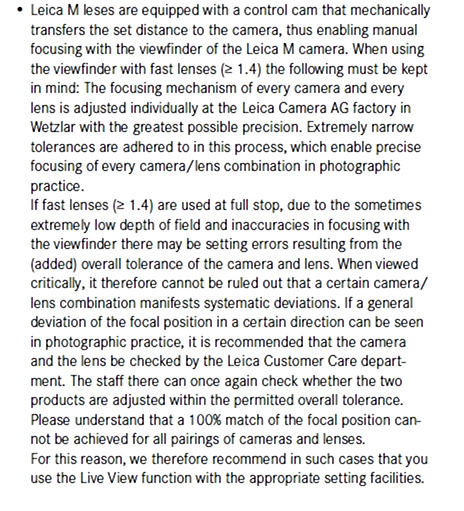
I understand why many M shooters are not upgrading and I think one of the reasons is because they know there is a limit to rangefinder accuracy even if it's perfectly calibrated. It's an even bigger problem with fast lenses (think Summilux, Noctilux) and Leica acknowledges this even with 24MP.
p.2 #20 · M10-R Thoughts from Steve Huff - Full of It
Fred Miranda wrote:
To be clear, I agree with Leica's move. Increasing resolution for their M camera without sacrificing much DR or SNR was unavoidable based on what Leica did with their Monochrom line and where the cameras market is heading to.
My point was that I think it will be challenging to "resolve" the 30% extra linear resolution when using the rangefinder exclusively. I personally dislike using the external EVF with my M10 and the rangefinder is the main reason I use this camera. If I were shooting with a Leica M10-R, I would be temped to use the external EVF more often for better accuracy (and to take advantage of the extra detail) and that would negatively affect my shooting experience. I mean, if I were using the EVF all the time, I'd much prefer grabbing my A7R4 or any other mirrorless camera instead.
Regarding the need for image stabilization....it all depends on focal length and lighting conditions. If you're shooting handheld and have to bump ISO to accommodate for faster shutter speeds for a stable image, noise would pretty much render the increase in resolution less relevant.
I understand why many M shooters are not upgrading and I think one of the reasons is because they know there is a limit to rangefinder accuracy even if it's perfectly calibrated. It's an even bigger problem with fast lenses (think Summilux, Noctilux) and Leica acknowledges this even with 24MP.
Main reason why people currently are hesitant to upgrade is the hefty price tag of > $8K. I understood that increasing ISO to higher levels is supposedly not an issue with the M10-R and shouldn't create much noise. And shooting very fast lenses wide open with any kind of rangefinder camera is a bit of hit and miss - here the EVF is a must.
And even I repeat myself - we can put all the potential cons due to the higher resolution out, history with all kind of cameras in the past has shown that higher resolution sensors always make the race in the end. It depends simply on the application - street photographers likely will avoid high resolution but for landscape, still life, studio photographers the high resolution will remain beneficial. This trend will be seen when prices come down which might take a bit with Leica.