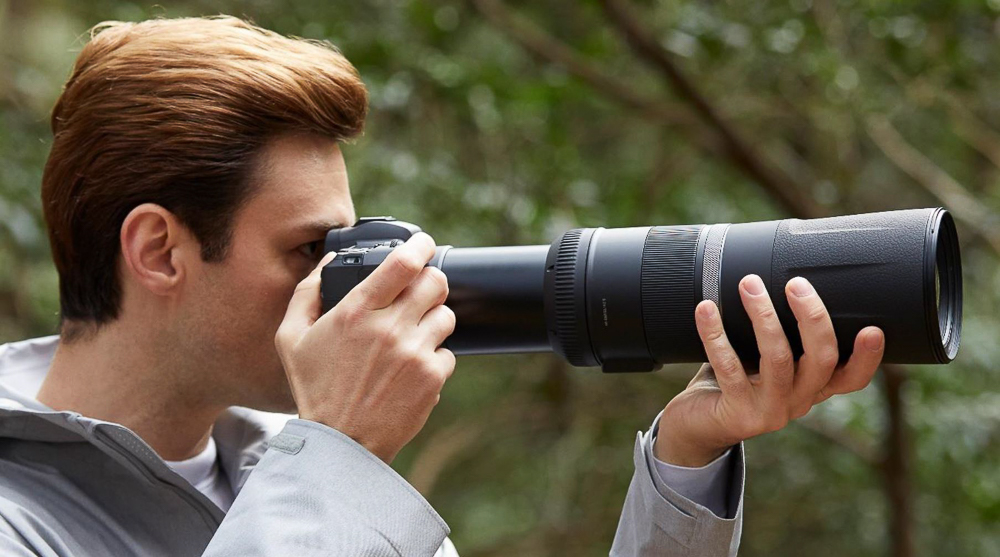
With the foot mount located on the now confirmed hollow front tube, I'm not sure I'd want to mount that to a tripod with 90% or more of the weight hanging toward the back.
Stand back or you could put your eye out with that thing Ralphie!
lighthound wrote:
With the foot mount located on the now confirmed hollow front tube, I'm not sure I'd want to mount that to a tripod with 90% or more of the weight hanging toward the back.
Stand back or you could put your eye out with that thing Ralphie!
Why would it be 90% back heavy? 90% of the weight of the lens will be in front of the mount, and the camera will be about half the lens. Not worse than 60-40 balance.
This will be a great lens for people that want to take pictures of the moon. And an interesting lens for people that want to shoot supertelephoto landscapes.
Jesse Evans wrote:
This will be a great lens for people that want to take pictures of the moon. And an interesting lens for people that want to shoot supertelephoto landscapes.
If the IQ is ok, can always stack pictures of the moon to reduce noise as it would be 1600 f32 with the 2x extender right?
alundeb wrote:
Why would it be 90% back heavy? 90% of the weight of the lens will be in front of the mount, and the camera will be about half the lens. Not worse than 60-40 balance.
With 11 elements in 8 groups, I'm guessing most of those are in the rear section looking at the photo. This would put almost all the weight behind the foot mount plus the weight of the body.
I'm not a lens design expert so maybe I'm missing something.
lighthound wrote:
With the foot mount located on the now confirmed hollow front tube, I'm not sure I'd want to mount that to a tripod with 90% or more of the weight hanging toward the back.
Stand back or you could put your eye out with that thing Ralphie!
I'm sure that Kirk, RRS, and the usual suspects will make a foot for this lens that will achieve balance. It's not that difficult for such a setup.
lighthound wrote:
With 11 elements in 8 groups, I'm guessing most of those are in the rear section looking at the photo. This would put almost all the weight behind the foot mount plus the weight of the body.
I'm not a lens design expert so maybe I'm missing something.
Yes, you are missing the patent drawings linked to earlier in the thread. There are no lens elements in the rear section at all, and the biggest elements are in the front.
alundeb wrote:
Yes, you are missing the patent drawings linked to earlier in the thread. There are no lens elements in the rear section at all, and the biggest elements are in the front.
So there is no glass in this lens at all until about where the control ring is?
If that's the case then would that make it extremely front heavy?
lighthound wrote:
So there is no glass in this lens at all until about where the control ring is?
If that's the case then would that make it extremely front heavy?
Do you mean control ring (silver) or the tightening ring? The lens will be very front heavy, yes.
Schlotkins wrote:
If the IQ is ok, can always stack pictures of the moon to reduce noise as it would be 1600 f32 with the 2x extender right?
I mean, I was being somewhat tongue in cheek, because taking pictures of the moon is one of the few things it doesn't really matter what the aperture of the lens is, because the moon is so absurdly bright. At f/11 you can shoot on a tripod comfortably at 1/125s at ISO 100.
johnvanr wrote:
I generally shoot birds at least at 1/1600 if not at 1/2000 of a second. In early morning light, even f/4 is a challenge to get that without too much noise. f/11 would prevent me from shooting in any but the best light conditions (unless Canon's surprise is amazing high-ISO images, beyond what a camera with that kind of resolution normally can produce).
This is what will likely change or a be available for trade-off. If in-body IS + in lens IS give you 6-8 stops and can be effective for panning, it changes the game quite a bit. I can get motion stop fro my style of shooting ( large mamals) @ 1/1000s. Doing f11 @ 1/1000s , the ISO will likely be in range of 3200-6400 for decent light. @ 45MP downsampled to most of my application, that will work very well. Would it be a pro quality? No. I am not a Pro, but it will help me make my expensive snapshots in a very portable light weight setup. That is my hope. Had they done a f9, I would have already placed the preorder.
lighthound wrote:
So there is no glass in this lens at all until about where the control ring is?
If that's the case then would that make it extremely front heavy?
If the patent is somewhat correct then I think all the glass is in the movable section and it will be front heavy for the 800 especially seeing how far it extends. The 600 seems like it will be much more reasonable and only 950g to start with.
Jesse Evans wrote:
I mean, I was being somewhat tongue in cheek, because taking pictures of the moon is one of the few things it doesn't really matter what the aperture of the lens is, because the moon is so absurdly bright. At f/11 you can shoot on a tripod comfortably at 1/125s at ISO 100.
Wrong ... such parameters may work for a full moon (I never try so don't know exactly). But if you want interesting detail it is best to shoot around half moon or closer to new moon. In this case exposure is like 1/60s f/11 at ISO 400 (or 1/30s with 1.4x TC added). Longer exposure times will give trouble with moon motion when TC is added and higher ISO means some detail loss (on my APS-C body, probably similar on a 45 MP R body).
Averaging a stack of pictures isn't going to work unless you have perfect atmospheric conditions. Normally all the details are slightly "wobbly' due to atmospheric distortion and averaging several images will likely blur fine detail compared to a single image (even if images are stacked as well as possible); in most cases noise will be the lesser evil.