arbitrage wrote:
That would be pretty slick if they were collapsible for packing or when walking through thick brush.
Anders in #10 suggested it would be a good plan, but it has risen to the level of a real rumour? If they can do it with a push-pull 100-400, they could do it with a fixed length "pull-out and click-stop" . With two moving barrels, it would be petite when collapsed !
A collapsing design might actually be heavier as the mechanical system to hold everything in alignment in such a long tube consisting of sliding parts would require more materials, likely metal. Such a system might require periodical adjustment to ensure the optical system is properly aligned every time.
ilkka_nissila wrote:
A collapsing design might actually be heavier as the mechanical system to hold everything in alignment in such a long tube consisting of sliding parts would require more materials, likely metal. Such a system might require periodical adjustment to ensure the optical system is properly aligned every time.
Yes, but many existing lenses are built like that. My Nikkor 1 70-300 is collapsible and does not require adjustment, but the amount of extension is moderate.
alundeb wrote:
Yes, but many existing lenses are built like that. My Nikkor 1 70-300 is collapsible and does not require adjustment, but the amount of extension is moderate.
Yes, but a 389mm long lens that as a comparatively narrow tube would present greater difficulty in implementing the collapsing mechanism given that the lens elements need to be precisely aligned in the extended position and because frequently people bump the lenses around when they are hiking in the field. Nikon used to make lenses such as 800 mm f/8 and 1200 mm f/11, and there are some reports that these needed regular adjustment to stay in alignment and to produce the optimal image quality.
It is also a known problem that zoom lenses in general have more copy variation and alignment problems out of factory than primes. These problems would apply for a collapsible prime design.
I guess the new lenses as patented won't solve all problems. Either it will have the quality problems associated with zooms, or I can't carry it in the bag I use for the 5DSR with 100-400 mounted. It is really a head scratcher what Canon is doing with these lenses, but I definitely want to try the 800.
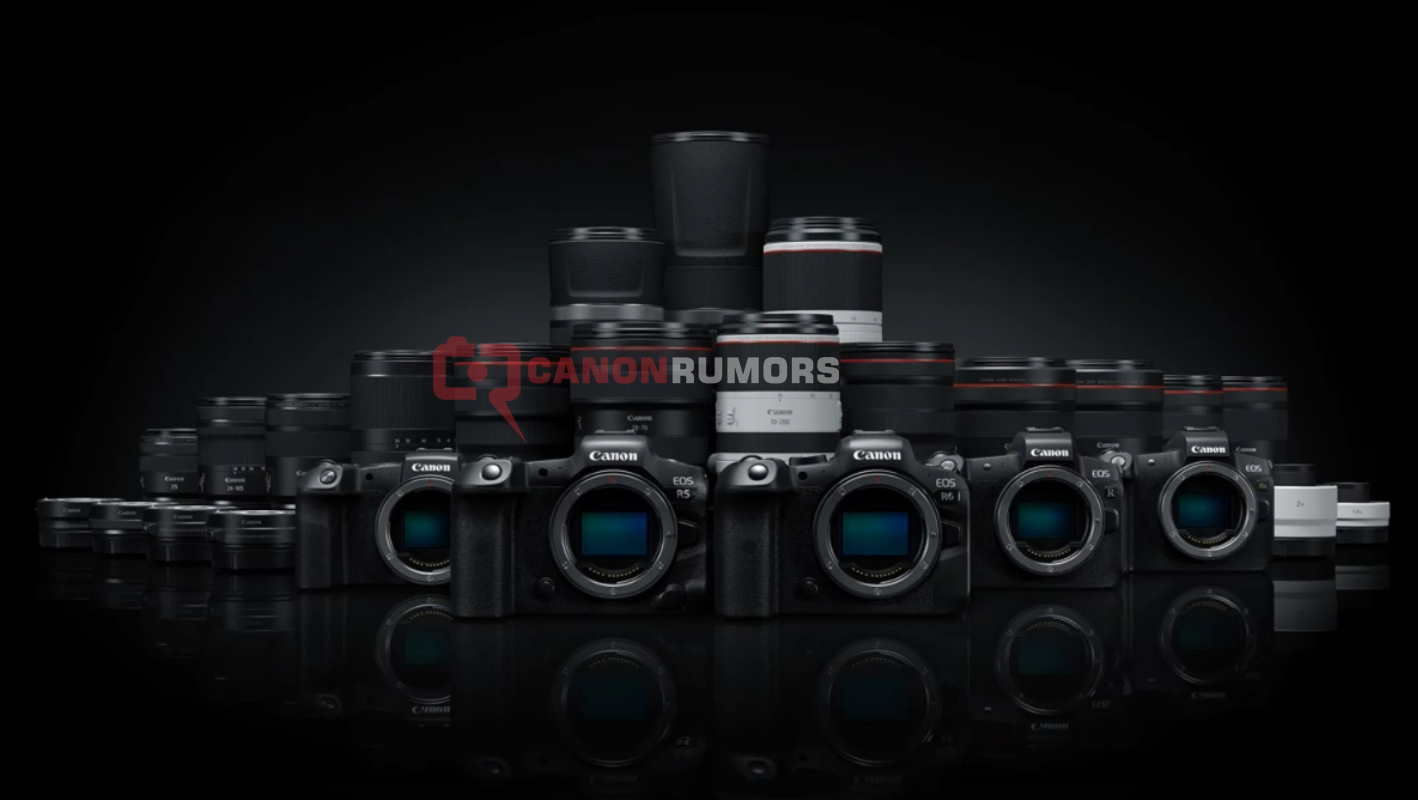
First image showing the new silver color and an idea of the length/width of the 600/800DO
I think that is an interesting look.
Collapsable?...seems they may be as they look like the top section may be extendable considering such a new design?? Also they look too short to be at full length in relation to the known size of the 100-500 next to them.
Also July 9th is announcement.
IF the patent we have seen is correct then the length of the 600DO should be ~ 314mm to the mount.
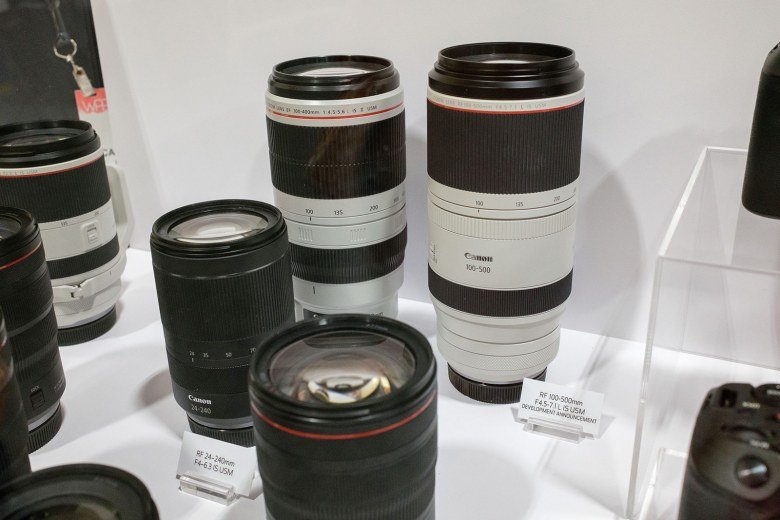
When we saw a photo of the 100-500 next to the 100-400II it looked maybe 10mm longer at most.
The 100-400II is listed at 193mm length. That means the 100-500 may be at most 210mm. The 600DO in this image is slightly shorter than the 100-500.
Therefore I'd say these are in their collapsed state and that rubberized section above the silver band extends out.
That is good news for packing.
alundeb wrote:
The 800 seems to be about 25-26 cm long, the same as the Sigma 150-600 C, and shorter than the Sony 200-600.
Sounds about right. Going off the patents the 800 should be 55mm longer than the 600 but they may extend by different amounts that could shift the ratio a little bit.
If you measure the main body width of the 600 & 800 in that photo, it almost looks like they are actually narrower than the 100-500. You would think they would be the same as the 100-500 if they extended. That extra hardware has to fit somewhere.
The EVF bulge on the R5 and R6 appears to be a bit wider than that of the R just to the right. Perhaps this is just because of the two new cameras being a bit closer, but it could signify a newer higher density EVF. One can hope.
The two new Teles do appear to be collapsable. When Canon is patenting zooms with 8 to 9 moving units--see the 120-700 patents--they have probably figured out how to collapse those two lenses and still keep everything in alignment. All that collapsing stuff will probably add a bit of weight but with small lightweight lens elements maybe they still come in at under 3 pounds.
juststeve wrote:
The EVF bulge on the R5 and R6 appears to be a bit wider than that of the R just to the right. Perhaps this is just because of the two new cameras being a bit closer, but it could signify a newer higher density EVF. One can hope.
I think it would be a real shame if they don't have a higher resolution EVF. Once you get used to using the ones in the Sony A7RIV and the Fuji GFX100 it's really hard to go back to a lower-resolution one.
Concerns of F11 diffraction will be mitigated when the RF 600mm F4 L, & 800mm F5.6 L DO lens's hit the market, so long as the bulk, weight and price's are not beyond ones means.
lighthound wrote:
If you measure the main body width of the 600 & 800 in that photo, it almost looks like they are actually narrower than the 100-500. You would think they would be the same as the 100-500 if they extended. That extra hardware has to fit somewhere.
I'm starting to think they're fixed length.
Yes they do look narrower. Probably the same as the 100-400II which seems narrower in the side by side image from the photo show compared to the 100-500 (although that may just be the angle that shot was taken at). The 800 flares out at the end to make up the 18mm larger front element.
arbitrage wrote:
First image showing the new silver color and an idea of the length/width of the 600/800DO
I think that is an interesting look.
Collapsable?...seems they may be as they look like the top section may be extendable considering such a new design?? Also they look too short to be at full length in relation to the known size of the 100-500 next to them.
Also July 9th is announcement.
5 Bodies and I see the R6 along with the R5 and R. Can't make out the other two.