MJP1
Offline
•
Upload & Sell: Off
|
gdanmitchell wrote:
If you are a fan on the 18-55, I'm not sure that the XPro design is the right one for you. The distinguishing feature of the XPro system is the hybrid viewfinder system that offers both OVF and EVF modes. In general zooms are large lenses and they block a portion (sometimes a large portion!) of the view through the OVF.
The OVF typically works best with relatively small prime lenses — the f/2 primes are really designed for this camera. I also use the 27mm f/2.8 with mine, and the 14mm f/2.8 works well (on the XPro2) if you don't use a large hood on it. The 35mm f/1.4 also is good with it.
If these sorts of lenses are not your cup of tea – and you prefer large aperture primes or you really want to use zooms — the XPro models don't really offer many advantages to you. You'd like be better off with the XT3 or XT4, since their DSLR-like design and electronic viewfinder work fine with larger lenses.
(The XPro models can work fine with the bigger lenses and zooms, but you'd almost certainly want to use the EVF... and there goes a primary advantage of the XPro models.)
BTW, the 18-55 is a fine lens that works better than you might expect... if you use the EVF.
I do think the XPro models produce an honest rangefinder-like experience, especially if you use the sorts of small primes that were traditionally used on such cameras.
As to the XPro2 versus XPro3 question. I've used the XPro2 since it was first released. I like this camera a lot — its flexibility is unparalleled. It works with small primes for street photography with the OVF, but it also works with large zooms with the EVF. My main purpose for the camera is street photography and it works quite well for that.
I'm unimpressed with the Xpro3. Actually, I'm disappointed in it. Yes, it provides a small sensor resolution increase. The rear screen offers a (somewhat limited) articulating ability. I regard the little fake film box end holder square screen as being a dumb gimmick, and lots of photographers are saying the same thing. (There were plenty of better ways this change could have been implemented, but Fujifilm's approach is inexplicably about the worst one imaginable.) In addition, as I understand it, the OVF no longer allows two levels of magnification, which helped with a wider range of focal lengths and the OVF.
I'm keeping my XPro2.
Dan...Show more →
I guess I did not make myself clear enough in my original post. The reason I brought up the 18-55 lens is because it seemed like a simple and inexpensive way to use the AF features of the camera. I wish I could try one of the Xpro cameras in the store, but I don't think they have them locally (camera stores are quickly becoming extinct).
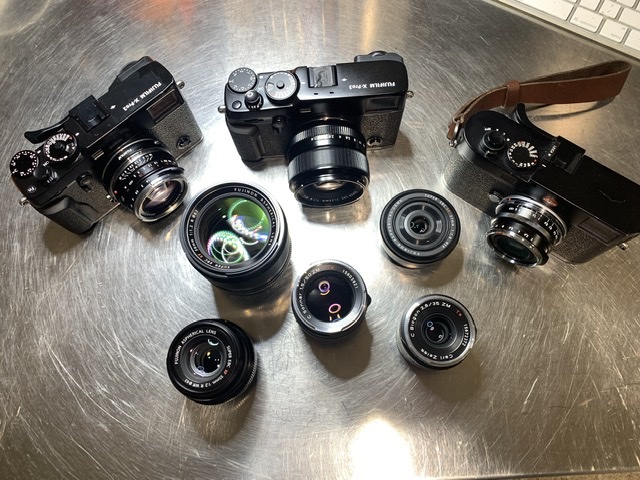
Should I get one of these XPro cameras, I'd expect to use them with my small, fast primes in MF mode. My question about this is about the efficacy of the focus peaking and/or the actual usability of the OVF/EFV in the XPro2 and XPro3. Like I said before, I've had a lot of experience with the MFT mirrorless cameras from Olympus and Panasonic with a large variety of their native prime and zoom lenses. Good as the MFT Olympus system is, using MF small primes was not a good experience. My last MFT camera was te OM1 and even that camera was not adequate for shooting with the Leica primes.
The newer offerings from Fuji (and others) claim much improved manual focusing with their EVF with focus peaking. I might be wasting my time looking outside of the Leica M system, but these XPro cameras appear very seductive in the ads, reviews, etc. It would be a lot of fun to have the flexibility of a long lens of a zoom lens (with AF) as well as the joy of shooting with my fast primes.
As far as the menus, adjustability, customizing ease and settings changing, programming, etc., etc., I don't care. I shoot with relatively few adjustments and I don't feel handicapped by the inability to instantaneously change settings. To be frank, I hate those Japanese menus with sub menus ad infinitum. To me photography is about composing, finding and capturing images. As long as the camera has excellent dynamic range, and great low light capability, I can do all my adjustments in PP after I'm back from the shooting. Of course, that's just me and I can understand how others might really like and effectively use the myriads of adjustments and settings of these modern cameras. Mostly I want to adjust shutter speed, aperture, ISO and focusing. Changing the EV is useful too, but even that I can do without and not lose the ability to capture images to my satisfaction.
|


 .
.