fredmiranda.com
Login

Moderated by: Fred Miranda
  New fredmiranda.com Mobile Site
  New Feature: SMS Notification alert
  New Feature: Buy & Sell Watchlist
  

FM Forums | Sony Forum | Join Upload & Sell

1       2       3              93              95              104       105       end
  

Voigtlander 50mm f/2 APO-Lanthar Review


RoamingScott
Offline
• • • • • •
Upload & Sell: Off
p.94 #1 · Voigtlander 50mm f/2 APO-Lanthar Review


Fred Miranda wrote:
Congratulations! I’m still baffled by Cosina’s decision to discontinue this lens for the Z mount.


If they were having issues moving these, they fixed that problem (for a month or two)


Sep 12, 2024 at 10:29 AM
Narwall87
Offline

Upload & Sell: Off
p.94 #2 · Voigtlander 50mm f/2 APO-Lanthar Review


Has anyone here compared the Voigtlander 50/2 APO to the Sony 50/2.5 G? Interested in a small 50 and these two keep popping up in searches. Aside from autofocus, I'm curious how the Sony stands against the awesome IQ of the APO.


Sep 19, 2024 at 09:49 AM
OscarF
Offline

Upload & Sell: Off
p.94 #3 · Voigtlander 50mm f/2 APO-Lanthar Review


Narwall87 wrote:
Has anyone here compared the Voigtlander 50/2 APO to the Sony 50/2.5 G? Interested in a small 50 and these two keep popping up in searches. Aside from autofocus, I'm curious how the Sony stands against the awesome IQ of the APO.


The Sony 50/2.5 G is nice and crisp in the center at f/2.5 but if you're pixel peeping on a 61mp sensor at 400% - the mid-zone and particularly the edges are a little less so. They gradually sharpen and look crisp at f/6.3.

By comparison the Voigtlander 50/2 APO is completely crisp across the frame from center to corner - wide open at f/2. Things sharpen a tiny bit at smaller apertures - until diffraction starts very slightly at f/8 and a little more at f/11.

I tested both of these on tall, shaggy Washington Palms with dangling fronds and stalks of seeds one block away (about 60 ft) on a tripod with high shutter speeds.

Neither lens has any lateral color fringes. Longitudinal color is minor on the Sony at wide open and not really there on the Voigtlander.

Neither lens needs distortion correction.


Sep 21, 2024 at 02:05 PM
philip_pj
Offline
• • • • • •
Upload & Sell: On
p.94 #4 · Voigtlander 50mm f/2 APO-Lanthar Review


New Voigtlander 50/3.5

Progress marches on unabated at Cosina. If in the market for a small 50 and you are not overly 'lens speedist', you may be interested to view these links, or maybe you would just like to see what happening these days:

. one, a comparison featuring the VM 50/2 APO-Lanthar and the newcomer 50/3.5 APO-Lanthar (the VM 50/2 is actually a little stronger at f4 than the E-version) :

https://www.fredmiranda.com/forum/topic/1868807/1#infinity2

. and the second showing how well the 50/3.5 APO does, mounted on...an a7cr (61mp)! :

https://www.fredmiranda.com/forum/topic/1868807/11#infinity5

That 50/3.5 weighs 150g and 175g in two versions of its new livery. It is a genuine APO without the bother of asph surfacing, something the Sony lens and the 50/2 APO-Lanthars must rely heavily on. $100-$150 more than the Sony, and likely to outlast it by decades. Manual lenses are future-oriented. APO lenses tend to shine over the others at higher resolutions.


Sep 21, 2024 at 06:46 PM
Narwall87
Offline

Upload & Sell: Off
p.94 #5 · Voigtlander 50mm f/2 APO-Lanthar Review


Good feedback, and that seems to be in line with what I've seen. That levels of sharpness still sounds pretty impressive, which makes the 50/25 g seem like a solid compact option for real-world documentary work. In those settings, perfect sharpness across the frame is more a luxury than a necessity. The AF on it make it more practical than the Voigt, and if the IQ isn't too far behind, then that's a win in my book. As someone with experience with both, how would you compare the bokeh and general rendering between the two?


Sep 22, 2024 at 01:03 PM
OscarF
Offline

Upload & Sell: Off
p.94 #6 · Voigtlander 50mm f/2 APO-Lanthar Review


Narwall87 wrote:
Good feedback, and that seems to be in line with what I've seen. That levels of sharpness still sounds pretty impressive, which makes the 50/25 g seem like a solid compact option for real-world documentary work. In those settings, perfect sharpness across the frame is more a luxury than a necessity. The AF on it make it more practical than the Voigt, and if the IQ isn't too far behind, then that's a win in my book. As someone with experience with both, how would you compare the bokeh and general rendering between the two?


General rendering is standard good quality Sony. It's colorful - normal Sony palette - not slightly muted like the Sony 20mm. Bokeh? It's f/2.5 - if you want creamy bokeh go with a wider aperture lens. But what bokeh is there looks good enough, not ultra edgy.

Did you look at this French review - it's pretty accurate:

https://www.lesnumeriques.com/focales-fixes/sony-fe-50mm-f2-5-g-p62675/test.html?_x_tr_sl=fr

I tried putting up the French review via the Google Translate address, but it doesn't like that - so just plug in the link above on Google Translate.


Sep 22, 2024 at 03:44 PM
Steve Spencer
Offline
• • • • • • •
Upload & Sell: On
p.94 #7 · Voigtlander 50mm f/2 APO-Lanthar Review


philip_pj wrote:
New Voigtlander 50/3.5

Progress marches on unabated at Cosina. If in the market for a small 50 and you are not overly 'lens speedist', you may be interested to view these links, or maybe you would just like to see what happening these days:

. one, a comparison featuring the VM 50/2 APO-Lanthar and the newcomer 50/3.5 APO-Lanthar (the VM 50/2 is actually a little stronger at f4 than the E-version) :

https://www.fredmiranda.com/forum/topic/1868807/1#infinity2

. and the second showing how well the 50/3.5 APO does, mounted on...an a7cr (61mp)! :

https://www.fredmiranda.com/forum/topic/1868807/11#infinity5

That 50/3.5 weighs 150g and 175g in two versions of its new livery. It is
...Show more

You have mentioned that you like APO lenses without Asph surfacing and I have to say I do too. In addition to this 50 f/3.5 APO and the Voigtlander 110 f/2.5 APO Macro, the Zeiss 135 f/2 APO Sonnar is one of my favorites and it too is APO without any Asph surfaces. I believe the Zeiss Batis 135 f/2.8 APO Sonnar is as well. I think the older Voigtlander 125 f/2.5 APO Macro didn't as well, but I am less sure of that. I generally like all these lenses. It seems to me that sometimes APO without Asph elements is an advantage as it might make it easier to get a lens that is both APO and has nice bokeh. I am not sure I like the bokeh that much of any of the APO lenses with Asph elements.


Sep 26, 2024 at 07:57 AM
philip_pj
Offline
• • • • • •
Upload & Sell: On
p.94 #8 · Voigtlander 50mm f/2 APO-Lanthar Review


Yes, easy to forget the widespread aversion to using asph in the mid-teen decade portrait length lenses (APO or not), of course you are right. Designers were really concerned at 'onion rings' showing up in the increasing resolution cameras being used, with everyone looking at 100% for them. (Reviewers and You-tubers have an unknown but definitely non-zero degree of influence over lens design, a very large subject for another discussion.)

One theory is that the more APD (different descriptions in different makers' nomenclature) glass a lens uses the easier it is to achieve optical excellence of the kind many are wanting, that is: 'beauty first'. This glass category appears to be well-characterized, and is widely used in promotional material.

The Batis 135/2.8 has no fewer than eight APD elements, as does the CV 110/2.5. No asph is used in these or in the Zeiss 135/2 APO - the blurb on B&H does not mention asph, and they always do if asph is used. Neither were regarded as 'cheap' on release. So the APD glass is still expensive, whereas the aspheric revolution is more of a victory for processing and design technologies than one of material science.

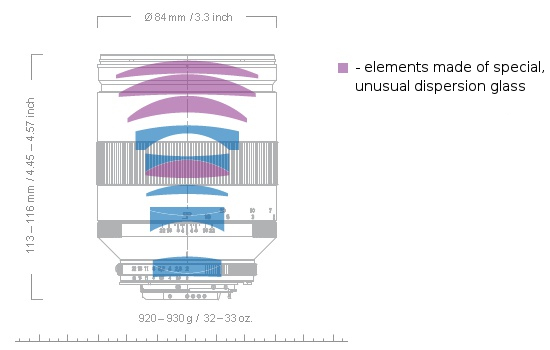
Is this high cost the reason Cosina reverted to using three plain (non-APD) elements in the (later release, 2021) VM 50/2 APO whereas the 2019 E-mount version has these same elements using APD (elements 1,3 and 6)? The M-mount lens took a moderate hit a wide open aperture before recovering lost ground by f4, in a telling display of the value of APD glass.

https://www.cosina.co.jp/voigtlander/en/e-mount/apo-lanthar-50mm-f2-aspherical/
https://www.cosina.co.jp/voigtlander/en/vm-mount/apo-lanthar-50mm-f2-aspherical/

I recall Zeiss saying their 21/2.8 from 1993 had no asph in its 15 elements, obviously a momentous design decision:

"..the Distagon 2.8/21 for the Contax SLR, a relatively complex lens with 15 elements in 13 groups. However, it had no aspherical surfaces. Its performance, particularly the perfect correction of lateral chromatic aberration, was *achieved solely by the combination of very special (and expensive) high-index glass types with glass types displaying extremely high anomalous partial dispersion*."

'From the series of articles on lens names: Distagon, Biogon and Hologon by H. H. Nasse'

Maybe it is now more of a real choice for lens makers due to reduction in the cost of production of this special glass type. Nasse goes on to give an explanation of APD, not to burden the thread with it. As stated, the aspheric revolution and its inevitable overreach may extend into a sort of glossy 'quasi-perfect' presentation, a kind of sugar hit for the visual cortex - what we may call the 'refined postcard look'. It seems to require careful handling, in design, if more traditional photographic rendering is desired. And, probably, round element shapes!

Going forward, one useful metric for the better photographic lenses might be #asph surfaces / #total elements. Another is the identification of lenses in which all non-traditional optical glass is aspherical - like phones, at 100%.

Canon's RF 28/2.8 STM which is literally built around asph oddities at the rear of the lens, with around 80% of the entire element mass being plastic. Like phone images, the lens is sharp and even has decent bokeh. But the lack of image depth is comical, despite it not being noticed by reviewers.


Sep 26, 2024 at 05:58 PM
Deathchant
Offline

Upload & Sell: Off
p.94 #9 · Voigtlander 50mm f/2 APO-Lanthar Review


@philip_pj: that is a wonderful post! Thanks for that!! I am not into such depth of technical details as you, but I am trying to understand it better, so I am thinking out loud here: I was always wondering why some brands use a designated "APO" naming while not using the classic 3-element-construction that bring light of three distinct colors (red, green and blue) to the same plane of focus.

When we look at the 135 apo sonnar, I see 4 elements "made of special glass with anomalous partial dispersion", but I don't see that typical 3-element-construction:

So APO-results can be achieved differently then?

When I look at the CV 50/2 Apo Lanthar, I also don't see that usual triplet, but no less than 5 APD elements and 2 asph elements.

By the way, I don't find the 135 apo sonnar completely CA-free (see my own example here), whereas other lenses (with those typical Apochromat triplets) seems to be completely CA-free.

Now, I don't know if those 3 elements need to be in a group or that they can be some elements apart...But it seems that the 135 apo sonnar and CV 110/2.5 APOresemble eachother and have more or less equal smooth bokeh, while the 50/2 APO and 65/2 APO resemble eachother and can have busier/harsh bokeh.

Some questions:
1: So, do I conclude it correctly when I say that because of the choice of tackling CA via the partial dispersion glass and not via the 3-element-construction, the 135 apo sonnar still has some CA (only very little) but also has a really nice smooth bokeh, and when Zeiss would choose the 3-element-construction, that the bokeh was less smooth (but better CA-performance)?

2: The 110/2.5 APO resembles the 135 apo sonnar in lens element construction, but I do know that the 110/2.5 has almost none to completely no CA, while the 135 apo does....How to explain that? Is it due to the more APD elements in the Voigtlander?

3: When a lens has more APD elements AND also aspherical elements, you get more optional "perfection", but at the expense of bokeh and "special rendering", thus getting a more clinical look?

4: What is considered the "optimum" (when looking at lens elements/construction) for negating CA while not affecting bokeh and rendering?

This out-loud-thinking makes me appreciate even more how some lens manufacturers produce lenses that create beautiful images. Seems like a difficult job to make a decision on how many APD + asph lenses to include without going overboard to either clinical perfection or nice rendering but with optical flaws....


Sep 27, 2024 at 06:35 AM
Ripolini
Offline
• • • •
Upload & Sell: Off
p.94 #10 · Voigtlander 50mm f/2 APO-Lanthar Review


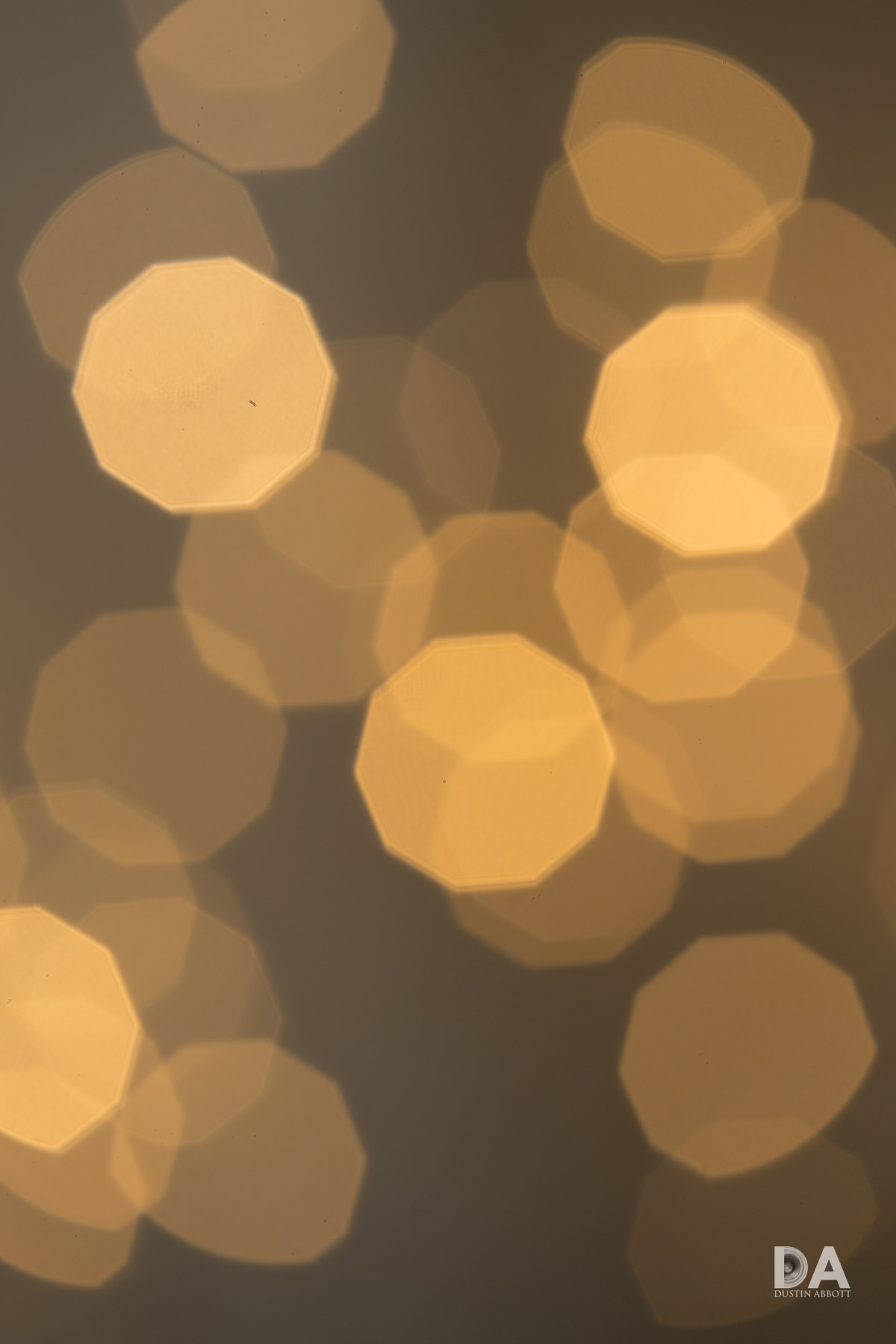
I'm not sure we can state that the 110/2.5 APO has - apart f/2.5 - a smooth bokeh (from Dustin Abbott review):


Sep 27, 2024 at 08:20 AM


Search in Used Dept. 

tsdevine
Offline
• • • • •
Upload & Sell: On
p.94 #11 · Voigtlander 50mm f/2 APO-Lanthar Review


Going with straight aperture blades on the 110 made the sunstar fans happy, but for a macro lens, I think they should have gone with curved blades. (Or maybe something along the lines of the 50 AL where at certain apertures it's round and at others it gives sunstars.....although even that might not make sense on a macro lens.)

Ripolini wrote:
I'm not sure we can state that the 110/2.5 APO has - apart f/2.5 - a smooth bokeh (from Dustin Abbott review):
https://dustinabbott.net/wp-content/gallery/voigtlander-110mm-review/31-Aperture-Shape-2.jpg
https://dustinabbott.net/wp-content/gallery/voigtlander-110mm-review/31-Aperture-Shape-3.jpg


Sep 27, 2024 at 08:26 AM
Steve Spencer
Offline
• • • • • • •
Upload & Sell: On
p.94 #12 · Voigtlander 50mm f/2 APO-Lanthar Review


Deathchant wrote:
@philip_pj@: that is a wonderful post! Thanks for that!! I am not into such depth of technical details as you, but I am trying to understand it better, so I am thinking out loud here: I was always wondering why some brands use a designated "APO" naming while not using the classic 3-element-construction that bring light of three distinct colors (red, green and blue) to the same plane of focus.

When we look at the 135 apo sonnar, I see 4 elements "made of special glass with anomalous partial dispersion", but I don't see that typical 3-element-construction:
https://www.lenstip.com/upload3/3952_zei135_bud.jpg
So APO-results can be achieved
...Show more

I don't think the 3 element construction you reference is really all that important for a lens to be APO. All APO means is that three wavelengths of light (and remember there are really an infinite number of wavelength in the visible spectrum if you divide it finely enough) focus on exactly the same plane. It doesn't have to be blue, green, red, and if it is it can be any shade of blue, green, and red. As I understand APD glass is one way to affect where those three focal lengths actually focus. Note an APO lens isn't defined by the lack of axial CA (it is defined by those three focal lengths focussing on exactly the same plane), but such lenses should have a lot less axial CA. Also doesn't have to be just 3 elements to do the work of focussing the three wavelengths on the same plane. That work can be spread out across multiple elements. So more APD elements can spread the work potentially making the correction easier or perhaps more thorough. I hope that helps answer your first question.

Your second question doesn't have an easy answer and a would probably require testing by a lens designer, but as noted above APO does not mean no axial CA, so both lenses can be APO and one can have some CA and the other none or very close to none. One thing that definitely helps the 110 f/2.5 over the 135 f/2 is that axial CA is reduced as you stopped down, so the narrower max aperture of the 110 f/2.5 certainly gives it an advantage in reducing CA.

Your third question is very complicated and beyond anything I can answer. I think you would need a lens designer to even try. I am suspect it depends on a number of important things about the Asph elements, the focal length, the focal distance, field curvature, etc.

Your fourth question again is likely not a simply answer, but for portrait lenses as I suggested above personally I tend to like lenses that are sharp but not exceptionally so with nice bokeh and reduced to very low axial CA. For me and what I like that typically means a lens with no or just one or maybe two Asph elements and quite a few APD elements. It also means a lens with some but not a lot of uncorrected spherical aberrations. It also seems that the Asph elements are less needed at longer focal lengths, so those longer focal length lenses are easier to make creating a lens I like.

Edited on Sep 27, 2024 at 08:17 PM · View previous versions


Sep 27, 2024 at 08:32 AM
Ripolini
Offline
• • • •
Upload & Sell: Off
p.94 #13 · Voigtlander 50mm f/2 APO-Lanthar Review


Steve Spencer wrote:
One thing that definitely helps the 110 f/2.5 over the 135 f/2 is that axial CA is reduced as you stopped down, so the narrower max aperture of the 110 f/2.5 certainly gives it an advantage in reducing CA.


Probably the shorter FL might help too, although a macro design adds complexity as high image quality must be ensured over a much wider focus distance range.


Sep 27, 2024 at 08:52 AM
tsdevine
Offline
• • • • •
Upload & Sell: On
p.94 #14 · Voigtlander 50mm f/2 APO-Lanthar Review


And just to add, my 125 AL keeps more round bokeh across apertures. I don't know how many blades it has and the shape, but I can see that it doesn't have the hard bokeh edges that my 110 does as you stop down from wide open.

For a macro lens, I would have prioritized the aperture mechanism design in favor of the 125 approach.

tsdevine wrote:
Going with straight aperture blades on the 110 made the sunstar fans happy, but for a macro lens, I think they should have gone with curved blades. (Or maybe something along the lines of the 50 AL where at certain apertures it's round and at others it gives sunstars.....although even that might not make sense on a macro lens.)


Edited on Sep 29, 2024 at 06:45 AM · View previous versions


Sep 27, 2024 at 09:18 AM
grantgoodes
Offline
• •
Upload & Sell: Off
p.94 #15 · Voigtlander 50mm f/2 APO-Lanthar Review


tsdevine wrote:
And just to add, my 125 AL keeps more round bokeh across apertures. I don't know how many blades it has and the shape, but I can see that it doesn't have the hard bokeh edges that the 110 does as you stop down from wide open.

For a macro lens, I would have prioritized the aperture mechanism design in favor of the 125 approach.

The 125/2.5 has 9-blades.


Sep 27, 2024 at 09:49 AM
philip_pj
Offline
• • • • • •
Upload & Sell: On
p.94 #16 · Voigtlander 50mm f/2 APO-Lanthar Review


It's no coincidence that APO lenses tend to be clustered around the short to mid telephoto focal lengths. These are the easiest lenses to design to high standards of performance. It's why we have so many great five and six element lenses at 85-100mm or so.

Zeiss tend to really mean it when they say APO, but the anomaly is that all APO lenses have residual CA. And others will know better than I that it can be hard to identify the type of CA at times. It's the digital curse! The CV 110/2.5 may be the best corrected APO commercially available, or close to it.

The three element reference probably relates to the original Sonnar design. From Wikipedia:

'The first Zeiss Sonnar, patented in 1929, was a f/2.0 50 mm lens with six elements in three groups and released with the Zeiss Contax I rangefinder camera in 1932. In 1931, Bertele reformulated the Sonnar with seven elements in three groups'

There is more on the preceding developments including triplets. But, in themselves, they have nothing to do with high optical correction of color.


Sep 27, 2024 at 07:58 PM
philip_pj
Offline
• • • • • •
Upload & Sell: On
p.94 #17 · Voigtlander 50mm f/2 APO-Lanthar Review


'The 110/2.5 APO resembles the 135 apo sonnar in lens element construction, but I do know that the 110/2.5 has almost none to completely no CA, while the 135 apo does....How to explain that? Is it due to the more APD elements in the Voigtlander?'

I would say so, yes. Cosina made both of them, one under their name. They had the legendary CV 125/2.5 to use as a model for their necessary target. Also, as satated, the slower aperture helps greatly. It's the reason we have asph surfaces in so many APOs today.

Note that Otus 100mm relies heavily on its eight APD elements with just one asph rear element to control (presumably) distortion and spherical aberration. The rear placement is a clue here, the light path has passed through 13 elelements to reach it, so the remaining aberrations at this stage are residual in the design. This domination of APD over asph surfacing betrays the corporate ideology of both Zeiss and Cosina.


Sep 27, 2024 at 08:39 PM
philip_pj
Offline
• • • • • •
Upload & Sell: On
p.94 #18 · Voigtlander 50mm f/2 APO-Lanthar Review


We just heard the new Leica Q3 43 fixed lens camera has no less than seven asph surfaces, an extraordinary count even for asph-friendly firms like Leica. It has eight groups of elements for 16 air-glass surfaces, so 7/16 is 44% of these surfaces being aspherical in nature. Zeiss was always more cautious, the Otus 100mm has 11 groups for 22 air-glass surfaces and just two came from an asph element, for 9% being aspherical.

I mention it to indicate that asph surfacing is now being used for ultra levels of sharpness (lens contrast), just as we see in zooms and phones. It's actually a rebranded Panasonic design, according to patent documentation.

'3: When a lens has more APD elements AND also aspherical elements, you get more optional "perfection", but at the expense of bokeh and "special rendering", thus getting a more clinical look?'

Very difficult to say. Bokeh design is an ongoing challenge for them, it depends on many input factors. It's fair to say that high performance lenses struggle more due to lens contrast levels and much greater scrutiny. You will notice in specifications that asph surfaces (though elements are often the term used) are generally limited to two or three. That might be a clue.

Paradoxically, the better optical lenses might be more liable to look 'clinical' because they are more restrained in color/contrast than say, commercial lenses like the Batis 25mm for example. The Batises are Tamron designs, and actually combine APD and asph surfacing, very unusual for the time of release.

My sense of the state of play is that lens makers are reaching more for asph surfacing than five or ten years ago for reasons of physical design (Canon and Nikon's wide mouth mounts) than optical correction.

4: What is considered the "optimum" (when looking at lens elements/construction) for negating CA while not affecting bokeh and rendering?

It's a personal question for us all. We still see debates about what exactly is good bokeh. Then, aperture blade design and blade counts. For me, I see many excellent lenses with minimal LoCA that are not APO yet have very high image quality using APD elements - the Loxia 85mm is a good example of this kind, and Nikon's perhap favourite S lens, the 85/1.8 has no asph surfacing either. But some, maybe all the wider S lenses do so.

If you are pretty OK with merely excellent bokeh, color correction via APD glass is the way to go, a personal preference of mine. It can obviously be done, there is no intrinsic relationship. Rendering is often exquisite.


Sep 27, 2024 at 08:39 PM
philip_pj
Offline
• • • • • •
Upload & Sell: On
p.94 #19 · Voigtlander 50mm f/2 APO-Lanthar Review


The real battleground for reducing aspheric dependence is the wide angle focal length arena. Ironically, it is the one where it probably matters least and where you pretty much need aspherics, certainly if aiming for fast lenses, like the Voigtlander 21/1.4. It has two aspheric elements in a 13 element design.

But here is what might be interesting. Two of the most loved 21mm lenses are the Loxia 21/2.8 and the Leica Super-Elmar 21/3.4. They have 11 elements and eight elements respectively, both are 'slow' and both have just one asph element, both deploy it in combination with four APD elements. Both are retrofocus designs (from Leica's data sheet), and the asph elements are at, or near the rear of each lens.

It appears that, if people are prepared to use a stop or so slower lenses, they can reap the benefits of balanced lens designs, even in ultra wide angles. These lenses will be used for all kinds of subject matter, excluding people and macro.

I think we will see many more APD heavy lenses from Cosina, despite them having recently developed a new GA process for preparing asph surfaces (used in the 50/1).

What exactly does the asph-heavy image look like? Most are familiar with phone images, that super crisp look. (In fact, how many view images on their phones these days?)

Here is a link to a page of images from the new seven asph surface Q3 43. I don't want to throw stones at this one, the bokeh is fine, color is typical Leica, and for many uses it will be very pleasing. I'm glad they made it. But see the hair and animal fur and the skin of the older people. It might not be optimal.

https://lightroom.adobe.com/shares/9ae161b1b74843c3a5c526754dcada7a


Sep 27, 2024 at 09:07 PM
Deathchant
Offline

Upload & Sell: Off
p.94 #20 · Voigtlander 50mm f/2 APO-Lanthar Review


@philip_pj and @Steve Spencer (and al others) thanks for your insightful posts! Appreciate it!

I count 9 APD elements (out of 14) in the 100 Otus, and it seems both optical perfection as well as gorgeous rendering.
You also mentioned there are many great 5 or 6 element 85-100'ish lenses...
I can follow that less elements means lesser air-surface transitions (thus less transmission loss when applying the right coatings), but does it also translate to that nice (3d like) rendering?

I mean, I have the 85 Planar with only 6 elements, no APD or asph elements at all. It really has some quality to the rendering that is special, but below f/2.5 it is dreamy/soft/tons of CA. But it produces landscape images of very high quality. Very micro-contrasty and 3d like rendering. The images also have high clarity, like there is no haze or moisture effects in the air.
The 135 apo has almost double the element count and the 100 Otus even more, while they also have the same clear and crisp 3d-like rendering...

So why does low element count seem to be so desired when looking purely to rendering? A while ago, i found a photography blog of Yannick Khong, all about low element count but I could not find any good explanations as to why that translates to that high micro-contrast rendering. The 28 Otus was compared against an older wide angle lens (I believe an old Nikkor lens) the latter seeming to be superior.
High praised and tack sharp Sigma lenses don't do it for me: I find it's rendering really clinical, flat even while not all of them have high element count. The CA correction and sharpness is however excellent...

By the way the skin on that old woman and also the furr on the dog looks okay to me...


Sep 28, 2024 at 03:55 AM
1       2       3              93              95              104       105       end


FM Forums | Sony Forum | Join Upload & Sell

1       2       3              93              95              104       105       end


Welcome back
Log in to your account