Steve Spencer
Offline
Upload & Sell: On
|
 Re: Voigtlander 50mm f/2 APO-Lanthar Review Re: Voigtlander 50mm f/2 APO-Lanthar Review | |
Deathchant wrote:
@philip_pj@: that is a wonderful post! Thanks for that!! I am not into such depth of technical details as you, but I am trying to understand it better, so I am thinking out loud here: I was always wondering why some brands use a designated "APO" naming while not using the classic 3-element-construction that bring light of three distinct colors (red, green and blue) to the same plane of focus.
When we look at the 135 apo sonnar, I see 4 elements "made of special glass with anomalous partial dispersion", but I don't see that typical 3-element-construction:
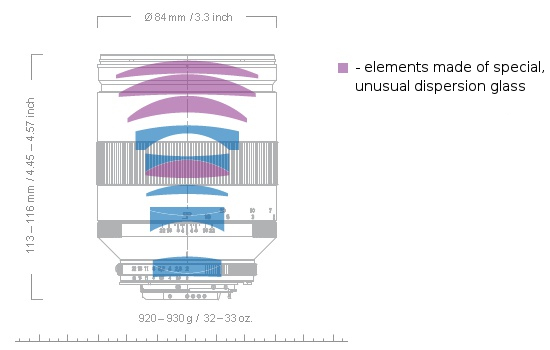
So APO-results can be achieved differently then?
When I look at the CV 50/2 Apo Lanthar, I also don't see that usual triplet, but no less than 5 APD elements and 2 asph elements.
By the way, I don't find the 135 apo sonnar completely CA-free (see my own example here), whereas other lenses (with those typical Apochromat triplets) seems to be completely CA-free.
Now, I don't know if those 3 elements need to be in a group or that they can be some elements apart...But it seems that the 135 apo sonnar and CV 110/2.5 APOresemble eachother and have more or less equal smooth bokeh, while the 50/2 APO and 65/2 APO resemble eachother and can have busier/harsh bokeh.
Some questions:
1: So, do I conclude it correctly when I say that because of the choice of tackling CA via the partial dispersion glass and not via the 3-element-construction, the 135 apo sonnar still has some CA (only very little) but also has a really nice smooth bokeh, and when Zeiss would choose the 3-element-construction, that the bokeh was less smooth (but better CA-performance)?
2: The 110/2.5 APO resembles the 135 apo sonnar in lens element construction, but I do know that the 110/2.5 has almost none to completely no CA, while the 135 apo does....How to explain that? Is it due to the more APD elements in the Voigtlander?
3: When a lens has more APD elements AND also aspherical elements, you get more optional "perfection", but at the expense of bokeh and "special rendering", thus getting a more clinical look?
4: What is considered the "optimum" (when looking at lens elements/construction) for negating CA while not affecting bokeh and rendering?
This out-loud-thinking makes me appreciate even more how some lens manufacturers produce lenses that create beautiful images. Seems like a difficult job to make a decision on how many APD + asph lenses to include without going overboard to either clinical perfection or nice rendering but with optical flaws....
I don't think the 3 element construction you reference is really all that important for a lens to be APO. All APO means is that three wavelengths of light (an remember there are really an infinite number of wavelength in the visible spectrum if you divide it finely enough) focus on exactly the same plane. It doesn't have to be blue, green, red, and if it is it can be any shade of blue, green, and red. As I understand APO glass is one way to affect where those three focal lengths actually focus. Note an APO lens isn't defined by the lack of axial CA (it is defined by those three focal lengths focussing on exactly the same plane), but such lenses should have a lot less axial CA. Also doesn't have to be just 3 elements to do the work of focussing the three wavelengths on the same plane. That work can be spread out across multiple elements. So more APD elements can spread the work potentially making the correction easier or perhaps more thorough. I hope that helps answer your first question.
Your second question doesn't have an easy answer and a would probably require testing by a lens designer, but as noted above APO does not mean no axial CA, so both lenses can be APO and one can have some CA and the other none or very close to none. One thing that definitely helps the 110 f/2.5 over the 135 f/2 is that axial CA is reduced as you stopped down, so the narrower max aperture of the 110 f/2.5 certainly gives it an advantage in reducing CA.
Your third question is very complicated and beyond anything I can answer. I think you would need a lens designer to even try. I am suspect it depends on a number of important things about the Asph elements, the focal length, the focal distance, field curvature, etc.
Your fourth question again is likely not a simply answer, but for portrait lenses as I suggested above personally I tend to like lenses that are sharp but not exceptionally so with nice bokeh and reduced to very low axial CA. For me and what I like that typically means a lens with no or just one or maybe two Asph elements and quite a few APO elements. It also means a lens with some but not a lot of uncorrected spherical aberrations. It also seems that the Asph elements are less needed at longer focal lengths, so those longer focal length lenses are easier to make creating a lens I like.
|


