Thanks; so fairly typical. When possible I try to stay on the wide side of 5.6 for landscape.
Hi Dave,
I would say that there will probably not be that much loss at f5.6 or f8. It comes down to focal length, how much DOF that you need/want, corner sharpness, and how much you are willing to lose by stopping down more. For myself, and I only have 36MP and 42MP Sony bodies is use what you need for DOF and accept any loss of sharpness and if you need smaller apertures for DOF and for corner sharpness, shoot away and don't worry. I normally try to stay away from stopping down to the minimum aperture or 1 more stop down for shooting my landscape images.
I would say that there will probably not be that much loss at f5.6 or f8. It comes down to focal length, how much DOF that you need/want, corner sharpness, and how much you are willing to lose by stopping down more. For myself, and I only have 35MP and 42MP Sony bodies is use what you need for DOF and accept any loss of sharpness and if you need smaller apertures for DOF and for corner sharpness, shoot away and don't worry. I normally try to stay away from stopping down to the minimum aperture or 2 stops down for shooting my landscape images.
DaveFP wrote:
Thanks Rich - I generally go with what works for desired dof; certainly not past f/8.
I was just curious about exactly when this lens began to lose it's calling card; that amazing sharpness.
I am going to try more landscapes with it with a wider aperture.
Best -
Hi Dave,
Hyperfocal can be your friend, which is especially helpful and useful with MF lenses that have measurements for distance and aperture rings and (and aperture ranges/marks) on the lens barrels. But, remember if you are using a MF lens with these markings these are only a guide and will only represent a print of about 5" X 7". You will need to stop down and use smaller apertures the larger the image that you wish to ultimately produce. Sometimes you will find that you will need f11. It isn't a crime.
Hyperfocal can be your friend, which is especially helpful and useful with MF lenses that have measurements for distance and aperture rings and (and aperture ranges/marks) on the lens barrels. But, remember if you are using a MF lens with these markings these are only a guide and will only represent a print of about 5" X 7". You will need to stop down and use smaller apertures the larger the image that you wish to ultimately produce. Sometimes you will find that you will need f11. It isn't a crime.
Rich
I generally focus on the primary area of interest and stop down only enough to capture anything important in the foreground.
I am usually not concerned with sharpness beyond the subject to any great extent.
I have used f/11 on occasion when it's the only way to include my foreground.
Most people don't like focus peaking but I do use it (on low) to help see where it all falls.
(I have Focus Peaking On/Off in my Fn menu)
I didn't realize that the hyperfocal markings were only valid for a 5 x 7 image...
DaveFP wrote:
ROY G BIV
Red Orange Yellow Green Blue Indigo Violet
would suggest that but I don't know for sure....
Diffraction becomes important when the wavelength of the wave is (at least) on the order of the size of the aperture, so for some fixed aperture it happens to larger wavelengths first, i.e. the red end of the spectrum.
You can understand this intuitively by the following: we all know large apertures don't make us worry about diffraction, right? But decreasing the aperture is equivalent to increasing the wavelength, since these are the only two physical scales we are considering. So large wavelengths are affected more, just as small apertures are.
Flavourdynamic wrote:
Diffraction becomes important when the wavelength of the wave is (at least) on the order of the size of the aperture, so for some fixed aperture it happens to larger wavelengths first, i.e. the blue end of the spectrum.
You can understand this intuitively by the following: we all know large apertures don't make us worry about diffraction, right? But decreasing the aperture is equivalent to increasing the wavelength, since these are the only two physical scales we are considering. So large wavelengths are affected more, just as small apertures are.
Red has the longest wavelength.
If the rest of what you are saying is correct then it would seem that green would, in fact, diffract first. No ?
The point spread function (the diameter of a diffraction-limited image "spot" on the sensor for an pbject point source) for an ideal diffraction-limited system with a circular aperture is 1.22 times the wavelength times the f-number. Red is around 650 nm wavelength. Green is around 530 nm. Blue is around 450 nm. Red diffracts more than green which diffracts more than blue. For a fixed aperture the red wavelengths will diffract the most, followed by the green, followed by the blue. This is why, for example, the outer ring of a corona around the moon or a street light behind clouds or fog is reddish.
photonoclast wrote:
The point spread function (the diameter of a diffraction-limited image "spot" on the sensor for an pbject point source) for an ideal diffraction-limited system with a circular aperture is 1.22 times the wavelength times the f-number. Red is around 650 nm wavelength. Green is around 530 nm. Blue is around 450 nm. Red diffracts more than green which diffracts more than blue. For a fixed aperture the red wavelengths will diffract the most, followed by the green, followed by the blue. This is why, for example, the outer ring of a corona around the moon or a street light behind clouds or fog is reddish....Show more →
Thanks; nicely explained.
RGB - easy to remember.
Now I just have to figure out why green clips first !
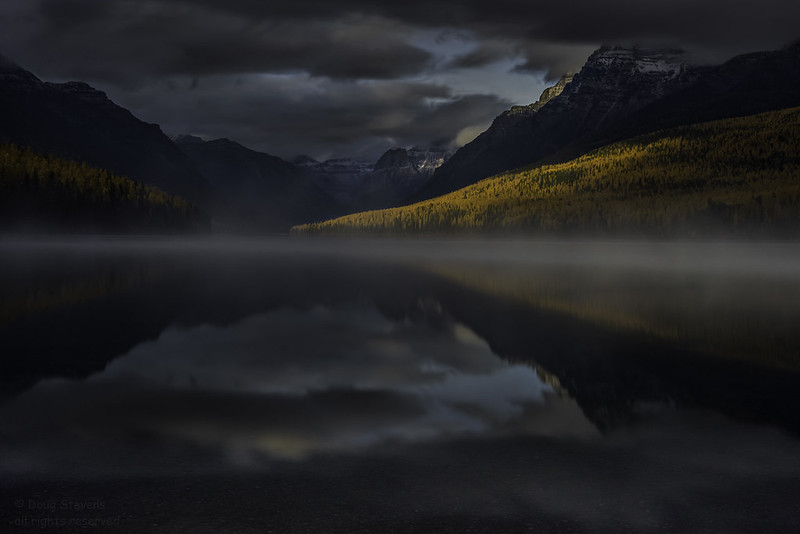
It's been fall colors season and both of my Voigt Apos have been getting a work out (along with a Loxia here or there). This last week was both the peak of the larch/tamarack colors and full moon. I have really been drawn by the "dark side" lately (night photography).
Here is a pre-dawn, blue hour photo of Bowman Lake, Glacier NP, before the moon set using the Voigt 50mm Apo:
graytrekker wrote:
It's been fall colors season and both of my Voigt Apos have been getting a work out (along with a Loxia here or there). This last week was both the peak of the larch/tamarack colors and full moon. I have really been drawn by the "dark side" lately (night photography).
Here is a pre-dawn, blue hour photo of Bowman Lake, Glacier NP, before the moon set using the Voigt 50mm Apo: