Though I'm sure there is nothing in there that isn't already known to anyone who participates in this thread.
Thanks for the excellent review. I am a big fan of your review style and your site. One small correction you describe the lens has having 10 aperture blades, but it has 12.
Steve Spencer wrote:
Thanks for the excellent review. I am a big fan of your review style and your site. One small correction you describe the lens has having 10 aperture blades, but it has 12.
I agree - great review of one of my favorite lenses.
Jordan, what does "out-resolving the sensor" mean? How do you identify this without detailed optical tests? What does it look like on real-world images?
waterden wrote:
Thanks very much indeed for this. It is perfectly clear that, for across-the-frame resolution at infinity focus, the APO-Lanthar wins hands down at f2 and, to a lesser extent, thereafter. The real question for me is whether it is sufficiently better, in practical rather than OMG terms, to warrant a switch, particularly as landscape photography is for me always on tripod at f8 or higher so the extraordinary corner to corner performance at f2 is only of academic interest.
The key factor (for me) when used wide open is the quality of subject separation and I suspect the Zeiss, with its signature mid range punch, might be the winner. I'd certainly be interested to know what owners of both think about that.
I wonder about this same thing as well since I'm mainly at f8+ on a tripod. The Voigtlander seems to have significantly better and more even sharpness across the frame, but does anyone with both have any comments on the color rendering of the Voigtlander vs Loxia?
This is probably my biggest disappointment in a year. I have been planning to buy for a long time, but I don't see the slightest point in holding the lens in the landscape and taking photos with the aperture fully open, while significantly improving the material, especially as it is not suitable for direct sending from the card as JPG files. If someone likes to spend more time on the computer before publishing a photo on the portal, they will definitely save time in post-processing by using the E Apo-Lanthar version. Loxia is a revised Planar or Biogon on the corners. Optical correction for thick sensors in Sony has been added. The colors and visuals of Loxia are very similar to the M. E Apo-Lanthar series, better for landscapes and still lifes, and Loxia for family photos and trips. You have to close the lens a lot to catch the corners like an E Apo-Lanthar, but there is no distortion and there are very nice colors typical for Zeiss. As I said, you can do it all in front of your computer.
The last time I did something on my computer, these were the framing and cropping tools that I stopped using as I have a 100% matrix in the viewfinder. I remember almost 20 years ago I started with Fred Miranda's Photoshop 6.0 plugin which I always used after scanned photos. Regards
I was very surprised at the retained image quality of the 50/2 APO at f8, a deep and rich contrast and colour performance. Peak image quality might be f4, as published by CV. F2 landscapes deliver very high microcontrast for superb separation. Its a new look, if you focus 10-20m away at f2, the background takes on a softer yet still detailed look.
Many of my seaside images earlier in the thread were shot at f8. The lens appears to lack field curvature at all apertures and is never harsh. Quite like the SL Leica images, in fact, so it may be a quality of modern APO correction.
DOF at smaller apertures only partially 'covers' for field curvature because the increased DOF intimately tracks the curved focal plane - the underlying image distortion remains but is merely less visible (as shown by lensrentals FC graphs). Near enough may be good enough.
But I want objects in image space to faithfully reflect the composition as I saw it, as it actually was! It appears to take a lot of APD glass to deliver flat fields with high IQ to do this, and the impressive strides in asph surfacing precision have seen double-sided asph surfacing emerge as a booster for IQ. You also get smaller lenses with fewer elements this way.
philip_pj wrote:
I was very surprised at the retained image quality of the 50/2 APO at f8, a deep and rich contrast and colour performance. Peak image quality might be f4, as published by CV. F2 landscapes deliver very high microcontrast for superb separation. Its a new look, if you focus 10-20m away at f2, the background takes on a softer yet still detailed look.
Many of my seaside images earlier in the thread were shot at f8. The lens appears to lack field curvature at all apertures and is never harsh. Quite like the SL Leica images, in fact, so it may be a quality of modern APO correction. ...Show more →
Very interesting; I've never tried shooting landscapes at/near f2 apertures but I consider myself a beginner and mostly shoot between f8-11. Can you elaborate a little bit on shooting landscapes at such open apertures, or point to some examples of your soft yet sharp background images? Are you mentioning hyperfocal distance focusing method when you say to focus at 10-20 meters away?
flower_power wrote:
Very interesting; I've never tried shooting landscapes at/near f2 apertures but I consider myself a beginner and mostly shoot between f8-11. Can you elaborate a little bit on shooting landscapes at such open apertures, or point to some examples of your soft yet sharp background images? Are you mentioning hyperfocal distance focusing method when you say to focus at 10-20 meters away?
Although more useful for nightscapes, I've shot low light landscapes at f/2 before.
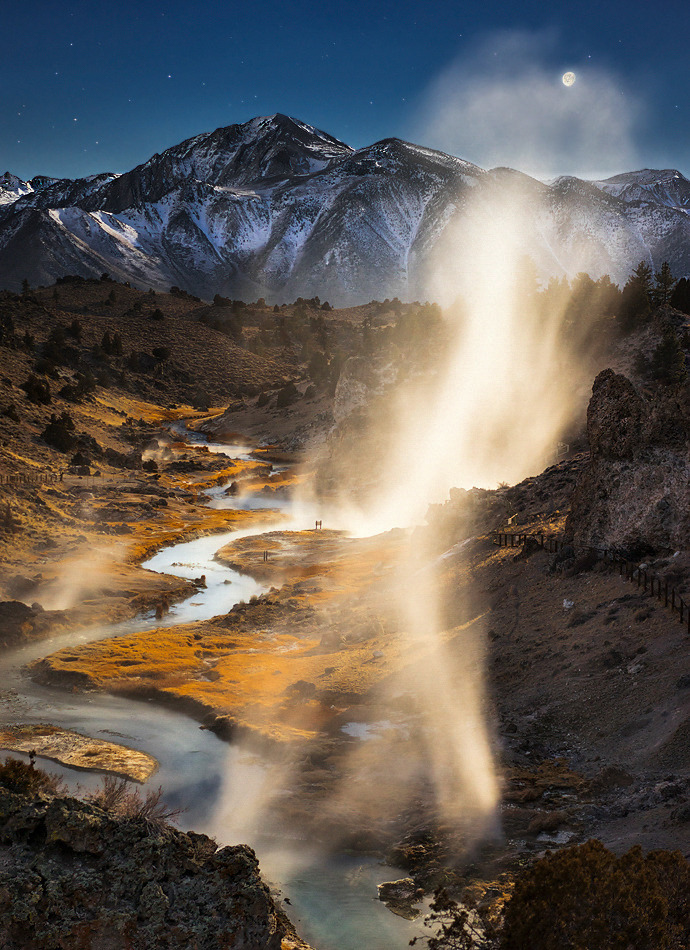
Here is a sample with the Sony 55/1.8 ZA. I wish I had the APO for this one but the Sony performed ok across the field at f/2.
Although more useful for nightscapes, I've shot low light landscapes at f/2 before.
Here is a sample with the Sony 55/1.8 ZA. I wish I had the APO for this one but the Sony performed ok across the field at f/2.
Holy cow, that is stunning! Guess I'll have to play around more with lower aperture landscape stuff, although I'm usually trying to get as much depth of field in focus as possible.
The test photos were processed by Capture One Pro 21 at approximately the same settings, with Direct RAW to Jpeg, or applied with Film Preset style, and all black and white photos were also processed by Nik Silver Efex 2…
Sure. At one end, some want focus stacking for total uniform performance. Even in single frame, at f8 or so using a 50mm, content is typically drawn within the DOF envelope, once past a threshold focus distance. If you have a strong element in the near foreground, you can use the high micro-contrast at the focal plane at ~f2 to make this element really sharp and have what lies beyond slowly fade yet still presents motifs in well recognisable form. To see the effect, do a few A-B f2-f8 sets. It's somewhat like what the eye naturally sees. Very image- and taste-specific, of course.
The Leica 50AA was a good technical lens for its day, but wildly overpriced. Resale is likely to fall like a stone shortly. Around 13% of it's purchase price will buy the superior performance of the APO-Lanthar 50mm. Back then, you needed f5.6 in the 50AA to reach the curvature control, astigmatism, outer frames and micro-contrast delivered by the 50AL E at f2! The 50AA was made for very different cameras and they effectively hid these aberrations.
That's progress for you. Hopes are high for the forthcoming APO-Summicron 35/2 however, with 2021 formulations, glass that has appeared since the time the 50AA was designed (2011-2012). Asph processing is far better today, as well. Fabrication, tolerance control, all of it is better.
I believe that for people who think the lens is rendering an image, this is a very good choice when spending most of their time post-processing anyway. On the other hand, for people who find that the lens draws, it will not necessarily be the best choice. Recently, I even heard in the retro section (forum) that the cassette is implemented in a tape recorder. Greetings
tsdevine wrote:
I notice some color drift towards magenta with the corners on my a7R III (vignetting correction off) with this lens. I notice this behavior on a couple of my other lenses as well, so I guess it could be my camera. I had created cornerfix profile to remove it, but I stumbled on another solution, at least it seems. Zeiss UV filters have a pretty hard cut at 410nm, and it seems to remove the drift I was seeing. Still have to do a little more shooting, but it may be worth considering if anyone else notices this behavior with their camera/lens combo.
While arguably there may be some impact to using the filter, it seems so far to be a fair tradeoff.
Yeah, it's not just my copy...and it shows on more than just my one body (both a7R III and a7R II.) An L41 filter such as the Kenko Zeta L41 UV filter (discontinued) or Zeiss UV filter takes care of most of it.
IndyFab wrote:
Agree, I noticed it when you posted the high contrast test on the tree branches. However I am seeing it in several other images other than yours.
smpetty wrote:
I agree - great review of one of my favorite lenses.
Jordan, what does "out-resolving the sensor" mean? How do you identify this without detailed optical tests? What does it look like on real-world images?
Possibly he means the resolution is such that, were you to have a higher resolution sensor, there would be an increase.
The problem with this definition is that there will always be an increase in in resolutions with a higher resolutions sensor. System resolution is a function of both lens and sensor resolution, and always increases if either increases (hens the absurdity of the idea that some lenses do worse on higher resolution sensors)
But there is a vague but maybe useful way of thinking of it. Some lenses are such that should the sensor resolutions increase, you get a huge increase in system resolution - in the limiting case of an infinity resolution lens, as much as the sensor resolution increase (ie in such a case system resolution would just be sensor resolution). Of course there is no infinite resolution lens, that's just to describe the limit. But for some lenses that's close. Weaker lenses show very little increase with increased sensor resolution.
So maybe "out resolving the sensor" means that the increase in system resolution with meaningful sensor resolution increase is very high. Of course it's a bit subjective: what does "very high" mean.
DavidBM wrote:
Possibly he means the resolution is such that, were you to have a higher resolution sensor, there would be an increase.
The problem with this definition is that there will always be an increase in in resolutions with a higher resolutions sensor. System resolution is a function of both lens and sensor resolution, and always increases if either increases (hens the absurdity of the idea that some lenses do worse on higher resolution sensors)
But there is a vague but maybe useful way of thinking of it. Some lenses are such that should the sensor resolutions increase, you get a huge increase in system resolution - in the limiting case of an infinity resolution lens, as much as the sensor resolution increase (ie in such a case system resolution would just be sensor resolution). Of course there is no infinite resolution lens, that's just to describe the limit. But for some lenses that's close. Weaker lenses show very little increase with increased sensor resolution.
So maybe "out resolving the sensor" means that the increase in system resolution with meaningful sensor resolution increase is very high. Of course it's a bit subjective: what does "very high" mean.
Very thoughtful David.
Most of the resolution increase I've noticed (at pixel level) when moving from 42MP to 61MP was at center with my high resolution lenses. I agree that all lenses improve to certain degree though.
Something else to consider is that if resolution increases greatly while optical technology does not improve much, we may see an even higher discrepancy between on-axis and off-axis performance. Thing could all change if a new technology like curved sensors become a reality one day.
At this stage the better lenses are well ahead of the sensors, even at the market's high point of 61mp. Market forces, user acceptance, technology and practical concerns constrain gains in sensor resolution. Lens contrast is now so high makers are considering adding 60 lpmm to their full frame charts - 80% at 40 lpmm equals the key figure of 50% contrast at 60 lpmm (Peter Karbe). It's only tradition stopping them.
There are many interesting measures to be gleaned from MTF charts, but for landscapes a particularly brutal one is 'maximum corner MTF' - at best aperture. 35s are hard to design but topical, so here are a few 35mm lenses from the old days and the new days, all from 'real world' methods - 40 lpmm data (fine detail) in the very corners (image height: 21mm) at infinity, averaged across tan and sag lines to balance astigmatism:
L/M APO 35/2 - 72%
CV APO 35/2 - 73%
L/SL APO 35/2 - 75%
Other measures that could be derived are: 'corner as a percentage of center', and 'MTF at image height of 15mm' - the traditional midfield dip, generally indicating curvature of field. The last three in this list show only tiny traces of field curvature - they and their S/C/N counterparts (that cannot be accurately assessed) are really a new breed of optics, fully up to 100mp at least.
100mp is just 28% more resolution than 61mp, and resolution is heavily subject to the law of diminishing returns. And you 'drop off' more lenses with each step up, as their outer frames fail to keep up. I'd have thought curved sensors in ILCs would be likely to render all current lenses obsolete, without radical computer 'corrections' at the least. But maybe I'm wrong about that.