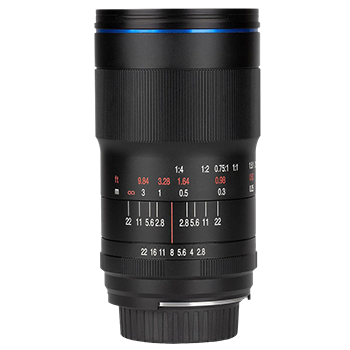
"There's lots that is interesting about the lens.
It's better at macro and infinity than at portrait distance.
It's very sharp, but suffers a bit in contrast.
It is completely apochromatic, which is still a real achievement at these focal lengths.
The focus ring has *very* short travel (connected with a bunch of mechanical features of the lens that are a little odd but interesting) which means that you will be wanting to move the lens for focus at macro, and actually I found that setting the rough focus with the ring and leaning forward and back to fine tune focus worked better even at portrait distance."
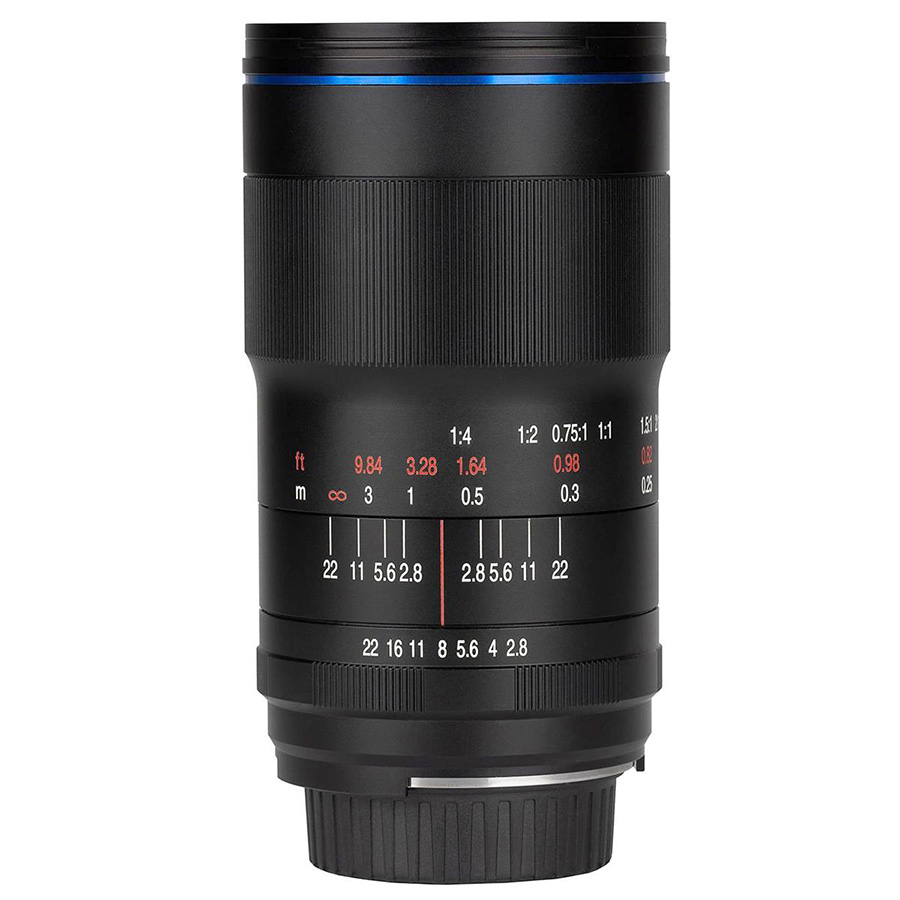
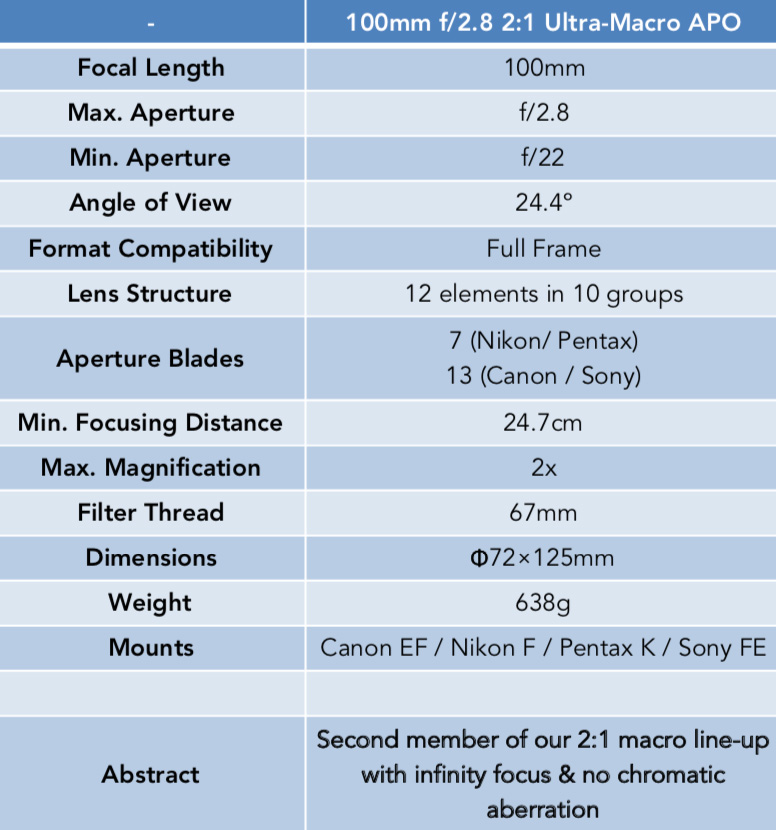
2:1 Magnification at same physical size - All of the 100mm macro lenses in the market can only reproduce 1:1 magnificati on (life-size) image only. The extended 2x magnification means more details ca n be seen through the lens. Photographers can now take advantage of the wider magnification range to capture bugs at different sizes.
Apochromat APO design (invisible CA)- The Laowa 100mm f/2.8 has a Apochromat (APO) design where the chromatic aberration (CA) at BOTH in-focus & out-of-focus area is controlled to the minimal. CA has long been one of the most annoying aberrations for macro photography and now you can forget about this and focus more on taking a great shot.
Similar size as 1:1 macro lens - Despite the extended magnification range, the size of our Laowa 100mm is actually comparable to other macro lenses in the market.
Outstanding Sharpness
Smooth Bokeh rendering
Outstanding Portrait lens with crystal sharpness - Laowa 100mm f/2.8 2:1 Ultra Macro APO is not only a exceptionally macro lens. It can also focus to infinity and is a very decent telephoto portrait lens.
So, we have a 2:1 (life size x 2), APO for only $450? Laowa produces outstanding lenses and the pricing is surprising to me. I'm not complaining.
The mfd is closer than the Canon 100mm macro, but since the Canon is 1x, does that mean that the distance for 1:1 with the Laowa is farther? If so, how much farther?
bluloo wrote:
I wonder how well it will compare to the CV 110.
The Canon/Sony versions seem to be equipped with 13 aperture blades. This could translate to rounder specular highlights at smaller apertures.
The CV 110/2.5 APO has 10 straight aperture blades which is great for sunstar definition but when stopping the lens down, bokeh balls look like decagons.
As far as resolution, it's hard to say but the Voigtlander is one of the sharpest lenses I've tested to date.
Likely it won't be as sharp to have that 2:1 magnification. They could very well optimize it for 1:1, instead of 1:10 (or any other lower mag.). However, it's bold of them to say that they are able to minimize the LoCA both in- and out-of-focus areas and charge only that much. I'll believe it when I see it.
hiepphotog wrote:
Likely it won't be as sharp to have that 2:1 magnification. They could very well optimize it for 1:1, instead of 1:10 (or any other lower mag.). However, it's bold of them to say that they are able to minimize the LoCA both in- and out-of-focus areas and charge only that much. I'll believe it when I see it.
Yes, the specs do not match the price but we won't know for sure until we test it out.
I have to say, though, I've been very impressed with the Irix 150, even though it's only 1:1 and focus breathes quite a bit. It'll be interesting to see how this stacks up.
Fred Miranda wrote:
Just found this video shot with this lens:
Interesting video with some footage that is difficult to get. But I'm 100% sure that at least some of the scenes are NOT from the 2.8/100 macro but from a SWA macro (maybe their 4/15mm?); sadly my Chinese is a bit rusty ;(
Also I see some high framerate (120/240 fps?) footage which makes me wonder what camera has been used, for sure not a standard Canon DLSR/ILC. I will try getting some similar scenes with my 80D and Canon 100L macro this summer, but wind is usually a huge problem in my area. Plus the problem that emerging damselflies are so small that you basically have to trust the Liveview AF to keep focus, which is very unreliable at such magnifications (strong tendency to focus on the wrong part). With the Laowa macro Liveview AF will not work at all so any little bit of wind or vibration could be a problem.
Thanks for the review, some very nice example images; I wish using stacking was easier out in the field (or even in a studio, in my previous home a car passing over the bridge 200 meters away would ruin any macro shot ...).
Would be interesting to compare this lens for work around 1:1 to the Canon 100L macro which isn't free from CA and other problems (my previous Sigma 150 macro was way better around 1:1). For me the range up to 2:1 would be great and the optical qualities sound good as well. But the lack of IS and AF is a limitation for use out in the field, e.g. when using Liveview AF to keep subject in focus without having your eye to the OVF, or for cameras that have focus stacking function. Despite the limitations sure looks like an interesting lens.
Too me, it appears as a very impressive performance.
Just one note on their measurement data for the lens - the magnification used for the testing isn't mentioned and it has a significant effect on performance. For example, when using the S1R in ~187MP multishot mode, I noticed a visible softening (at 2x) in finest detail when moving to f/4
One other thing is the vignetting mentioned at f/2.8
I noticed this with the lens at infinity, however the optical elements retreat a long way into the body at ∞ which could easily produce a bit of physical vignetting wide open. It doesn't seem nearly so obvious at 2x
Fred Miranda wrote:
The Canon/Sony versions seem to be equipped with 13 aperture blades. This could translate to rounder specular highlights at smaller apertures.
The CV 110/2.5 APO has 10 straight aperture blades which is great for sunstar definition but when stopping the lens down, bokeh balls look like decagons.
As far as resolution, it's hard to say but the Voigtlander is one of the sharpest lenses I've tested to date.
Error in the specs, Canon has 9 blades.
hiepphotog wrote:
Likely it won't be as sharp to have that 2:1 magnification. They could very well optimize it for 1:1, instead of 1:10 (or any other lower mag.). However, it's bold of them to say that they are able to minimize the LoCA both in- and out-of-focus areas and charge only that much. I'll believe it when I see it.
Klaus (of PZ/OL) says in his review (linked above):
As the name implies, the Laowa 100mm f/2.8 2x Macro APO is marketed as an "APO" (apochromatic) lens thus we were curious whether the lens can correct axial chromatic aberrations (on the Z-axis that is). And yes, there is barely any visible fringing (coloured halos around high contrast transitions) which is pretty unusual and quite impressive actually.
So it appears true.
Still a no-go for me because it's only MF but an impressive lens nonetheless.