OwlsEyes wrote:
It's a new autumn season, and my friend returns.
I began photographing this pie-bald deer two years ago, September. At first I was enamored by his patterning and photographed many "clean" portraits and body shots. Last year, as a spiked buck, I started to think of him as a ghost in the forest. This year I hope to continue building a portfolio of images with a hint of mystery.
This weekend I found him once again, but this time he was wrestling with another young, but larger, buck. While I doubt that my two year old friend will sire any fawns this year, I am hopeful that he will survive the litany of hunters and vehicles that cross his path so I can continue to find and photograph him into the future.
I, too, hope for a prosperous future for you buddy.
PhilM
Thank you Phil... I was pretty excited to see him on Sunday.
I'm off to the Badlands for a while, but will try to spend some quality with the young buck and friends when I get back from my upcoming trip.
OwlsEyes wrote:
It's a new autumn season, and my friend returns.
I began photographing this pie-bald deer two years ago, September. At first I was enamored by his patterning and photographed many "clean" portraits and body shots. Last year, as a spiked buck, I started to think of him as a ghost in the forest. This year I hope to continue building a portfolio of images with a hint of mystery.
This weekend I found him once again, but this time he was wrestling with another young, but larger, buck. While I doubt that my two year old friend will sire any fawns this year, I am hopeful that he will survive the litany of hunters and vehicles that cross his path so I can continue to find and photograph him into the future.
Thanks Lance...
I think it's rare for nature photographers to find that one subject that can be tracked across the years. With the exception of catching a leg band on a perching bird, or some mammal with a distinguishing ear tear, most of the wildlife we see is fleeting and without distinguishing marks. Countless years of evolution have crafted the patterns of mammalian coats and rendered them with a type of "perfection" that enhances their capacity to survive throughout the years.
I guess I am now experiencing the beauty of a "rare" genetic combination, as it allows me to connect with an individual rather than the species. In some ways, recognizing the individual has made the picture taking even more special for me.
OwlsEyes wrote:
Thanks Lance...
I think it's rare for nature photographers to find that one subject that can be tracked across the years. With the exception of catching a leg band on a perching bird, or some mammal with a distinguishing ear tear, most of the wildlife we see is fleeting and without distinguishing marks. Countless years of evolution have crafted the patterns of mammalian coats and rendered them with a type of "perfection" that enhances their capacity to survive throughout the years.
I guess I am now experiencing the beauty of a "rare" genetic combination, as it allows me to connect with an individual rather than the species. In some ways, recognizing the individual has made the picture taking even more special for me.
Actually there are quite some opportunities to follow individual subjects in nature, you just have to know what to look at (examples: zebra stripes, spot patterns on big cats, many fish and amphibians, etc.). Of course very "rare" mutations are easier to spot.
I have done a science project for identifying/tracking individual dragonflies based on their wing vene patterns. This allows extremely reliable ID assuming you get a nice sharp picture of the wings - which is difficult if you can only take in-flight pictures, so it isn't always practical. No two dragonflies have identical wing patterns and the pattern is fixed for life, although parts could disappear due to wear and tear on the wings. Dragonflies live only a few months so you can follow them over the course of several weeks instead of years and this allows all kinds of interesting observations. Science is just starting to experiment with the possibilities
I fully agree that connecting with the individual makes things far more interesting. Even with insects you can see huge variation in individual character/behavior.
I'm direly envious of any of you live where there is good light.
But the ducks took off late this morning, 8:20 and not the usual 7:50.
The different is ISO 12,800 vs. ISO 7200
And this is a D500
Went out to photograph the beaver pond today with the hope of finding my buddy and his family. Other than a 6:30 am encounter when the tail hit the water notifying the family of my presence, I was "skunked" by the beaver family.
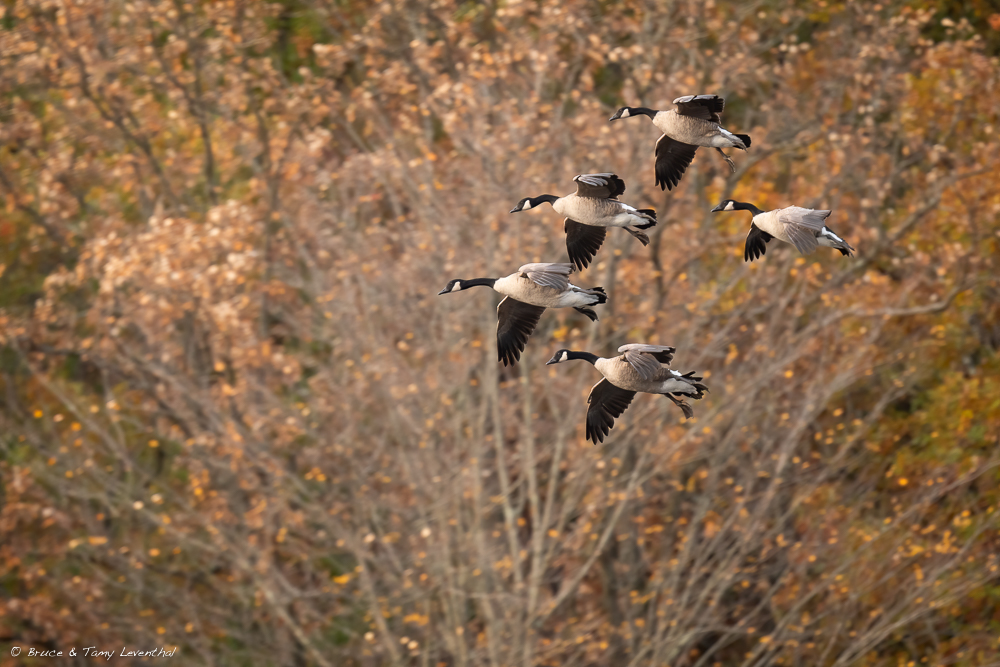
In the end, I only managed to photograph this goose flock backed by autumn foliage.
cheers,
bruce