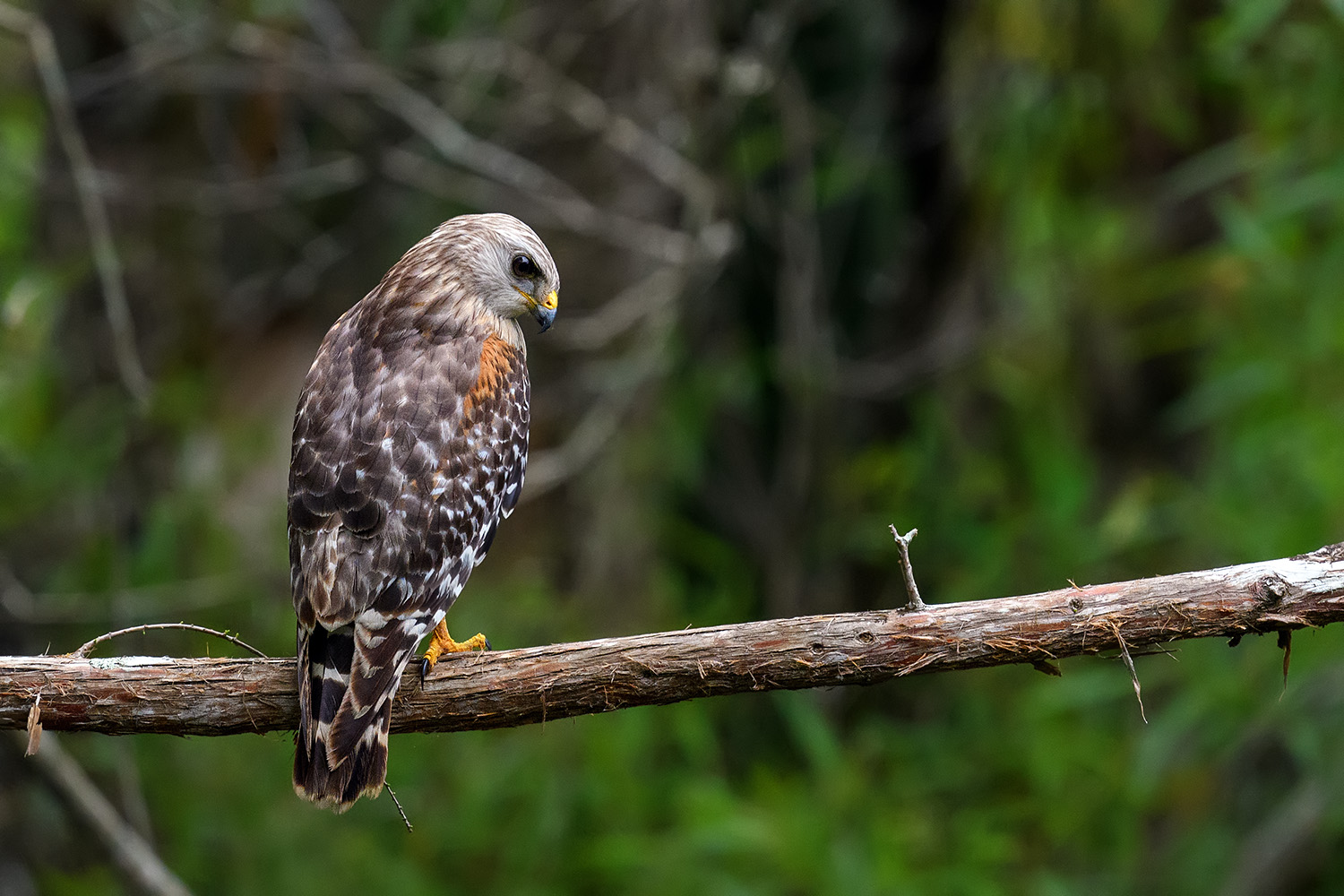
My belief in the 500 f5.6 PF being an "inexpensive lens" is that when compared to the 500 f4E VR and built to pro spec standards of build quality, AF speed and accuracy, and sharpness, especially wide open, it is definitely inexpensive. It is 1/3rd the cost of the 500 f4E VR, US$3,600 compared to US$10,300 at B&H. As to affordability, that is a different question.
Lance B wrote:
My belief in the 500 f5.6 PF being an "inexpensive lens" is that when compared to the 500 f4E VR and built to pro spec standards of build quality, AF speed and accuracy, and sharpness, especially wide open, it is definitely inexpensive. It is 1/3rd the cost of the 500 f4E VR, US$3,600 compared to US$10,300 at B&H. As to affordability, that is a different question.
I get your point here Lance. I was just trying to make it clear that $3600 (+/-) is not a trivial expenditure. However, relative to the FLE series, the 500PF is inexpensive, if not a bargain, when you consider the quality per dollar spent.
ilkka_nissila wrote:
Yes but at least my experience of bird photography is that 500mm is sort of a wide angle and more often a framing corresponding to 800-1200mm is desired. So an appropriate zoom range might be 500-1250mm, if it were practical or available. For example, the prestigious Fotofinlandia prize was won by Markus Varesvuo’s image of an Ural owl with an 800mm + 1.4x using a 1.3x crop body, if I recall the technical defails correctly....
It seems that geography is everything when it comes to this discussion. While I am not a bird specialist, I do plenty of bird photography that falls within the 80-500mm range, what's more, 80mm is often more telephoto than I need when photographing deer, whales, and beavers. An 800-1200mm lens would be wasted on me, as I prefer to include some landscape in my wildlife work.
The good news here is that we do not live in a one size fits all world. What's more, the modern photo industry has created enough diversity in optics and cameras that just about everyone's specialized needs can be met... these are very different times from when I first began photographing nature in the early 1980's.
Had already returned to the van as the sun had set and the bears lay down. Then she sat up and I grabbed my D5 with 500pf...bumped the iso to 1600 to capture a few last light pix
Eric
bs kite wrote:
Did you keep your D500 or sell it? I suppose I could sell my D500 and the 200-500. Why would I keep the 2-5 if I got the 500 5.6? Mmmm. And I already have the 80-400; it's super sharp for close ups.
Anyway. You shared some very interesting findings here....
Just shoot the approaching bird, until it hits the frame and call it good. What’s the matter with that? Would love to see those several duck heads you have that fill the FX frame. Why did I not see that for so long? And the root reason for my buying my D850 was that I would be able to cover things with 45 megapixels. I now like the idea of an incoming waterbird filling the frame and then cropping itself. The closer it gets, the more chance for the head to be covered by 45 megapixels. What’s the matter with that......I now ask myself.
Yes, my 200-500 is often slow to acquire but once acquired, it rarely loses the acquisition.
Very tired just now. Thanks much for your comments Geoff.
I kept my D500 but really not using it much, keeping it mainly for a second body if I go on a trip somewhere. I sold my 200-500 even before getting the 500PF because I just wasn't using it next to my 500/4 and 300PF at the time.
As for the frame filling head shots...it doesn't happen often and a lot of time the DOF is so thin that focus is slightly off the eye so they get deleted. A duck has to come very close to fill the frame with a head at 500mm but head/neck and a little body sometimes happens.
OwlsEyes wrote:
I get your point here Lance. I was just trying to make it clear that $3600 (+/-) is not a trivial expenditure. However, relative to the FLE series, the 500PF is inexpensive, if not a bargain, when you consider the quality per dollar spent.
cheers,
bruce
Even $3,600 is not a cost to take lightly and I fully understand that. Here is Australia, it relates to $6,000 and $13,500 so, not triple the price as it is in the US thus an even higher expenditure for the average Joe!
eyelaser wrote:
Had already returned to the van as the sun had set and the bears lay down. Then she sat up and I grabbed my D5 with 500pf...bumped the iso to 1600 to capture a few last light pix
Eric
Gone for very long weekend and hard to catch up.
My first outing using the 850 and 500 for BIF attempt.
I'm so glad the Z6/7 came out putting the 850 in my price range
on the sells forums.
arbitrage wrote:
I kept my D500 but really not using it much, keeping it mainly for a second body if I go on a trip somewhere. I sold my 200-500 even before getting the 500PF because I just wasn't using it next to my 500/4 and 300PF at the time.
As for the frame filling head shots...it doesn't happen often and a lot of time the DOF is so thin that focus is slightly off the eye so they get deleted. A duck has to come very close to fill the frame with a head at 500mm but head/neck and a little body sometimes happens....Show more →
I also kept my D500 and also have not used it for quite some time. But I think I will.
For sure that absolutely everything has to be perfect when the waterbird head fills the frame.
ilkka_nissila wrote:
Lightweight and high quality is a combination which is very expensive to implement. I was just told by Nikon that the reason the 500 PF is so hard to find is because the PF element is very difficult to make and the success rate is low i.e. a lot of them are rejected by QC (or earlier). This increases the cost of production if the expensive manufacturing equipment produces failed elements a lot of the time and the personnel have to inspect them.
The 300 PF was an engineering breakthrough, and in this interview in Japanese, the engineer admits to challenges in design and also production. We will likely never know the full story but there must be sound reasons why the 500 PF took its time to appear. The demand for these remarkable telephotos is significant. Nikon have perfected the design so it makes sense to build on their inaugural success.
In addition to what you have heard so far, please tell us if you have any innovative points or struggling points?
Fujimoto: In terms of optical design, we devised not to degrade the optical performance when a teleconverter is worn. Although it has become more sophisticated in terms of mechanism in clearing the issue of weight saving, the optical system also devised much about lightening, such as reducing glass weight as much as possible.
Terio: On the mechanism side, the overall length has been shortened, and functional elements such as the VR mechanism and electromagnetic diaphragm are increasing, so the difficulty level of design increases in the sense that many elements are incorporated in a limited space, In that respect I had a lot of hardships. After that, I am struggling with establishing the process from the development to the production of the PF lens, which is my first time as Nikkor, properly.
How popular is the 500 f5.6E PF Nikkor? It's interesting to compare estimated production totals of the more mainstream Nikkor telephotos. The only stats available are collated by Roland Vink in his wonderful website - photosynthesis.co.nz These stats are derived from registered lenses.
Totals of the popular 300 f4AF = 16026 copies (from 2000 - 2005) and 38773 sold since 2006. So approx 54799 in nearly 2 decades. Registers of all versions of the prominent 200-400 f4 total 25 568 since July 2003. These totals equate to 2994 and 1388/year, respectively, for these 2 models.
Sales of more expensive telephotos have been predictably lower. Arguably the 300 f2.8 is the most accessible and versatile model of the exotic tele primes. The first AF version was released in 1988. A total of 61461 copies of all models registered. 25649 of these are the G models = 1769/yr in 12.5 years overall since Aug 2007.
What about the Pygmy Exotic? Compared to the 300 f4 AFS, 35,074 copies of the 300 PF registered in 4.25 years for 8250/yr arguably qualifies as Decent sales of a telephoto prime.
What about the 500 PF - priced 2.3+ times higher than the 300 PF? A total of 4977 registered since it was announced in August last year. Based on at most 6 months of sales, this is heading to as many as 10000 copies registered in its first year. This underlines significant, in fact unprecedented, demand for a telephoto prime in its class of focal length. Compare the total of 10443 of all AF models of the 500 f4 registered since Nov 1994. It is only 1656 are the current 500 f4E (released July 2015), with 3670 of the 400 f2.8E (July 2014) and 4236 of the 600 f4E (July 2015).
It will be interesting to recheck these estimates at the end of this year. Obviously, all these totals must underestimate real sale figures.
The problem is that you are comparing numbers for the first months of sales of the 500 PF against multi-year averages for the other lenses. It is typical that sales peak in the first months after release and then decline. Thus a reasonably realistic comparison of sales based on the user-reported serial numbers would take place several years from today, in the absence of detailed (by month) Nikon data.
It does seem the 500PF is popular for such an expensive lens, and quite many copies have been shipped to users.