This topic is in the 2018 archive. You can read it and like its posts here. It is read only.
Archive 2018Milvus 25 vs Loxia 21 @5.6 on A7R II
p.1 #1Milvus 25 vs Loxia 21 @5.6 on A7R II
Here's a quick test I ran today comparing these two lenses side by side, testing for center/corner sharpness and field curvature near infinity at what for me is a field relevant aperture of F5.6. The images are 100% crops, with minimal sharpening (camera raw default). The Loxia has had only CA removed by the inbuilt lens profile, which I cannot disable in camera raw (no distortion or vignetting adjustments applied). For that reason I enabled 'remove CA' for the Milvus images also in camera raw.
Top row is Loxia 21, bottom row is Milvus 25. The Milvus is the zf.2 version, adapted via a combination of redrock nik-eos and a (carefully shimmed) mirex eos-nex tilt-shift adapter (no tilt or shift applied).
Left most images are for a distant tree placed in the middle of the frame and manual focus optimally adjusted for that condition. Middle column is for the tree moved to the far top-right corner of the frame without adjusting focus. Right most column is for the same framing as the middle row, with focus readjusted to optimize corner focus to compensate for field curvature.
The Loxia has had the benefit of being the best of two trials of the procedure as the corner (without refocus) seemed softer than I expected on the first trial, despite taking care when focusing. The Milvus is from a single trial.
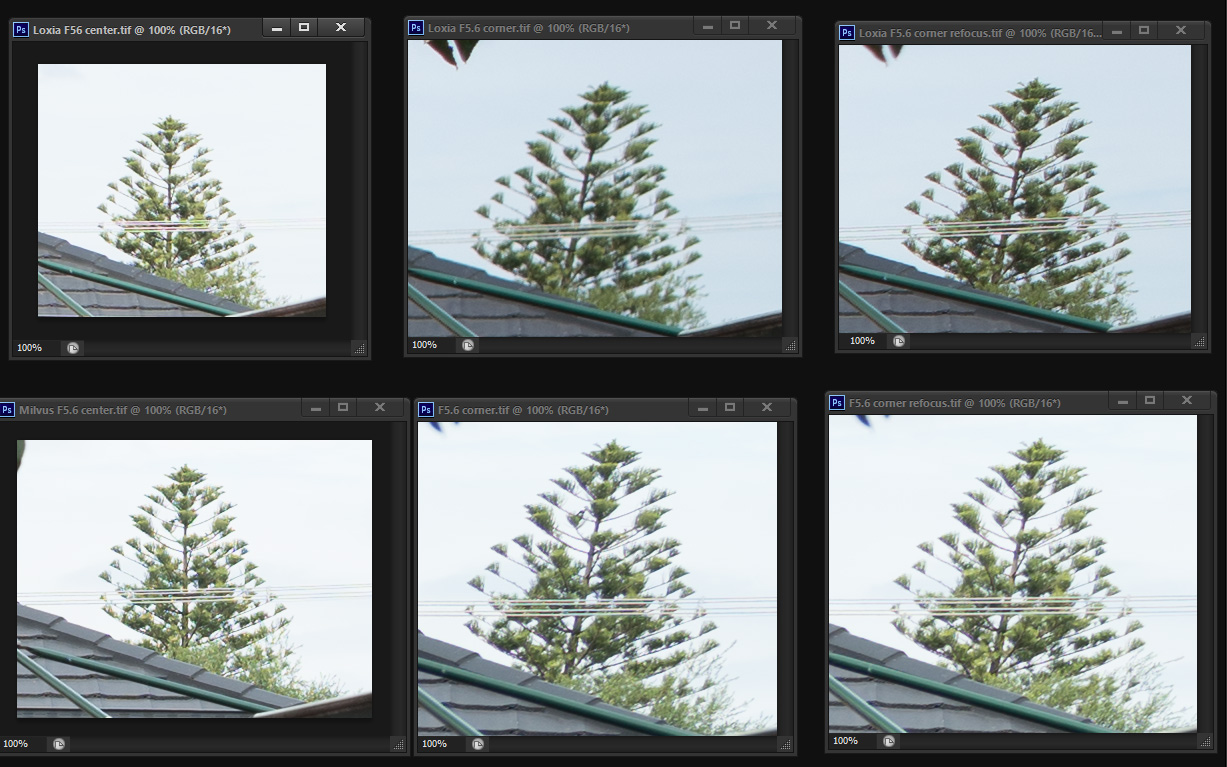
Top row is Loxia 21, bottom row is Milvus 25. The Milvus is the zf.2 version, adapted via a combination of redrock nik-eos and a (carefully shimmed) mirex eos-nex tilt-shift adapter (no tilt or shift applied).
Left most images are for a distant tree placed in the middle of the frame and manual focus optimally adjusted for that condition. Middle column is for the tree moved to the far top-right corner of the frame without adjusting focus. Right most column is for the same framing as the middle row, with focus readjusted to optimize corner focus to compensate for field curvature.
The Loxia has had the benefit of being the best of two trials of the procedure as the corner (without refocus) seemed softer than I expected on the first trial, despite taking care when focusing. The Milvus is from a single trial.
Mar 13, 2018 at 08:41 PM
p.1 #2Milvus 25 vs Loxia 21 @5.6 on A7R II
Thanks for the test. That's probably due to FC which is still evident even at f/5.6 for the Loxia. For me, the best corner resolution is achieved with the lens hard stop and the center a small tad before that. This may vary among different copies though.
My takeaway it that the Milvus is an incredible lens and it's more flat-field than the Loxia. Hopefully the new Loxia 25/2.4 will do better regarding field curvature but I am not hopeful.
Fred
My takeaway it that the Milvus is an incredible lens and it's more flat-field than the Loxia. Hopefully the new Loxia 25/2.4 will do better regarding field curvature but I am not hopeful.
Fred
Mar 13, 2018 at 10:11 PM
p.1 #3Milvus 25 vs Loxia 21 @5.6 on A7R II
First, thank you for doing this. It's ground truth on top of the MTF data, which we only have at 'best' apertures - CZ give Lloyd the full set that they deprive users of seeing.
[This 'CA fix always on' profiling bugs me no end. They will increasingly tailor the lens aberrations to the profile, effectively tying the lens to the camera series - not good in the long haul.]
A very lively lens is the Milvus 25mm. See the L21's heavier vignette even at f5.6 - corner illumination is a bit over 50% for the Loxia at f5.6 and over 70% for the Milvus (at f4). So that is one overlay. It's distortion pattern is also much better so the 'fix' for that will impact Loxia IQ. The lack of M25 curvature is surprising. Even with mag'n difference, it takes out center micro-contrast easily. Can see a little residual CA in L21 right side image. Very convincing roof detail M25 - one heck of a lens, all things considered.
Will you look at the soon-to-be-released Loxia 25mm? It will be closer (no pun intended). MTF indicates its outer frame will be even better at f5.6 than the M25 at f4, while giving up a little in the center (and same vignette as L21). Unlike the L21, its center actually improves stopped down to f5.6. But, you can see why CZ consistently assert bigger lenses are technically better; this is a very good result for a two stops faster lens, working far away from its intended purpose. It's much more pricey at $2400 (US) against $1500, which makes the Loxia 25/2.4 a very good deal at $1300.
[I imagine a modern Loxia 35/2 at 600 grams..]
Mar 13, 2018 at 10:11 PM
p.1 #4Milvus 25 vs Loxia 21 @5.6 on A7R II
Fred, yes my take away also. My Loxia behaves exactly the same way as yours. For critical sharpness across the frame at infinity I always take two shots as they are easy to stack because there's no motion of consequence at that distance. I was very impressed with the flat field of the Milvus. That's probably a big part of what makes it a well behaved lens for tilt also, so I have finally been able to replace my TS-E.
Philip, I agree the center micro contrast I have seen with the Milvus is phenomenal, and indeed confirms the very high mtf curves in that region. Combined with the flat field, the fact that I can use it tilted and that 24/25 is my favorite focal length anyway, they are reasons enough for me to justify the weight and cost of this lens even on small cameras. I do hope to compare it with the new Loxia 25 soon, but am a bit concerned I will end up wanting to keep both.
One thing I haven't tested thoroughly yet is focus shift, but I get the impression it too is very well behaved in the Milvus, which would make focusing in low light easier.
Mar 13, 2018 at 11:32 PM
p.1 #5Milvus 25 vs Loxia 21 @5.6 on A7R II
I thought I would add a short note about the comparative handling of the two lenses for anyone who is deciding between Milvus and Loxia.
Before getting the Milvus I never worried too much about the Loxias being a bit 'fiddly' to adjust in the field because everything is so small. But having had the Milvus for a while, I now notice that aspect of the Loxias more. Particularly the superbly damped heavier focus, and larger throw than the Loxia, make getting critical focus easier on the Milvus. On the Loxia I often find that releasing the focus ring on the lens has to be done very carefully to avoid slightly nudging its position, which can be very challenging in some conditions.
As an aside, I noticed on the Diglloyd website a comment about camera lens mount potentially suffering over time with a lens as heavy as the Milvus, But of course that's not an issue if you have your tripod mount on the adapter instead of the camera.
Mar 17, 2018 at 04:44 PM