This topic is in the 2018 archive. You can read it and like its posts here. It is read only.
Archive 2018Zeiss Loxia 25mm f2.4 is a distagon
p.4 #1Zeiss Loxia 25mm f2.4 is a distagon
My guess is that the 25 will be very close to APO, similar to 25 and 35 Milvus, and probably have as much blur as Batis 25 despite the speed handicap. Recent Zeiss wides lenses have had a lot of blur (Milvus 25, 35, Otus 28). Just a guess though.
Feb 09, 2018 at 01:31 PM
p.4 #2Zeiss Loxia 25mm f2.4 is a distagon
This should have less field curvature than the 21 is my guess.
Feb 09, 2018 at 01:43 PM
p.4 #3Zeiss Loxia 25mm f2.4 is a distagon
Fred Miranda wrote:
The Lox 25/2.4 is 1/2 stop slower than the Batis 25/2. Aside from rendering slightly less blur, do you guys think the OOF rendering will be as smooth as the Batis?
Based on the Lox 21/2.8 axial CA correction, I'm hoping the new 25mm will be better corrected than the Batis which is imo a major negative.
That is an interesting one: the ZF.2 25/2 distagon that I intend to replace with the Loxia, is very well corrected, well ahead of the 28 and 35 ZF.2 distagons, which were a bit of a CA nightmare on the Sony A7r(II). I fully expect the Loxia 25 to do as well as the Loxia 35 in this regard.
Chris
Feb 09, 2018 at 02:05 PM
p.4 #4Zeiss Loxia 25mm f2.4 is a distagon
DavidBM wrote:
Luvwine wrote
Fred Miranda wrote
nandadevieast wrote
By Zeiss logic, next lens could be a 29mm.
Seems pretty much inevitable: Zeiss has said their Canon/Nikon business has been declining but the growth in their Sony business has replaced it. Now, we have Canon and Nikon entering the full frame mirrorless market, as well. If Zeiss isn't making Otus tier lenses for mirrorless, well, that's tantamount to saying that Zeissc will no longer be making high end glass. Don't think that's happening!
Feb 09, 2018 at 02:29 PM
p.4 #5Zeiss Loxia 25mm f2.4 is a distagon
Yes, agree it will have more Milvus DNA certainly than the Batis 25mm. It's hard to conceive of two more different lenses at the same focal length. The 25/2.4 was commenced deep in the Loxia era, so it makes sense the engineers used lessons learned from their other prestigious (DSLR) lines evolving at that time. Having made the hard decision to relinquish the critical half stop (and taken a market hit for it), all they can do is produce the best performance possible within the constraints set for the range: cost/size/weight/filter etc.
Now this might be left field but CZ don't like taking a back seat. At 85mm they did something special to give the Loxia a place in the sun and they did it with a very simple design. I'm more critical than most, but admit it is quite a lens, and cannot be left behind. Here at 25mm, the Batis 25 has simply outstanding MTF in mid apertures despite it being more of an all rounder, intimate shooting, very short MFD and WA bokeh machine.
So this is the IQ CZ will have seen as a target and reference for themselves, and they may well have done something special. With rare exception, makers get better as the range evolves, they seem to 'find their feet' and get more support for off-center designs, confidence builds in the expected sales volumes. You will find this in the ZM (35/1.4) and especially the CY range where the real stars came late, during the 1990s (e.g. 21/2.8, 100-300). The Loxia 21mm is over two years old.
Feb 09, 2018 at 03:08 PM
p.4 #6Zeiss Loxia 25mm f2.4 is a distagon
philip_pj wrote:
Always amazes that there are no: range outlines, medium term plans, intended completion dates, forums for user feedback. Just: 'in two weeks this xx/f2.x is being released and BH/Ado will have it; it's good.'
Strange way to do business. A very different company to late last century when they were real tigers and made everything: CY/G/N/Blad. Maybe C/N entering MILC will give them a prod, they might rouse themselves and shake off their lethargy. Right now it's Rip Van Winkle activity levels - then again, he woke up after 20 years so there is still hope.
Very different times though. Possibly being much more cautious given the uncertainties of the future market's size/direction?
Edited on Feb 09, 2018 at 06:51 PM · View previous versions
Feb 09, 2018 at 03:24 PM
p.4 #7Zeiss Loxia 25mm f2.4 is a distagon
It seems that way, a lack of confidence in Sony to deliver a high end system maybe, and serious doubts about mirrorless as a dominant market force? Those Otuses and Milvuses must have cost a packet to develop, aimed squarely at the pro corner of the market - the very same people who are now making YT videos extolling the a9 and a7rIII, lol.
DSLRs down another 10% in 2017, MILC up 40%. It was easy to get this wrong back in 2013. These are already very different times, characterized by great changes in the market, all moving in our direction. They knew full frame would be the retreat position of the serious market once phones stabilized, but got the formats wrong. It happens.
It's not like CZ would have the foresight we have here.
Feb 09, 2018 at 05:33 PM
p.4 #8Zeiss Loxia 25mm f2.4 is a distagon
I agree with Danny's experience, in that my Loxia 35 is outstanding even wide open. Naturally, we are talking central imaging for sharpness and detail, and naturally, contrast and other matters improve as the lens stops down. But even wide open, the lens has sufficient contrast for broad middle distance subjects/scenes with OOF foreground/background, and is decent for close-up.
To add to Fred's list of positive attributes: Some owners respond that the Loxia 35 corners "never become sharp" or "don't sharpen until f/8 or smaller aperture". One of the first things to understand about the Loxia 35 is that is has moderate curvature of field. So, we really are in a plus/minus situation where the focus rolls forward noticeably on the edges. The plus is that subjects at longer distances have apparent enhanced DOF, which is very useful for a "longer" landscape focal length like 35mm. The minus is that as a result, the same scene or subject will never get sharp corners on areas approaching infinity distance objects, unless careful focusing slightly past the subject plane, then stopping down a little more than you might have been inclined, to achieve acceptable overall focus. Usually, the upper corners in the image contain little information, compared to lower corners that lead the viewer into the scene or subject. (Very rarely the overall scene will extend beyond the means of f/11 and careful focusing, and when such occurs, focus stacking is the technique to use.)
Personally, I like the mild curvature working to my advantage. In the past, I've been disappointed by Nikon manual retro-focus design WA's such as 24, 28, and 35, having very strong curvature, making it difficult to estimate without careful stopping down. The Loxia by comparison is a dream to use and gives me many great scenes at middle distance using f/4-8 without too much thought besides picking my focal point within the scene.
If I had my wish before buying any Loxia lenses, it would be for a 30mm f/2 lens for slightly wider AOV and slightly greater DOF and fitting closer to the Loxia 21. (That Pentax Limited 31mm makes more and more sense to me!) That's where the Loxia 28mm would fit in nicely, because I almost always crop a little toward 3x4 format and fix any tilt in the verticals, giving me around 30mm anyway!
I can't imagine getting rid of my Loxia 35, as it's my best all-around illustrative lens. But never say never!
Feb 10, 2018 at 12:37 PM
p.4 #9Zeiss Loxia 25mm f2.4 is a distagon
Gunzorro wrote:
I agree with Danny's experience, in that my Loxia 35 is outstanding even wide open. Naturally, we are talking central imaging for sharpness and detail, and naturally, contrast and other matters improve as the lens stops down. But even wide open, the lens has sufficient contrast for broad middle distance subjects/scenes with OOF foreground/background, and is decent for close-up.
To add to Fred's list of positive attributes: Some owners respond that the Loxia 35 corners "never become sharp" or "don't sharpen until f/8 or smaller aperture". One of the first things to understand about the Loxia 35 is that is has...Show more →
From my experience testing five Lox 35 lenses at infinity distance, the field curvature is not a simple curve. The center and edges are pretty much in the same plane while the mid-field is not. Therefore I agree that focusing is tricky and always a compromise.
The lens looks great at f/4 and f/5.6 at the edges but the very extreme corners of the image field need f/8 or smaller. The latter is not always visible in real images and therefore we see different opinions on this.
I can see a big bump in contrast and to a lesser degree in resolution from f/2 to f/2.8 mainly due to uncorrected SA. Wide open, it shows a slight "veil", which could be a plus or cons depending on your subject.
Feb 10, 2018 at 12:47 PM
p.4 #10Zeiss Loxia 25mm f2.4 is a distagon
But I remember when Loxia was first introduced that the description on the website said that Loxia would be offered in other mounts. The reason I noticed that part of the description was that I assumed CaNikon would get around to mirrorless. (I mean, mirrorless is nothing more than a digital movie camera). I assumed also that Zeiss would make it their business to be aware of Canon's and Nikon's product planning. So Zeiss probably can change the mount on the Loxia, and quickly engage 2 more markets.
CZ may not have the foresight we have here, but they've got better information.
CZ may not have the foresight we have here, but they've got better information.
Feb 10, 2018 at 12:53 PM
p.4 #11Zeiss Loxia 25mm f2.4 is a distagon
Fred Miranda wrote:
From my experience testing five Lox 35 lenses at infinity distance, the field curvature is not a simple curve. The center and edges are pretty much in the same plane while the mid-field is not.
+1
The field curvature of the Loxia 35 is really strange. It seems shaped like a Gauss bell-curve ("dome"), with a bulge towards infinity in the middle. But I'm not entirely sure it's only FC. DOF sometimes seems greater in the middle of the frame, than at mid-field. Perhaps due to the thick filter stack of the Sony sensors?
Edit: I seldom shoot stopped down at infinity, but I've seen this many times when shooting at 3-5 meter distance, and f/2.8-5.6 or so.
Feb 10, 2018 at 01:43 PM
p.4 #12Zeiss Loxia 25mm f2.4 is a distagon
https://www.personal-view.com/talks/discussion/18823/25mm-f2.4-loxia-lens?Sort=newest
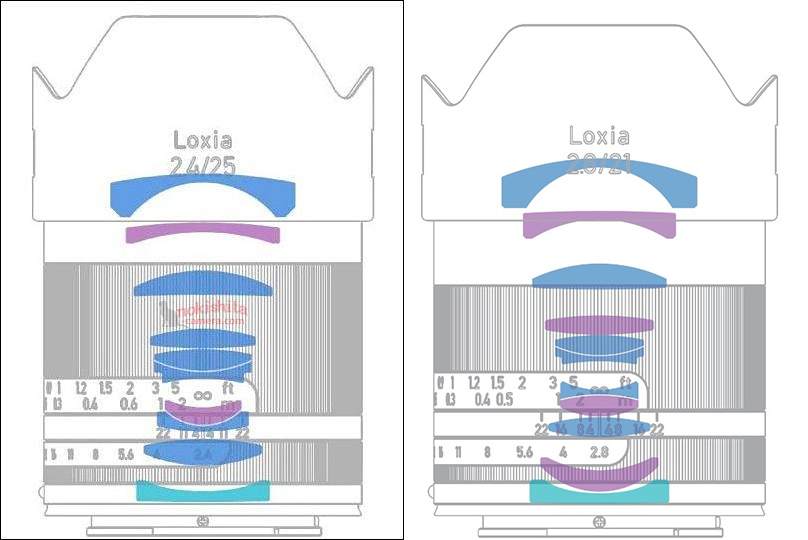
No idea if this is the final design, but it looks legit as compared with Zeiss data sheets. If so, it's a 10/8 very close to the Loxia 21mm, but dispenses with the second last element in the L21's 11/9 array. It also is indicated as having two fewer APD elements (4>2), and near identical everything else: MFD, length/diameter, filter (of course).
No idea if this is the final design, but it looks legit as compared with Zeiss data sheets. If so, it's a 10/8 very close to the Loxia 21mm, but dispenses with the second last element in the L21's 11/9 array. It also is indicated as having two fewer APD elements (4>2), and near identical everything else: MFD, length/diameter, filter (of course).
Feb 11, 2018 at 03:15 PM
p.4 #13Zeiss Loxia 25mm f2.4 is a distagon
Curious. I find 24/25mm just above infamous wide-angle distortion concerns. Might the Zeiss Loxia 25 be my first Loxia lens ? Anxious to see what this lens can do or not.
Feb 11, 2018 at 05:51 PM
p.4 #14Zeiss Loxia 25mm f2.4 is a distagon
philip_pj wrote:
https://www.personal-view.com/talks/discussion/18823/25mm-f2.4-loxia-lens?Sort=newest
No idea if this is the final design, but it looks legit as compared with Zeiss data sheets. If so, it's a 10/8 very close to the Loxia 21mm, but dispenses with the second last element in the L21's 11/9 array. It also is indicated as having two fewer APD elements (4>2), and near identical everything else: MFD, length/diameter, filter (of course).
Nice description Philip. I placed both optical designs side-by-side:
Loxia 25/2.4 left | Loxia 21/2.8 right
https://www.personal-view.com/talks/discussion/18823/25mm-f2.4-loxia-lens?Sort=newest
No idea if this is the final design, but it looks legit as compared with Zeiss data sheets. If so, it's a 10/8 very close to the Loxia 21mm, but dispenses with the second last element in the L21's 11/9 array. It also is indicated as having two fewer APD elements (4>2), and near identical everything else: MFD, length/diameter, filter (of course).
Nice description Philip. I placed both optical designs side-by-side:
 |
||
 |
||
|
Loxia 25/2.4 left | Loxia 21/2.8 right
Feb 11, 2018 at 05:57 PM
p.4 #15Zeiss Loxia 25mm f2.4 is a distagon
Is this thing going to be announced tomorrow?
Feb 13, 2018 at 10:45 AM
p.4 #16Zeiss Loxia 25mm f2.4 is a distagon
I’ll let you know tomorrow Fred! 🤪👍🏻
Fred Miranda wrote:
Is this thing going to be announced tomorrow?
Fred Miranda wrote:
Is this thing going to be announced tomorrow?
Feb 13, 2018 at 11:06 AM
p.4 #18Zeiss Loxia 25mm f2.4 is a distagon
Hmmmm who will get this lens first Fred or Guy? 
Feb 13, 2018 at 11:52 AM
p.4 #19Zeiss Loxia 25mm f2.4 is a distagon
LBJ2 wrote:
Hmmmm who will get this lens first Fred or Guy?
I will probably get a loan and test it out. Mainly compare it to the Loxia 21/2.8.
Guy will definitely get it. He does not skip new releases. 
Hmmmm who will get this lens first Fred or Guy?
I will probably get a loan and test it out. Mainly compare it to the Loxia 21/2.8.
Guy will definitely get it. He does not skip new releases.
Feb 13, 2018 at 11:54 AM
p.4 #20Zeiss Loxia 25mm f2.4 is a distagon
Fred Miranda wrote:
I will probably get a loan and test it out. Mainly compare it to the Loxia 21/2.8.
That would be excellent Fred. I believe there is a lot of interest in comparing those two lenses.
LBJ2 wrote
Hmmmm who will get this lens first Fred or Guy?That would be excellent Fred. I believe there is a lot of interest in comparing those two lenses.
Feb 13, 2018 at 12:03 PM