Daan B wrote:
Of course the systems are rather different (MF mirrorless vs FF DSLR). Especially considering features like AF, performance and so on. Plus the Fuji can take all kinds of glass. That is a given and not the point I am trying to make.
I would expect to see a difference in tonality, DR and noise.
The DR and tonality of the D810/850 is already awesome at ISO64. I doubt the Fuji will be much better. It isn't what I am seeing anyway. And online reviews seem to agree with this.
Maybe the high ISO noise is better on the Fuji? Difference between APS-C and FF is usually about one stop. I doubt the Fuji will be one stop better at high ISO than the D850.
Well, if someone could prove otherwise, please do. I have nothing against the Fuji. I was considering one myself. But it is 2 tot 3 times as expensive as the D850, but not 2 to 3 times better (or different) in file output. With that in mind, it seems not logical to prefer the Fuji over the Nikon. YMMV of course. ...Show more →
From my experience with X series I'm sure Fuji will try and innovate in software to create features that will make it a high quality photographer friendly camera that's pleasing to shoot with. I can't see what the hard IQ differences will be either since I have neither of these cameras. But I do think Fuji is suffering from Sony sensor jail just like Nikon was before D850. Sony has under delivered on aps-c and MF sensors and had protectionist policies about who gets to use the latest and greatest tech on FF sensors. I've heard Nikon like Leica designed their own sensor and I think that's part of the D850's strong specs. They're not dictated by Sony. So I think that Fuji will have to consider that going forward as the Sony sensor their using is really a generation behind. Don't get me wrong I think it's a great camera that a lot of professionals will be happy using but Sony specs their sensors to protect their own Alpha series cameras.
Daan B wrote:
Of course the systems are rather different (MF mirrorless vs FF DSLR). Especially considering features like AF, performance and so on. Plus the Fuji can take all kinds of glass. That is a given and not the point I am trying to make.
I would expect to see a difference in tonality, DR and noise.
The DR and tonality of the D810/850 is already awesome at ISO64. I doubt the Fuji will be much better. It isn't what I am seeing anyway. And online reviews seem to agree with this.
Maybe the high ISO noise is better on the Fuji? Difference between APS-C and FF is usually about one stop. I doubt the Fuji will be one stop better at high ISO than the D850.
Well, if someone could prove otherwise, please do. I have nothing against the Fuji. I was considering one myself. But it is 2 tot 3 times as expensive as the D850, but not 2 to 3 times better (or different) in file output. With that in mind, it seems not logical to prefer the Fuji over the Nikon. YMMV of course. ...Show more →
Why would anyone buy MF for high iso noise?
As I stated earlier, you can't even tell the difference between APS-C and FF on the internet with compressed JPEGS at 1080px wide. I am not saying there is no difference in the original or final files, just that one can not generally see them on the internet when compressed and downsized.
Why then would you expect to see a difference on the internet with MF? How do you propose that someone explains or even proves some sense of superiority over the internet?
Just as FF files are typically going to have superior IQ traits to APS-C, MF is going to have superior IQ traits to FF. It is a larger sensor. Even when comparing another 50MP FF sensor, the GFX will have larger pixel sizes, capable of obtaining more light (think A7S for FF). If you don't get any of this, then don't pay big money for MF. It is fine and your images can still be great.
Maybe FF is plenty good enough for you. APS-C happens to be plenty good enough for me. But I that does not mean that I am misguided enough to claim that no meaningful difference exists between the two.
drewmey wrote:
Why would anyone buy MF for high iso noise?
Street photography for example.
As I stated earlier, you can't even tell the difference between APS-C and FF on the internet with compressed JPEGS at 1080px wide. I am not saying there is no difference in the original or final files, just that one can not generally see them on the internet when compressed and downsized.
Why then would you expect to see a difference on the internet with MF? How do you propose that someone explains or even proves some sense of superiority over the internet?
Fair enough... making a comparison based on internet resolution isn't ideal.
I do have enough experience with D810 files first hand though. And I have played with some GFX50 files. And with direct comparisons (like in the beginning of this thread) there are things you can see even at lower resolutions. The pictures in this thread kind of confirm what I had already seen.
Just as FF files are typically going to have superior IQ traits to APS-C, MF is going to have superior IQ traits to FF. It is a larger sensor. Even when comparing another 50MP FF sensor, the GFX will have larger pixel sizes, capable of obtaining more light (think A7S for FF). If you don't get any of this, then don't pay big money for MF. It is fine and your images can still be great.
I do get the theory. In the real world there are other things to consider. For example, not all FF sensors give the same output for tonality, DR and so on. Comparing the Canon 5Dsr and Nikon D850 will show huge differences. When comparing a previous gen MF sensor to a current gen FF sensor, the differences may be small(er).
Maybe FF is plenty good enough for you. APS-C happens to be plenty good enough for me. But I that does not mean that I am misguided enough to claim that no meaningful difference exists between the two.
Daan B wrote:
Try me... oh wait... that isn't possible of course and you are cursing your way out of it. haha. Who is the sad one here? Never mind Molson
Try it yourself - go out and rent or buy the camera and see for yourself. Put your money where your mouth is, instead of trolling other forums making stupid comments.
But you won't do that, will you? You seem unwilling to look objectively at the examples that are all around you, because you aren't really interested in the Fuji GFX - you're just trying to compensate for your fanboy insecurity by belittling other people's work.
Daan B wrote:
Great shots in here. However, I don't see anything different from what a DSLR like the Nikon D810/850 with good primes will produce (DR, DOF, overall look of image).
I think that is a legitimate question. Here's an interesting discussion in a review of the GFX 50S review: https://photographylife.com/reviews/fuji-gfx-50s
He did a head to head comparison with the Hasselblad and the highly regarded Nikon D810. He found that the Fuji did provide some significant advantages regarding IQ.
The D810 is a fine camera and much more versatile than the GFX. I would consider it a niche camera, appealing to certain photographers with specific needs. I doubt we can appreciate the differences here on the internet, but I'm willing to bet that when viewing a 30x40 print the difference would be significant.
To put things in perspective, I compared the price of the GFX to a Leica M10. The Fuji body is cheaper and so are the lenses. I know they aren't the same kind of cameras, but I actually considered buying the M10 at one point. My dream system would be combination of Fuji X and GFX cameras and lenses.
dmacmillan, thanks for posting the link. Very helpful
Interesting to see that the GFX can take a lot of beating in post (exposure +4) and still produces great IQ. The noise advantage over the D810 is there too, but only by a small margin.
I was already spoiled by the D810 ISO64 DR performance when comparing it to Canon sensors. It is good to know that it can even be better with the GFX50 sensor.
I will investigate this further
In pratical terms:
- how does the GFX stack up against the D850 for DR and noise?
- do I need even better DR than the D810/D850 provides? For me the main concern is exposing for the mid tones and bringing back highlights and open up shadows to cope with high contrast situations. Exposure pushed of +4 are not common.
- I would use the GFX mostly for interior/product/studio portraiture shooting - will the GFX make a difference compared to the D810/850? I guess it also depends on the available lenses.
- AF in a dark studio must be great. Will the GFX be able to keep up?
Daan, too bad you aren't in th US! You could rent the GFX from LensRentals and give it a good test. I don't know if you have somewhere to rent in the Netherlands. Maybe you could find an official Fuji X photographer who could hook you up.
Daan B wrote:
dmacmillan, thanks for posting the link. Very helpful
Interesting to see that the GFX can take a lot of beating in post (exposure +4) and still produces great IQ. The noise advantage over the D810 is there too, but only by a small margin.
I was already spoiled by the D810 ISO64 DR performance when comparing it to Canon sensors. It is good to know that it can even be better with the GFX50 sensor.
I will investigate this further
- AF in a dark studio must be great. Will the GFX be able to keep up?
As far the AF the sensor they sourced from Sony does not have phase detect so you'll have contrast detect only. So D850 has the better AF with the D5 system. But in your case doing interior/product/studio I think you could get away with it if you get reasonable image quality benefits in return. I would rent it and try it. I think interior/product/studio/landscape are areas the GFX would really shine in even with contrast detect only AF due to sensor. Particularly if you crop down the 4:3 or 1:1 a lot. Cropping down on 3:2 sensors to 1:1 and 4:3 throws away a lot of the sensor area. I think someone calculated in another thread that cropping down to 3:2 on the GFX you still get more sensor area than on FF. This really depends on your personal style.
dmacmillan wrote:
Daan, too bad you aren't in th US! You could rent the GFX from LensRentals and give it a good test. I don't know if you have somewhere to rent in the Netherlands. Maybe you could find an official Fuji X photographer who could hook you up.
BTW, we were in Amsterdam last year and loved it!
Regards, Doug
Unfortunately, I haven't been able to find a rental service that has the Fuji GFX50s. Maybe I will contact the Fuji importer over here to see if they can help me out.
Amsterdam is a great place! Especially fun for street photography IMO. And there is some nice old architecture as well.
rbf_ wrote:
As far the AF the sensor they sourced from Sony does not have phase detect so you'll have contrast detect only. So D850 has the better AF with the D5 system. But in your case doing interior/product/studio I think you could get away with it if you get reasonable image quality benefits in return. I would rent it and try it. I think interior/product/studio/landscape are areas the GFX would really shine in even with contrast detect only AF due to sensor. Particularly if you crop down the 4:3 or 1:1 a lot. Cropping down on 3:2 sensors to 1:1 and 4:3 throws away a lot of the sensor area. I think someone calculated in another thread that cropping down to 3:2 on the GFX you still get more sensor area than on FF. This really depends on your personal style....Show more →
For interior/product I use manual focus 95% of the time. So that won't be an issue. But for studio portraiture I am not so sure. It can be quite dark in the studio sometimes. I saw some online reviewers say that the Fuji GFX AF isn't great in low light. Commercial work is a lot of 3:2 in my case (magazines for example).
Oct 29, 2017 at 07:37 AM
Steve Spencer Offline • • • • • • • Upload & Sell: On
Daan B wrote:
dmacmillan, thanks for posting the link. Very helpful
Interesting to see that the GFX can take a lot of beating in post (exposure +4) and still produces great IQ. The noise advantage over the D810 is there too, but only by a small margin.
I was already spoiled by the D810 ISO64 DR performance when comparing it to Canon sensors. It is good to know that it can even be better with the GFX50 sensor.
I will investigate this further
In pratical terms:
- how does the GFX stack up against the D850 for DR and noise?
- do I need even better DR than the D810/D850 provides? For me the main concern is exposing for the mid tones and bringing back highlights and open up shadows to cope with high contrast situations. Exposure pushed of +4 are not common.
- I would use the GFX mostly for interior/product/studio portraiture shooting - will the GFX make a difference compared to the D810/850? I guess it also depends on the available lenses.
- AF in a dark studio must be great. Will the GFX be able to keep up?
The D850 has pretty much exactly the same DR as the D810, so you have seen that comparison. For noise the D850 is a little better than the D810, but not by much. The GFX will still be better by about a half to a full stop (DXO measures the Hassy X1D, which has a very similar sensor to the GFX, as being a half stop better than the the D850 and Bill Claff's website measure the GFX as having about a stop better high ISO noise than the D850).
Only you know whether you need better DR than the D810/D850? More DR does mean opening up shadows more and/or bring back highlights, so you need to decide whether that would help your photography.
Product shooting can done very well for the GFX particularly with the Cambo Actus with allows great control over camera movements, but it can be done well with a similar system and a Nikon camera, but the Nikon may need to be supplemented with wide tilt/shift lenses. Those systems can work well for interiors too. For portraits with the right lenses you can get very shallow depth of the field if you want it on the GFX and you can shoot with leaf shutter lenses that you cannot use on the Nikon. Either of these things may or may not be something you would be interested in.
I haven't used the GFX in a dark studio, so I don't know how it would perform and I actually don't use AF at all with my GFX, but I suspect you would need to alter the way you shot in the studio if you had a GFX, but that with modifications I think it could be used quite well in studio.
I have both D850 and GFX (and D810 previously). If I can only have one camera and one system, I do think that D850 is a more complete and more capable camera for various task since I do a bit of everything, landscape, portrait, wildlife, sports, underwater (yeah, my D850 underwater housing just arrived in time for my trip this week). I do prefer D850 WB and color over GFX (personal preference, mind you).
Personally, I hate the way GFX handle shadow and black. It requires more effort to pull out detail in the shadow than A7r ii, D810/D850 but in the end, the file is so malleable that I don't feel like I lose anything, just require a bit more work.
However, looking on my 4k 43inch monitor, the amount of resolution and fine detail of GFX is quite amazing. As good as D850 and A7r ii are, GFX is better still. Part of it could also be the excellent Fuji glasses which really has no weakness and will compare very well with Otus glasses. But using the same lens, I will still give an edge to GFX. The picture on the web does not really do justice to GFX (or D850 for that matter) but if you have the NEF and RAF file side by side, you will appreciate both cameras more. The difference in IQ, whether it is worth the extra expense, that's an individual choice. In low light, GFX AF will suffer just like any CDAF based mirrorless camera. Unfortunately there is no getting around that. For portrait, it is hard to beat GFX with 110/2 but D850 with 105/1.4 and 58/1.4 will give a compelling alternative for quite a bit less money.
PS tilted EVF on GFX is a major plus. For the first time, I can wear sunglasses and use GFX outside in broad daylight and can still see EVF clearly. A major annoyance for using EVF for me.
PSS DR is not something that I worry much between these 2 systems. Both are comparable and in practice, I don't think I ever had a picture that was ruin by one system for less DR than the other. Low light situation, I do prefer D850 a bit though. AF is much better and Nikon has so many more options for fast glasses. While I can adapter many fast glasses for GFX, there is no really a lot of choice at wide angle end. Also, sensitivity of iso 1600 is not the same on both camera. I think Fuji iso is a bit misleading and its iso in term of light sensitivity is actually a bit lower than Nikon, I think.
Daan B wrote:
Unfortunately, I haven't been able to find a rental service that has the Fuji GFX50s. Maybe I will contact the Fuji importer over here to see if they can help me out.
Amsterdam is a great place! Especially fun for street photography IMO. And there is some nice old architecture as well.
My experience with the contrast only AF comes from using my XE1 so I would not take this as representative of what the GFX can do as it's been improved in many ways. In fact I heard they got eye AF working on it and my AF system never got the big X-T1 AF FW upgrade (4.). I found on the XE1 that AF would slow down in low light and hunt for focus lock. But it was very generally very accurate. I shot low light events with it informally and was able to make it work and got a lot of nice shots. The one issue I did have with it was a couple of shots where I was focusing with the center point in low light, it locked on the face and I took a few shots. One or two of them it inadvertently focused on the background behind the subject. I think the background was high contrast and well lit. Those are the only issues I had with the XE1 AF system, it slowed down in low light and was generally accurate. But there was that one time it locked and focused on a high contrast background rather than subject. That's why I would recommend you try the GFX AF out as it's been improved a lot over from the years from the contrast only AF I used.
A lot of it will come down to the lens motors as well. Certain lens motors are faster and I think the GFX is using the newer LM motors but some lens designs require older ones so performance varies per lens too as with all systems.
I'm tempted (again) by the GFX. Now that it has been out for quite a while, what are the main advantages/disadvantages of the camera? With this camera, 95% of my shooting would be tripod mounted landscape shooting. Most scenes I tend to shoot a bit wider - maybe 16-21mm usually. I don't shoot much (any?) wildlife or scenes that require longer lenses. I'm heavily invested in the Sony system and am looking to buy the A7RIII. BUT, I am not brand loyal and the GFX looks very tempting. Any feedback would be appreciated!
Quote from Daan:
"Unfortunately, I haven't been able to find a rental service that has the Fuji GFX50s. Maybe I will contact the Fuji importer over here to see if they can help me out."
Hi Daan,
You might try CameraTools in Apeldoorn. They are an official Fujifilm Expert Center and GFX dealer and do have a rental program. I just checked their website and they have a GFX lens for rent but the GFX body is not mentioned.
In my experience it is certainly worth giving them a call. That way I was able to rent a system that was not yet on their website. Especialy now with the big promo that Fujifilm is running for the GFX system, I would be surprised if you cannot rent the GFX.
Gary Clennan wrote:
I'm tempted (again) by the GFX. Now that it has been out for quite a while, what are the main advantages/disadvantages of the camera? With this camera, 95% of my shooting would be tripod mounted landscape shooting. Most scenes I tend to shoot a bit wider - maybe 16-21mm usually. I don't shoot much (any?) wildlife or scenes that require longer lenses. I'm heavily invested in the Sony system and am looking to buy the A7RIII. BUT, I am not brand loyal and the GFX looks very tempting. Any feedback would be appreciated!
Gary,
The major advantages for your type of shooting is that the camera has both excellent resolution and DR for the type of shooting you do. The native lenses are also very good. For your type of shooting the Fuji 23 would be a very good lens. If you shoot in 3 X 2 aspect ratio or a skinnier rectangle it is about like a 19mm f/3.2 lens, and if you shoot in 4 X 3 or squarer it is about like a 17mm f/2.9, so should be right in the ball park of what you like to shoot. I love the tilting EVF for composition and it works great on a tripod. I also really like how easy the camera is to operate. Finally, I think it is a system that still is going to grow a lot and in the next few years. Over the next generation or two we can bet it will go to a 100 megapixel sensor and then the gains in IQ are likely to be a bit more noticeable.
I think the major drawback is that there are no zoom lenses for the camera in your shooting zone. I did see someone did surgery on a Canon 11-24 and got it to work, but it didn't look like it was for the faint of heart. There are a couple of other lenses you could adapt (the Canon TSE 24L, the Hassy 24 HCD, the Hassy 28 HCD, the SK 28 tilt/shift) but I don't think the 24mm options probably make a lot of sense it probably makes more sense to go with the Native Fuji. Personally, I have the Hassy 24 HCD, which is excellent, but I doubt it is better than the Fuji other than that it has a better manual focus experience, which matters to me. Getting a 28mm lens might well make sense as a complement to the Fuji 23 or one of the 24mm lenses.
Beyond the no zooms issue, which doesn't bother me, the two drawbacks I think are size and cost. Other than that I don't see any drawbacks for your type of shooting.
All that said, I also think the gains over using a Sony A7r II or III would be small in IQ. I actually think the tillable EVF and easy of use I value more than the small gains in IQ. So, you will have to decide whether it is worth it to you. If you do get one, just don't expect huge gains in IQ at least for now.
Steve Spencer wrote:
Gary,
The major advantages for your type of shooting is that the camera has both excellent resolution and DR for the type of shooting you do. The native lenses are also very good. For your type of shooting the Fuji 23 would be a very good lens. If you shoot in 3 X 2 aspect ratio or a skinnier rectangle it is about like a 19mm f/3.2 lens, and if you shoot in 4 X 3 or squarer it is about like a 17mm f/2.9, so should be right in the ball park of what you like to shoot. I love the tilting EVF for composition and it works great on a tripod. I also really like how easy the camera is to operate. Finally, I think it is a system that still is going to grow a lot and in the next few years. Over the next generation or two we can bet it will go to a 100 megapixel sensor and then the gains in IQ are likely to be a bit more noticeable.
I think the major drawback is that there are no zoom lenses for the camera in your shooting zone. I did see someone did surgery on a Canon 11-24 and got it to work, but it didn't look like it was for the faint of heart. There are a couple of other lenses you could adapt (the Canon TSE 24L, the Hassy 24 HCD, the Hassy 28 HCD, the SK 28 tilt/shift) but I don't think the 24mm options probably make a lot of sense it probably makes more sense to go with the Native Fuji. Personally, I have the Hassy 24 HCD, which is excellent, but I doubt it is better than the Fuji other than that it has a better manual focus experience, which matters to me. Getting a 28mm lens might well make sense as a complement to the Fuji 23 or one of the 24mm lenses.
Beyond the no zooms issue, which doesn't bother me, the two drawbacks I think are size and cost. Other than that I don't see any drawbacks for your type of shooting.
All that said, I also think the gains over using a Sony A7r II or III would be small in IQ. I actually think the tillable EVF and easy of use I value more than the small gains in IQ. So, you will have to decide whether it is worth it to you. If you do get one, just don't expect huge gains in IQ at least for now....Show more →
Thanks Steve - truly appreciate your thorough input. I would love to have something equivalent to a 16-35mm f/2.8 but that may take some waiting. With all the mountains I shoot, I often prefer say 14mm or 16mm but am trying to shoot longer FL's a bit more. Do they have a lens release roadmap for the GF lenses? Just wondering what is in the future... The tiltable EVF and overall ruggedness appeal to me. Thanks again - really appreciate it.
Steve Spencer wrote:
For your type of shooting the Fuji 23 would be a very good lens. If you shoot in 3 X 2 aspect ratio or a skinnier rectangle it is about like a 19mm f/3.2 lens, and if you shoot in 4 X 3 or squarer it is about like a 17mm f/2.9, so should be right in the ball park of what you like to shoot.
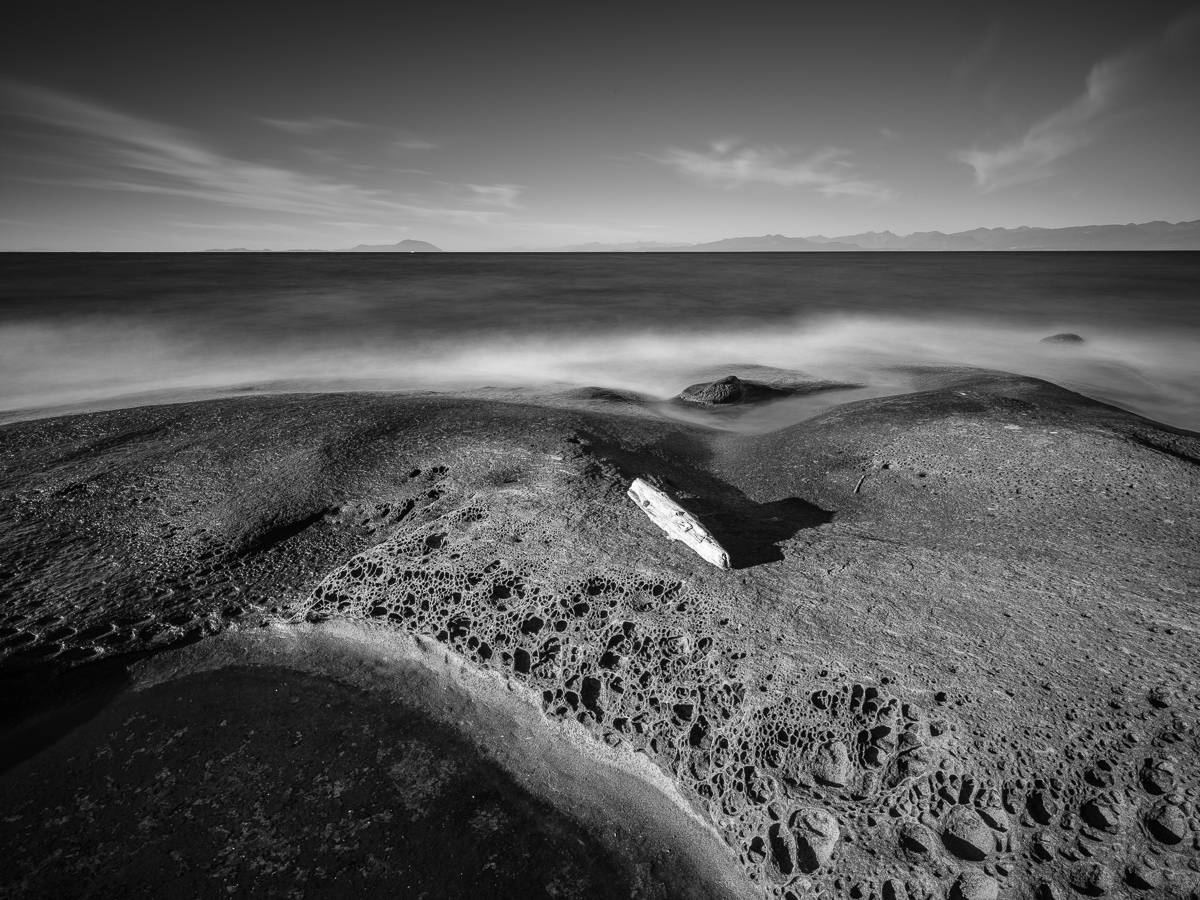
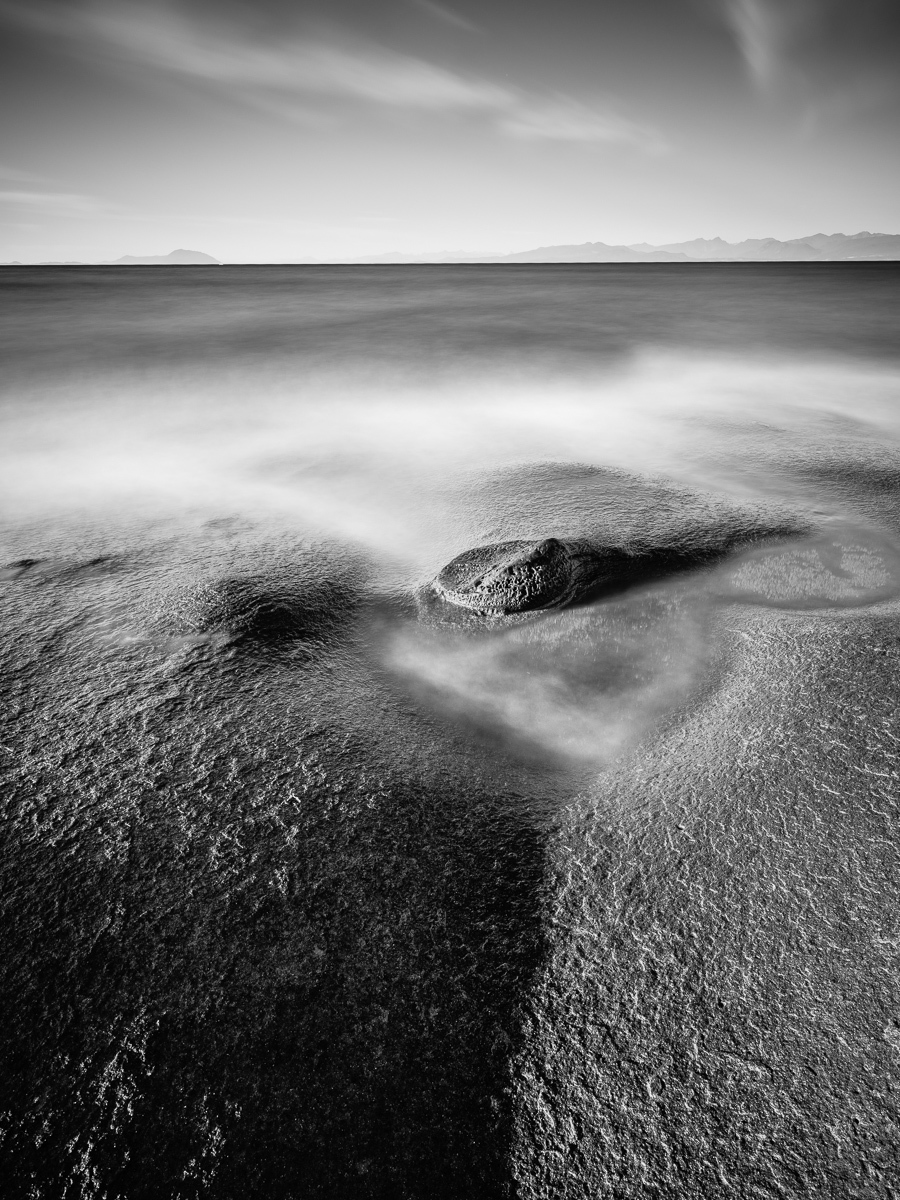
One characteristic of the medium format cameras that's hard to get across in small web images is the different perspective you get using longer focal length lenses. With a wide lenses like the 23mm f4, you can capture a wide view without diminishing the size of your foreground subjects as much as you would with an equivalent angle of view on a miniature-format camera.
For example, in the vertical image I posted above (Gabriola Shoreline II) I would have needed an 18mm lens on my A7R II to get the same angle of view, but in order to keep the round rock the same size in the image, I would have needed to get a lot closer to it - and in this instance, I would have gotten wet.
This perspective change is inherently neither good not bad, just different... but the more I get used to it, the more I like it.