The late Zeiss' Dr Hubert Nasse admitted that the Zeiss 135/2 APO was one of the best lenses ever designed. (around 31:30s...but I recommend watching the entire interview!)
An OTUS without the label. From the samples I've seen, the Batis 135/2.8 is even better color corrected. If anyone owns both lenses and disagree, please correct me if I'm wrong.
I agree on the CV 65 APO + Batis 135 APO combo for outstanding IQ. Perhaps close to Otus level in a slower but much more compact native package.
By "Otus level" I mean superb CA correction (no color fringing) and outstanding resolution and contrast from center to the very edges wide open.
The late Zeiss' Dr Hubert Nasse admitted that the Zeiss 135/2 APO was one of the best lenses ever designed. (around 31:30s...but I recommend watching the entire interview!)
An OTUS without the label. From the samples I've seen, the Batis 135/2.8 is even better color corrected. If anyone owns both lenses and disagree, please correct me if I'm wrong.
I agree on the CV 65 APO + Batis 135 APO combo for outstanding IQ. Perhaps close to Otus level in a slower but much more compact
native package.
By "Otus level" I mean superb CA correction (no color fringing) and outstanding resolution and contrast from center to the very edges from wide open.....Show more →
I own both lenses ( I meant to sell the 2/135 but I do like f2 ocassionally ) and agree the Batis is even better corrected for LoCA, and slightly better for flare, other than that they look astonishingly similar at shared apertures.
Agree Fred. I think across the frame the 135 has the edge. Beautiful corners even wide open and even across the frame with no dips. Truly outstanding and I tend to think and I need to shoot it more the VC 65 at F2 on center is equal to the 135 on center so the 65 gets the center edge and the corners are good at F4. Which makes me think the VC could have a very slight lens curvature over the 135. You may want to look for that in your tests
Need to shoot it more but for the money it's a dream and glad I waited for it.
GMPhotography wrote:
Agree Fred. I think across the frame the 135 has the edge. Beautiful corners even wide open and even across the frame with no dips. Truly outstanding and I tend to think and I need to shoot it more the VC 65 at F2 on center is equal to the 135 on center so the 65 gets the center edge and the corners are good at F4. Which makes me think the VC could have a very slight lens curvature over the 135. You may want to look for that in your tests
Need to shoot it more but for the money it's a dream and glad I waited for it.
I'm really interested in the 1.2/40. I'm sure it won't be the technical tour de force Tour de force of the 65mm: it's just too small for an f1.2. So it's going to have some LoCA and I'll bet it'll be unsharp off axis at wide apertures.
BUT
If it's decently sharp in central areas wide open, and CA etc is no too bad, it could still be very tempting. I love the 40mm angle of view, but there's never been a way to get much separation at 40 (except for cvs own 1.4/40 which is terrible, er I mean characterful, on Sony).
F1.2 on 40mm gives you similar blur to f1.4 at 50, and f2.4 at 85mm, so is not absurdly fast but rather a really useful look for, say, environmental portraits with a bit of recognizable but blurred background (and it'll give noticeably more blur than a 1.4/35).
If it turns out to be sharp across the field at f8 with good flare control, then with it's ten bladed aperture and probably nice sunstars, that'll be the icing on the cake - a useful landscape lens as well.
But it might be not that great, and be a touch too compact for good enough performance at f1.2. So I really is one of those lenses to watch...
Gary Clennan wrote:
Sharpness looks great but it has that signature jittery VC bokeh wide open...
+1 for jittery/busy/ugly boke
Phillip forest scenes all show pretty awful boke and Guy's frontal shot of car @ f/2 as well + many other f/2 samples, which are not "flower scenario" (=close subject, relative far background) or "urban simple boke scenarios" (=scenes where background is relative far and lacks structure and large texture).
This is typical to majority of lenses wide open, nothing new under the sun. The real question is how much stopping down is needed for the boke to smooth out?
Typically good * f/2 lenses, e.g. APO-Sonnar 2/135, ZM 2/35 (with suitable sensor cover glass/correction filter), require closing down 1 1/3 stops (=f/3.2) to produce smooth boke.
* = good from boke perspective, pixel peeping gets 100% irrelevant in my opinion if 1000px wide webthumbnail already sucks badly due to ugly boke, why anybody would like to see closer/larger?
Getting slightly interested about this lens as there is no great 28mm lens at the moment, but there are multiple good 35mm (FE1.4, ZM2/Loxia35, ZM1.4 and maybe the new Milvus 1.4, thou there is risk they ruined boke with too much focus on sharpness etc. pixel peeping qualities). Shooting 3-4 lens combos with 35mm do not work well in practice; "hole" from 35mm to 85/90mm is too wide for me and 50mm & 35mm are too close to each another, and 135mm is "too close" to 85/90mm, and also jump from 35mm to 21mm is mostly too big. 21-35-85-135 seemed good idea, but now shooting it in real life has changed my opinion. This lens would partially solve the middle/tele spacing issue, and on wide end 25mm & 35mm work better together than 21mm & 35mm.
Re: 40/1.2 - IIRC, someone here (or one of the forums) was at CPP+ and posted some test shots with the 40/1.2 shot on the a7II. I just had a look through them again and my thoughts are the background rendering is not busy like their 40/1.4. OOF background specular highlights have a slight ring edge to them, but nothing terrible. The lens's character reminds me more of the CV 50/1.5 or 35/1.7 than the 40/1.4 with some aspects of background rendering reminding me of the ZM35/1.4. There is some hint at possible onion ring, but it's slight and not in all OOF speculars. OOF foreground rendering seems harsher than background rendering, but I've seen this with a number of other lenses before, so it's probably a tradeoff. There's 'bokeh fringing' evident in front and behind the plane of focus. CA seems minimal in the plane of focus. There's a noticeable amount of SA in the plane of focus wide open and cleans up pretty much by f/2. Though I wouldn't classify the lens as crazy sharp at f/2, it's definitely very good. The wide open SA adds a nice amount of smoothness to character without also making everything look too soft. Difficult to judge across-frame stopped down performance from the samples, but it seemed reasonable. Maybe not great all the way into the corners, but still good. Sunstars are very defined 10 points.
Guess this Bokeh thing is very subjective as I like the bokeh on the front of the car shot. I have more series of images stopping down. I'll post later and I still want to get out up to my junkyard in Jerome this weekend .
I try to have one or two lenses that are good at Bokeh . Right now I have the FE 35 1.4
Now I'm testing in harsh conditions too. Maybe with softer light which is rare here
I also look at sharpness a little differently where as it creates a 3D look so not always about pure resolution.
GMPhotography wrote:
Guess this Bokeh thing is very subjective as I like the bokeh on the front of the car shot. I have more series of images stopping down. I'll post later and I still want to get out up to my junkyard in Jerome this weekend .
I try to have one or two lenses that are good at Bokeh . Right now I have the FE 35 1.4
Now I'm testing in harsh conditions too. Maybe with softer light which is rare here
I also look at sharpness a little differently where as it creates a 3D look so not always about pure resolution. ...Show more →
Agreed, Guy, I think the bokeh on the car shot is great.
And I think the Bokeh in Phillip's forest shots is as good as it gets for f2! Stopping down a bit of course will slightly smooth the bokeh, but also slightly reduce the blur.
So my take is that the bokeh on the CVBeast is as good as all it's other qualities. If there's an issue it's just weight!
GMPhotography wrote:
Now I'm testing in harsh conditions too. Maybe with softer light which is rare here
Guy, this is highly appreciated, it's much more informative to shoot stuff under harsh Arizona sun than in nice sunset. As well as Phillip's forest shots (which could have been considerably smoothed using polarizer, good that he didn't).
Typically people shoot flowers in soft light to show boke quality. In real life that tells nothing useful, at least for me they don't. Also on this kind of setup any lens renders about the same, unless photographer doing something incredibly stupid e.g. shooting classic (C/Y or ZE/ZF) 1.4/50 wide open on these conditions.
Thanks appreciate it. I'm a ugly tester I admit it for a reason as I want to know the limits. I'll keep shooting some more shots to post. It's a keeper for me but hope all this helps others.
I know some folks think Big Bronco is just a wall but it's a brutal test to any lens because of the extreme detail in it. You can really tell where a lens is at with little guessing.
One thing I think I'm seeing with this lens's bokeh is that like the Loxia 50, there is less blur than I would expect. The bokeh has more detail than I would expect for the FL/aperture/distance. It's way different from, for example the Rokkor 58 1.2 (speaking of heavy rocks) stopped down just a little bit.
> In real life that tells nothing useful
It is possible for a lens to completely fall apart at wider apertures, even shooting flowers in soft light. The Rokkor 58 wide open for instance, or some of my fast 50s. The fact that this lens is super sharp and has actually often decent bokeh wide open in those conditions tells me something, sorry if you are disappointed.
jlehet wrote:
...tells me something, sorry if you are disappointed.
I don't shoot flowers or other makro stuff (at least not very often, not every year...), so I'm not disappointed.
I could imagine that many people are interested on flower rendering as this is makro lens - for them your samples are very useful. If everyone would be same with same preferences, this world would be pretty damn boring place.
Usually OOF rendering won't be as pleasant with lenses with high level of color correction. At least not in all scenarios, lighting and distances. We can't have it all.
When there is foliage in the background, spherocromatism will actually be beneficial smoothing things out.
The green fringing behind the focus plane 'blurs' high contrast edges and that in turn gives the impression of smoother bokeh. You won't get this effect from an APO lens.
Personally, I avoid using words like 'sucks' or 'terrible' when describing bokeh. In many instances that's highly subjective and scene dependent.
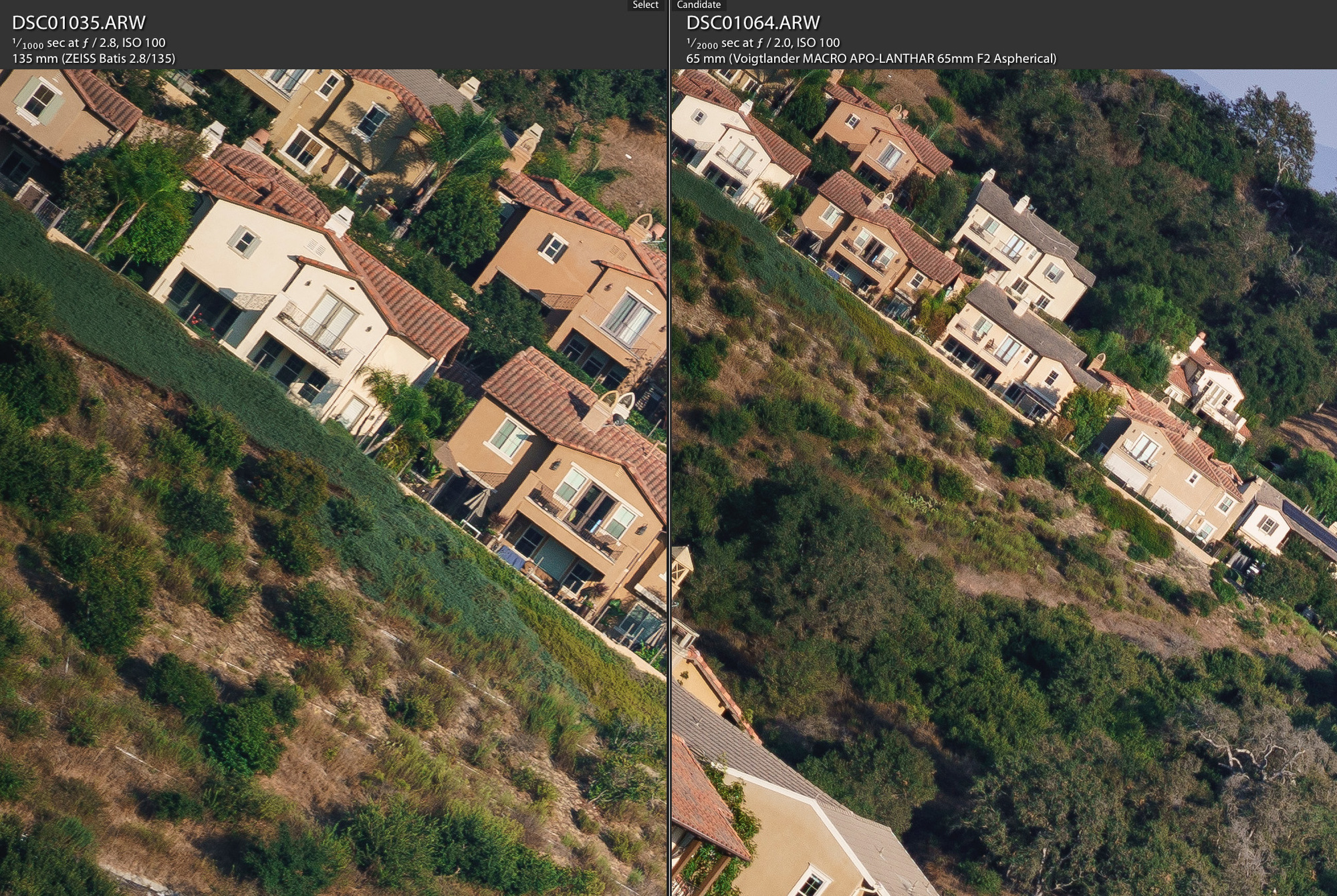
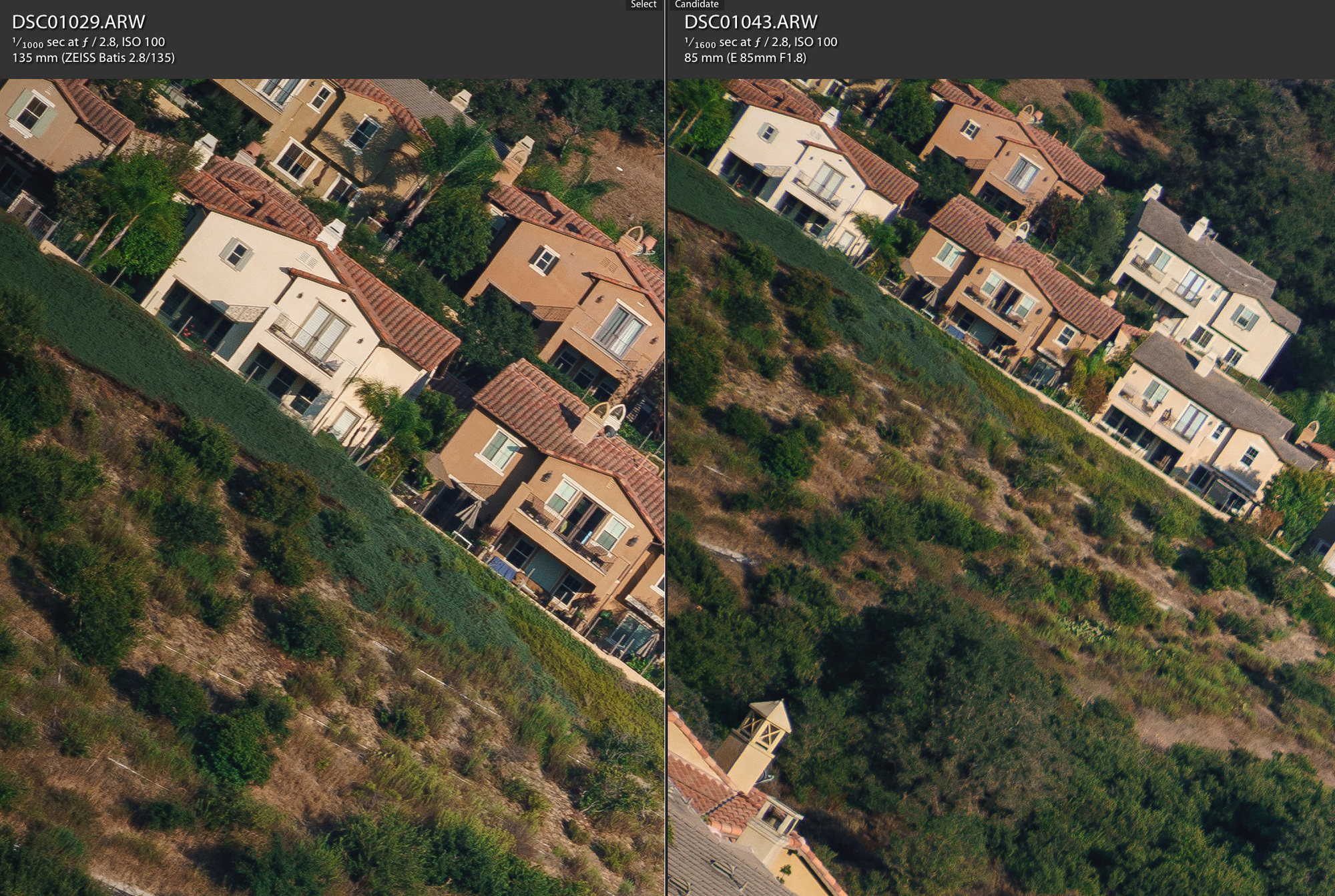
Just for curiosity, I compared the CV 65/2 APO vs Batis 135/2.8 APO vs Batis 85/1.8 at infinity side-by-side. I was more interested in the corner performance wide-open. (or close to it)
I have an amazing Batis 85/1.8 copy that I thought would do very well in the comparison. It did, but could not quite keep up with the 135 and 65 beasts.
Here are some crops. (Big crops!)
First off, Zeiss 135/2.8 vs CV 65/2 (Both wide open)...only showing the extreme corners. Both lenses are extremely flat-field and focus was on the center of the frame.
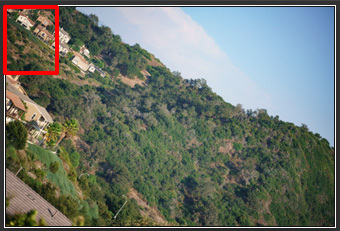
thumb showing image area (extreme corner)
Corners: Zeiss 135/2.8 vs CV 65/2 (Both wide open)