This topic is in the 2015 archive. You can read it and like its posts here. It is read only.
Archive 2015Zeiss Unveils the Loxia 21mm f/2.8
p.45 #1Zeiss Unveils the Loxia 21mm f/2.8
Yes, that is what I did with my 21mm Distagon as well. I explained my results taken with 4 different Nikon bodies. Oberkochen acknowledged everything and did their job.
Perhaps, what helped the most was that I was able to show test shots from a working, properly centered lens. So maybe you guys living on the same continent should gather in these kind of situations and take test shots with decentered lens and with a lens known to work properly. If that does not help, then god knows what will...
Perhaps, what helped the most was that I was able to show test shots from a working, properly centered lens. So maybe you guys living on the same continent should gather in these kind of situations and take test shots with decentered lens and with a lens known to work properly. If that does not help, then god knows what will...
Feb 25, 2016 at 08:58 AM
p.45 #2Zeiss Unveils the Loxia 21mm f/2.8
Reports of decentration and questionable QC and repairability stopped me from purchasing the Sony 35mm f/1.4, but I don't generally test a lens unless it becomes obvious when shooting. I do believe that we all suffer higher priced lens costs due to returns. I can only hope that there are but a few perfectionists with unrealistic expectations and lots of time on their hands.
That said, I won't cancel my Loxia 21mm and won't test my Loxia 35mm .. It has been a stellar lens.
Lastly, I hate Fred. Your Yosemite Loxia images are absolutely jaw dropping.
That said, I won't cancel my Loxia 21mm and won't test my Loxia 35mm .. It has been a stellar lens.
Lastly, I hate Fred. Your Yosemite Loxia images are absolutely jaw dropping.
Feb 25, 2016 at 09:06 AM
p.45 #3Zeiss Unveils the Loxia 21mm f/2.8
I showed Zeiss a comparison shot between my Loxia and Batis (which I sent in) and it did make it seem more obvious that there might be an issue with the Batis (although the Loxia has some field curvature, which I noted.) When I sent the lens in, I put in the comments that I could provide comparison shots if need be. (I just supplied samples from the Batis.)
-Tim
MJKoski wrote:
Yes, that is what I did with my 21mm Distagon as well. I explained my results taken with 4 different Nikon bodies. Oberkochen acknowledged everything and did their job.
Perhaps, what helped the most was that I was able to show test shots from a working, properly centered lens. So maybe you guys living on the same continent should gather in these kind of situations and take test shots with decentered lens and with a lens known to work properly. If that does not help, then god knows what will...
Feb 25, 2016 at 09:10 AM
p.45 #4Zeiss Unveils the Loxia 21mm f/2.8
bjornthun wrote:
I was able to do more than just the "Gletscherbruch" test to investigate and describe the problem with my 18/3.5.
The whole point of such a "Gletscherbruch" test is that it shows issues immediately, in a very easy way. No need to be perfectly parallel to subjects like a wooden house.
I shoot other kinds of test photos too. Never have the results from the initial "Gletscherbruch" test been wrong. The "normal" tests always confirm the issue. That's why it's a proven test to me and why I'm very surprised that Zeiss thinks it's a completely foolish thing to do.
Being able to show how a perfectly aligned lens looks should always be completely unnecessary. If a lens isn't symmetrical around it's optical axis it's always misaligned (if you know that your camera isn't the problem). It's not rocket science.
Edited on Feb 25, 2016 at 09:31 AM · View previous versions
Feb 25, 2016 at 09:17 AM
p.45 #5Zeiss Unveils the Loxia 21mm f/2.8
bwcolor wrote:
Reports of decentration and questionable QC and repairability stopped me from purchasing the Sony 35mm f/1.4, but I don't generally test a lens unless it becomes obvious when shooting. I do believe that we all suffer higher priced lens costs due to returns. I can only hope that there are but a few perfectionists with unrealistic expectations and lots of time on their hands.
That said, I won't cancel my Loxia 21mm and won't test my Loxia 35mm .. It has been a stellar lens.
Lastly, I hate Fred. Your Yosemite Loxia images are absolutely jaw dropping.
It has nothing to do with having too much time on hands. It's about testing what you pay for.
You say that we suffer from higher lens costs because of returning faulty lenses? I could say that people that never test their gear cause manufacturers to lower their QC standards.
Feb 25, 2016 at 09:25 AM
p.45 #6Zeiss Unveils the Loxia 21mm f/2.8
Jochenb wrote:
The whole point of such a "Gletscherbruch" test is that it shows issues immediately, in a very easy way. No need to be perfectly parallel to subjects like a wooden house.
I shoot other kinds of test photos too. Never have the results from the initial "Gletscherbruch" test been wrong. The "normal" tests always confirm the issue. That's why it's a proven test to me and why I'm very surprised that Zeiss thinks it's a completely foolish thing to do.
The effort I took, when doing more testing, helped much more in understanding and explaining what was wrong with my lens. As I said, the ZF 18/3.5 is known to have significant curvature of field, to the point of making the "Gletscherbruch" test difficult to do.
bjornthun wrote
I was able to do more than just the "Gletscherbruch" test to investigate and describe the problem with my 18/3.5.I shoot other kinds of test photos too. Never have the results from the initial "Gletscherbruch" test been wrong. The "normal" tests always confirm the issue. That's why it's a proven test to me and why I'm very surprised that Zeiss thinks it's a completely foolish thing to do.
The effort I took, when doing more testing, helped much more in understanding and explaining what was wrong with my lens. As I said, the ZF 18/3.5 is known to have significant curvature of field, to the point of making the "Gletscherbruch" test difficult to do.
Feb 25, 2016 at 09:29 AM
p.45 #7Zeiss Unveils the Loxia 21mm f/2.8
Jochenb wrote:
I now got a new reply from Zeiss, were they also mention that "Gletscherbruch-Method":
"Unfortunately, those strange "Gletscherbruch" test method where images are taken in a row with the camera/lens orientated in different directions has nothing to do with the typcial still photo applications and the approved lens adjustment and test methods used in the lens manufacturing industry since decades. Too many factors can influence the results, so the resulting pictures do not tell much about possible symmetrie issues of the lens in use."
It's amazing how much this reminds of another German company, Power2Max, and how they tell people that a static torque test is not a valid way to check the calibration of a cycling power meter.
FWIW, my Batis 25 (which has since been stolen) was essentially perfect when tested in this way:
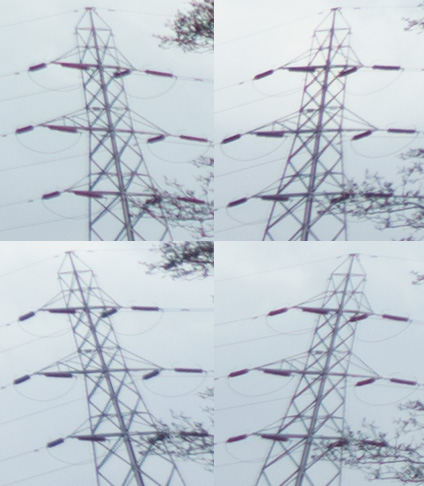
I also tested it by taking the same landscape picture upright and upside down, then stacking them in photoshop to be able to switch back and forth between the two while looking at any part of the image. The two images were essentially identical over the entire frame.
OTOH my 16-35 had a bottom right corner that was distinctly better than the other 3:
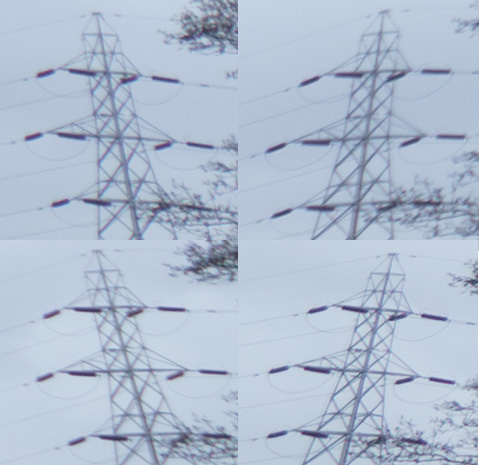
Now, interestingly, I always considered that 16-35 an acceptable copy, but what caused me to do that test is that when I took exactly the same landscape shot with both the Batis 25 and 16-35 at 25, The Batis was noticeably better than the 16-35 apart from the lower right quadrant, where the 16-35 was as good as the Batis, maybe even slightly better. So I did the 4 corner test with both lenses to establish if the Batis was weak in that quadrant or the 16-35 weak in the other quadrants. It made me wonder if some copies of the 16-35 are as good over the whole frame as that copy was in the bottom right quadrant.
I now got a new reply from Zeiss, were they also mention that "Gletscherbruch-Method":
"Unfortunately, those strange "Gletscherbruch" test method where images are taken in a row with the camera/lens orientated in different directions has nothing to do with the typcial still photo applications and the approved lens adjustment and test methods used in the lens manufacturing industry since decades. Too many factors can influence the results, so the resulting pictures do not tell much about possible symmetrie issues of the lens in use."
It's amazing how much this reminds of another German company, Power2Max, and how they tell people that a static torque test is not a valid way to check the calibration of a cycling power meter.
FWIW, my Batis 25 (which has since been stolen) was essentially perfect when tested in this way:
I also tested it by taking the same landscape picture upright and upside down, then stacking them in photoshop to be able to switch back and forth between the two while looking at any part of the image. The two images were essentially identical over the entire frame.
OTOH my 16-35 had a bottom right corner that was distinctly better than the other 3:
Now, interestingly, I always considered that 16-35 an acceptable copy, but what caused me to do that test is that when I took exactly the same landscape shot with both the Batis 25 and 16-35 at 25, The Batis was noticeably better than the 16-35 apart from the lower right quadrant, where the 16-35 was as good as the Batis, maybe even slightly better. So I did the 4 corner test with both lenses to establish if the Batis was weak in that quadrant or the 16-35 weak in the other quadrants. It made me wonder if some copies of the 16-35 are as good over the whole frame as that copy was in the bottom right quadrant.
Feb 25, 2016 at 09:44 AM
p.45 #8Zeiss Unveils the Loxia 21mm f/2.8
bjornthun wrote:
The whole point of such a "Gletscherbruch" test is that it shows issues immediately, in a very easy way. No need to be perfectly parallel to subjects like a wooden house.
I shoot other kinds of test photos too. Never have the results from the initial "Gletscherbruch" test been wrong. The "normal" tests always confirm the issue. That's why it's a proven test to me and why I'm very surprised that Zeiss thinks it's a completely foolish thing to do.The effort I took, when doing more testing, helped much more in understanding and explaining what was wrong with my lens. As I said, the ZF 18/3.5 is known to have significant curvature of field, to the point of making the "Gletscherbruch" test difficult to do.
Yes I also do that to know for certain what's the exact problem with the lens. I also shared such a test with Zeiss and explained how the focal plane tilts more towards the camera on the left. It should be parallel to the sensor. They (or should I say that one employee) completely ignored it all. Frustrating.
Jochenb wrote
bjornthun wrote
I was able to do more than just the "Gletscherbruch" test to investigate and describe the problem with my 18/3.5.I shoot other kinds of test photos too. Never have the results from the initial "Gletscherbruch" test been wrong. The "normal" tests always confirm the issue. That's why it's a proven test to me and why I'm very surprised that Zeiss thinks it's a completely foolish thing to do.
Yes I also do that to know for certain what's the exact problem with the lens. I also shared such a test with Zeiss and explained how the focal plane tilts more towards the camera on the left. It should be parallel to the sensor. They (or should I say that one employee) completely ignored it all. Frustrating.
Feb 25, 2016 at 09:54 AM
p.45 #9Zeiss Unveils the Loxia 21mm f/2.8
Jochenb wrote:
That said, I won't cancel my Loxia 21mm and won't test my Loxia 35mm .. It has been a stellar lens.
Lastly, I hate Fred. Your Yosemite Loxia images are absolutely jaw dropping.It has nothing to do with having too much time on hands. It's about testing what you pay for.
You say that we suffer from higher lens costs because of returning faulty lenses? I could say that people that never test their gear cause manufacturers to lower their QC standards.
I agree, if the issue is negatively impacting your images when shooting whatever it is that you shoot. To send a lens back because of a problem that doesn't impact your work is what I'm addressing. When someone does the latter, we all pay.
bwcolor wrote
Reports of decentration and questionable QC and repairability stopped me from purchasing the Sony 35mm f/1.4, but I don't generally test a lens unless it becomes obvious when shooting. I do believe that we all suffer higher priced lens costs due to returns. I can only hope that there are but a few perfectionists with unrealistic expectations and lots of time on their hands.That said, I won't cancel my Loxia 21mm and won't test my Loxia 35mm .. It has been a stellar lens.
Lastly, I hate Fred. Your Yosemite Loxia images are absolutely jaw dropping.
You say that we suffer from higher lens costs because of returning faulty lenses? I could say that people that never test their gear cause manufacturers to lower their QC standards.
I agree, if the issue is negatively impacting your images when shooting whatever it is that you shoot. To send a lens back because of a problem that doesn't impact your work is what I'm addressing. When someone does the latter, we all pay.
Feb 25, 2016 at 10:16 AM
p.45 #10Zeiss Unveils the Loxia 21mm f/2.8
I have to say I am not usually a great tester of lenses as I shoot and if I notice something wrong in normal use then I will get it fixed (has happened several times with Leica lenses but not for de-centering) and with my FE55 I used it for 2 years before noticing that it was de-centered in some landscape shots and as I use it mostly for people shots and wide open it's not really an issue (now have the Loxia 50 for landscape work). My Loxia 21 is slightly out in a way that wouldn't be noticed in most landscape work but would when shooting architecture and as I want it for this sort of work I feel I need a perfectly centred lens. Anyway i look forward to getting it back as otherwise it is a great performer
Feb 25, 2016 at 11:07 AM
p.45 #11Zeiss Unveils the Loxia 21mm f/2.8
bjornthun wrote:
The whole point of such a "Gletscherbruch" test is that it shows issues immediately, in a very easy way. No need to be perfectly parallel to subjects like a wooden house.
I shoot other kinds of test photos too. Never have the results from the initial "Gletscherbruch" test been wrong. The "normal" tests always confirm the issue. That's why it's a proven test to me and why I'm very surprised that Zeiss thinks it's a completely foolish thing to do.The effort I took, when doing more testing, helped much more in understanding and explaining what was wrong with my lens. As I said, the ZF 18/3.5 is known to have significant curvature of field, to the point of making the "Gletscherbruch" test difficult to do.
As long as you place your target at the same exact location for all 4 corners, field curvature should not be an issue at all.
With fast ultra wides, distortion and vignetting can be distracting when evaluating sharpness and therefore I prefer using the upside down method. (for both portrait and landscape orientations)
Jochenb wrote
bjornthun wrote
I was able to do more than just the "Gletscherbruch" test to investigate and describe the problem with my 18/3.5.I shoot other kinds of test photos too. Never have the results from the initial "Gletscherbruch" test been wrong. The "normal" tests always confirm the issue. That's why it's a proven test to me and why I'm very surprised that Zeiss thinks it's a completely foolish thing to do.
As long as you place your target at the same exact location for all 4 corners, field curvature should not be an issue at all.
With fast ultra wides, distortion and vignetting can be distracting when evaluating sharpness and therefore I prefer using the upside down method. (for both portrait and landscape orientations)
Feb 25, 2016 at 12:00 PM
p.45 #12Zeiss Unveils the Loxia 21mm f/2.8
Fred Miranda wrote:
The whole point of such a "Gletscherbruch" test is that it shows issues immediately, in a very easy way. No need to be perfectly parallel to subjects like a wooden house.
I shoot other kinds of test photos too. Never have the results from the initial "Gletscherbruch" test been wrong. The "normal" tests always confirm the issue. That's why it's a proven test to me and why I'm very surprised that Zeiss thinks it's a completely foolish thing to do.The effort I took, when doing more testing, helped much more in understanding and explaining what was wrong with my lens. As I said, the ZF 18/3.5 is known to have significant curvature of field, to the point of making the "Gletscherbruch" test difficult to do.As long as you place your target at the same exact location for all 4 corners, field curvature should not be an issue at all.
With fast ultra wides, distortion and vignetting can be distracting when evaluating sharpness and therefore I prefer using the upside down method. (for both portrait and landscape orientations)
In some cases curvature of field could prevent distant objects from coming into sharp focus, unless care is taken to shift focus. So having more ways of evaluating the lens is useful. Anyway, I got my lens fixed.
bjornthun wrote
Jochenb wrote
bjornthun wrote
I was able to do more than just the "Gletscherbruch" test to investigate and describe the problem with my 18/3.5.I shoot other kinds of test photos too. Never have the results from the initial "Gletscherbruch" test been wrong. The "normal" tests always confirm the issue. That's why it's a proven test to me and why I'm very surprised that Zeiss thinks it's a completely foolish thing to do.
With fast ultra wides, distortion and vignetting can be distracting when evaluating sharpness and therefore I prefer using the upside down method. (for both portrait and landscape orientations)
In some cases curvature of field could prevent distant objects from coming into sharp focus, unless care is taken to shift focus. So having more ways of evaluating the lens is useful. Anyway, I got my lens fixed.
Feb 25, 2016 at 12:32 PM
p.45 #13Zeiss Unveils the Loxia 21mm f/2.8
bjornthun wrote:
The whole point of such a "Gletscherbruch" test is that it shows issues immediately, in a very easy way. No need to be perfectly parallel to subjects like a wooden house.
I shoot other kinds of test photos too. Never have the results from the initial "Gletscherbruch" test been wrong. The "normal" tests always confirm the issue. That's why it's a proven test to me and why I'm very surprised that Zeiss thinks it's a completely foolish thing to do.The effort I took, when doing more testing, helped much more in understanding and explaining what was wrong with my lens. As I said, the ZF 18/3.5 is known to have significant curvature of field, to the point of making the "Gletscherbruch" test difficult to do.As long as you place your target at the same exact location for all 4 corners, field curvature should not be an issue at all.
With fast ultra wides, distortion and vignetting can be distracting when evaluating sharpness and therefore I prefer using the upside down method. (for both portrait and landscape orientations)In some cases curvature of field could prevent distant objects from coming into sharp focus, unless care is taken to shift focus. So having more ways of evaluating the lens is useful. Anyway, I got my lens fixed.
Yes, and that's my point. It would happen to all four corners and the test would still be valid.
I'm glad you got your lens fixed. I just heard from Zeiss that my lens was sent to Germany and I won't see it for 'many weeks'.
Fred
Fred Miranda wrote
bjornthun wrote
Jochenb wrote
bjornthun wrote
I was able to do more than just the "Gletscherbruch" test to investigate and describe the problem with my 18/3.5.I shoot other kinds of test photos too. Never have the results from the initial "Gletscherbruch" test been wrong. The "normal" tests always confirm the issue. That's why it's a proven test to me and why I'm very surprised that Zeiss thinks it's a completely foolish thing to do.
With fast ultra wides, distortion and vignetting can be distracting when evaluating sharpness and therefore I prefer using the upside down method. (for both portrait and landscape orientations)
Yes, and that's my point. It would happen to all four corners and the test would still be valid.
I'm glad you got your lens fixed. I just heard from Zeiss that my lens was sent to Germany and I won't see it for 'many weeks'.
Fred
Feb 25, 2016 at 01:58 PM
p.45 #14Zeiss Unveils the Loxia 21mm f/2.8
Jman13 wrote:
For those who are interested, my full review is up: http://admiringlight.com/blog/review-zeiss-loxia-21mm-f2-8-distagon-t/
Great review Jordan! I really enjoyed the reading.
Somehow I missed the link a few pages back.
For those who are interested, my full review is up: http://admiringlight.com/blog/review-zeiss-loxia-21mm-f2-8-distagon-t/
Great review Jordan! I really enjoyed the reading.
Somehow I missed the link a few pages back.
Feb 25, 2016 at 11:41 PM
p.45 #15Zeiss Unveils the Loxia 21mm f/2.8
My Loxia 21mm arrived Wednesday, and is badly decentered.  It is OK left to right, but top and bottom are wildly different. I did the test by shooting at near infinity with camera level, and then turning upside down and shooting second image without touching focus. In one top is sharp, the other bottom is sharp.
The good news is my Batis 25mm is great. Trying to decide on the send 21mm to Germany or just return and stick with Batis 25,, and wait for the Batis 18mm
What a bummer this design is so sensitive. Nice concept...Bad execution
It is OK left to right, but top and bottom are wildly different. I did the test by shooting at near infinity with camera level, and then turning upside down and shooting second image without touching focus. In one top is sharp, the other bottom is sharp.The good news is my Batis 25mm is great. Trying to decide on the send 21mm to Germany or just return and stick with Batis 25,, and wait for the Batis 18mm
What a bummer this design is so sensitive. Nice concept...Bad execution
Feb 26, 2016 at 07:55 PM
p.45 #16Zeiss Unveils the Loxia 21mm f/2.8
Sorry to hear that Bill
BTW has anyone seen a report of a de-centered 25/2? I have not, so far.
BTW has anyone seen a report of a de-centered 25/2? I have not, so far.
Feb 27, 2016 at 12:23 AM
p.45 #17Zeiss Unveils the Loxia 21mm f/2.8
Ouch Bill, sounds like both my faulty copies. I'm returning the second one too, because whatever I try... Zeiss keeps saying that my testing is flawed or that it might as well be my camera. 
Both copies show a difference between top and bottom. Like a tilt/shift lens that's slighty tilted. In normal use it'll depend on the scene if you'll notice it or not. What makes it annoying is that because it's slighty tilted... less DOF goes to the close foreground. When I turn the camera upside down, that same foreground is more in focus.
Edited on Feb 27, 2016 at 09:04 AM · View previous versions
Feb 27, 2016 at 03:25 AM
p.45 #18Zeiss Unveils the Loxia 21mm f/2.8
This is quite troubling. I'm receiving my copy on Monday and was very much looking forward to it, but now I'm starting to worry that I'll have to deal with returns etc.
Feb 27, 2016 at 03:59 AM
p.45 #19Zeiss Unveils the Loxia 21mm f/2.8
Hi alksv,
I am hoping your copy is a good one. At least if your copy needs to go in for service it will stay on same continent.
If I want mine serviced, I send it to New York, then they send it to Germany. This is a bit ironic, as it was made in Japan. It would seems if they can service them outside the factory, they may want to consider having at least one optical bench and trained technician in New York. When was the last time they made a lens in Germany?
Oh well... Good luck
Feb 27, 2016 at 03:20 PM
p.45 #20Zeiss Unveils the Loxia 21mm f/2.8
Ah HA!!! The plot thickens
Ran another test of new Loxia 21mm. Used the same protocol as last time shooting 1 picture with camera in normal level position and then turned upside down.
First pair of two pictures was with optimal focus using 12.5X magnifier which resulted in focus a bit short of infinity hard stop. The second pair was shot with the lens driven to infinity hard stop. The results of the ideal focus were exactly the same as last time with top much sharper than bottom and the reverse when camera turned upside down. The pair shot at the hard stop still showed the asymmetry, but to a much smaller degree. Now the top of the two images looked close and there was on a slight difference in the two bottoms.
Slammed to the hard stop, the lens would be quite usable at f8. Focused to an intermediate point, not so much.
Raises a new question if it can really be fixed by adjustment? Or is this just slop in the helicoid, that can never be fixed? UGH!
Feb 27, 2016 at 05:48 PM