jhinkey wrote:
Non-parallelism of the lens mount to the sensor can be seen with uneven sharpness across the frame.
My D800 showed this with my 135/2 APO - this lens was sharp enough wide open and the DOF small enough that my right side of the frame is slightly unsharp when the center is critically focused. If I use the right side to achieve focus then the left side was now out by a lot. Thought it was the lens.
Put the same 135/2 APO on my A7R with the (luckily?) very parallel Fotasy F to E adapter and the image is critically sharp across the entire width of the frame.
The D800 will go in for an AF adjustment AND a mounting flange adjustment sometime soon....Show more →
Did you test a bunch of other lenses on both of these setups and get the same results? If not maybe the lens and the Fotasy were the ones that were off, but in a way that they canceled each other out. It's a really tricky business.
Fred Miranda wrote:
So snapsy,
8MP scaled 14.5 stops dynamic range and only half stop penalty for continuos and bulb modes. One stop for silent shooting.
Seems to be roughly the case. Plus he notes there's a knee in high ISO DR, indicating the A7rII may have inherited the same analog ISO gain optimizations of the A7s.
It occurs to me that those who plan to shoot bracketed landscapes should use the continuous shooting mode with silent shutter. The 1EV read-noise/DR penalty will not matter since you'll be merging multiple exposures anyway (ie, the higher exposures of the bracket will allow you to push the shadows with multi-EV gains). And by using continuous shooting with silent shutter you'll get zero vibration on all shots with zero delay between shots for the absolute minimum risk for scene movement during the bracket (clouds, water, etc..), whereas bracketing even with EFCS means you'll get vibration from the second+first mechanical curtains opening between each exposure of the bracket, unless you shoot each exposure of the bracket individually in non-continuous mode with a human-injected delay, which in turn means the risk for motion effects in your bracket.
snapsy wrote:
It occurs to me that those who plan to shoot bracketed landscapes should use the continuous shooting mode with silent shutter. The 1EV read-noise/DR penalty will not matter since you'll be merging multiple exposures anyway (ie, the higher exposures of the bracket will allow you to push the shadows with multi-EV gains). And by using continuous shooting with silent shutter you'll get zero vibration on all shots with zero delay between shots for the absolute minimum risk for scene movement during the bracket (clouds, water, etc..), whereas bracketing even with EFCS means you'll get vibration from the second+first mechanical curtains opening between each exposure of the bracket, unless you shoot each exposure of the bracket individually in non-continuous mode with a human-injected delay, which in turn means the risk for motion effects in your bracket. ...Show more →
Are these potential landscape issues also present in the A7R as well? Overall, will these limitations limit the A7R II's potential as a high resolution landscape camera?
Unless I am mistaken the D810 does not have any of these issues. What they don't provide an option to not limit the DR is beyond me.
snapsy wrote:
It occurs to me that those who plan to shoot bracketed landscapes should use the continuous shooting mode with silent shutter. The 1EV read-noise/DR penalty will not matter since you'll be merging multiple exposures anyway (ie, the higher exposures of the bracket will allow you to push the shadows with multi-EV gains). And by using continuous shooting with silent shutter you'll get zero vibration on all shots with zero delay between shots for the absolute minimum risk for scene movement during the bracket (clouds, water, etc..), whereas bracketing even with EFCS means you'll get vibration from the second+first mechanical curtains opening between each exposure of the bracket, unless you shoot each exposure of the bracket individually in non-continuous mode with a human-injected delay, which in turn means the risk for motion effects in your bracket. ...Show more →
That makes sense snapsy since we would be blending exposures and expand DR anyways.
We just need to find out if there is actually a benefit for bracketing in SS vs EFCS because it seems that in continuous mode, the DR penalty is only 1/2 stop instead of a full stop for SS. (Even if the files get downgraded to 12 bits in either mode)
Anyways, I like the idea to speed up the bracketing process in silent mode with zero change of vibration though. Photographers around you will think you didn't take a single shot.
gdanmitchell wrote:
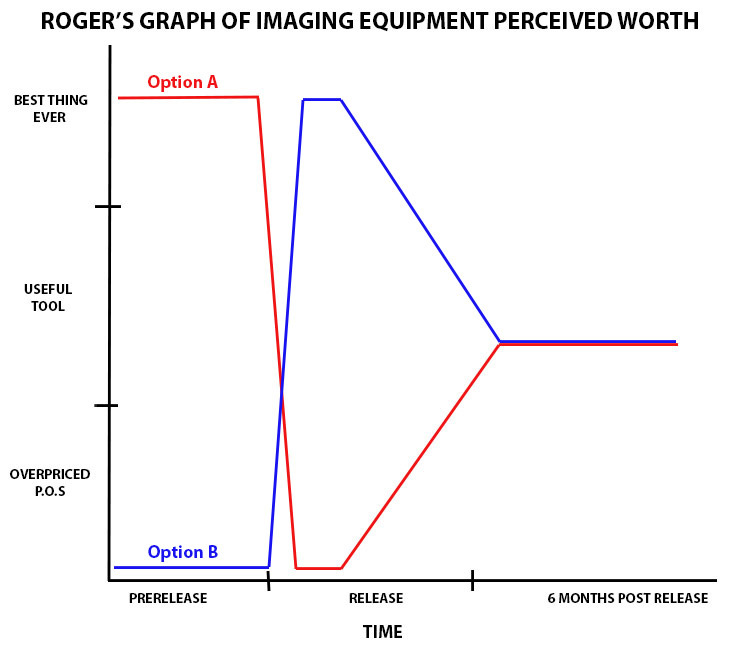
This is a familiar pattern, I think, with just about all cameras and brands as they go through the announcement, first sales, and wide-spread usage cycle — not just a Sony thing. I see the three phases roughly as follows:
1. Announcement — Many hope/expect that product will be "miraculous" in some way and focus on the positives.
2. First sales — As the product gets into the hands of the first buyers, who put it to practical use and look for its limits, things are discovered — both positive (it is as good or better than expected) and negative (ways in which it doesn't quite match the expectations).
3. Wide-spread use — For the most part, the initial "extreme" (positive and negative) reactions smooth out and the great majority of users find that the product is very good and works quite, expectations and reality come into better alignment, and buyers come to understand more fully both the inevitable pluses and minuses.
(Though this Sony thread inspired this post, it is not meant as a specific comment — much less a negative comment — on the very interesting Sony camera offerings as much as it is meant as a general comment on the process that accompanies the release of new products.)
I've read the article linked in the first post and I gather that the compression slightly affects photos that have been pushed 4 or 5 stops, and one really needs to strain to see it at 100%. That's a rather unusual situation. It seems that won't affect the vast bulk of real world picture taking. Of course, there are extreme situations were it will, but they are ... extreme.
If I understand correctly, the problem is avoided simply by using single shot rather than continuous. If that's all there is to it, then I don't see a problem.
Anyone but me noticed how RAW developing apps like ACR, C1, DXO create edge artefacts in high contrast edges when huge shadow / highlight recovery actions are used...............
Fred Miranda wrote:
That makes sense snapsy since we would be blending exposures and expand DR anyways.
We just need to find out if there is actually a benefit for bracketing in SS vs EFCS because it seems that in continuous mode, the DR penalty is only 1/2 stop instead of a full stop for SS. (Even if the files get downgraded to 12 bits in either mode)
Anyways, I like the idea to speed up the bracketing process in silent mode with zero change of vibration though. Photographers around you will think you didn't take a single shot.
My landscape shots tend to be of the dynamic nature, so being able to bracket in silent mode very rapidly is a new tool - something not available on my venerable D800. So, anyone know how many frames per second you can shoot in silent mode.
jhinkey wrote:
My landscape shots tend to be of the dynamic nature, so being able to bracket in silent mode very rapidly is a new tool - something not available on my venerable D800. So, anyone know how many frames per second you can shoot in silent mode.
My A7RII doesn't come until tomorrow . . .
It's actually pretty cool shooting bracketing in silent mode. It's fast and silent. Absolutely zero vibration between exposures.
The fps in silent mode will depend on your bracket shutter speed but it has sensor read-out speed of 1/30.
Fred Miranda wrote:
It's actually pretty cool shooting bracketing in silent mode. It's fast and silent. Absolutely zero vibration between exposures.
The fps in silent mode will depend on your bracket shutter speed but it has sensor read-out speed of 1/30.
If it's like other Sony bodies it should shoot at the same rate as the EFCS and mechanical shutter. A sensor read-out speed of 1/30 would support 30fps by itself, if that were the only consideration. Last night I shot my RX10M2 at >10fps with the silent shutter
Unrelated to this, another possible workaround for the Bulb limitation is to take as many 30-second captures as you need and stack them in Photoshop as Smart Objects with Stack Mode: Summation.
So if you really need 45 seconds for example, take a 30s exposure and another 15s right after. This would avoid Bulb mode.
I've never used stacking and summation Fred. Is there an advantage in stacking a short and long exposure, or would 2x22s or 3x15s do the same thing?
When you did your test a few pages ago, did you verify that long exposure NR was turned OFF? If not then according to the Sony guide both exposures would be 12 bit, which may be why you couldn't see a difference...
Fred Miranda wrote:
It's actually pretty cool shooting bracketing in silent mode. It's fast and silent. Absolutely zero vibration between exposures.
The fps in silent mode will depend on your bracket shutter speed but it has sensor read-out speed of 1/30.
That's very cool - many of my tripod-shot long distance landscapes have some for of rapidly moving element in them (or even the slower kind like clouds that can be moving relatively fast).
I get my A7RII today . . . yay!
Ugh ... I actually shoot fireworks and lightning in bulb mode, as I time the exposure to how many rockets went up or how many lightning bolts came down. What an odd 'feature' ...
mcbroomf wrote:
I've never used stacking and summation Fred. Is there an advantage in stacking a short and long exposure, or would 2x22s or 3x15s do the same thing?
When you did your test a few pages ago, did you verify that long exposure NR was turned OFF? If not then according to the Sony guide both exposures would be 12 bit, which may be why you couldn't see a difference...
Yes, LENR was OFF for the images I posted a few pages back.
snapsy wrote:
It occurs to me that those who plan to shoot bracketed landscapes should use the continuous shooting mode with silent shutter. The 1EV read-noise/DR penalty will not matter since you'll be merging multiple exposures anyway (ie, the higher exposures of the bracket will allow you to push the shadows with multi-EV gains). And by using continuous shooting with silent shutter you'll get zero vibration on all shots with zero delay between shots for the absolute minimum risk for scene movement during the bracket (clouds, water, etc..), whereas bracketing even with EFCS means you'll get vibration from the second+first mechanical curtains opening between each exposure of the bracket, unless you shoot each exposure of the bracket individually in non-continuous mode with a human-injected delay, which in turn means the risk for motion effects in your bracket. ...Show more →
We still have not figured out if a combination of precision loss modes (13 bits to 12 bits) would degrade IQ even further.
For example:
Combining continuous bracketing + silent shutter
Bulb + LENR
etc...
Something came to mind when using continuous bracket today.
If you lose a full stop when using continuous bracketing mode, many bracketing settings could potentially provide less DR than shooting one image in the first place.
For example: when choosing continuous bracket [-0.5, 0, 0.5] you would end up with the SAME dynamic range as if taking a single shot. The stop you gain by bracketing you lose with the precision loss...
If your bracketing settings is for less than a stop (-0.3,0,0.3), you get less DR than a single shot!!
Even when bracketing for an extra 2 stops (-1,0,1), you are only really be getting one extra stop DR.
I would advise against using continuous bracket and manually take your single shots when bracketing or at least choose 4 stops bracketing (-2,0,2) when using the continuous mode.