This topic is in the 2015 archive. You can read it and like its posts here. It is read only.
Archive 2015Canon 5DS dynamic range: zero improvement (RAWs analyzed)
p.11 #1Canon 5DS dynamic range: zero improvement (RAWs analyzed)
chez wrote:
You mean discussions that say the sensor has very similar DR performance to other canon FF sensors? Is anyone learning anything new here? Canon certainly never said the DR was higher in this sensor. This topic is really not a discussion, it is a simple fact.
Now, if this was a topic on the overall image quality and comparisons to other camera systems, that would be an actual discussion.
As it is, these DR 'discussions' just turn to the same tired argument with both sides digging in. You either buy a camera with higher DR or you don't.Hey JC...I'll ask again. If you know what the discussion is about in this thread, and you are sick and tired of hearing this same discussion...over and over...why are you still reading this thread? Is it just to come onto thread and disrupt it? Seems to me the title of the thread was very clear. Why not just ignore this thread and move onto something that does not annoy you.edited parts of your post...lets keep it civil here.
Cher, you totally missed the point of my post. Not uncommon with you or others around here.
The title of this thread is a statement. Someone analyzed some raw files and made a statement of fact (unless you doubt his analysis). The 'discussion', using the term loosely, is then only vaguely related to the title of the thread. It is another in an endless string of such discussions from both sides of the DR 'issue'. It seems that only one side really has an issue and desire to convert everyone else.Still did not answer my question. If you are sick and tired discussing DR, why are you still contributing to a thread that was discussing DR? Maybe down deep you like to discuss ( argue ) for the sake of it.
I get nothing out of discussions on AF tracking for birds in flight so I just ignore those threads. You should try to ignore threads that don't interest you.
Chess, I didn't respond to your question because it was completely irrelevant. This thread is a bitchfest, not a discussion. The OP contained a statement of fact and people launched into the usual crap. You might notice that I wasn't telling anyone what to do, like you so often do.
Why do you feel the need to respond to my posts? I would've thought you were relaxed and refreshed after a photo trip without that horrible bulky dslr
jctriguy wrote
chez wrote
jctriguy wrote
retrofocus wrote
Your renewed attempt to shut down any kind of discussion which reveals potential (since we don't know it fully yet!) drawbacks of Canon's new sensor does not work. Sorry.Now, if this was a topic on the overall image quality and comparisons to other camera systems, that would be an actual discussion.
As it is, these DR 'discussions' just turn to the same tired argument with both sides digging in. You either buy a camera with higher DR or you don't.
Cher, you totally missed the point of my post. Not uncommon with you or others around here.
The title of this thread is a statement. Someone analyzed some raw files and made a statement of fact (unless you doubt his analysis). The 'discussion', using the term loosely, is then only vaguely related to the title of the thread. It is another in an endless string of such discussions from both sides of the DR 'issue'. It seems that only one side really has an issue and desire to convert everyone else.
I get nothing out of discussions on AF tracking for birds in flight so I just ignore those threads. You should try to ignore threads that don't interest you.
Chess, I didn't respond to your question because it was completely irrelevant. This thread is a bitchfest, not a discussion. The OP contained a statement of fact and people launched into the usual crap. You might notice that I wasn't telling anyone what to do, like you so often do.
Why do you feel the need to respond to my posts? I would've thought you were relaxed and refreshed after a photo trip without that horrible bulky dslr
Mar 24, 2015 at 10:56 PM

p.11 #2Canon 5DS dynamic range: zero improvement (RAWs analyzed)
artd wrote:
While I understand either of those scenarios as business realities, it doesn't mean I won't be disappointed.
Thanks, I get that too.
Kind of like when Dodge dropped the 5.2L & 5.9L engines from the Dakota ... I was bummed that the 4.7L was the available V-8. Yet, I still find the other attributes of the Dakota compelling reasons why I drive the Dakota. I spent a lot of time looking at the other trucks and just couldn't find one that fit my purposes better than the Dakota, despite my disappointment in their business decision. So, I bought another Dakota and funny enough ... it turns out the 4.7L still gets >99% of my jobs (key concept @ my jobs) done. I just haven't tried to tow my house with it yet.
In discussions @ WA / UWA lenses, I often tell folks to "choose your poison" referring to things like distortion, vignetting, etc. This is often in context of "resolution wars" ... i.e. sometimes the issue is determined not by what you want, but rather by what you don't want.
As to the DR war, most would like to have more (similar to yearning for more resolution). However, in the current real world, it can be a similar exercise in (individual preference) at what you "don't want" guiding you more than what you do want. Myself, for instance ... I don't want to be limited to the SoNikon glass options. Sure, while you can use adapters, what's the point of having great AF performing glass, if it takes a hit via the adapter. After years of using adapters with my alts, I'm very familiar with such and really do use a lot of manual focus techniques ... BUT, when I want AF, I want great AF.
Similarly, I'm not fond of the ergonomics of the Sony (which can use Canon glass), but could go with the Nikon ergonomics okay. However, once again the glass options become an issue in a variety of regards (personal preferences). I'm not bashing, Sony, nor Nikon for their decisions ... they just have issues that are on my "poison" list that outweigh the gains realized by uber-DR. Others have different "poison" lists, and if Canon's DR is a poison for someone ... then they should go with SoNikon, etc. For me (and apparently many others), Canon's non-advancement in DR is somewhat disappointing @ not keeping up with SoNikon, yet it is not a poison as the current DR still serves my purposes. There is a vast difference between a poison and a disappointment.
That said, the OP's indication that things remain the same @ DR in Canon-land is disappointing, yet relieving at the same time ... to the point that I can rest my angst of hope for more DR, and continue doing as I have for so many years ... returning my focus to what I do best, rather than what I might be wishing for. I'd like to see Canon produce a 170/2 (bridge between 135/2 & 200/2 @ size / weight / cost) ... but I don't spend much time thinking about it, if it doesn't fit their business model (although, I think it would sell really well).
Imo, DR is just another aspect of "choose your poison". No such thing as a perfect camera, car or man / woman. Sometimes it is more important to know what you don't want, rather than being hyper-focused on more of what you do want. Sure, some folks want maximum DR more than anything else in the world. Meanwhile, many others find Canon's DR still provides a sufficiency (key concept) that allows them to do what they do and do it well without a need for the additional uber-DR.
Thanks to the OP (et al) for the insight.
Mar 25, 2015 at 07:00 AM
p.11 #3Canon 5DS dynamic range: zero improvement (RAWs analyzed)
One more thought ... what is the DR of MFD cameras ... and why aren't MFD shooters abandoning MFD in favor of SoNikon's greater DR? If Canon is "locked out" by patent, so is MFD (unless partnering with Sony). Does that mean that MFD will die because of SoNikon's higher DR?
Just a thought.
Just a thought.
Mar 25, 2015 at 08:27 AM
p.11 #4Canon 5DS dynamic range: zero improvement (RAWs analyzed)
RustyBug wrote:
One more thought ... what is the DR of MFD cameras ... and why aren't MFD shooters abandoning MFD in favor of SoNikon's greater DR? If Canon is "locked out" by patent, so is MFD (unless partnering with Sony). Does that mean that MFD will die because of SoNikon's higher DR?
Just a thought.
https://www.fredmiranda.com/forum/topic/1355054/2#12928050
Mar 25, 2015 at 08:34 AM
p.11 #5Canon 5DS dynamic range: zero improvement (RAWs analyzed)
RustyBug wrote:
One more thought ... what is the DR of MFD cameras ... and why aren't MFD shooters abandoning MFD in favor of SoNikon's greater DR? If Canon is "locked out" by patent, so is MFD (unless partnering with Sony). Does that mean that MFD will die because of SoNikon's higher DR?
Just a thought.
Pentax is using a Sony sensor. So is Phase One. So is Mamiya, I believe.
Mar 25, 2015 at 08:47 AM
p.11 #6Canon 5DS dynamic range: zero improvement (RAWs analyzed)
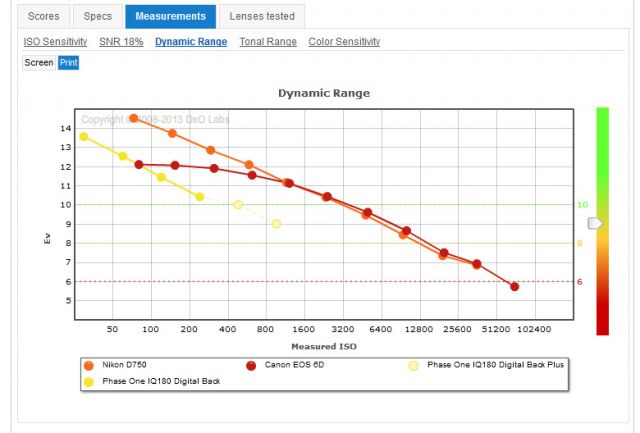
So, if someone is shooting @ ISO 400 / 800 or greater to facilitate shutter speed, for instance.
What does this suggest / how should it be read?
Edited on Mar 25, 2015 at 09:16 AM · View previous versions
What does this suggest / how should it be read?
Edited on Mar 25, 2015 at 09:16 AM · View previous versions
Mar 25, 2015 at 09:12 AM
p.11 #7Canon 5DS dynamic range: zero improvement (RAWs analyzed)
RustyBug wrote:
So, if someone is shooting @ ISO 800 or greater to facilitate shutter speed, for instance.
What does this suggest / how should it be read?
The IQ180 doesn't use the Sony sensor. As far as I'm aware DxO hasn't tested any of the MFD bodies that use the newer Sony 50MP sensor.
So, if someone is shooting @ ISO 800 or greater to facilitate shutter speed, for instance.
What does this suggest / how should it be read?
The IQ180 doesn't use the Sony sensor. As far as I'm aware DxO hasn't tested any of the MFD bodies that use the newer Sony 50MP sensor.
Mar 25, 2015 at 09:15 AM
p.11 #8Canon 5DS dynamic range: zero improvement (RAWs analyzed)
snapsy wrote:
The IQ180 doesn't use the Sony sensor. As far as I'm aware DxO hasn't tested any of the MFD bodies that use the newer Sony 50MP sensor.
Okay, thanks.
What about the converge / cross-over point @ D750 vs. 6D?
The IQ180 doesn't use the Sony sensor. As far as I'm aware DxO hasn't tested any of the MFD bodies that use the newer Sony 50MP sensor.
Okay, thanks.
What about the converge / cross-over point @ D750 vs. 6D?
Mar 25, 2015 at 09:17 AM
p.11 #9Canon 5DS dynamic range: zero improvement (RAWs analyzed)
RustyBug wrote:
As to the DR war, most would like to have more (similar to yearning for more resolution). However, in the current real world, it can be a similar exercise in (individual preference) at what you "don't want" guiding you more than what you do want. Myself, for instance ... I don't want to be limited to the SoNikon glass options. Sure, while you can use adapters, what's the point of having great AF performing glass, if it takes a hit via the adapter. After years of using adapters with my alts, I'm very familiar with such and really do use...Show more →
I'm not sure how the topic is even a "war." Again, it's not like having less DR provides a benefit somehow. It's really become a few people who have made it into a personal crusade to try and skewer the other side. Someone invariably chimes in with an exaggeration or mischaracterization of the other side's position: "if you think 11 stops of DR is so terrible how are all these people making great photos with Canon cameras" or "you're just a fanboi wanting to silence any criticism of Canon." That compels the other side to go off and throw their jabs in, and before you know it, there's a forum thread with a double-digit page count filled with squabbling about how unreasonable everyone else is.
It is disappointing because these days, you can't make a post or any kind related to DR without this happening. This post at the outset was reporting on an analysis of new data to confirm that Canon's DR hasn't changed. Some folks have pointed to the word "boring" used by the OP and claimed that shows he was trolling. I mean, give me a break. Does anyone really think that, even if the OP had worded the post in very careful, precise, diplomatically neutral English, that anything would be different? That people wouldn't be chiming in with their witty barbs and egging each other on?
It's probably because as far as the actual issue goes, there's not much to discuss anymore. The DR difference is clearly demonstrable. Lost in all the squabbling is that there actually are reasonable points to be discussed about where and how DR makes a difference, weighing pros and cons of different options, workarounds to issues, and so on.
Mar 25, 2015 at 09:20 AM
p.11 #10Canon 5DS dynamic range: zero improvement (RAWs analyzed)
artd wrote:
there actually are reasonable points to be discussed about where and how DR makes a difference, weighing pros and cons of different options, workarounds to issues, and so on.
Go on ...
(Links vs. re-hash ... either are welcome.)
Edited on Mar 25, 2015 at 09:29 AM · View previous versions
there actually are reasonable points to be discussed about where and how DR makes a difference, weighing pros and cons of different options, workarounds to issues, and so on.
Go on ...
(Links vs. re-hash ... either are welcome.)
Edited on Mar 25, 2015 at 09:29 AM · View previous versions
Mar 25, 2015 at 09:24 AM
p.11 #11Canon 5DS dynamic range: zero improvement (RAWs analyzed)
RustyBug wrote:
Okay, thanks.
What about the converge / cross-over point @ D750 vs. 6D?
The 6D's low ISO DR is ADC-limited - the sensor itself can likely do 14+ EVs just as the D750 can. The convergence at mid ISOs occurs because the D750's DR drop is linear as ISO progresses (drops 1EV per ISO), whereas the 6D's DR curve is flat due to ADC-limited noise - the point they meet is where the ADC stops limiting DR, and also where the 6D's post-gain optimizations take hold.
snapsy wrote
The IQ180 doesn't use the Sony sensor. As far as I'm aware DxO hasn't tested any of the MFD bodies that use the newer Sony 50MP sensor.What about the converge / cross-over point @ D750 vs. 6D?
The 6D's low ISO DR is ADC-limited - the sensor itself can likely do 14+ EVs just as the D750 can. The convergence at mid ISOs occurs because the D750's DR drop is linear as ISO progresses (drops 1EV per ISO), whereas the 6D's DR curve is flat due to ADC-limited noise - the point they meet is where the ADC stops limiting DR, and also where the 6D's post-gain optimizations take hold.
Mar 25, 2015 at 09:26 AM
p.11 #12Canon 5DS dynamic range: zero improvement (RAWs analyzed)
Okay, I get the linear / curve / flat explanation @ point of constraint.
What does that mean for the workaround or limitations regarding real world shooting / processing @ the flat portions. It would seem to suggest that the ADC point of constraint becomes irrelevant at the point of convergence. Where does the variance create the greatest significance vs. insignificant in application?
What does that mean for the workaround or limitations regarding real world shooting / processing @ the flat portions. It would seem to suggest that the ADC point of constraint becomes irrelevant at the point of convergence. Where does the variance create the greatest significance vs. insignificant in application?
Mar 25, 2015 at 09:35 AM
p.11 #13Canon 5DS dynamic range: zero improvement (RAWs analyzed)
Snapsy is it the ADC itself or the readout error? B'cos if it was just the ADC itself, pretty sure they could have fixed that already.
If Sony places the ADCs closer to the photosite, they may have significantly reduced readout error.
I know one thing you can select in camera is the D+ or "highlight tone priority" which tends to give about half a stop more dynamic range.
If Sony places the ADCs closer to the photosite, they may have significantly reduced readout error.
I know one thing you can select in camera is the D+ or "highlight tone priority" which tends to give about half a stop more dynamic range.
Mar 25, 2015 at 09:52 AM
p.11 #14Canon 5DS dynamic range: zero improvement (RAWs analyzed)
Access wrote:
Snapsy is it the ADC itself or the readout error? B'cos if it was just the ADC itself, pretty sure they could have fixed that already.
If Sony places the ADCs closer to the photosite, they may have significantly reduced readout error.
I know one thing you can select in camera is the D+ or "highlight tone priority" which tends to give about half a stop more dynamic range.
It's a function of both. Because the sensor doesn't have massively parallel on-chip ADCs, all the pixels must be read and shifted out over just a few parallel channels. That means the clock rate of those few channels must be very high to support the data payload and that results in noise. Also, because of the ADC is off-chip, the trace length of those high-speed pathways is longer, which further exasperates noise. As to whether the "blame" resides in the sensor for forcing the ADC to clock in electrically difficult conditions or the ADC for not doing a better job in those conditions, normally a sensor's DR is quoted independently of readout concerns, at least at the pixel level.
Mar 25, 2015 at 10:16 AM
p.11 #15Canon 5DS dynamic range: zero improvement (RAWs analyzed)
RustyBug wrote:
Okay, I get the linear / curve / flat explanation @ point of constraint.
What does that mean for the workaround or limitations regarding real world shooting / processing @ the flat portions. It would seem to suggest that the ADC point of constraint becomes irrelevant at the point of convergence. Where does the variance create the greatest significance vs. insignificant in application?
Hi RustyBug,
Hopefully this article, with real world examples, will help with that understanding. Comparing files from the D800E vs the 6D...
Nikon vs Canon Dynamic Range:
https://photographylife.com/nikon-vs-canon-dynamic-range
In the article's first comparison, Overexposure, it becomes clear that the sensor in the D800E retains better color information than the 6D at +4 EV should one need to reign in their over-exposed highlights.
In the second comparison, Underexposure, it becomes clear that the sensor in the D800E has considerably less noise at -5EV than the 6D should one need to lift their shadows.
All images in that article are shot at ISO 100. Seeing is believing, I hope this helps?!
Jimmy G
Mar 25, 2015 at 10:26 AM
p.11 #16Canon 5DS dynamic range: zero improvement (RAWs analyzed)
Here is an illuminating post by David Hull from the discussion on "Canon rumors" board on "Canon and will they develop a first class FF sensor(!)" ( http://www.canonrumors.com/forum/index.php?topic=20935.40 )
He wrote:
When I say system architecture, I mean exactly that -- how the system is architected. In Sony's case they have optimized the architecture to minimize pattern noise and overall system read noise -- it is an excellent design in that respect. They achieved this through the use of a distributed ADC structure that they were able to implement on-chip. It is a clever and innovative approach (originally invented by IBM, BTW) ... Canon has chosen to design their system in a more traditional way using an ADC off-chip. This has consequences, since it requires a higher speed, more complex pipelined ADC which will not yield the same effective number of bits (ENOB) of the Sony approach.
Note the comment on "innovative, the stuff of patents
FWIW, the ADC that canon is using is state of the art, they have a 14 bit converter that is probably getting about 12.5 ENOB at 40 MSPS. That is about as good as it gets for a pipelined ADC running that fast. Both companies have state of the art sensors which appear to yield pretty much the same performance, Sony has done a better job on system design by optimizing the system noise line up for this one particular parameter.
....If you are going to talk about sensors you need to talk about sensors, the sensor is only one part of the overall system and it is this overall system implementation that determines the noise figure and dynamic range of the camera. In the case of Canon the sensor and ADC are separate chips.
Mar 25, 2015 at 10:34 AM
p.11 #17Canon 5DS dynamic range: zero improvement (RAWs analyzed)
jimmy462 wrote:
Hopefully this article, with real world examples, will help with that understanding. Comparing files from the D800E vs the 6D...
+1 I can take my 5D3 files and D800 files and push and pull them around in LR all day long. And you know what? The Nikon files are simply more malleable.
Love my 5D3 - use the hell out of it, as it approaches 200,000 actuations. A touch more detail in the highlights? Yes, please. Cleaner shadows? Yes, please.
Studio or sublime light renders the argument almost null. Crappy real world light at events and out amongst people - that's what I want more DR (particularly headroom) for.
Mar 25, 2015 at 10:37 AM
p.11 #18Canon 5DS dynamic range: zero improvement (RAWs analyzed)
Thanks Jimmy ... will check out the link.
In the mean time ... +4 EV overexposure & -5 EV underexposure seem like they might be kinda foreign concepts to me for my shooting. I tend to push/pull around +/- 2.5 EV at most by intent. At 5 stops underexposed ... I just don't seem oriented to shoot that way very often.
Paul Mo wrote:
Studio or sublime light renders the argument almost null.
Mar 25, 2015 at 10:44 AM
p.11 #19Canon 5DS dynamic range: zero improvement (RAWs analyzed)
So with a photosite dynamic range of 15 stops, and a ADC dynamic range of 12.5 stops, why does the Canon architecture still yield only 11 stops DR? The answer is on the sensor chip, in the ISO amplifiers. Each photosite has its own amplifier, with its own output noise.
Mar 25, 2015 at 11:06 AM
p.11 #20Canon 5DS dynamic range: zero improvement (RAWs analyzed)
RustyBug wrote:
Go on ...
(Links vs. re-hash ... either are welcome.)
Sure. All of this is rehash, but there are always new folks stopping through forums so I suppose it never hurts to toss in a few very abbreviated discussion points.
Example of where and how DR makes a difference:
http://blog.arthurdomagala.com/2014/10/sony-a7r-on-architecture-duty/
Where does more DR not make a difference? Most obvious are situations with controlled lighting (e.g. studio scenario).
Workarounds:
http://blog.arthurdomagala.com/2012/04/dynamic-range-canon-dslrs-and-shadow-noise-dealing-with-it/
There are many workarounds of course, but they all have downsides. Exposure blending is a common one I use, but again, not always feasible when you have a scene where things are in motion. Graduated ND filters are another method, but again not always practical and you don't get as selective control. Setting up remote strobes and fill lights is a sure-fire solution, but takes time.
Time is the most concerning constraint to me. When shooting building exteriors at dusk, for instance, there's usually a very narrow window of time you can get a nice balanced exposure. If you can push the shadows a bit more if a certain part of the exposure gets too dark, you might buy yourself a little extra time to get another angle. Sometimes I also find a need to do exposure blending on exteriors...and if you are doing multiple 20-30 second exposures on multiple angles, well, that adds up, and when the light is rapidly changing on you, those few extra minutes you spent doing additional exposures to compensate for DR limitations might mean a missed shot. Or, say you're shooting an interior scene that exceeds the DR of the sensor, such as where you have a window and you want to show the view outside. Sometimes you can set up lights to fill in the shadows of the interior. But that takes a lot of time...time which could be spent instead on other shots. Exposure blending is the other solution, which doesn't take a lot of extra time on site...but does take a lot of extra time in processing.
So the real thing about having better DR to me is that is not so much that you can't produce a shot without it, it's that you can produce the shot faster or with less effort. If you can produce shots faster, you can produce more shots in general. Which let's you get more done in a day. And if I can spend less time blending exposures, I get more leisure time.
Pros and cons of different options:
I think you've done a nice job starting that discussion, the "pick your poison" in your previous post. The way I see it, DR is a sort of third-tier consideration in picking my gear. Primary is the lens. Secondary is the working speed/usability of the system. Canon tends to excel in both those areas. There are scenarios where a different system has its advantages, and of course being able to use Canon lenses on different bodies helps open up more options.
artd wrote
there actually are reasonable points to be discussed about where and how DR makes a difference, weighing pros and cons of different options, workarounds to issues, and so on.(Links vs. re-hash ... either are welcome.)
Sure.
All of this is rehash, but there are always new folks stopping through forums so I suppose it never hurts to toss in a few very abbreviated discussion points.Example of where and how DR makes a difference:
http://blog.arthurdomagala.com/2014/10/sony-a7r-on-architecture-duty/
Where does more DR not make a difference? Most obvious are situations with controlled lighting (e.g. studio scenario).
Workarounds:
http://blog.arthurdomagala.com/2012/04/dynamic-range-canon-dslrs-and-shadow-noise-dealing-with-it/
There are many workarounds of course, but they all have downsides. Exposure blending is a common one I use, but again, not always feasible when you have a scene where things are in motion. Graduated ND filters are another method, but again not always practical and you don't get as selective control. Setting up remote strobes and fill lights is a sure-fire solution, but takes time.
Time is the most concerning constraint to me. When shooting building exteriors at dusk, for instance, there's usually a very narrow window of time you can get a nice balanced exposure. If you can push the shadows a bit more if a certain part of the exposure gets too dark, you might buy yourself a little extra time to get another angle. Sometimes I also find a need to do exposure blending on exteriors...and if you are doing multiple 20-30 second exposures on multiple angles, well, that adds up, and when the light is rapidly changing on you, those few extra minutes you spent doing additional exposures to compensate for DR limitations might mean a missed shot. Or, say you're shooting an interior scene that exceeds the DR of the sensor, such as where you have a window and you want to show the view outside. Sometimes you can set up lights to fill in the shadows of the interior. But that takes a lot of time...time which could be spent instead on other shots. Exposure blending is the other solution, which doesn't take a lot of extra time on site...but does take a lot of extra time in processing.
So the real thing about having better DR to me is that is not so much that you can't produce a shot without it, it's that you can produce the shot faster or with less effort. If you can produce shots faster, you can produce more shots in general. Which let's you get more done in a day. And if I can spend less time blending exposures, I get more leisure time.
Pros and cons of different options:
I think you've done a nice job starting that discussion, the "pick your poison" in your previous post. The way I see it, DR is a sort of third-tier consideration in picking my gear. Primary is the lens. Secondary is the working speed/usability of the system. Canon tends to excel in both those areas. There are scenarios where a different system has its advantages, and of course being able to use Canon lenses on different bodies helps open up more options.
Mar 25, 2015 at 12:31 PM