This topic is in the 2015 archive. You can read it and like its posts here. It is read only.
Archive 2015No DR improvement = no 5Ds for me
p.13 #1No DR improvement = no 5Ds for me
RustyBug wrote:
Okay, so I'm following the sqrt numbers.
But, how do you get from 625 photons of energy to generate a signal equal to the signal generated by 10,000 photons of energy ... without some form of amplification or gain in the process?
We need some sort of amplification in order to represent 625 e- or 10000 e- with the same brightness. Both the signal and the noise gets the same amplification, so the signal to noise ratio is not affected by the amplification.
The big concept about photon shot noise, is that light is both signal and noise. Too many people don't realize this, but thinks about light as signal only. They only see the ratio of the average light (which corresponds to exposure) to the electronics noise as the signal to noise ratio. This is dead wrong and misses the by far most important noise source, the light itself.
Feb 09, 2015 at 02:19 AM

p.13 #2No DR improvement = no 5Ds for me
takowasa wrote:
Best to quote the whole paragraph, because a lot of context is lost with that snippet of what I said:
+1 ... my bad.
That's when I knew it was time for me to recharge.
Even though I had an awareness of possible contextual misinterpretation, I couldn't formulate the rest of my thought and left it hanging. Interestingly though, it does illustrate how certain points may get propagated. But, given the readily available reference, I figured most rational folks could readily return to the full context for reference, sans the quote.
No foul intended.
Edited on Feb 09, 2015 at 08:27 AM · View previous versions
Feb 09, 2015 at 07:50 AM
p.13 #3No DR improvement = no 5Ds for me
OKay ...
The math is very helpful.
So, we do have math that illustrates a higher noise on a per pixel basis (context retained). I think that is very helpful to validate one aspect of what so many intelligent, logical, rational people have been taught (largely by the photographic community). Dismissing this as erroneous when people suggest that smaller pixels are noisier than larger pixels goes against their ardent belief in something that actually appears mathematically TRUE ... THIS is likely what gets their ire up.
But, I'm gathering here that while it is a truth (predicated upon your presentation thereof), it is not a sufficient piece to stand alone as the final determinant. Your continued math then provides an illustration of equation at the aggregate ... with the corresponding square of the quantity providing the basis for yielding how 50 @ 4 = 100 @ 1. Without this missing piece well presented, it defies a rationale mind how a(n accurately derived) higher per pixel noise can be dismissed as being inaccurate, folly or otherwise errant ... and then supplanted by the concept of aggregation. Imo, this presents a very significant point of disconnect between otherwise rational, logical and credible minds.
A couple of additional (crude paraphrasing) points that seem pertinent.
Noise, by definition is essentially deviation or departure from expectation. Somewhat akin to the diff of accuracy vs. precision (let's not really go there atm), a single pixel cannot, by definition of noise @ deviation, present a range of deviation. It can only present a single value. In order to develop any form of deviation, it must be compared to something other than itself ... i.e. repetition (precision) or the standard expectation (accuracy) or neighboring (precision).
In the case of neighboring pixels, we now have something readily at hand for which to compare and derive (i.e. see) a range of deviation. To the point of the Bayer array, we can have a deviation in the quantity of photomic delivery regarding luminance noise ... ALSO ... we can have a deviation in the interpretation of the R,G,B assignment @ color noise.
I find this interesting regarding the quantity of light having variation vs. a consistency quantity (i.e. the basis for the noise/deviation). This is a paradigm shift from former understanding (i.e. light is consistent).
But, if the light itself is not the point of constraint, rather the QE is, then it would seem that there may be a crossover point when the amount of light does become the more prevalent point of constraint than the QE (or vice verse) for a given combination of the two predicated upon the asymmetrical relationships. I suspect that this is what occurs "in the shadows" vs. the higher values and/or along the sliding scale of increasing ISO. Hmmm, at the math to illustrate.
Additionally, it makes me ask the question of under what conditions is light most consistent, exhibiting the least amount of deviation at the starting point of the process light>lens>(QE) sensor (Demming 101) as light moves from greater areas of concentration to lesser areas of concentration.
Does the light path impact the consistency of light being delivered. Does the physical / optical aperture size influence the "turbulence" of delivery consistency? Does the collimation influence the delivery consistency? Does the number of elements influence the consistency? To what degree does duration (i.e. shutter) influence consistency?
Does the longer duration afford for a better "average", or does the longer duration afford an opportunity for greater deviation? Does the duration of electronic flash provide for a more consistent quantity than that of ambient when ambient duration is above / below that of a flash. Does HSS flash provide more consistency or less? Is this consistency something that is influenced in the engineering design choices of lighting such as Broncolor vs. Profoto vs. PCB vs. OCF?
A bit of Pandora's Box here ... but if I've followed correctly, then my former "spartan" understanding of noise has been raised, but the question of light @ homogenous vs. inconsistent is tugging at me a bit here. In theory, it would seem that if we are able to deliver light in the most homogenous / least deviating manner, that would be an additional point of control, prior to QE / FWC influence (says the man shooting SLR/C).
Feb 09, 2015 at 08:14 AM
p.13 #4No DR improvement = no 5Ds for me
To help answer your question it's helpful to understand what photon shot noise actually is. It's not noise per se but instead a "counting error". The arrival rate of photos follows a Poisson distribution, which is to say the general number of photons arriving for a given exposure is a known quantity but the rate and timing of that arrival is unknown, and it's the variance of that arrival over a fixed quantity of time which we perceive as noise.
Regarding your questions about longer light duration/intensity and its affect on the average...a good analogy used is traffic counting. If you stand on a corner and count the number of cars passing an intersection over a 1-minute period you'll get a good estimate of the traffic volume. If you instead count over a 5-minute period you'll get a much better estimate because variance of a Poisson distribution decreases with quantity. That is the bases of the sqrt(photons) SNR measurement of photon noise.
Regarding your questions about longer light duration/intensity and its affect on the average...a good analogy used is traffic counting. If you stand on a corner and count the number of cars passing an intersection over a 1-minute period you'll get a good estimate of the traffic volume. If you instead count over a 5-minute period you'll get a much better estimate because variance of a Poisson distribution decreases with quantity. That is the bases of the sqrt(photons) SNR measurement of photon noise.
Feb 09, 2015 at 09:35 AM
p.13 #5No DR improvement = no 5Ds for me
snapsy wrote:
it's the variance of that arrival over a fixed quantity of time which we perceive as noise.
So, armed with that knowledge ... how can we harness / apply the knowledge of it to our advantage (as shooters), or at least in an effort to minimize its impact? Does it (superficially) suggest that shorter durations afford less opportunity for deviation than longer durations or vice verse (ceteris paribus)?
It would seem that the shorter duration (when options are afforded) would infer a greater quantity of light over a shorter period of time. This "greater quantity" would then align to the S/N as a stronger signal than a lesser quantity of light over a longer duration @ weaker signal ... and the corresponding N that accompanies. I suspect that this could be evident in the studio (cheap) slow duration lighting vs. (not cheap) short duration lighting, despite operating within the same window of sync (ambient influence notwithstanding).
While many associate short duration to "freeze" capability, I'm wondering if it has additional benefit in noise reduction (even if minute in perception) that aid in things like that "look" of Profoto lighting for instance.
Edited on Feb 09, 2015 at 10:06 AM · View previous versions
Feb 09, 2015 at 09:44 AM
p.13 #6No DR improvement = no 5Ds for me
RustyBug wrote:
So, armed with that knowledge ... how can we harness the knowledge of it to our advantage (as shooters), or at least in an effort to minimize its impact.
By just accepting it And of course by always trying to use the maximum exposure that a scene will allow within the constraints of needed DOF (aperture), motion-freezing shutter speed, and dynamic range. This is the basis of ETTR.
snapsy wrote
it's the variance of that arrival over a fixed quantity of time which we perceive as noise.By just accepting it
And of course by always trying to use the maximum exposure that a scene will allow within the constraints of needed DOF (aperture), motion-freezing shutter speed, and dynamic range. This is the basis of ETTR.Feb 09, 2015 at 09:47 AM
p.13 #7No DR improvement = no 5Ds for me
So, going WAY BACK ... I made the point that the FF vs. crop would have a different physical / optical aperture (driven by the change in focal length @ framing parity) for a given exposure (of same f-stop/shutter/ISO combination).
This larger input of light then provides a larger signal (less susceptible to deviation than a smaller signal / counting error / sampling), regardless of pixel size (which we saw equalize @ per pixel vs. aggregate). MFD would then provide an even larger signal yet and LF even larger still ... resulting in corresponding noise levels based on the magnitude of the signal strength (and QE), not the capture device segmentation itself as the primary determinant. Thus, the delta seen in the comps @ FF vs. crop with corresponding pixel size is predominantly effected by the magnitude of the larger format's greater signal strength (QE etc. assumed ceteris paribus).
Then the matter of pixel size vs. FWC ... how does that come into play? (or dare I ask)
Hmm @ the question of T-stops though the lens. Does a greater T-stop aid or deter the consistency of light passing though to the counting error / accuracy?
Edited on Feb 09, 2015 at 10:39 AM · View previous versions
Feb 09, 2015 at 10:15 AM
p.13 #8No DR improvement = no 5Ds for me
Rusty -- I think you are over-thinking this. Just jump in!
Feb 09, 2015 at 10:33 AM
p.13 #9No DR improvement = no 5Ds for me
Gunzorro wrote:
Just jump in!
Oh, I already did ... the deep end that is.
No worries, though. I know how to swim to the shore. But, it does help me to keep from being swayed by others once I've fleshed out my own understanding to the nth degree ... as I head off to grab my SLR/C.
I dig pics .. but I dig light, physics, math just as much. All the better when I can connect the two ... the understanding gives me a calm about my shooting and helps keep me keep the noise from the pundits from spinning me around too much.
Thanks to all ... I don't feel so "spartan" on the matter any longer.
Feb 09, 2015 at 10:45 AM
p.13 #10No DR improvement = no 5Ds for me
RustyBug wrote:
Hmm @ the question of T-stops though the lens. Does a greater T-stop aid or deter the consistency of light passing though to the counting error / accuracy?
A lower T-stop number means more light to the sensor, just like a lower F-stop (wider aperture).
More light -> less noise. That's pretty much all there is to it (until you get into the shadows) you can talk about dark current, amp glow, quantisation noise, but they're fairly meaningless complications they're all fairly minor when it comes to shot noise.
Toss a coin ten times and work out the proportion of heads / tails. Do it again and you'll get a different number. Do it again and a different number still. Now toss a coin 10,000 times and count the heads / tails, you'll get almost exactly 50/50, do it again, and again, same result.
10 coin tosses is just like 10 photons, and the different results you can correspond to the different values of neighboring pixels. 10,000 coin tosses is like 10,000 photons and the consistent results you get correspond to a nice smooth image with very little noise.
A bigger sensor (for the same f/stop) means more coin tosses.
Feb 09, 2015 at 11:29 AM
p.13 #11No DR improvement = no 5Ds for me
Matt Grum wrote:
10 coin tosses is just like 10 photons, and the different results you can correspond to the different values of neighboring pixels. 10,000 coin tosses is like 10,000 photons and the consistent results you get correspond to a nice smooth image with very little noise.
Very nice analogy.
10 coin tosses is just like 10 photons, and the different results you can correspond to the different values of neighboring pixels. 10,000 coin tosses is like 10,000 photons and the consistent results you get correspond to a nice smooth image with very little noise.
Very nice analogy.
Feb 09, 2015 at 11:52 AM
p.13 #12No DR improvement = no 5Ds for me
RustyBug wrote:
OKay ...
The math is very helpful.
So, we do have math that illustrates a higher noise on a per pixel basis (context retained). I think that is very helpful to validate one aspect of what so many intelligent, logical, rational people have been taught (largely by the photographic community). Dismissing this as erroneous when people suggest that smaller pixels are noisier than larger pixels goes against their ardent belief in something that actually appears mathematically TRUE ... THIS is likely what gets their ire up.
No one denies that the per-pixel noise increases with the pixel count, all else equal. But, as photographers, we are only concerned with individual pixels inasmuch as they contribute to the photo as a whole, so it's the image level noise that matters, not the per-pixel noise. In fact, it is the exact same thing that goes on with diffraction and motion blur.
All else equal, the image level noise is determined by the amount of light falling on the sensor. In terms of the sensor, the primary agents are the quantum efficiency of the sensor, the electronic noise of the sensor, and, at base ISO, also the amount of light the sensor can absorb.
But, I'm gathering here that while it is a truth (predicated upon your presentation thereof), it is not a sufficient piece to stand alone as the final determinant. Your continued math then provides an illustration of equation at the aggregate ... with the corresponding square of the quantity providing the basis for yielding how 50 @ 4 = 100 @ 1.
I am not sure what you mean by "50 @ 4 = 100 @ 1". My guess is you are wondering how four pixels with a photon noise of 50 electrons each have the same noise as one pixel with a photon noisy of 100 electrons. However, that point was already explained, and demonstrated, in detail: noise adds in quadrature: sqrt(4 x 50^2) = 100. The reason noise adds in quadrature is because noise is the standard deviation of the signal and the noise for each pixel is [largely] uncorrelated.
Without this missing piece well presented, it defies a rationale mind how a(n accurately derived) higher per pixel noise can be dismissed as being inaccurate, folly or otherwise errant ... and then supplanted by the concept of aggregation. Imo, this presents a very significant point of disconnect between otherwise rational, logical and credible minds.
This might give you the details you want:
http://www.josephjamesphotography.com/equivalence/#noise
It's an in-depth and long explanation about what noise is, what the sources of noise are, etc., etc.
A couple of additional (crude paraphrasing) points that seem pertinent.
Noise, by definition is essentially deviation or departure from expectation. Somewhat akin to the diff of accuracy vs. precision (let's not really go there atm), a single pixel cannot, by definition of noise @ deviation, present a range of deviation. It can only present a single value. In order to develop any form of deviation, it must be compared to something other than itself ... i.e. repetition (precision) or the standard expectation (accuracy) or neighboring (precision).
In the case of neighboring pixels, we now have something readily at hand for which to compare...Show more →
Read the link above. It gives the details you want to know.
Feb 09, 2015 at 01:26 PM
p.13 #13No DR improvement = no 5Ds for me
Without this missing piece well presented, it defies a rationale mind how a(n accurately derived) higher per pixel noise can be dismissed as being inaccurate, folly or otherwise errant ... and then supplanted by the concept of aggregation. Imo, this presents a very significant point of disconnect between otherwise rational, logical and credible minds.
takowasa wrote:
This might give you the details you want:
http://www.josephjamesphotography.com/equivalence/#noise
It's an in-depth and long explanation about what noise is, what the sources of noise are, etc., etc.
Thanks. I'll check it out.
My point here is that you may want to remember how long it too us to get to this point. Early on, you were telling people how WRONG they were, yet the were actually in agreement on this subpoint ... they just hadn't carried it through. If this is where the disconnect is, it might be something to keep handy for future use to show them where you ARE in agreement (@ per pixel) ... then continue it from there. I think many intelligent folks could follow that more readily than trying to defend that what they know to be true @ per pixel (even if it isn't the end of the story).
Just a thought @ a nugget for the future.
Thanks again for the walk through the park.
Feb 09, 2015 at 04:18 PM
p.13 #14No DR improvement = no 5Ds for me
takowasa wrote:
This might give you the details you want:
http://www.josephjamesphotography.com/equivalence/#noise
It's an in-depth and long explanation about what noise is, what the sources of noise are, etc., etc.
RustyBug wrote:
Thanks. I'll check it out.
My point here is that you may want to remember how long it too us to get to this point. Early on, you were telling people how WRONG they were, yet the were actually in agreement on this subpoint ... they just hadn't carried it through.
If I might ask a favor from you, since you charge me with saying that I was telling people they were wrong when I agreed with them, could you link that post where I did as you claim? I reread all my posts through the thread, and the only post I found that remotely resembles your charge is this one:
https://www.fredmiranda.com/forum/topic/1346234/7#12847805
where I said:
That's a common myth. It's not because the photosites are larger, but because they gather more light for a given area of the photo and exposure. The only reason that the pixel size matters is that a greater number of smaller pixels generally results in more additional electronic noise than a smaller number of larger pixels for a given tech level. However, the electronic noise is only significant for portions of the photo made from very little light, such as deep shadows or high ISO.
However, the very next thing I wrote in that post was:
The per-pixel noise will be the same, as you say. The per-image noise will be less, however, because more light made up the photo.
which is exactly opposite your claim. However, if my offense was in another post that I missed, as I said, I'd be pleased for you to link that to me so that I may apologize for any confusion I may have caused.
Perhaps you are confusing me with gdanmitchell who said in response to my position:
https://www.fredmiranda.com/forum/topic/1346234/8#12847897
There are some folks here who are persistently and stubbornly wrong about this stuff, and eventually one wants to say, "Fine. Go ahead and be wrong."
If this is where the disconnect is, it might be something to keep handy for future use to show them where you ARE in agreement (@ per pixel) ... then continue it from there. I think many intelligent folks could follow that more readily than trying to defend that what they know to be true @ per pixel (even if it isn't the end of the story).
Just a thought @ a nugget for the future.
Thanks again for the walk through the park.
Anyway, I'd consider it a personal favor if you would link the post(s) I made where I behaved in the manner you describe, as I would like to sincerely apologize if I did as you charge.
Feb 09, 2015 at 04:30 PM
p.13 #15No DR improvement = no 5Ds for me
Yes, that's the one. I guess you didn't actually say they were WRONG, but it came across that strongly discounted the validity of their input, telling them @ common myth.
Cyber semantics are a tough gig ... I didn't mean to claim "foul" quite as harshly as it may have sounded. Just that I felt like the "lynchpin" had been identified, and that it could be used as a stronger point of agreement rather than leading with our following a myth. Again, semantics ... just a thought that's all.
As an after thought ... I should have PM'd you my thought on the matter. Apologies are due on my end, not yours.
In my defense ... you (et al) taxed my grey matter very well.
Feb 09, 2015 at 07:32 PM
p.13 #16No DR improvement = no 5Ds for me
All this talk about noise ... got me to look at some comps on multiple sites. My intent was to evaluate a possible "high ISO" (Canon) mate to the forthcoming 5Ds or 5Ds.
The Canon 1DX seemed to have some of the better noise than almost all other cameras I compared it to ... both Canon & other brands. The only cameras that seemed a touch better (to my eye) was the D4s and the A7s ... obliterating the likes of the A7R.
Coming from the former conversation that suggests that pixel size did NOT have any influence on the noise, rather based on the aggregate light and QE ... what rationale exists for such a significant difference between the 1DX vs. the A7R @ high ISO?
Given the 1DX being older than the A7R and the amount of dialogue about Canon being behind Sony and dismissal of build components, etc. ... ... a bit of a surprise here if pixel size is not somehow involved.
I understand if folks have tired of this ... but there seems to be more to the picture. Hopefully the 5DS will be an improvement over the current 5DIII ... given the 1DX @ 2011 technology, that could bode hope beyond what we may hear otherwise. The intriguing comp though is the 1DX vs. the 5D III @ why the 5D III
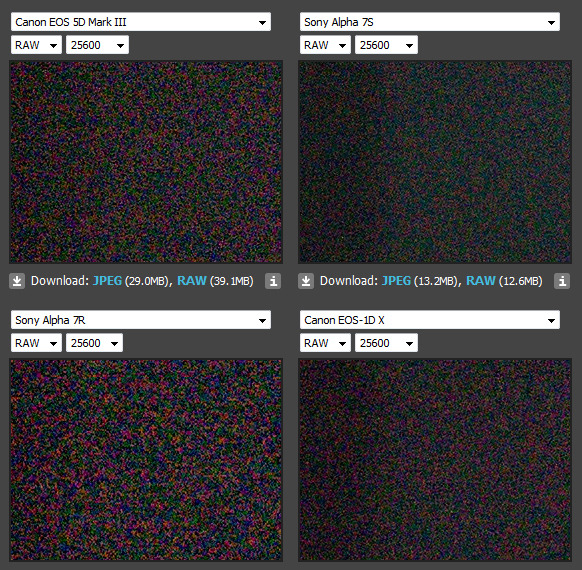
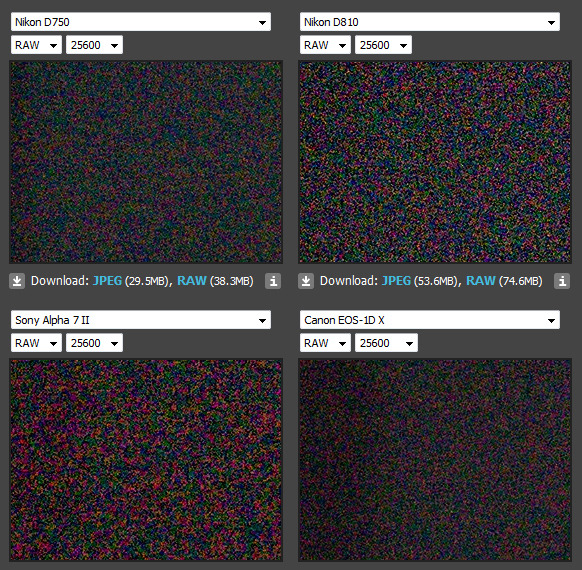
The Canon 1DX seemed to have some of the better noise than almost all other cameras I compared it to ... both Canon & other brands. The only cameras that seemed a touch better (to my eye) was the D4s and the A7s ... obliterating the likes of the A7R.
Coming from the former conversation that suggests that pixel size did NOT have any influence on the noise, rather based on the aggregate light and QE ... what rationale exists for such a significant difference between the 1DX vs. the A7R @ high ISO?
Given the 1DX being older than the A7R and the amount of dialogue about Canon being behind Sony and dismissal of build components, etc. ...
... a bit of a surprise here if pixel size is not somehow involved.I understand if folks have tired of this ... but there seems to be more to the picture. Hopefully the 5DS will be an improvement over the current 5DIII ... given the 1DX @ 2011 technology, that could bode hope beyond what we may hear otherwise. The intriguing comp though is the 1DX vs. the 5D III @ why the 5D III
Feb 09, 2015 at 10:16 PM
p.13 #17No DR improvement = no 5Ds for me
I forgot how much better the 1Dx was at high ISOs than the 5D3. Not that I could swing the price of admission for the 1Dx club but I'll definitely pick one up after the prices halve when its replacement comes out.
I had no idea how much the D750 rocked in qualitative terms at high ISO though. Nikon really nailed it! I have a couple of buddies using them right now for concert photography and it is readily apparent why one might choose a pair of D750s over the D810.
While the A7s appears to have the best noise control out of the whole group, I despise the artifacting Sony somehow manages to introduce to all of their camera's images in the sensor pipeline, which makes the noise incredible ugly to my eyes. It looks like patchwork at 100%, even when you run chrome noise reduction on it.
Feb 09, 2015 at 11:00 PM
p.13 #18No DR improvement = no 5Ds for me
RustyBug wrote:
All this talk about noise ... got me to look at some comps on multiple sites. My intent was to evaluate a possible "high ISO" (Canon) mate to the forthcoming 5Ds or 5Ds.
The Canon 1DX seemed to have some of the better noise than almost all other cameras I compared it to ... both Canon & other brands. The only cameras that seemed a touch better (to my eye) was the D4s and the A7s ... obliterating the likes of the A7R.
Canon sensors fare well at high ISOs (same quantum efficiency as everyone else, and the same, or even a tad lower, electronic noise per pixel). The "deficiencies" of Canon sensors compared to the competition are low pixel count and high electronic noise at low ISOs.
On the other hand, Canon appears to use a weaker CFA (color filter array) which results in a bit more color noise than the competition. All the talk of noise in this thread so far has been about luminance noise, not color noise. If Canon used a stronger CFA, then it would adversely affect the quantum efficiency of the sensor, resulting in more luminance noise. In my experience, however, noise filtering handles the chroma noise rather well so that it isn't really a significant factor.
Coming from the former conversation that suggests that pixel size did NOT have any influence on the noise, rather based on the aggregate light and QE ... what rationale exists for such a significant difference between the 1DX vs. the A7R @ high ISO?
Given the 1DX being older than the A7R and the amount of dialogue about Canon being behind Sony and dismissal of build components, etc. ... ... a bit of a surprise here if pixel size is not somehow involved.
As I've been saying, the greater number of smaller pixels results in more electronic noise, which becomes significant at high ISOs, and that's a big part of it. However, as I recall, there was some sort of issue with the Sony A7 and A7R sensors ("purple haze"?) that was also an issue, and unique, so far as I'm aware, to those two sensors. I also seem to remember that the issue was fixed, or there was some sort of remedy, but I don't really know.
I understand if folks have tired of this ... but there seems to be more to the picture.
Whenever you go to extremes, small differences that are normally insignificant come to prominence, and high ISO photography is certainly an example of this. For example, for long exposures, thermal noise becomes a huge consideration where it is normally completely negligible. For extremely low light, even small differences in electronic noise can make a big difference.
All this talk about noise ... got me to look at some comps on multiple sites. My intent was to evaluate a possible "high ISO" (Canon) mate to the forthcoming 5Ds or 5Ds.
The Canon 1DX seemed to have some of the better noise than almost all other cameras I compared it to ... both Canon & other brands. The only cameras that seemed a touch better (to my eye) was the D4s and the A7s ... obliterating the likes of the A7R.
Canon sensors fare well at high ISOs (same quantum efficiency as everyone else, and the same, or even a tad lower, electronic noise per pixel). The "deficiencies" of Canon sensors compared to the competition are low pixel count and high electronic noise at low ISOs.
On the other hand, Canon appears to use a weaker CFA (color filter array) which results in a bit more color noise than the competition. All the talk of noise in this thread so far has been about luminance noise, not color noise. If Canon used a stronger CFA, then it would adversely affect the quantum efficiency of the sensor, resulting in more luminance noise. In my experience, however, noise filtering handles the chroma noise rather well so that it isn't really a significant factor.
Coming from the former conversation that suggests that pixel size did NOT have any influence on the noise, rather based on the aggregate light and QE ... what rationale exists for such a significant difference between the 1DX vs. the A7R @ high ISO?
Given the 1DX being older than the A7R and the amount of dialogue about Canon being behind Sony and dismissal of build components, etc. ...
... a bit of a surprise here if pixel size is not somehow involved.As I've been saying, the greater number of smaller pixels results in more electronic noise, which becomes significant at high ISOs, and that's a big part of it. However, as I recall, there was some sort of issue with the Sony A7 and A7R sensors ("purple haze"?) that was also an issue, and unique, so far as I'm aware, to those two sensors. I also seem to remember that the issue was fixed, or there was some sort of remedy, but I don't really know.
I understand if folks have tired of this ... but there seems to be more to the picture.
Whenever you go to extremes, small differences that are normally insignificant come to prominence, and high ISO photography is certainly an example of this. For example, for long exposures, thermal noise becomes a huge consideration where it is normally completely negligible. For extremely low light, even small differences in electronic noise can make a big difference.
Feb 09, 2015 at 11:02 PM
p.13 #19No DR improvement = no 5Ds for me
kezeka wrote:
I forgot how much better the 1Dx was at high ISOs than the 5D3. Not that I could swing the price of admission for the 1Dx club but I'll definitely pick one up after the prices halve when its replacement comes out.
I had no idea how much the D750 rocked in qualitative terms at high ISO though. Nikon really nailed it! I have a couple of buddies using them right now for concert photography and it is readily apparent why one might choose a pair of D750s over the D810.
While the A7s appears to have the best noise...Show more →
If the 6D2 had the D750 sensor and the 7D2 AF, and sold for $2K when it is released in a year, I'd be cool with that.
Feb 09, 2015 at 11:06 PM
p.13 #20No DR improvement = no 5Ds for me
If all else is equal, but photo site "size" is smaller, the image is more susceptible to noise at the photosite level (S/N ratio is smaller), though the noise may be less visible to viewers of a print at a given size since its "grain size" (to use a film way of thinking) is smaller.
Edited on Feb 11, 2015 at 12:29 AM · View previous versions
Edited on Feb 11, 2015 at 12:29 AM · View previous versions
Feb 09, 2015 at 11:06 PM