Matt Grum wrote:
Mirrorless is gaining much more traction in Europe and Asia, in North America cultural preferences toward things being larger* have kept DSLR sales alive.
*Just look at the size of cars people drive compared to the rest of the world. When Microsoft launched the original X-Box they had to manufacture smaller controllers to gain any traction in the Japanese market.
There's nothing stopping anyone making a DSLR sized mirrorless (Sony are most of the way there already with the SLT line), in fact going large would silence many of the ciriticisms as it would facilitate much bigger batteries and in turn larger brighter EVF screens (which would in turn lead to greater sales and cheaper parts to make small mirrorless offerings, so everybody wins).
AF performance remains largely a data processing problem and gains will be made here. Mirrorless offers the possibility of much higher accuracy due to the closed loop nature and lack of calibration required.
I see the DSLR design becoming a niche product, but not the form factor....Show more →
I disagree, I hardly ever see anyone with a mirrorless camera (in the UK). Its either a bridge camera or a D/SLR (apart from smart phones), very rarely a mirrorless.
Matt Grum wrote:
Mirrorless is gaining much more traction in Europe and Asia, in North America cultural preferences toward things being larger* have kept DSLR sales alive.
*Just look at the size of cars people drive compared to the rest of the world. When Microsoft launched the original X-Box they had to manufacture smaller controllers to gain any traction in the Japanese market.
There's nothing stopping anyone making a DSLR sized mirrorless (Sony are most of the way there already with the SLT line), in fact going large would silence many of the ciriticisms as it would facilitate much bigger batteries and in turn larger brighter EVF screens (which would in turn lead to greater sales and cheaper parts to make small mirrorless offerings, so everybody wins).
AF performance remains largely a data processing problem and gains will be made here. Mirrorless offers the possibility of much higher accuracy due to the closed loop nature and lack of calibration required.
I see the DSLR design becoming a niche product, but not the form factor. ...Show more →
Bones74 wrote:
I disagree, I hardly ever see anyone with a mirrorless camera (in the UK). Its either a bridge camera or a D/SLR (apart from smart phones), very rarely a mirrorless.
Here's my comments from a recent trip to Italy,
"I just returned from a two week vacation in Italy; Tuscany and Venice. Canon DSLR were by far the most common cameras, and a lot of people had cameras. The next most common seemed to be super-zoom/bridge cameras, followed by Nikon DSLR. I also saw some Fuji X (X-E1/-E2, X-T1), Sony DSLR (not A7/R/S), and Oly m4/3."
Naturally, since an awful lot of people have bought a DSLR during the last couple of years, that's what you see most people use nowadays. What's happening in the market (the market = the Camera Stores where the guys in the video live every day) now, will show in the field after some time.
jcolwell wrote:
Here's my comments from a recent trip to Italy,
"I just returned from a two week vacation in Italy; Tuscany and Venice. Canon DSLR were by far the most common cameras, and a lot of people had cameras. The next most common seemed to be super-zoom/bridge cameras, followed by Nikon DSLR. I also saw some Fuji X (X-E1/-E2, X-T1), Sony DSLR (not A7/R/S), and Oly m4/3."
That's impressive. When I look around at events that I cover, I see almost no ML, P+S, or DSLR's. Everybody is using a cell phone to take photos. It's staggering how quickly dedicated camera's have disappeared.
DSLR's and ML are fighting it out over a tiny piece of crust in the pie.
It seems to be that the majority of those using cellphones never used DSLR's in the first place, and many never used P&S either. It is just that the pie is so much larger now. Since most people now have a cellphone and it is so easy to send and receive photos from them, they were bound to become the most popular image recording devices in the world. There are just so many people taking photos now compared to a few years ago, regardless what people used before. IMO.
I understand the expansion of the pie but you would think a few enthusiasts would show up at events using something other then an iphone. I shoot a lot of university events so maybe it's an age thing. Younger generation has no interest in single use devices to carry around.
The only place I see dedicated cameras are with the student photographers covering events for campus organizations and then only a few.
jcolwell wrote:
Here's my comments from a recent trip to Italy,
"I just returned from a two week vacation in Italy; Tuscany and Venice. Canon DSLR were by far the most common cameras, and a lot of people had cameras. The next most common seemed to be super-zoom/bridge cameras, followed by Nikon DSLR. I also saw some Fuji X (X-E1/-E2, X-T1), Sony DSLR (not A7/R/S), and Oly m4/3."
ggreene wrote:
That's impressive. When I look around at events that I cover, I see almost no ML, P+S, or DSLR's. Everybody is using a cell phone to take photos. ...
I was talking about what you see when looking at other folks who are out walking around in touristy places, like Siena and Venice.
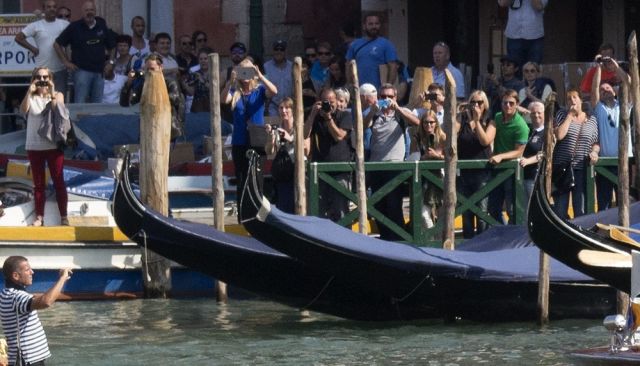
I agree that it's a lot different at events. Here's four crowd shots from the Clooney event in Venice on 29 September. Phones all over the place. I was planning to do a count, but I haven't had enough time, and I don't have that many fingfers...
alundeb wrote:
The trend among system cameras is that mirrorless is gaining market shares from DSLR. You may say that they haven't eaten that much yet, but it is still a trend. In Norway, the DSLR sales dropped 49 % while mirrorless dropped "only" 5 % the first 6 months of 2014. Churning out new DSLR models with incremental improvements isn't the solution to that.
I didn't even say mirrorless in my comment.
Also, who buys cameras from a camera store in person anymore? Not very many people. The n for The Camera Store is FAR TOO SMALL for their informal discussion of their customers to have any power at all to represent an overall trend in the market.
Further, the market is so tiny for mirrorless and driven by enthusiasts so of course it is going to see less of a drop than the dSLR market that is driven by market forces for the general population that is rapidly switching to phone based cameras from everything.
At the end of the day, I think we may eventually all move to mirrorless cameras that resemble nothing close to what we have seen thus far. First and foremost, someone needs to figure out how to dump a FF sensor into a small flange distance wide diameter mount so that we don't have to have gigantic telecentric designs for all lenses in order to get adequate imaging at the sensors edges. Sony can't do that with the E mount. Leica can't do it with the M mount without in camera processing of the images. I bet Canon could do it, if they wanted to.
So Psychic, you have less than a week. Better have something planned to say if No Amazing New Canon DSLR is introduced during Photo Plus Expo. When's the next show after that?
Psychic1 wrote:
I knew u could not resist and i was waiting for you to crack. twice.
There are two or three days next week that it could happen, but truthfully, the odds are very low, since info almost always leaks at least 1-2 weeks in advance.
I disagree, I hardly ever see anyone with a mirrorless camera (in the UK). Its either a bridge camera or a D/SLR (apart from smart phones), very rarely a mirrorless.
I pay a lot of attention to what others are shooting with and if it's not a smartphone, I'd say 99% are using DSLR's (99% of which are Canikon) and the other 1% a mirrorless. For all the hype about mirrorless (and I own one) not many people in Australia are listening. It's yet again the forums which concentrates the anti-DSLR rabid mirrorless fanbois into making a huge amount of noise about how mirroless is the best thing ever and only a moron would lug around a brick.
Matt Grum wrote:
Mirrorless is gaining much more traction in Europe and Asia, in North America cultural preferences toward things being larger* have kept DSLR sales alive.
On a random occasion, in a group of 15, I saw 1 old entry level DSLR, 2 mirrorless system cameras, 1 large sensor compact, a couple of smaller compacts and the rest using cell phone cameras.

 Archive 2014 · OMG - 1DsX in NYC...


 , here is another one on this page:




 twice.