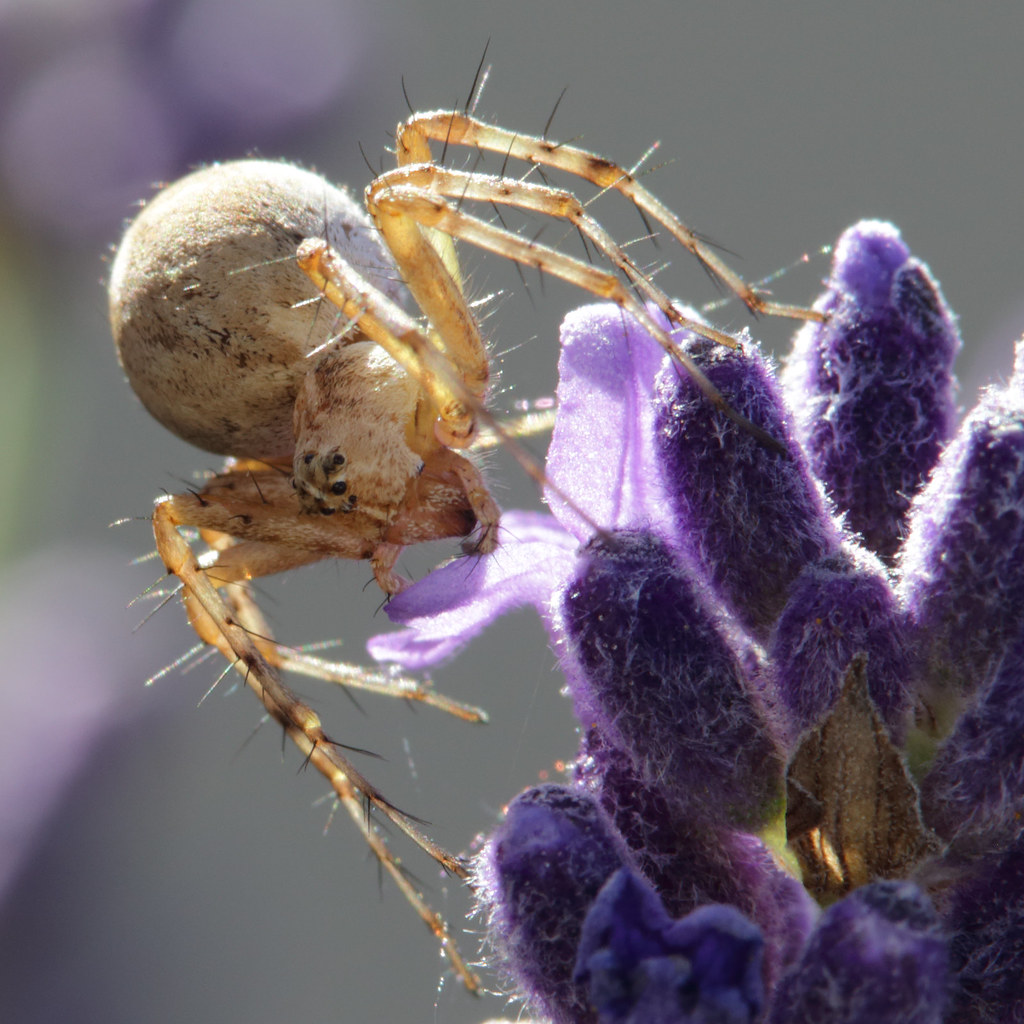
I'm trying to get the most out of my macro photography. These were both shot in my front yard, without my macro lights or focus rail. Canon 6D with 180mm L stacked on the Canon Life-Size Converter EF. I use a Benro carbon fiber tripod with an AcraTech ballhead. I usually just run the ballhead with a bit of friction, rather than locked down. Focus is with a cheap viewfinder over the screen to block reflections, and at 5x and 10x in Live View.
I've had to sharpen both images a bit, and don't like to spend much time in post. Perhaps if I knew what I was doing (I've shot film more than digital in the last 30+ years), I'd spend more time in post. Suggestions welcome.
The creepy spider was shot at 1/50, f/11, ISO 400. Surprised it's as sharp as it, given the magnification.
This little grasshopper was trying to hide from me. I shot a series with his face on either side of the lavender stalk, as he would move back to the other side, as soon as I got my camera in position. 1/50, f/9, ISO 800.
Your Flickr link is different from those of images which display directly here. (It is longer and lacks a .jpg). Perhaps a Flickr user will tell you how to do it.
Open image
Click On Download link bottom right corner : Select view all sizes
right click : select Open Image in new tab
copy link from address bar
paste link to forum post
Started this genre of photography this year as I became interested in the beauty of small insects. It's a fantastic hobby and you can get good results without spending a lot.
slopoki wrote:
Started this genre of photography this year as I became interested in the beauty of small insects. It's a fantastic hobby and you can get good results without spending a lot.
KankRat wrote:
Wait...wuh? 10X objective as in microscope?
A lot of microscope lenses, copying lenses and reversed enlarger lenses are used in extreme macro.
Microscope lenses are often used on the front of a photographic lens, typically 200mm, the latter may be referred to as the "tube lens". A tube lens need not be of very high quality.
If you put a high quality supplementary lens on the front of a lens of moderate quality you may be surprised at the improvement.
e6filmuser wrote:
A lot of microscope lenses, copying lenses and reversed enlarger lenses are used in extreme macro.
Microscope lenses are often used on the front of a photographic lens, typically 200mm, the latter may be referred to as the "tube lens". A tube lens need not be of very high quality.
If you put a high quality supplementary lens on the front of a lens of moderate quality you may be surprised at the improvement.
e6filmuser wrote:
I like it. The water drops make the bodywork more interesting without distracting.
Harold
---------------------------------------------
SomeDude661 wrote:
I agree, sometimes I'll take pics of badges on old machinery and they nearly always look more interesting after a shower of rain.
Thank you very much!
slopoki wrote:
Started this genre of photography this year as I became interested in the beauty of small insects. It's a fantastic hobby and you can get good results without spending a lot.
Stunning photos - thank you for sharing! I'd love a look at how you put your gear together?
slopoki wrote:
Started this genre of photography this year as I became interested in the beauty of small insects. It's a fantastic hobby and you can get good results without spending a lot.
Can I ask why the link to your website goes nowhere? I'd like to see more....