Archive 2014 · Sony FE 24-70 lens
p.3 #1Sony FE 24-70 lens
Those tests are confusing. I had hoped it would be at least as good as the ZA, albeit alot slower. I hope this sample was a lemon.
Jan 21, 2014 at 01:47 PM
p.3 #2Sony FE 24-70 lens
I took a look at the translated text, which was informative. He started out with a large handicap by using the FE55 for a while before doing this analysis. Like most everyone else he is wowed by it. I like to read comments as the tester sees the full files.
This FE 24-70/4 will demand good copies to work well on the a7r, so caveat emptor applies to early adopters. His copy is defective, and he is surprised by its edge performance matching or beating the ZA f2.8 zoom and the Canon 24-70/4 in the 70mm shots of the buildings, when it does less well in the image centre. It also does poorly in some other tests as compared with the other two.
~At 24mm the FE 24-70/4 was not expected to go well wide open but it actually did pretty good, and by f8 results were more consistent.~ My paraphrasing of the translation. The same set of crops - 24mm near the long edge - show the 24-70/2.8 to look worse at f4 than the FE, and the Canon had CA and similarly poor definition. TBH, the centre crops don't look that poor either.
Is that Canon regarded as a good lens? It is $1500, quite a surcharge over the FE, 200 grams extra also, plus adapter for a7/r users, so would end up around twice as heavy.
Country of manufacture is not correlated highly with quality of product, but quality of manufacturing process and quality assurance certainly are.
Jan 21, 2014 at 05:33 PM
p.3 #3Sony FE 24-70 lens
briantho wrote:
Those tests are confusing. I had hoped it would be at least as good as the ZA, albeit alot slower. I hope this sample was a lemon.
The most confusing thing is that they only tested the lens at 24 mm and 70 mm. Noobs.
Those tests are confusing. I had hoped it would be at least as good as the ZA, albeit alot slower. I hope this sample was a lemon.
The most confusing thing is that they only tested the lens at 24 mm and 70 mm. Noobs.
Jan 21, 2014 at 05:53 PM
p.3 #4Sony FE 24-70 lens
The brick wall with the window was at 52mm @ f/5.
-Tim
Edited on Jan 21, 2014 at 06:03 PM · View previous versions
-Tim
Edited on Jan 21, 2014 at 06:03 PM · View previous versions
Jan 21, 2014 at 06:00 PM
p.3 #5Sony FE 24-70 lens
philip_pj wrote:
Country of manufacture is not correlated highly with quality of product, but quality of manufacturing process and quality assurance certainly are.
True...though traditionally, it has correlated with which lenses in a manufacturers range are selected to be made in certain countries, where the very highest range are often produced in Japan or Germany. That's changing I guess. Nikon now makes many of their newer, decent G Primes in China (where once they only had their cheapest lenses made there). Not sure if Canon or Nikon are making their very highest range lenses in China though. Most (all I believe?) Pentax lenses have been manufactured in Vietnam for a while now.
Interestingly, there actually has been a recent push to bring manufacturing back to Japan with the efforts of that government to devalue the yen. Canon is about to do so. So, I'm surprised that Sony is going in the other direction.
Jan 21, 2014 at 06:01 PM
p.3 #6Sony FE 24-70 lens
Another review
http://www.slrclub.com/bbs/vx2.php?id=slr_review&no=383
Jan 24, 2014 at 05:02 AM
p.3 #7Sony FE 24-70 lens
tsdevine wrote:
Another review
http://www.slrclub.com/bbs/vx2.php?id=slr_review&no=383
Two observations at 24 mm:
Significant lateral CA. The split in sag/tan curves in the MTF chart seems to be caused by CA more than astigmatism.
The corners clean up at f/11.
Another review
http://www.slrclub.com/bbs/vx2.php?id=slr_review&no=383
Two observations at 24 mm:
Significant lateral CA. The split in sag/tan curves in the MTF chart seems to be caused by CA more than astigmatism.
The corners clean up at f/11.
Jan 24, 2014 at 06:04 AM
p.3 #8Sony FE 24-70 lens
The astigmatism is clearly evident as well. If you look at the test chart for 24mm and f/8 in the corner you will see that the horizontal lines show pretty good resolution, whereas the vertical lines have pretty poor resolution. This discrepancy between resolution in different orientations is exactly what astigmatism is and can be measured on MTF charts from a K8 machine as differences between tang/sag lines. At 24mm there is some pretty strong CA as well. This may be caused by the astigmatism, but I am not sure.
Jan 24, 2014 at 09:18 AM
p.3 #9Sony FE 24-70 lens
Steve Spencer wrote:
The astigmatism is clearly evident as well. If you look at the test chart for 24mm and f/8 in the corner you will see that the horizontal lines show pretty good resolution, whereas the vertical lines have pretty poor resolution. This discrepancy between resolution in different orientations is exactly what astigmatism is and can be measured on MTF charts from a K8 machine as differences between tang/sag lines. At 24mm there is some pretty strong CA as well. This may be caused by the astigmatism, but I am not sure.
Can you explain this in terms of how it would show up in an image? I'm especially curious about landscape images stopped down.
Thx,
Rob
Jan 24, 2014 at 09:55 AM
p.3 #10Sony FE 24-70 lens
RobCD wrote:
Can you explain this in terms of how it would show up in an image? I'm especially curious about landscape images stopped down.
Thx,
Rob
Strictly speaking, lateral/transverse chromatic aberration is where different colors/wavelengths have different magnifications. This is most apparent with tangential structures, where a black line crossing the corner of the frame has one color on the inside of it and another color on the outside of it. This is trivial to fix with modern software, though you lose a few pixels of chromaticity at the edges of the frame. Astigmatism is where the radial and tangential structures do not focus on the same plane. Astigmatism is a side effect of making the focal plane relatively flat, so it is usually a "better of two evils" sort of thing. In practice, the effect of astigmatism is that you can never get edges/corners that are as sharp as the center, but where edges/corners have far more depth of field at their lower resolution. If you use a heavily astigmatic lens for landscape work, it is important to check the edge rendering when finding optimal focus, rather than only the center focus. The easiest way to see the effects of astigmatism is with live view at high magnification: find a high contrast detail near the corner, then try to focus on the object, and, if the issue is astigmatism, you will see two fairly defined ghosts of the same subject come in an out of focus (as opposed to the blurring-into-discs that you'll see in the center of the frame) but the two ghosts will never align with each other to create a truly in-focus image. The two ghosts you're looking at there are the radial and tangential focus plane images. Unfortunately, this cannot be corrected in software, but you'll likely get an overall sharper image of a landscape than if the focal plane wasn't flattened. Also, astigmatism often combines with spherical aberration to create some color outlines that look similar to lateral chromatic aberration, which, as it is longitudinal chromatic aberration, can only be "fixed" by applying a desaturating notch filter.
Both of them result in separation between the radial and tangential curves on an MTF chart. Whereas lateral chromatic aberration is easy to correct for, astigmatism is more complex and, in some cases, compared to the alternatives, even desirable.
Hope this helps.
Cheers,
Jon
Steve Spencer wrote
The astigmatism is clearly evident as well. If you look at the test chart for 24mm and f/8 in the corner you will see that the horizontal lines show pretty good resolution, whereas the vertical lines have pretty poor resolution. This discrepancy between resolution in different orientations is exactly what astigmatism is and can be measured on MTF charts from a K8 machine as differences between tang/sag lines. At 24mm there is some pretty strong CA as well. This may be caused by the astigmatism, but I am not sure.Thx,
Rob
Strictly speaking, lateral/transverse chromatic aberration is where different colors/wavelengths have different magnifications. This is most apparent with tangential structures, where a black line crossing the corner of the frame has one color on the inside of it and another color on the outside of it. This is trivial to fix with modern software, though you lose a few pixels of chromaticity at the edges of the frame. Astigmatism is where the radial and tangential structures do not focus on the same plane. Astigmatism is a side effect of making the focal plane relatively flat, so it is usually a "better of two evils" sort of thing. In practice, the effect of astigmatism is that you can never get edges/corners that are as sharp as the center, but where edges/corners have far more depth of field at their lower resolution. If you use a heavily astigmatic lens for landscape work, it is important to check the edge rendering when finding optimal focus, rather than only the center focus. The easiest way to see the effects of astigmatism is with live view at high magnification: find a high contrast detail near the corner, then try to focus on the object, and, if the issue is astigmatism, you will see two fairly defined ghosts of the same subject come in an out of focus (as opposed to the blurring-into-discs that you'll see in the center of the frame) but the two ghosts will never align with each other to create a truly in-focus image. The two ghosts you're looking at there are the radial and tangential focus plane images. Unfortunately, this cannot be corrected in software, but you'll likely get an overall sharper image of a landscape than if the focal plane wasn't flattened. Also, astigmatism often combines with spherical aberration to create some color outlines that look similar to lateral chromatic aberration, which, as it is longitudinal chromatic aberration, can only be "fixed" by applying a desaturating notch filter.
Both of them result in separation between the radial and tangential curves on an MTF chart. Whereas lateral chromatic aberration is easy to correct for, astigmatism is more complex and, in some cases, compared to the alternatives, even desirable.
Hope this helps.
Cheers,
Jon
Jan 24, 2014 at 10:45 AM
p.3 #11Sony FE 24-70 lens
Clearly beaten by the A mount 24-70 2.8 zoom, which is outstanding. However, I don't know how reliable the focus is, in some cases the corner crops are sharper than center.
Looks like a lot of poor focusing in those examples. Probably a poor adapter on the canon as well.
Looks like a lot of poor focusing in those examples. Probably a poor adapter on the canon as well.
Jan 24, 2014 at 11:49 AM
p.3 #12Sony FE 24-70 lens
tsdevine wrote:
Another review
http://www.slrclub.com/bbs/vx2.php?id=slr_review&no=383
Thanks !
Most helpful here for me is the fact that they present three ARW files...
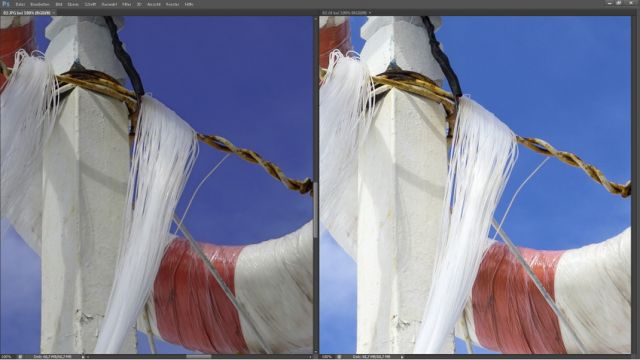
left: jpeg right: LR5 (A7 and FE 24-70 @ 24 mm ISO 100, 1/500 sec f:9
Another review
http://www.slrclub.com/bbs/vx2.php?id=slr_review&no=383
Thanks !
Most helpful here for me is the fact that they present three ARW files...
left: jpeg right: LR5 (A7 and FE 24-70 @ 24 mm ISO 100, 1/500 sec f:9
Jan 24, 2014 at 03:17 PM
p.3 #13Sony FE 24-70 lens
JonPB wrote:
Can you explain this in terms of how it would show up in an image? I'm especially curious about landscape images stopped down.
Thx,
RobStrictly speaking, lateral/transverse chromatic aberration is where different colors/wavelengths have different magnifications. This is most apparent with tangential structures, where a black line crossing the corner of the frame has one color on the inside of it and another color on the outside of it. This is trivial to fix with modern software, though you lose a few pixels of chromaticity at the edges of the frame. Astigmatism is where the radial and tangential structures do not focus on the same plane. Astigmatism is a side effect of making the focal plane relatively flat, so it is usually a "better...Show more →
Jon,
Great information and it does help.
Rob
RobCD wrote
Steve Spencer wrote
The astigmatism is clearly evident as well. If you look at the test chart for 24mm and f/8 in the corner you will see that the horizontal lines show pretty good resolution, whereas the vertical lines have pretty poor resolution. This discrepancy between resolution in different orientations is exactly what astigmatism is and can be measured on MTF charts from a K8 machine as differences between tang/sag lines. At 24mm there is some pretty strong CA as well. This may be caused by the astigmatism, but I am not sure.Thx,
Rob
Jon,
Great information and it does help.
Rob
Jan 24, 2014 at 06:59 PM
p.3 #14Sony FE 24-70 lens
Looks like the US shipment is delayed until later in February....Sony store says 2/20. I guess it's the same issue with the batch that was slotted for Europe.
Better get it right though, I'd rather wait than get something less then what it should be.
-Tim
Jan 25, 2014 at 04:52 PM
p.3 #15Sony FE 24-70 lens
Amazon now says currently unavailable, no longer offers a pre-order option, does not list a price and states "We don't know when or if this item will be back in stock". That is strange. In any case this will allow reviews to be posted and allow time to decide if this is really the lens I want.
Dave
Dave
Jan 25, 2014 at 06:06 PM
p.3 #16Sony FE 24-70 lens
AFAIC given the severe shortage of good wides for the A7's I'll be first in line if it matches anything like the CY 35-70 or CY 28-85. Those lenses are not very fast but match or supersede corresponding CY primes in critical ways.
Jan 25, 2014 at 06:37 PM
p.3 #17Sony FE 24-70 lens
A guy on dpreview got his FE 24-70, his first impressions:
dpreview
Carsten
dpreview
Carsten
Jan 26, 2014 at 12:50 PM
p.3 #19Sony FE 24-70 lens
Compared to the 55m it doesn't look that large. Don't know what all the people on that thread are complaining about. Unfortunately no real pictures to judge image quality from.
Jan 26, 2014 at 02:56 PM
p.3 #20Sony FE 24-70 lens
It's 426 grams, whereas a 35-70 is 475 grams and add an adapter to that so around 600-630 grams all up. FE 24-70 zoom is 94mm long but extends so you might see it at the long end in images.
Jan 26, 2014 at 03:54 PM