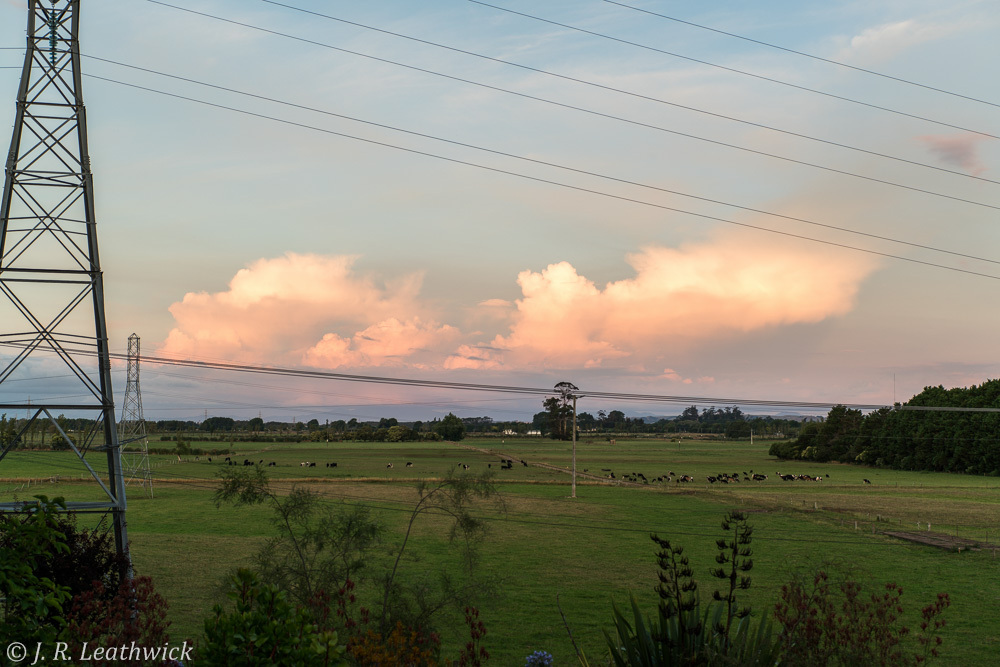
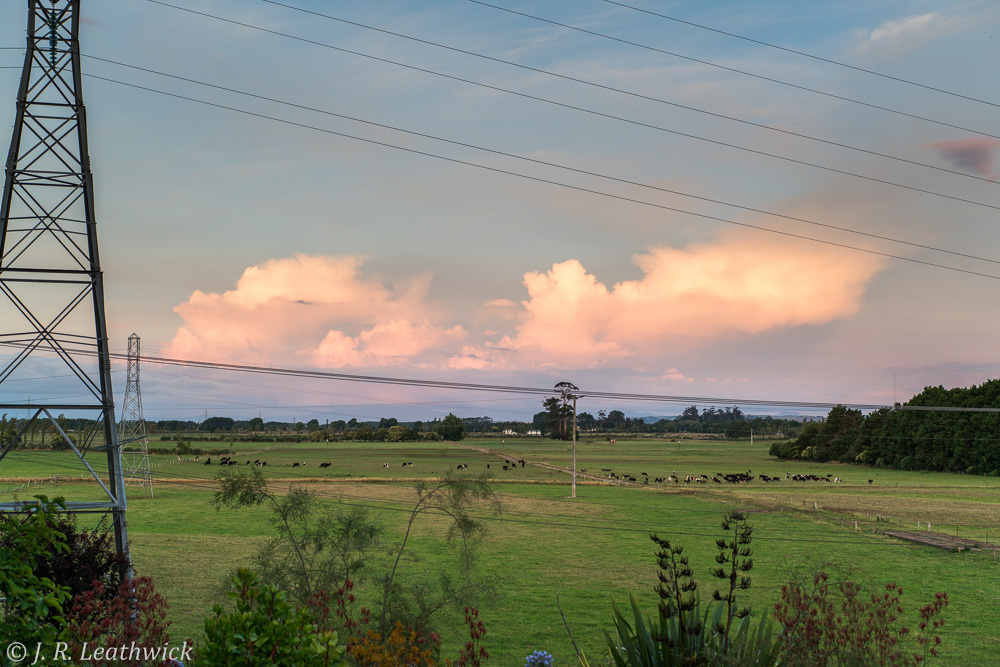
I'm not sure how many of you follow SonyAlphaRumors, but I was interested to see their plug for the new Sony 'HDR' app that has just been released. I decided to download it and see if it is a genuine alternative to a graduated filter, and it appears promising for some circumstances. The two images below provide a (somewhat underwhelming?) demo of its capability, with both shot close to sunset from my front lawn. I exposed both so that the cloud highlights were just triggering blinkies, but using the graduated filter option in the second, was able to set up a filter line on the horizon, controlling its angle and degree of progression, and setting it so that there was a 2.3 unit difference in exposure value between the foreground (1/40th) and the sky (1/200th). It then takes two exposures, combining them into a single raw file, with an intermediate step where you are able to adjust the progression.
While applying a correction like this could obviously be applied in lightroom with a grad filter in post processing, I have certainly encountered situations where there is a much greater difference in brightness where it would be very useful to bring up the exposure for part of the image - and if the physical grad filter doesn't happen to be in the bag, for $10 it seems a pretty cost effective. The one circumstance where it obviously wouldn't work would be moving subjects, and for that a physical filter or LR would seem to be the only option...
navmannz wrote:
I'm not sure how many of you follow SonyAlphaRumors, but I was interested to see their plug for the new Sony 'HDR' app that has just been released. I decided to download it and see if it is a genuine alternative to a graduated filter, and it appears promising for some circumstances. The two images below provide a (somewhat underwhelming?) demo of its capability, with both shot close to sunset from my front lawn. I exposed both so that the cloud highlights were just triggering blinkies, but using the graduated filter option in the second, was able to set up a filter line on the horizon, controlling its angle and degree of progression, and setting it so that there was a 2.3 unit difference in exposure value between the foreground (1/40th) and the sky (1/200th). It then takes two exposures, combining them into a single raw file, with an intermediate step where you are able to adjust the progression.
While applying a correction like this could obviously be applied in lightroom with a grad filter in post processing, I have certainly encountered situations where there is a much greater difference in brightness where it would be very useful to bring up the exposure for part of the image - and if the physical grad filter doesn't happen to be in the bag, for $10 it seems a pretty cost effective. The one circumstance where it obviously wouldn't work would be moving subjects, and for that a physical filter or LR would seem to be the only option...
mcbroomf wrote:
Looks reasonable to me. What were your expectations?
Also;
Diffraction (what was your F stop?)
Lens quality (what lens and converters did you use)
ISO (what ISO?)
Crop (how much is this cropped?)
Thank you for the response.
F12, Vivitar converter Sigma lens, ISO 400, uncropped.
Otherwise without the Vivitar adapter Sigma 70-300 is sharp on my Sony A7