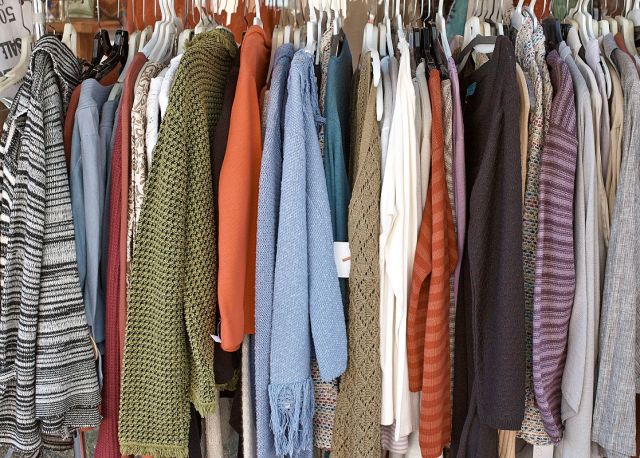
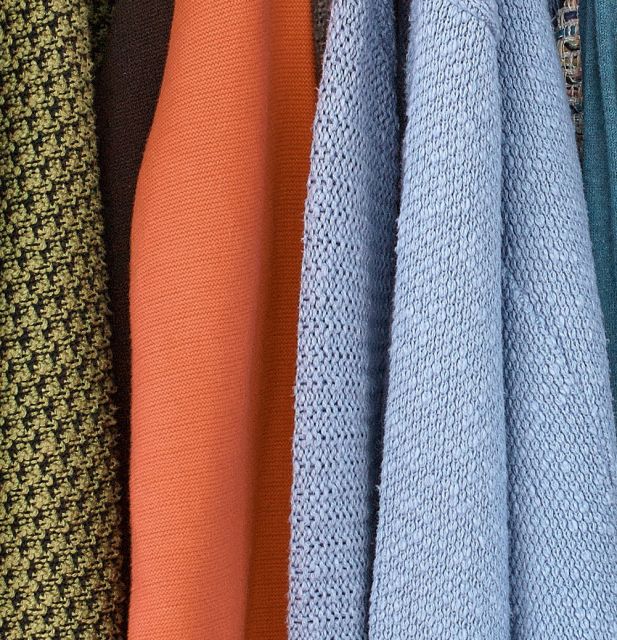
So far, I've seen little to no evidence of moire or any other issues that would lead me to regret having the AA filter removed (see the fabric shot below and the 100% crop of same). In some instances, the overall clarity in large prints is pretty astonishing. The differences in my lenses is way more apparent than before. My 16-35 f/2.8, for example, is a better lens than I thought, while the 24-105 f/4 ... which I've enjoyed for many years on my 5D, 1Ds II, etc ... is turning out to exhibit a bit of "roughness" (for want of a better word) and exaggerated contrast. In any event, my t1i is always with me now. I'm finding it addictive.
- Steve
If you want to see some moire, I suggest you try some very fine material, like a smooth silk scarf or blouse, loosely draped over somthing or in a loose pile, so there's lots of undulations. Also, try shooting a screen window from angles varying from straight on (perpendicular to the screen), to a slight grazing angle, almost parallel to the screen.
jcolwell wrote:
If you want to see some moire, I suggest you try some very fine material, like a smooth silk scarf or blouse, loosely draped over somthing or in a loose pile, so there's lots of undulations. Also, try shooting a screen window from angles varying from straight on (perpendicular to the screen), to a slight grazing angle, almost parallel to the screen.
Ok ... but who shoots things like that on a regular basis? .... not to mention with the intention of purposely inducing moire? Also: a screen window is always an opportunity for moire, even with an AA filter in place. Happens a lot when I photograph interiors with my Canon 5D Classic. So using a screen window to test out a filterless camera doesn't prove much ... except that screened windows can induce moire on digital cams.
- Steve
Moiré is only the most visible manifestation of false image data. The fabric shown is too coarse to show moiré.
You need fine regular or semi-regular detail for it to show up; detail about 1 to 4 pixels across. The unadorned sensor will alias if detail is finer than 2 pixels. If it is repeating at exactly 2 pixels and is perfectly aligned with the sensor it will alias onto itself and not show moiré. Less than perfect alignment or less than 2 pixels will make the aliasing apparent since it won't be alias on top of scene data.
Monito wrote:
Moiré is only the most visible manifestation of false image data. The fabric shown is too coarse to show moiré.
You need fine regular or semi-regular detail for it to show up; detail about 1 to 4 pixels across. The unadorned sensor will alias if detail is finer than 2 pixels. If it is repeating at exactly 2 pixels and is perfectly aligned with the sensor it will alias onto itself and not show moiré. Less than perfect alignment or less than 2 pixels will make the aliasing apparent since it won't be alias on top of scene data. The 5D classic has a weak AA filter:...Show more →
I'm fully aware of all this. My post isn't just attempting to show or NOT show moire. More importantly, the post is simply to show the increased resolution of the t1i sans AA filter. Sure would be nice to hear comments on what's actually been shown.
- Steve
veroman wrote:
...while the 24-105 f/4 ... which I've enjoyed for many years on my 5D, 1Ds II, etc ... is turning out to exhibit a bit of "roughness" (for want of a better word) and exaggerated contrast.
Did you use the 24-105 on the T1i before the AA filter was removed? If so then images with the 24-105 look worse now?
Seem to recall some people saying a so-so lens doing better, but not the other way around.
Daigen-za wrote:
Did you use the 24-105 on the T1i before the AA filter was removed? If so then images with the 24-105 look worse now? Seem to recall some people saying a so-so lens doing better, but not the other way around.
Yes, I used the 24-105 before the filter surgery. It's one of my favorite out-and-about lenses. I can't say it's "worse" on the t1i without filter ... just different. The rendering is different than it is on other cameras, and maybe something I just need to get used to. I'll need to use it more to find out.
As far as "so-so" lenses doing better: I think you're referring to a situation where a particular camera/sensor is more forgiving of lens shortcomings than another camera/sensor might be. A good example is the 5D Classic, which is one of the more forgiving cameras out there. But, generally speaking, as resolution increases, i.e. 12MP to 15MP to 21MP to whatever, most of the current crop of lenses (particularly zooms) do struggle to keep up with the resolution of these newer, higher MP-count cameras. Canon's old 28-105, for example, was great on the 10D/20D/30D cameras, but with the release of the 5D and the 40D and, subsequently, the 50D, that lens pretty much fell by the wayside and was discontinued. Too soft.
On the other hand, my workhorse 35m f/2 prime keeps getting better and better and better. I was really surprised by its great performance on my 1Ds Mark II and now surprised again at how well it's doing on my filterless 500D.
It is the detail in photos taken by sensors without AA that just blows me away. The sensor in the t1i on its own was nothing to write home about but these photos capture so much more detail than the stock sensor.
I have to agree that the detail is pretty astounding in these photos.
And I saw your last thread and the shit storm that ensued. The people that seemed so vehement about aliasing and moire must shoot product photos for window screen retailers.
kezeka wrote:
It is the detail in photos taken by sensors without AA that just blows me away. The sensor in the t1i on its own was nothing to write home about but these photos capture so much more detail than the stock sensor. Who did you have remove the filter?
Blows me away, too. That's why I post the pics. But these web views really don't do full justice to the images. The full size prints are pretty remarkable. The filter was removed by http://www.maxmax.com. They've been doing this kind of work for many years. (Awful web site, though.) They're located only 20 minutes from where I live. Very convenient.
- Steve
rcheliphotog wrote:
I have to agree that the detail is pretty astounding in these photos. And I saw your last thread and the shit storm that ensued. The people that seemed so vehement about aliasing and moire must shoot product photos for window screen retailers.... !
veroman wrote:
Blows me away, too. That's why I post the pics. But these web views really don't do full justice to the images. The full size prints are pretty remarkable. The filter was removed by http://www.maxmax.com. They've been doing this kind of work for many years. (Awful web site, though.) They're located only 20 minutes from where I live. Very convenient.
- Steve
It costs nearly as much to have the AA filter removed as it does to buy a whole new rebel!
kezeka wrote:
It costs nearly as much to have the AA filter removed as it does to buy a whole new rebel!
The cost of a used 500D/t1i plus AA filter removal doesn't add up to the cost of the new t5i or t4i. You could get a t3i, but you'd still have a camera with an AA filter!
In terms of new cameras that come without an AA filter, the closest cameras to compare mine to are the new Nikon D7100 @ $1,200 and the Pentax K-5 IIs @ $1,100. My camera and conversion didn't cost anywhere near those prices. And if you DID go for one of the new AA-filterless models, you'd have to switch platforms if you're a Canon shooter. New lenses. New flashes. etc. Canon doesn't offer a DSLR without AA filter ... not yet anyway.
Then there's the filterless Sigma SD1 Merrill @ $1,900; the Nikon D800E @ $3,300, or the Leica M-E @ $5,400.
Considering the images I'm now getting from my t1i, it appears to be a real bargain.
- Steve
veroman wrote:
The cost of a used 500D/t1i plus AA filter removal doesn't add up to the cost of the new t5i or t4i. You could get a t3i, but you'd still have a camera with an AA filter!
In terms of new cameras that come without an AA filter, the closest cameras to compare mine to are the new Nikon D7100 @ $1,200 and the Pentax K-5 IIs @ $1,100. My camera and conversion didn't cost anywhere near those prices. And if you DID go for one of the new AA-filterless models, you'd have to switch platforms if you're a Canon shooter. New lenses. New flashes. etc. Canon doesn't offer a DSLR without AA filter ... not yet anyway.
Then there's the filterless Sigma SD1 Merrill @ $1,900; the Nikon D800E @ $3,300, or the Leica M-E @ $5,400.
Considering the images I'm now getting from my t1i, it appears to be a real bargain.
- Steve ...Show more →
Undoubtedly you got a good deal - I was just in shock that replacing a piece of plastic/glass cost so much. I have read that removing the AA filter on canon sensors means also removing the dust reduction system - have you found that your sensor is attracting more dust/dirt than before?
15Bit wrote:
Not so fussed about removing the AA filter, but if it were possible to remove the Bayer filter and convert to monochrome i'd be interested.
Looking at their web site (which agree is awful) they do a bayer removal (or am I reading it wrong?)
I assumed the Bayer filter was an integral part of the sensor silicon, not a separate item. Now I just need to find $450 plus postage and a suitable donor camera....
kezeka wrote:
.... Undoubtedly you got a good deal - I was just in shock that replacing a piece of plastic/glass cost so much. I have read that removing the AA filter on canon sensors means also removing the dust reduction system - have you found that your sensor is attracting more dust/dirt than before?
It seems like a lot of money for the filter removal ($450), but it is after all a specialty and, of course, it must be done with great precision. The filter removal is just one part of the process. Once the filter is removed, it needs to be replaced with a piece of glass in order to ensure accurate auto focus. The glass must be of the highest optical quality in all planes and must be of a precise thickness. Putting it in place is no easy task and is not for the squeamish.
I'm a very handy guy with most things electronic, electrical, wood, ceramic, etc. I own tons of tools large and small. I've opened my Macs many, many times to repair and/or install new components. But if there's anything I won't open and fool around with, it's my cameras. I leave that to the people who know how to open them and then put everything back as if they were never touched.
I have not found that the sensor attracts more dust ... in fact, just the opposite. I haven't had to clean it once since the filter was removed. Yes, the dust removal system is also removed, but it can be re-attached at an additional charge. If I remember correctly, a special connector or connector platform has to be made. I opted to leave the dust system out. I think they charge $175 to re-fit the dust removal system.






 !
! ) they do a bayer removal (or am I reading it wrong?)