andyjaggy82 wrote:
It looks like they can remove the bayer filter. I have been thinking about having the AA filter in my 7D removed.
Do you think the 7D would really benefit all that much from having the filter removed? The pics I've seen from that camera look pretty damn sharp and clear to me. I've never used one though, so I guess there's something about its output that indicates too much blur from the filter.
- Steve
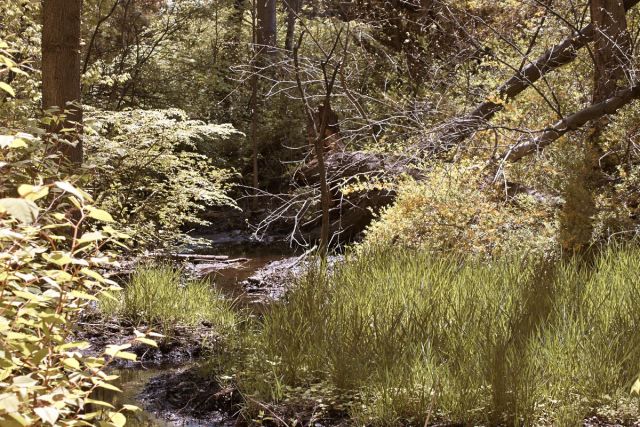
Another sample from my 500D, this one shot today with a really low-end lens ... my Tamron 55-200 ... which I use for travel because of its light weight and relatively good performance for a low-cost lens. I think it did nicely on the 500D, even with complex subject matter:
I think the 7D has a really heavy handed AA filter, I think the benefits would be quite noticeable. My 7D files have always felt soft to me, despite using quality lenses, manually focusing with live view, tripod, mirror lock up, etc...... they just always have this softness to them that requires a good deal of sharpening.
Sharpening of course would take your pictures to the same place that removing the AA filter would..... but then of course you are sharpening all the noise, which tends to be pretty high on the 7D as well.
In reality what I really need to do is to just go full frame... but financially it's just not an option. So if I could squeeze 10-15% more resolution out of my 7D for 450 bucks I would do it.
I can't seem to find anyone online that's done it with the 7D though, and maybe they don't even do it with that camera. I emailed them so we'll see.
andyjaggy82 wrote:
In reality what I really need to do is to just go full frame... but financially it's just not an option. So if I could squeeze 10-15% more resolution out of my 7D for 450 bucks I would do it.
Selling your 7D and throwing in $450 should get you a used 5DII....
veroman wrote:
I'm a very handy guy with most things electronic, electrical, wood, ceramic, etc. I own tons of tools large and small. I've opened my Macs many, many times to repair and/or install new components. But if there's anything I won't open and fool around with, it's my cameras. I leave that to the people who know how to open them and then put everything back as if they were never touched.
I don't think its all that hard to remove and replace the filters. Lifepixel actually have instructions on how to do it, and it looks like you just need a decent set of micro tools, some patience and a steady hand. The AF distances will need re-calibrating, but i think you can do that via a screw on the sensor mount that moves the sensor forward and back. For that i guess all you need is patience and a resolution chart.
So i doubt it is beyond you. I would agree it might not be worth your time and risk though, especially if the conversion is on a camera that still holds some value.
Looking more into the Bayer filter thing (i.e. 20 mins on google) it appears that the Bayer filter *is* physically deposited on the sensor silicon, and is most likely an organic/polymer-based material of some sort sandwiched between the sensor silicon and the microlens. Removal would thus need to be chemical (i.e. boil it in acetone or something) and therefore not at all trivial.
andyjaggy82 wrote:
Lenses are all crop lenses. I could sell them yes, but I think I would take quite a hit.
Before I bought my 5D2, I was between getting it or the 7D. I remember that it was primarily the difference in AA filter strength that drove me to spending the extra money for a 5D2. Haven't regretted the purchase since. That said, I only ever bought FF lenses because I knew I wanted to escape from APS-C land ASAP. Let us know if you figure out if the AA filter can be removed.
They emailed me back, the filter can be removed on the 7D. It is 450.00 plus shipping.
I don't know if I will do it or not. I'll probably mull it over for a few days and decide not to. If it was 250 dollars I think I would do it. 450 seems a bit steep.
Overall I don't have a burning desire to go full frame. Noise is manageable at ISO100 where I shoot 90% of the time, except for the fact that I need pretty heavy sharpening because of the strong AA filter on the 7D, which tends to sharpen that noise quite a bit. I like the slightly smaller/lighter benefits of an APS-C system. I also like that it's easier to get everything in focus because of the deeper DOF of the small sensor. The 7D files are just a bit too soft. This looks like it could help quite a bit.....
I wonder if Canon will have an AA filterless version of the 7D II. Assuming that camera ever materializes, though I probably couldn't afford it anyway.
andyjaggy82 wrote:
They emailed me back, the filter can be removed on the 7D. It is 450.00 plus shipping. I don't know if I will do it or not. I'll probably mull it over for a few days and decide not to. If it was 250 dollars I think I would do it. 450 seems a bit steep.The results seem pretty impressive though. Overall I don't have a burning desire to go full frame. Noise is manageable at ISO100 where I shoot 90% of the time, except for the fact that I need pretty heavy sharpening because of the strong AA filter on the 7D, which tends to sharpen that noise quite a bit. I like the slightly smaller/lighter benefits of an APS-C system. I also like that it's easier to get everything in focus because of the deeper DOF of the small sensor. The 7D files are just a bit too soft. This looks like it could help quite a bit.....I wonder if Canon will have an AA filterless version of the 7D II. Assuming that camera ever materializes, though I probably couldn't afford it anyway. ...Show more →
I imagine that Canon will emulate Nikon at some point and at least offer a model with the option of no filter a la the D800 and D800E. Then again, maybe not. Time will tell.
Though I never owned or used the 7D, I did own for a time the t3i. I didn't like it and, like yourself, found the images to be on the soft side, requiring more sharpening than I'm used to with other cameras. I know the t3i and 7D share the same sensor, but from the 7D pics I've seen I thought the filter was "thinner" on the 7D. Guess not.
You mention one of the big benefits of removing the filter: less sharpening overall means less accentuation of noise. Noise is pretty evident in the t1i as low as ISO 200. My t3i was similar, but not as noticeable until ISO 400. I think this is a very good reason for going "filterless." These newer, hi-rez cameras do exhibit noise at lower ISOs compared to 12MP cameras. If there's any that don't, it's probably because they're introducing some NR even in the RAW files (the 5D II was known to do this).
Anyway, here's another sample with my "cheapie" Tamron zoom:
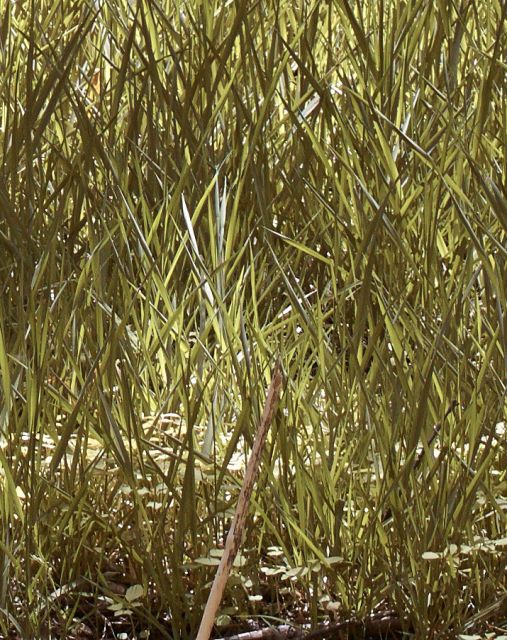
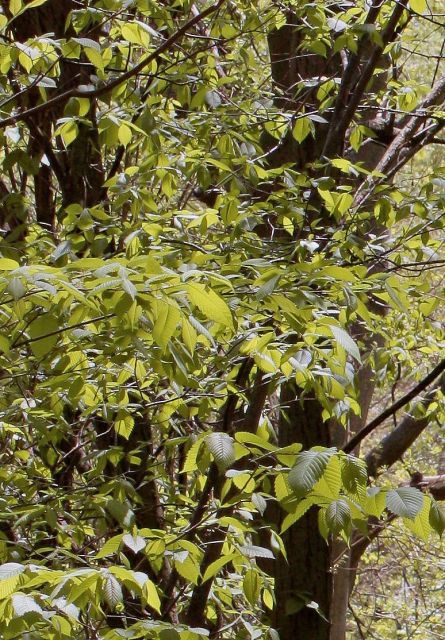
Am I the only one to whom these full-size and crop images look jagged and riddled with artifacts-- the stuff one would look for in an over-USM'd image?
These foliage-heavy shots look incredibly digital, almost pixelated. Almost like real resolution has been traded for interpolated/artifact-based resolution. I don't know how to describe it. And I know this doesn't necessarily make sense-- considering AA removal is being sold as resolution-enhancing.
It looks good/best, to me, on here, in the first shot. The hanging clothing with consistent light. But the nature shots really look bad to me on a calibrated IPS monitor.
Are these sharpened, or in some other way really processed heavily in post? It might simply be the processing and not the AA-filter removal. Or maybe it's the cheap lens? Or maybe it's the interplay of AA removal AND already high noise in low ISOs from the camera itself.
I wonder how these would look printed because sometimes this super-artificial, too much USM works really well in preparation for printing while looking comical when output for screen. Kinda like how processing for print and screen are different today, perhaps AA removal adds one layer of the same?
This looks somewhat familiar to me with respect to comparing my 5D2 (AA filter) to my Fuji X-E1 (no AA filter) when processed through Aperture-- which fixes the so-called Fuji water color issue but introduces color artifacting and some moire where previously the funky watercolor effect would have been visible (notably foliage heavy shots). In the case of the Fuji, I tend to prefer the Aperture trade-offs; the artifacting there seems isolated to certain problem areas. But in the two foliage images above (and notably so in the 100% crops)-- the artifacting/crunchiness appears layered over the entire image in a way that makes it very unnerving.
justruss wrote:
Am I the only one to whom these full-size and crop images look jagged and riddled with artifacts-- the stuff one would look for in an over-USM'd image?
These foliage-heavy shots look incredibly digital, almost pixelated. Almost like real resolution has been traded for interpolated/artifact-based resolution. I don't know how to describe it. And I know this doesn't necessarily make sense-- considering AA removal is being sold as resolution-enhancing.
It looks good/best, to me, on here, in the first shot. The hanging clothing with consistent light. But the nature shots really look bad to me on a calibrated IPS monitor.
Are these sharpened, or in some other way really processed heavily in post? It might simply be the processing and not the AA-filter removal. Or maybe it's the cheap lens? Or maybe it's the interplay of AA removal AND already high noise in low ISOs from the camera itself.
I wonder how these would look printed because sometimes this super-artificial, too much USM works really well in preparation for printing while looking comical when output for screen. Kinda like how processing for print and screen are different today, perhaps AA removal adds one layer of the same?
This looks somewhat familiar to me with respect to comparing my 5D2 (AA filter) to my Fuji X-E1 (no AA filter) when processed through Aperture-- which fixes the so-called Fuji water color issue but introduces color artifacting and some moire where previously the funky watercolor effect would have been visible (notably foliage heavy shots). In the case of the Fuji, I tend to prefer the Aperture trade-offs; the artifacting there seems isolated to certain problem areas. But in the two foliage images above (and notably so in the 100% crops)-- the artifacting/crunchiness appears layered over the entire image in a way that makes it very unnerving.
I agree with you and I noticed this same thing with the first thread that was posted on this subject. Crunchy is a correct word for these images. Either they are over processed or the removal of the filter is causing some funkiness to the images. But you are right, in print they may be fantastic as that is the way my images look that are destined for the printer and they turn out very nice.
justruss wrote:
.... I wonder how these would look printed because sometimes this super-artificial, too much USM works really well in preparation for printing while looking comical when output for screen. Kinda like how processing for print and screen are different today, perhaps AA removal adds one layer of the same?
... in the two foliage images above (and notably so in the 100% crops)-- the artifacting/crunchiness appears layered over the entire image in a way that makes it very unnerving.
I think there are at least three things going on here: first is that I'm not quite seeing the same things you're seeing on my Apple 30" ... that is, the artifacts and false detail (an unfortunate side effect of removing the AA filter when viewing at 100%) aren't quite as bad as you're describing. I see them, but it's not too disturbing to me because I know these things totally disappear in prints. I think the first 100% foliage crop ... the blades of tall grass with the stick ... has very little in the way of artifacts and false detail.
Second is the choice of lenses on the original shots (Canon 16-35 f/2.8 and Tamron 17-50 f/2.8) vs. the foliage shots. On the latter I used the cheapest lens I own, a Tamron 55-200. Its shortcomings are obvious in these photos. One of the reasons I posted those shots is to show how important the lens choice becomes when the AA filter has been removed. It's ALWAYS important, of course, but 100X more important when the lens is working with a naked sensor.
Third: AA-filter or no AA-filter, we're still dealing with a Canon 500D/t1i Rebel. It's not a 5DII or Nikon D800 or Fuji X100 or Leica M9. Removing the filter has improved this camera dramatically, which is why I had it removed. But it's still a 500D underneath and would not be my first choice ... or anyone else's ... for critical landscape work (which I don't do that much of anyway). But for what it is and what it's capable of without the filter, it definitely has its place as a worthy travel camera. With a 35mm f/2 attached, it's a small, light, first rate, unobtrusive street camera. Black & White output is exceptional.
As you say, I'm guessing this is optimal for those focused on outputting to print.
It'd be really interesting if someone could loan you a non-AA-removed 500D to setup and shoot side-by-side with your modified one-- in full manual with the same lens.
More samples! No matter the outcome, this is a great thread because it actually adds something new to the discussions on this board, much of which ends up being a re-hashing of the same old stuff over and over again.
Do you have any versions of the above samples-- without any processing?
justruss wrote:
As you say, I'm guessing this is optimal for those focused on outputting to print. It'd be really interesting if someone could loan you a non-AA-removed 500D to setup and shoot side-by-side with your modified one-- in full manual with the same lens. More samples! No matter the outcome, this is a great thread because it actually adds something new to the discussions on this board, much of which ends up being a re-hashing of the same old stuff over and over again. Do you have any versions of the above samples-- without any processing?
Thank you for your comments. I agree with you about the "re-hashing." Same old, same old ....
I wish I had another, stock 500D to compare with. Would be interesting, to say the least. I've decided today to go to some places I recently visited with my filterless Rebel and re-shoot same with my 5D and Fuji X10 (don't laugh; superb camera; very high resolution; interpolates upwards exceptionally well). Should prove interesting as well.
justruss wrote:
Am I the only one to whom these full-size and crop images look jagged and riddled with artifacts-- the stuff one would look for in an over-USM'd image?
These foliage-heavy shots look incredibly digital, almost pixelated. Almost like real resolution has been traded for interpolated/artifact-based resolution. I don't know how to describe it. And I know this doesn't necessarily make sense-- considering AA removal is being sold as resolution-enhancing.
It looks good/best, to me, on here, in the first shot. The hanging clothing with consistent light. But the nature shots really look bad to me on a calibrated IPS monitor.
Are these sharpened, or in some other way really processed heavily in post? It might simply be the processing and not the AA-filter removal. Or maybe it's the cheap lens? Or maybe it's the interplay of AA removal AND already high noise in low ISOs from the camera itself.
I wonder how these would look printed because sometimes this super-artificial, too much USM works really well in preparation for printing while looking comical when output for screen. Kinda like how processing for print and screen are different today, perhaps AA removal adds one layer of the same?
This looks somewhat familiar to me with respect to comparing my 5D2 (AA filter) to my Fuji X-E1 (no AA filter) when processed through Aperture-- which fixes the so-called Fuji water color issue but introduces color artifacting and some moire where previously the funky watercolor effect would have been visible (notably foliage heavy shots). In the case of the Fuji, I tend to prefer the Aperture trade-offs; the artifacting there seems isolated to certain problem areas. But in the two foliage images above (and notably so in the 100% crops)-- the artifacting/crunchiness appears layered over the entire image in a way that makes it very unnerving.
No, you are not the only one It really hurts my eyes looking at them. The images would really benefit from a bit smoothing or AA filtering. Oh, wait a minute...
In my experience things properly sharpened for print look very overdone when viewed at 100% on screen. My guess is this is similar, they look crunchy, but i bet they print really well.
I guess the question is do you want to leave the AA filter on and have to sharpen more, with the minus of also exaggerating the noise in the image, or would you rather have the sharper image straight out of camera that looks crunchy, but prints really well anyway?
gfiksel wrote:
No, you are not the only one It really hurts my eyes looking at them. The images would really benefit from a bit smoothing or AA filtering. Oh, wait a minute...
Show us something better in the way of 100% crops.
- Steve
It also looks like I am seeing quite a bit of artifacting from the jpeg compression, I think you should really post unmanipulated raw files if you want us to get the best feel for what removing the filter really does.
You should see if you know anyone who has an unmodified T1i, I would be really interested to get raw files from both cameras, same lens, same shot, and then post process each one for printing, do a print, and see which ones looks better.
andyjaggy82 wrote:
It also looks like I am seeing quite a bit of artifacting from the jpeg compression, I think you should really post unmanipulated raw files if you want us to get the best feel for what removing the filter really does.
Yes, there's noticeable JPEG compression as well. I think the file sizes for RAW would be prohibitive on FM, wouldn't they?
- Steve


 I could sell them yes, but I think I would take quite a hit.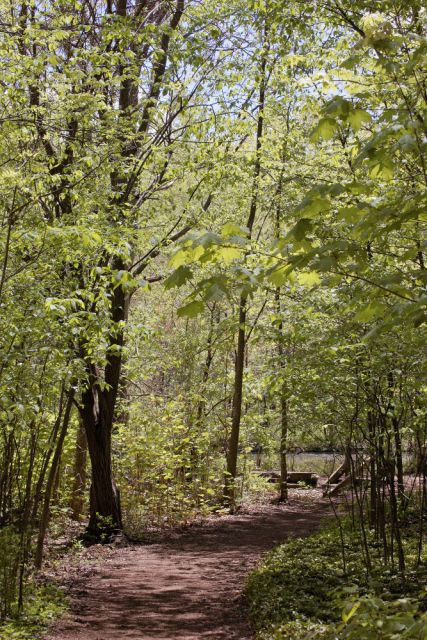
 It really hurts my eyes looking at them. The images would really benefit from a bit smoothing or AA filtering. Oh, wait a minute...