p.13 #1 · lens repair, modification and disassembly guide thread
m-a-x wrote:
Digging out this thread, which started with Contax G conversions.
This Contax G Sonnar 90/2.8 is now a M42 fix-focus lens.
At infinity at F2.8 it is spot on.
Focusing is possible with a generic M42-yourcamerasystem focusing adapter.
Mine is a Fuji X.
p.13 #2 · lens repair, modification and disassembly guide thread
Thanks Both!
The M42 mount is from an old M42 extension tube. It almost fit as is, I just had to reduce half a millimeter from its diameter. It is glued from within to the rear remaining body part in 12-o'clock-position, with strong 2-component epoxy.
The other body parts are comfortably attached to the rear ring by their original fixtures.
The length of the aforementioned rear body part is reduced with a plain cut. You can see the blank metal rim from the bottom.
The original helicoid is not used since it adds no function.
The cast metal part with the indents for the click-stops however is cut and epoxied to the correct position (attached to the M42 part and the rear Body part).
That's basically it! The lens block is not modified and can be taken out and cleaned, if needed.
Ultimately I removed two from the four original shims in order to tune infinity.
I had the hardest time when I was opening the lens. Some stupid lens technician formerly glued the name-ring (with the Serial number) in place.
I had to completely destroy it in order to open the lens. Hence the anonymous black ring.
I think the same modification could be done with the 45mm Planar. Only the rearmost part must be much thinner than the one here, and I think the glass elements will reach into the adapter. Otherwise should be fine. One day when I'd own the A7 I would give it a try. At the moment I don't need 45mm for APS-C.
p.13 #3 · lens repair, modification and disassembly guide thread
I have been trying to figure out how can i remove and clean haze from the front element (underside) of a Canon FD 80-200 f4 L zoom lens. I have searched the net extensively but haven't found any threads / posts which would point me in the right direction.
It would be fantastic if someone could give me some pointers.
p.13 #4 · lens repair, modification and disassembly guide thread
starlights wrote:
I have been trying to figure out how can i remove and clean haze from the front element (underside) of a Canon FD 80-200 f4 L zoom lens. I have searched the net extensively but haven't found any threads / posts which would point me in the right direction.
It would be fantastic if someone could give me some pointers.
i don't have one, so i can't help much. most lenses require the removal of the front ring surrounding the front element (usually unscrewed using a rubber ring of the proper diameter). it looks like there isn't much of surround on the 80-400L, so you probably have to remove the front lens barrel to access the front group...
p.13 #5 · lens repair, modification and disassembly guide thread
sebboh wrote:
i don't have one, so i can't help much. most lenses require the removal of the front ring surrounding the front element (usually unscrewed using a rubber ring of the proper diameter). it looks like there isn't much of surround on the 80-400L, so you probably have to remove the front lens barrel to access the front group...
Thanks for your response. I ve successfully cleaned 50mm and 200mm Takumars in the past, but they were easy. Not sure about messing with this expensive zoom until I know it can be done easily. I know zooms are usually difficult. I am wondering if the front element can be accessed by removing just the front ring. If I have to remove the entire barrel, then it may be out of scope for me.
p.13 #6 · lens repair, modification and disassembly guide thread
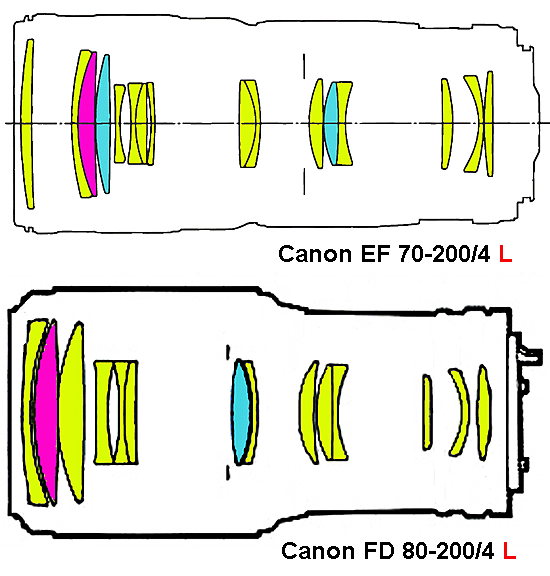
I managed to find a FD Lenswork Reference guide by Canon on the internet - and looking at the lens grouping diagram on pg 114 - the front element seems to be comprised of 2-3 lenses (including UD) stuck together. I could be wrong, but if this is the case, then i think I may be SOL
Anyway, here is the link to this fantastic Lenswork Reference Guide (FD) - and it covers all FD lenses - I think anyone who cares about FD lenses should download it - that will save this from getting lost forever:
p.13 #7 · lens repair, modification and disassembly guide thread
starlights wrote:
I managed to find a FD Lenswork Reference guide by Canon on the internet - and looking at the lens grouping diagram on pg 114 - the front element seems to be comprised of 2-3 lenses (including UD) stuck together. I could be wrong, but if this is the case, then i think I may be SOL
Anyway, here is the link to this fantastic Lenswork Reference Guide (FD) - and it covers all FD lenses - I think anyone who cares about FD lenses should download it - that will save this from getting lost forever:
p.13 #8 · lens repair, modification and disassembly guide thread
starlights wrote:
I managed to find a FD Lenswork Reference guide by Canon on the internet - and looking at the lens grouping diagram on pg 114 - the front element seems to be comprised of 2-3 lenses (including UD) stuck together. I could be wrong, but if this is the case, then i think I may be SOL
Anyway, here is the link to this fantastic Lenswork Reference Guide (FD) - and it covers all FD lenses - I think anyone who cares about FD lenses should download it - that will save this from getting lost forever:
p.13 #9 · lens repair, modification and disassembly guide thread
While on the topic of Contax G lenses, has anyone had problems with the focus screw? My G45 stopped focusing recently. After removing the plastic panel covering the focus mechanism, I noticed that the tiny gear linking the focus screw and the larger helical gear had fallen out of place. I tried placing it back, but it no longer stays in position. The gear spins on a little axle; however, the axle only fits somewhat loosely into a small hole. After a short while, the gear and axle pop out again. Any thoughts?
p.13 #10 · lens repair, modification and disassembly guide thread
It sounds like it's worn out, if the spindle is still good, you may be able to fill the hole and re-drill the axle hole, I assume it's plastic, so an epoxy should work, and the drill bit should be available at a hobby store if it's real tiny.
Or... This sounds like a prime opportunity for a transplant, I don't know if there is an updated set of design drawings for the rings, maybe sebboh will respond.
Maybe if there's enough interest, a new batch of rings could be made with offset mount holes for the 6bit.
p.13 #12 · lens repair, modification and disassembly guide thread
prh5551 wrote:
I have a Zeiss c/y 50 1.7. The front black element is loose. It doesn't seem to effect the picture. Is it possible to tighten it myself? Thanks, phil
do you mean the front element itself, or the black retaining ring holding it in place, or the nameplate on the front of the lens?
p.13 #14 · lens repair, modification and disassembly guide thread
starlights wrote:
I managed to find a FD Lenswork Reference guide by Canon on the internet - and looking at the lens grouping diagram on pg 114 - the front element seems to be comprised of 2-3 lenses (including UD) stuck together. I could be wrong, but if this is the case, then i think I may be SOL
Just a couple notes...
I'm 99% sure that the front three elements *are not* stuck together. This is a 14 elements in 12 groups design, and it is the two groups on each side of the aperture that consist of more than one element. The front three elements *should* be their own groups with air spaces between them--likely in the form of a tiny rubber o-ring that prevents the elements from coming in contact and damaging each other--that's the case with the FD 135mm f/2.
I don't have that lens, but that's how these things are supposed to work.
On another note, for removing the front element, you'll need a spanner wrench, not a rubber tool. There are notches in the front name plate for the wrench. Moreover, if the 80-200L is like the 85L and the 135mm f/2, then that plate is glued in place. You'll need to apply acetone to dissolve the glue.
Finally, be extremely careful with the flourite element in the second group from the front. They're very soft.
Fortunately for me, the glass in the lens turned out to be pristine. The eBay seller said a little haze on the front of the lens, and it turns out, what he meant was that there was a little white mark (irregular shape of about 2mm by 5mm) on the rubber ring behind the front element - on the forward facing concentric circle part of the ring - the spot looks similar to what a spot of dried milk would look like, though i am not sure what it is or how it got there) - so, I was overjoyed to realize that i don't need to open or clean the lens
Thanks so much - I am sure someone else will be able to use this information in future.
Sanjay
Here is the image of the actual lens with the white mark visible at 2 O'Clock position. I am wondering if someone can figure out what it is or how it could have gotten there - the lens doesn't appear to have ever been opened or repaired.
p.13 #16 · lens repair, modification and disassembly guide thread
starlights wrote:
Thank you, MAubrey! Thats pretty detailed information.
Sure thing. I picked up a Canon FD 135mm f/2 for $80 with fungus on the inner side of the the very front and back elements. The price was so low I thought it would be a good opportunity to try my hand at cleaning it myself. I figured if it worked, I'd have a $300 lens for $80...and it did and I learned a lot about FD internals on the way.
(no, for anyone else reading--I won't clean your lens. I barely trust the few skills that I've learned on my own) starlights wrote:
Here is the image of the actual lens with the white mark visible at 2 O'Clock position. I am wondering if someone can figure out what it is or how it could have gotten there - the lens doesn't appear to have ever been opened or repaired.
If I were to guess, it could be similar to some thing I saw in a Contax Zeiss 80-200mm f/4. Some grease had evaporated and somehow got on the inner side of the front element. In that instance, the seller had listed it as coating loss, but removing it simply involved taking out the front element, wiping it down with a micro fiber cloth and then putting it back in. It's your call. Marks on the front element--especially on telephotos--rarely affect the image.I'd say take some shots and decide how you feel about it first. It's unlikely that you'll be able to see the difference before and after cleaning.
p.13 #17 · lens repair, modification and disassembly guide thread
LightShow wrote:
It sounds like it's worn out, if the spindle is still good, you may be able to fill the hole and re-drill the axle hole, I assume it's plastic, so an epoxy should work, and the drill bit should be available at a hobby store if it's real tiny.
Or... This sounds like a prime opportunity for a transplant, I don't know if there is an updated set of design drawings for the rings, maybe sebboh will respond.
Maybe if there's enough interest, a new batch of rings could be made with offset mount holes for the 6bit.
i updated my design to make the rear ring thicker, didn't do anything about offsetting mount holes. if people are interested in ordering another batch i can make that mod.
MAubrey wrote:
On another note, for removing the front element, you'll need a spanner wrench, not a rubber tool. There are notches in the front name plate for the wrench. Moreover, if the 80-200L is like the 85L and the 135mm f/2, then that plate is glued in place. You'll need to apply acetone to dissolve the glue.
.
i started out using spanner wrenches for this but found the rubber ring to generally work better and be less likely to leave a mark on the notches in the retaining rings or nameplates. where do you apply the acetone? is the glue on the front surface of the ring instead of underneath?
p.13 #18 · lens repair, modification and disassembly guide thread
sebboh wrote:
i started out using spanner wrenches for this but found the rubber ring to generally work better and be less likely to leave a mark on the notches in the retaining rings or nameplates. where do you apply the acetone? is the glue on the front surface of the ring instead of underneath?
That's smart with the rubber ring...though you then need a rubber ring for each filter size.
The acetone is tricky. The glue is in the threading of the name plate. You can usually see usually two or three spots around the ring where with it there. What I did was try to get it into the thread and work it around. It took me a few tries with the 135mm--acetone...wrench...acetone...wrench--before it came loose. That's the best I can do to describe it.
p.13 #19 · lens repair, modification and disassembly guide thread
MAubrey wrote:
That's smart with the rubber ring...though you then need a rubber ring for each filter size.
The acetone is tricky. The glue is in the threading of the name plate. You can usually see usually two or three spots around the ring where with it there. What I did was try to get it into the thread and work it around. It took me a few tries with the 135mm--acetone...wrench...acetone...wrench--before it came loose. That's the best I can do to describe it.
ah, that makes sense. all the glued nameplates i've encountered so far have come lose pretty easily with a little elbow grease luckily.
microtools sells full sets of rubber rings for considerably less than the price of a good spanner.
p.13 #20 · lens repair, modification and disassembly guide thread
MAubrey wrote:
If I were to guess, it could be similar to some thing I saw in a Contax Zeiss 80-200mm f/4. Some grease had evaporated and somehow got on the inner side of the front element. In that instance, the seller had listed it as coating loss, but removing it simply involved taking out the front element, wiping it down with a micro fiber cloth and then putting it back in. It's your call. Marks on the front element--especially on telephotos--rarely affect the image.I'd say take some shots and decide how you feel about it first. It's unlikely that you'll be able to see the difference before and after cleaning....Show more →
Yes, I think you are right, that's one thing that makes sense - evaporated grease.
The lens glass itself is immaculate, so I don't see any need to open up this lens to get rid of a mark on the rubber part of the ring (that white mark which can be seen in the image above is on the rubber part behind the glass and does not effect the image in the slightest) I think I can co exist with that mark.